


Indirect DNA damage

Encyclopedia
DNA
Deoxyribonucleic acid is a nucleic acid that contains the genetic instructions used in the development and functioning of all known living organisms . The DNA segments that carry this genetic information are called genes, but other DNA sequences have structural purposes, or are involved in...
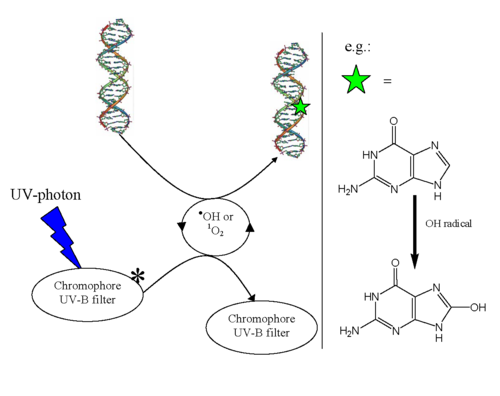
damage occurs when a UV-photon
Ultraviolet
Ultraviolet light is electromagnetic radiation with a wavelength shorter than that of visible light, but longer than X-rays, in the range 10 nm to 400 nm, and energies from 3 eV to 124 eV...
is absorbed in the human skin by a chromophore
Chromophore
A chromophore is the part of a molecule responsible for its color. The color arises when a molecule absorbs certain wavelengths of visible light and transmits or reflects others. The chromophore is a region in the molecule where the energy difference between two different molecular orbitals falls...
that does not have the ability to convert the energy into harmless heat very quickly. Molecules that do not have this ability have a long lived excited state
Excited state
Excitation is an elevation in energy level above an arbitrary baseline energy state. In physics there is a specific technical definition for energy level which is often associated with an atom being excited to an excited state....
. This long lifetime leads to a high probability for reactions with other molecules - so called bimolecular reactions. Melanin
Melanin
Melanin is a pigment that is ubiquitous in nature, being found in most organisms . In animals melanin pigments are derivatives of the amino acid tyrosine. The most common form of biological melanin is eumelanin, a brown-black polymer of dihydroxyindole carboxylic acids, and their reduced forms...
and DNA have extremely short excited state lifetimes in the range of a few femtoseconds (10−15s). The excited state lifetime of these substances is 1,000 to 1,000,000 times longer than the lifetime of melanin and therefore they may cause damage to living cells that come in contact with them.
The molecule that originally absorbs the UV-photon is called a "chromophore". Bimolecular reactions can occur either between the excited chromophore and DNA, or between the excited chromophore and another species, to produce free radicals and Reactive Oxygen Species
Reactive oxygen species
Reactive oxygen species are chemically reactive molecules containing oxygen. Examples include oxygen ions and peroxides. Reactive oxygen species are highly reactive due to the presence of unpaired valence shell electrons....
. These reactive chemical species can reach DNA by diffusion and the bimolecular reaction damages the DNA (oxidative stress
Oxidative stress
Oxidative stress represents an imbalance between the production and manifestation of reactive oxygen species and a biological system's ability to readily detoxify the reactive intermediates or to repair the resulting damage...
). Importantly, indirect DNA damage does not result in any warning signal or pain in the human body.
The bimolecular reactions that cause the indirect DNA damage are illustrated in the figure:

1O2 is reactive harmful singlet oxygen
Singlet oxygen
Singlet oxygen is the common name used for the diamagnetic form of molecular oxygen , which is less stable than the normal triplet oxygen. Because of its unusual properties, singlet oxygen can persist for over an hour at room temperature, depending on the environment...
:

Location of the damage
Unlike direct DNA damageDirect DNA damage
Direct DNA damage can occur when DNA directly absorbs the UV-B-photon. UVB light causes thymine base pairs next to each other in genetic sequences to bond together into thymine dimers, a disruption in the strand, which reproductive enzymes cannot copy...
, which occurs in areas directly exposed to UV-B light, free radicals can travel through the body and affect other areas - possibly even inner organs. The traveling nature of the indirect DNA damage can be seen in the fact that the malignant melanoma can occur in places that are not directly illuminated by the sun—in contrast to basal-cell carcinoma and squamous cell carcinoma
Squamous cell carcinoma
Squamous cell carcinoma , occasionally rendered as "squamous-cell carcinoma", is a histologically distinct form of cancer. It arises from the uncontrolled multiplication of malignant cells deriving from epithelium, or showing particular cytological or tissue architectural characteristics of...
, which only appear on directly illuminated locations on the body.