
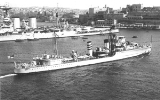
The
I class was a
classA ship class is a group of ships of a similar design. This is distinct from a ship-type, which might reflect a similarity of tonnage or intended use. For example, the is a nuclear aircraft carrier of the Nimitz class....
of eight
destroyerIn naval terminology, a destroyer is a fast and maneuverable yet long-endurance warship intended to escort larger vessels in a fleet, convoy or battle group and defend them against smaller, powerful, short-range attackers. Destroyers, originally called torpedo-boat destroyers in 1892, evolved from...
s plus a
flotilla leaderA flotilla leader was a warship suitable for commanding a flotilla of destroyers or other small warships, typically a small cruiser or a large destroyer...
of the British
Royal NavyThe Royal Navy is the naval warfare service branch of the British Armed Forces. Founded in the 16th century, it is the oldest service branch and is known as the Senior Service...
ordered under the 1935 naval programme, laid down in 1936 and completed in 1937 and 1938. Four similar ships were ordered by the
Turkish NavyThe Turkish Navy is the naval warfare service branch of the Turkish Armed Forces.- Ottoman fleet after Mudros :Following the demise of the Ottoman Empire in the aftermath of World War I, on November 3, 1918, the fleet commander of the Ottoman Navy, Liva Amiral Arif Pasha, ordered all flags to be...
, of which two were purchased for the Royal Navy, bringing the total number of these ships in that service to 11—although three of the original ships had been lost by the time
Inconstant and
Ithuriel commissioned. They served in World War II and six were lost, with a seventh ship being written off as a constructive total loss.
Design
The Is were a repeat of the preceding
H classThe G- and H-class destroyers were a class of twenty-four destroyers of the Royal Navy launched in 1935–1939. They served in World War II and sixteen were lost, with a seventeenth being written off as a constructive total loss...
, except that they had ten torpedo tubes (two banks of five) instead of eight. They incorporated the new bridge and wheelhouse layout as trialled in
HeroHMS Hero was an H-class destroyer built for the Royal Navy in the mid-1930s. During the Spanish Civil War of 1936–1939 the ship enforced the arms blockade imposed by Britain and France on both sides as part of the Mediterranean Fleet...
and
HerewardHMS Hereward , named after Hereward the Wake, was an H-class destroyer built for the Royal Navy in the mid-1930s. She was assigned to the Mediterranean Fleet before and the ship spent four months during the Spanish Civil War in mid-1937 in Spanish waters, enforcing the arms blockade imposed by...
(except the flotilla leader
Inglefield).
Inglefield also had a larger tripod foremast, her sisters having pole masts. The extra weight of the torpedo tubes and fitting both minesweeps and depth charge gear (previous vessels carrier one or the other) on the same hull as the H class caused a loss of stability, resulting in the need to
ballastA ballast tank is a compartment within a boat, ship or other floating structure that holds water.-History:The basic concept behind the ballast tank can be seen in many forms of aquatic life, such as the blowfish or argonaut octopus, and the concept has been invented and reinvented many times by...
when bunker levels were low.
All ships were fitted for
minesweepingA minesweeper is a small naval warship designed to counter the threat posed by naval mines. Minesweepers generally detect then neutralize mines in advance of other naval operations.-History:...
and with
depth chargeA depth charge is an anti-submarine warfare weapon intended to destroy or cripple a target submarine by the shock of exploding near it. Most use explosives and a fuze set to go off at a preselected depth in the ocean. Depth charges can be dropped by either surface ships, patrol aircraft, or from...
s and Asdic for
anti-submarineAnti-submarine warfare is a branch of naval warfare that uses surface warships, aircraft, or other submarines to find, track and deter, damage or destroy enemy submarines....
(A/S) work and were capable of conversion to
minelayerMinelaying is the act of deploying explosive mines. Historically this has been carried out by ships, submarines and aircraft. Additionally, since World War I the term minelayer refers specifically to a naval ship used for deploying naval mines...
s. For this, they landed 'A' and 'Y' 4.7 inch guns, the torpedo tubes and their minesweeps, allowing carriage of up to 60 mines, however only four ships ever served in this role (see below).
Turkish ships
The Turkish I class ships were of a similar design to their British counterparts, but shipped only eight torpedoes (two banks of four).
Wartime modifications
Early war modifications (probably not applicable to the early losses) involved replacing the after bank of torpedoes with a single
QF 12 pounder (3 inch / 76 mm)12-pounder gun or 12-pdr, usually denotes a gun which fired a projectile of approximately 12 pounds.Guns of this type include:* A cannon sized for a 12 pound ball, see Naval artillery in the Age of Sail*Canon de 12 de Vallière French canon of 1732...
anti-aircraftNATO defines air defence as "all measures designed to nullify or reduce the effectiveness of hostile air action." They include ground and air based weapon systems, associated sensor systems, command and control arrangements and passive measures. It may be to protect naval, ground and air forces...
(A/A) gun, cutting down the after funnel and mainmast to improve the former weapon's field of fire and adding a pair of
QF 20 mm OerlikonThe Oerlikon 20 mm cannon is a series of autocannons, based on an original design by Reinhold Becker of Germany, very early in World War I, and widely produced by Oerlikon Contraves and others...
guns in the bridge wings. Radar Type 286, a metric wavelength surface-warning set, was added as it became available, and the ineffective multiple 0.5 inches (12.7 mm)
Vickers machine gunNot to be confused with the Vickers light machine gunThe Vickers machine gun or Vickers gun is a name primarily used to refer to the water-cooled .303 inch machine gun produced by Vickers Limited, originally for the British Army...
s were replaced with further Oerlikons; the central tube was deleted from the torpedo launchers to lessen topweight.
Icarus lost 'Y' gun to stow extra depth charges (for a total load of 110) and their mortars. Surviving ships received a third pair of Oerlikons, added abreast the searchlight position, and the 12 pounder gun was deleted to increase depth charge stowage. In some ships, 'A' gun was replaced with a
HedgehogThe Hedgehog was an anti-submarine weapon developed by the Royal Navy during World War II, that was deployed on convoy escort warships such as destroyers to supplement the depth charge. The weapon worked by firing a number of small spigot mortar bombs from spiked fittings...
ahead-throwing A/S weapon, but this alteration seems to have been reversed at a later stage.
Ilex,
Intrepid,
Impulsive and
Isis had 'B' gun removed and two
QF 6 pounder 10 cwt (2.25 inch / 57 mm L/47 ) gunsThe British QF 6 pounder 10 cwt gun"6 pounder" refers to approximate weight of projectiles, which was a traditional British way of denoting small guns. "10 cwt" referred to the approximate weight of the gun and breech in cwt rounded up : 10 cwt = 10 x 112 pounds = 1,120 pounds...
were added, on the twin mounting Mark I* along with a Hedgehog, the former for anti-E boat work.
Inglefield later had the second bank of torpedo tubes re-instated, but like her sisters, the central tube was removed. A 4 inches (101.6 mm) A/A gun was added in lieu of 'X' gun, and she had a total of six Oerlikons. Radar Type 291 was later added at the foremast head as well as "
Huff-DuffHigh-frequency direction finding, usually known by its abbreviation HF/DF is the common name for a type of radio direction finding employed especially during the two World Wars....
" in some ships.
The ex-Turkish ships were modified along similar lines to their I class sisters.
Inconstant later received Radar Type 270, a centimetric wavelength target indication set, in lieu of the director and rangefinder on the bridge. Again, eventually six Oerlikons were carried.
Ships
Pennant number |
Ship |
Builder |
Laid down |
Launched |
Commissioned |
Fate |
| D03 |
IcarusHMS Icarus was an I-class destroyer that served with the Royal Navy in World War II.On 29 November 1939, Icarus sighted the German U-boat U-35 between the Shetland Islands and Bergen , but was unable to launch an effective attack because her ASDIC was out of commission. Fellow destroyers and ... † |
John Brown & Company John Brown and Company of Clydebank was a pre-eminent Scottish marine engineering and shipbuilding firm, responsible for building many notable and world-famous ships, such as the , the , the , the , the , and the... , ClydebankClydebank is a town in West Dunbartonshire, in the Central Lowlands of Scotland. Situated on the north bank of the River Clyde, Clydebank borders Dumbarton, the town with which it was combined to form West Dunbartonshire, as well as the town of Milngavie in East Dunbartonshire, and the Yoker and...
|
9 March 1936 |
26 November 1936 |
3 May 1937 |
Sold for scrapping 29 October 1946. |
| D61 |
Ilex HMS Ilex was an I-class destroyer that served during World War II. She is the only ship of the Royal Navy ever to have been named after Ilex, the genus of flowering plants commonly known as holly.-1939:...
|
John Brown |
9 March 1936 |
28 January 1937 |
7 July 1937 |
Sold for scrapping in Sicily 1948. |
| D44 |
Imogen |
Hawthorn Leslie & Company, Hebburn Hebburn is a small town situated on the south bank of the River Tyne in North East England, sandwiched between the towns of Jarrow and Bill Quay...
|
18 January 1936 |
30 October 1936 |
2 June 1937 |
Collided with cruiser Glasgow 16 July 1940 and sunk. |
| D09 |
ImperialHMS Imperial was an commissioned in 1937, that served with the Royal Navy during World War II until she was scuttled by HMS Hotspur in 1941.-Construction:...
|
Hawthorn Leslie |
29 January 1936 |
11 December 1936 |
30 June 1937 |
Severely damaged by air attack 29 May 1941 in Battle of CreteThe Battle of Crete was a battle during World War II on the Greek island of Crete. It began on the morning of 20 May 1941, when Nazi Germany launched an airborne invasion of Crete under the code-name Unternehmen Merkur... , sunk by torpedoes from HotspurHMS Hotspur was an H-class destroyer built for the Royal Navy during the 1930s. During the Spanish Civil War of 1936–1939 the ship spent considerable time in Spanish waters, enforcing the arms blockade imposed by Britain and France on both sides of the conflict...
|
| D11 |
Impulsive HMS Impulsive was an I-class destroyer that served in the Royal Navy during the Second World War. She has been the only ship of the Navy to bear this name.... † |
J. Samuel White J. Samuel White was a British shipbuilding firm based in Cowes, taking its name from John Samuel White . It came to prominence during the Victorian era... , CowesCowes is an English seaport town and civil parish on the Isle of Wight. Cowes is located on the west bank of the estuary of the River Medina facing the smaller town of East Cowes on the east Bank...
|
9 March 1936 |
1 March 1936 |
29 January 1938 |
Sold for scrapping 22 January 1946. |
| D02 |
InglefieldHMS Inglefield was an I-class destroyer leader built for the Royal Navy that served during World War II. She was the navy's last purpose-built flotilla leader. She was named after the 19th century Admiral Sir Edward Augustus Inglefield , and is so far the only warship to carry the name of that...
|
Cammell Laird & Company, BirkenheadBirkenhead is a town within the Metropolitan Borough of Wirral in Merseyside, England. It is on the Wirral Peninsula, along the west bank of the River Mersey, opposite the city of Liverpool...
|
29 April 1936 |
15 October 1936 |
25 June 1937 |
Sunk by German wire-guided missile A wire-guided missile is a missile that is guided by signals sent to it via thin wires connected between the missile and its guidance mechanism, which is located somewhere near the launch site. As the missile flies, the wires are reeled out behind it... off AnzioAnzio is a city and comune on the coast of the Lazio region of Italy, about south of Rome.Well known for its seaside harbour setting, it is a fishing port and a departure point for ferries and hydroplanes to the Pontine Islands of Ponza, Palmarola and Ventotene... , 25 February 1944 |
| D10 |
IntrepidHMS Intrepid was an I-class destroyer that served with Royal Navy during World War II.In World War II, Intrepid attacked and sank the German submarine U-45 south-west of Ireland on 14 October 1939 in company with the destroyers and... † |
John I. Thornycroft & Company John I. Thornycroft & Company Limited, usually known simply as Thornycroft was a British shipbuilding firm started by John Isaac Thornycroft in the 19th century.-History:... , Woolston |
6 January 1936 |
17 December 1936 |
29 July 1937 |
Sunk by German Ju 88The Junkers Ju 88 was a World War II German Luftwaffe twin-engine, multi-role aircraft. Designed by Hugo Junkers' company through the services of two American aviation engineers in the mid-1930s, it suffered from a number of technical problems during the later stages of its development and early... bombers off LerosLeros is a Greek island and municipality in the Dodecanese in the southern Aegean Sea. It lies 317 km from Athens's port of Piraeus, from which it can be reached by an 11-hour ferry ride . Leros is part of the Kalymnos peripheral unit... , 26 September 1943 |
| D87 |
IsisHMS Isis was an I-class destroyer laid down by the Yarrow and Company, at Scotstoun in Glasgow on 6 February 1936, launched on 12 November 1936 and commissioned on 2 June 1937.-World War II:...
|
Yarrow & Company, Scotstoun Scotstoun is a historic district of Glasgow, Scotland, west of Glasgow City Centre. It is bounded by Yoker and Knightswood to the west, Victoria Park, Broomhill and Whiteinch to the east, Jordanhill to the north and the River Clyde to the south...
|
5 February 1936 |
12 December 1936 |
2 June 1937 |
Mined and sunk off Normandy beachesNormandy is a geographical region corresponding to the former Duchy of Normandy. It is in France.The continental territory covers 30,627 km² and forms the preponderant part of Normandy and roughly 5% of the territory of France. It is divided for administrative purposes into two régions:... , 20 July 1944. |
| D16 |
IvanhoeHMS Ivanhoe was an of the British Royal Navy, commissioned in 1937, that served during World War II until sunk during the Texel Disaster on 31 August 1940.-Construction:... † |
Yarrow |
12 February 1936 |
11 February 1937 |
24 August 1937 |
Mined and sunk off TexelTexel is a municipality and an island in the Netherlands, in the province of North Holland. It is the biggest and most populated of the Frisian Islands in the Wadden Sea, and also the westernmost of this archipelago, which extends to Denmark... , 1 September 1940 |
† = fitted as minelayers
Turkish Ships
Four ships were ordered for the
Turkish NavyThe Turkish Navy is the naval warfare service branch of the Turkish Armed Forces.- Ottoman fleet after Mudros :Following the demise of the Ottoman Empire in the aftermath of World War I, on November 3, 1918, the fleet commander of the Ottoman Navy, Liva Amiral Arif Pasha, ordered all flags to be...
in 1938. Upon the outbreak of war, two were purchased by the British, but two were delivered to Turkey in 1942 as the
Sultanhisar and the
Demirhisar.
Pennant number |
Ship |
Builder |
Laid down |
Launched |
Completed |
Fate |
| H49 |
InconstantHMS Inconstant was an I-class destroyer laid down as TCG Muavenet for the Turkish Navy by Vickers Armstrong Naval Construction Works at Barrow-in-Furness on 24 May 1939, purchased in September 1939 by the Royal Navy, launched on 24 February 1941 and commissioned on 24 January 1942.Inconstant...
(ex- Muavenet) |
Vickers Armstrongs, Barrow in Furness |
24 May 1939 |
24 February 1941 |
24 January 1942 |
Acquired 14 November 1941, ceded to Turkey 9 March 1946, sold for scrapping 1960. |
| H05 |
IthurielHMS Ithuriel was an I-class destroyer laid down as Gayret for the Turkish Navy by Vickers Armstrong Naval Construction Works at Barrow-in-Furness on 24 May 1939, but taken over by the Royal Navy on the outbreak of the Second World War whilst still under construction.Launched on 15 December 1940 and...
(ex- Gayret) |
Vickers Armstrongs |
24 May 1939 |
15 December 1940 |
3 March 1942 |
Bombed at Bône 28 November 1942 and beached. Written off as constructive total loss 27 February 1943 and hulked. Sold for scrapping 25 August 1945. |
| - |
Sultanhisar |
William Denny & Brothers, Dumbarton |
1939 |
1941 |
1942 |
Delivered to Turkey in 1942, decommissioned 1960 |
| - |
Demirhisar |
Denny |
1939 |
1941 |
1942 |
Delivered to Turkey in 1942, decommissioned 1960 |