
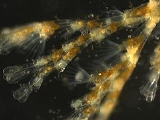
Hydrozoa (
hydrozoans) are a taxonomic
classIn biological classification, class is* a taxonomic rank. Other well-known ranks are life, domain, kingdom, phylum, order, family, genus, and species, with class fitting between phylum and order...
of very small, predatory animals which can be solitary or colonial and which mostly live in saltwater. A few genera within this class live in freshwater. Hydrozoans are related to
jellyfishJellyfish are free-swimming members of the phylum Cnidaria. Jellyfish have several different morphologies that represent several different cnidarian classes including the Scyphozoa , Staurozoa , Cubozoa , and Hydrozoa Jellyfish (also known as jellies or sea jellies) are free-swimming members of...
and corals and belong to the phylum
CnidariaCnidaria is a phylum containing over 10,000 species of animals found exclusively in aquatic, mostly marine, environments. Their distinguishing feature is cnidocytes, specialized cells that they use mainly for capturing prey...
.
Some examples of hydrozoans are the Freshwater Jelly (
Craspedacusta sowerbyi), the freshwater polyps (
HydraHydra is a genus of simple fresh-water animal possessing radial symmetry. Hydras are predatory animals belonging to the phylum Cnidaria and the class Hydrozoa. They can be found in most unpolluted freshwater ponds, lakes and streams in the temperate and tropical regions by gently sweeping a...
),
ObeliaObelia is a genus in the class Hydrozoa, which consists of mainly marine and some freshwater animal species and have both the polyp and medusa stages in their life cycle...
, the
Portuguese Man o' WarThe Portuguese Man o' War , also known as the blue bubble, blue bottle, man-of-war, or the Portuguese man of war, is a jelly-like, marine invertebrate of the family Physaliidae....
(
Physalia physalis), the
chondrophoreThe chondrophores or porpitids are a small and very unusual group of hydrozoans today classified as family Porpitidae. Though it derives from an outdated name for this lineage , some still find the term "chondrophore" useful as a synonym to "porpitid" in discussions of the three genera contained...
s (Porpitidae), "
air fernAir fern or "Neptune plant" is a name given to a product that is in fact composed of a species of marine animal called Sertularia argentea, also known as the "sea fir"....
" (
Sertularia argenta) and the pink-hearted hydroids (
Tubularia).
Systematics
Hydrozoan
systematicsBiological systematics is the study of the diversification of life on the planet Earth, both past and present, and the relationships among living things through time. Relationships are visualized as evolutionary trees...
is highly complex. Several approaches for expressing their interrelationships were proposed and heavily contested since the late 19th century, but in more recent times a consensus seems to be emerging.
For long, the hydrozoans were divided into a number of
orderIn scientific classification used in biology, the order is# a taxonomic rank used in the classification of organisms. Other well-known ranks are life, domain, kingdom, phylum, class, family, genus, and species, with order fitting in between class and family...
s, according to their mode of growth and reproduction. Most famous among these was probably the assemblage called "
HydroidaHydroida is an obsolete cnidarian order which united such animals as hydras, hydromedusae, and many marine attached hydroids. However, the group is paraphyletic and not composed from close relatives...
", but this group is apparently paraphyletic, united by plesiomorphic (ancestral) traits. Other such orders were the Anthoathecatae, Actinulidae, Laingiomedusae, Polypodiozoa,
SiphonophoraSiphonophorae or Siphonophora, the siphonophores, are an order of the Hydrozoa, a class of marine invertebrates belonging to the phylum Cnidaria. They are colonial, but the colonies can superficially resemble jellyfish; although they appear to be a single organism, each specimen is actually a...
and Trachylina.
As far as can be told from the molecular and
morphologicalIn biology morphology is the form, structure and configuration of an organism.This includes aspects of the outward appearance as well as the form and structure of the internal parts like bones and organs...
data at hand, the Siphonophora for example were just highly specialized "hydroids," whereas the Limnomedusae - presumed to be a "hydroid" suborder - were simply very primitive hydrozoans and not closely related to the other "hydroids." Therefore, today the hydrozoans are at least tentatively divided into two
subclassSubclass may refer to:* Class , a taxonomic rank intermediate between class and superorder* Subclass , a class that is derived from another class or classes...
es, the
LeptolinaeLeptolinae are a cnidarian subclass of the Hydrozoa. They contain the bulk of the paraphyletic "Hydroida" which were one of the main groupings of the Hydrozoa in older classifications and were placed at order rank...
(containing the bulk of the former "Hydroida" and the Siphonophora) and the
TrachylinaeTrachylinae are a cnidarian subclass of the Hydrozoa. They are placed at order rank in many older classifications, and limited to contain the Narcomedusae and Trachymedusae...
, containing the others (including the Limnomedusae). The
monophylyIn common cladistic usage, a monophyletic group is a taxon which forms a clade, meaning that it consists of an ancestor and all its descendants. The term is synonymous with the uncommon term holophyly...
of several of the presumed orders in each subclass is still in need of verification.
In any case, according to this classification, the hydrozoans can be subdivided as follows, with
taxon|thumb|270px|[[African elephants]] form a widely-accepted taxon, the [[genus]] LoxodontaA taxon is a group of organisms, which a taxonomist adjudges to be a unit. Usually a taxon is given a name and a rank, although neither is a requirement. Defining what belongs or does not belong to such a...
names emended to end in "-ae":
CLASS HYDROZOA
- Subclass Leptolinae
Leptolinae are a cnidarian subclass of the Hydrozoa. They contain the bulk of the paraphyletic "Hydroida" which were one of the main groupings of the Hydrozoa in older classifications and were placed at order rank...
- Order Anthomedusae
Anthomedusae or Anthomedusa, the athecate hydroids, are an order of the Hydrozoa, a class of marine invertebrates belonging to the phylum Cnidaria...
(= Anthoathecata(e), Athecata(e), Stylasterina(e)) - includes Laingoimedusae but monophyly requires verification
- Order Leptomedusae
Leptomedusae or Leptomedusa, commonly called thecate hydroids, are a cnidarian order in the subclass Leptolinae. They were formerly placed at suborder rank in the paraphyletic "Hydroida"...
(= Leptothecata(e), Thecaphora(e), Thecata(e))
- Order Siphonophorae
- Subclass Trachylinae
Trachylinae are a cnidarian subclass of the Hydrozoa. They are placed at order rank in many older classifications, and limited to contain the Narcomedusae and Trachymedusae...
- Order Actinulidae
- Order Limnomedusae - monophyly requires verification; tentatively placed here
- Order Narcomedusae
- Order Trachymedusae
Trachymedusae are an order in the cnidarian class Hydrozoa. They contain some 50 species, divided among about 30 genera and 5 families, of which the Rhopalonematidae are by far the most diverse. They only reproduce sexually as medusa, never forming polyps...
- monophyly requires verification
ITISItis may refer to* Integrated Taxonomic Information System * -itis, an English suffix typically used to denote an inflammation* "The Itis" , an episode of the TV series The Boondocks...
uses the same system but unlike here does not use the oldest available names for many groups.
In addition, there exists a weird cnidarian parasite,
Polypodium hydriforme, which lives inside its host's
cellThe cell is the basic structural and functional unit of all known living organisms. It is the smallest unit of an organism that is classified as living, and is often called the building block of life. The Alberts text discusses how the "cellular building blocks" move to shape developing embryos...
s. It is sometimes placed in the Hydrozoa, but actually its relationships are better treated as unresolved for the time being - a somewhat controversial 18S rRNA
sequenceA DNA sequence or genetic sequence is a succession of letters representing the primary structure of a real or hypothetical DNA molecule or strand, with the capacity to carry information as described by the central dogma of molecular biology....
analysis found it to be closer to
MyxozoaThe Myxozoa are a group of parasitic animals of aquatic environments. Over 1300 species have been described and many have a two-host lifecycle, involving a fish and an annelid worm or bryozoan. The average size of a Myxosporea spore usually ranges from 10μm to 20μm and Malacosporea up to 2mm...
. It was traditionally placed in its own
classIn biological classification, class is* a taxonomic rank. Other well-known ranks are life, domain, kingdom, phylum, order, family, genus, and species, with class fitting between phylum and order...
Polypodiozoa and this view is presently often seen to reflect the uncertainties surrounding this highly distinct animal.
Other classifications
Some of the more widespread classification systems for the Hydrozoa are listed below. Though they are often found in seemingly authoritative Internet sources and databases, they do not agree with the currently available data. Especially the presumed phylogenetic distinctness of the
SiphonophoraSiphonophorae or Siphonophora, the siphonophores, are an order of the Hydrozoa, a class of marine invertebrates belonging to the phylum Cnidaria. They are colonial, but the colonies can superficially resemble jellyfish; although they appear to be a single organism, each specimen is actually a...
is a major flaw that was corrected only recently.
The obsolete classification mentioned above was as follows:
- Order Actinulidae
- Order Anthoathecatae
- Order Hydroida
Hydroida is an obsolete cnidarian order which united such animals as hydras, hydromedusae, and many marine attached hydroids. However, the group is paraphyletic and not composed from close relatives...
- Suborder Anthomedusae
Anthomedusae or Anthomedusa, the athecate hydroids, are an order of the Hydrozoa, a class of marine invertebrates belonging to the phylum Cnidaria...
- Suborder Leptomedusae
Leptomedusae or Leptomedusa, commonly called thecate hydroids, are a cnidarian order in the subclass Leptolinae. They were formerly placed at suborder rank in the paraphyletic "Hydroida"...
- Suborder Limnomedusae
- Order Laingiomedusae
- Order Polypodiozoa
- Order Siphonophora
Siphonophorae or Siphonophora, the siphonophores, are an order of the Hydrozoa, a class of marine invertebrates belonging to the phylum Cnidaria. They are colonial, but the colonies can superficially resemble jellyfish; although they appear to be a single organism, each specimen is actually a...

- Order Trachylina
- Suborder Narcomedusae
- Suborder Trachymedusae
Trachymedusae are an order in the cnidarian class Hydrozoa. They contain some 50 species, divided among about 30 genera and 5 families, of which the Rhopalonematidae are by far the most diverse. They only reproduce sexually as medusa, never forming polyps...
A very old classification that is sometimes still seen is:
- Order Hydroida
Hydroida is an obsolete cnidarian order which united such animals as hydras, hydromedusae, and many marine attached hydroids. However, the group is paraphyletic and not composed from close relatives...
- Order Milleporina
- Order Siphonophorida
- Order Stylasterina (= Anthomedusae)
- Order Trachylinida
Catalogue of LifeThe Catalogue of Life, started in June 2001 by Species 2000 and Integrated Taxonomic Information System , is planned to become a comprehensive catalogue of all known species of organisms on Earth by the year 2011. 66 taxonomic databases with contributions from more than 3,000 specialists from...
uses the following:
- Order Actinulida
- Order Anthoathecata (= Anthomedusae)
- Order Hydroida
Hydroida is an obsolete cnidarian order which united such animals as hydras, hydromedusae, and many marine attached hydroids. However, the group is paraphyletic and not composed from close relatives...
- Order Laingiomedusae
- Order Leptothecata (= Leptomedusae)
- Order Limnomedusae
- Order Narcomedusae
- Order Siphonophora
Siphonophorae or Siphonophora, the siphonophores, are an order of the Hydrozoa, a class of marine invertebrates belonging to the phylum Cnidaria. They are colonial, but the colonies can superficially resemble jellyfish; although they appear to be a single organism, each specimen is actually a...
- Order Trachymedusae
Trachymedusae are an order in the cnidarian class Hydrozoa. They contain some 50 species, divided among about 30 genera and 5 families, of which the Rhopalonematidae are by far the most diverse. They only reproduce sexually as medusa, never forming polyps...
Animal Diversity WebAnimal Diversity Web is an online database that collects the natural history, classification, species characteristics, conservation biology, and distribution information of thousands of species of animals...
uses the following:
- Order Actinulida
- Order Capitata
- Order Chondrophora
- Order Filifera
- Order Hydroida
Hydroida is an obsolete cnidarian order which united such animals as hydras, hydromedusae, and many marine attached hydroids. However, the group is paraphyletic and not composed from close relatives...
- Order Siphonophora
Siphonophorae or Siphonophora, the siphonophores, are an order of the Hydrozoa, a class of marine invertebrates belonging to the phylum Cnidaria. They are colonial, but the colonies can superficially resemble jellyfish; although they appear to be a single organism, each specimen is actually a...
Hydra, a freshwater genus
The most widely-known and researched freshwater hydrozoan is
HydraHydra is a genus of simple fresh-water animal possessing radial symmetry. Hydras are predatory animals belonging to the phylum Cnidaria and the class Hydrozoa. They can be found in most unpolluted freshwater ponds, lakes and streams in the temperate and tropical regions by gently sweeping a...
, which is found in slow-moving waters.
Hydra has a
pedal discThe pedal disc The pedal disc The pedal disc (also known as a basal plate is, in anatomy of the sea anemone, the surface opposite to the mouth, and generally serves to attach the anemone to the substrate, or hard surface, upon which it lives. It is composed of a thin tissue plate and is used...
composed of gland cells that helps it attach to substrates, and like all cnidarians uses nematocysts, or "stinging cells," to disable its prey. Hydra eat small
crustaceanCrustaceans are a very large group of arthropods, comprising almost 52,000 described species , and are usually treated as a subphylum . They include various familiar animals, such as crabs, lobsters, crayfish, shrimp, krill and barnacles...
s (such as brine shrimp),
insectInsects are arthropods, having a hard exoskeleton, a three-part body , three pairs of jointed legs, compound eyes, and two antennae. They are the most diverse group of animals on the planet and include more than a million species that are already described. Insects represent more than half of all...
larvaA larva is a young form of animal with indirect development, going through or undergoing metamorphosis ....
e, and
annelidThe annelids, collectively called Annelida , are a large phylum of segmented worms, with over 17,000 modern species including ragworms, earthworms and leeches. They are found in marine environments from tidal zones to hydrothermal vents, in freshwater, and in moist terrestrial environments...
worms. Hydra may reproduce sexually, through the spawning of sperm (and thus insemination of eggs on the female body column), or through
asexual reproductionAsexual reproduction is reproduction which does not involve meiosis, ploidy reduction, or fertilization. Only one parent is involved in asexual reproduction. A more stringent definition is agamogenesis which refers to reproduction without the fusion of gametes...
(budding).
Life cycles
Some colonial hydrozoans have both a
medusaIn biology, a medusa is a form of cnidarian in which the body is shortened on its principal axis and broadened, sometimes greatly, in contrast with polyps. Medusae vary from bell-shaped to the shape of a thin disk, scarcely convex above and only slightly concave below...
stage and a
polypA polyp in zoology is one of two forms found in the phylum Cnidaria, the other being the medusa. Polyps are approximately cylindrical in shape and elongated at the axis of the body...
stage in their life cycle (but more hydrozoan species do not have the medusa stage). Each colony has a base, a stalk, and one or more polyps.
Hydroid-Marine Biology:Colonial, plant-like animals closely related to jellyfish, with stinging cellsany member of the invertebrate order Hydroida...
colonies are usually
dioeciousDioecious species are whose members can produce only one type of gamete; each individual organism belonging to a dioecious species is distinctly male or female . The majority of animal species are dioecious...
, which means that they have separate sexes - all the polyps in each colony are either male or female, but not usually both sexes in the same colony. Hydrozoan colonies are composed of a number of specialized polyps (or "zooids") - including feeding, reproductive, and sometimes, protective zooids. In some species, the reproductive polyps, known as gonozooids (or "gonotheca" in
thecate hydrozoansLeptomedusae or Leptomedusa, commonly called thecate hydroids, are a cnidarian order in the subclass Leptolinae. They were formerly placed at suborder rank in the paraphyletic "Hydroida"...
) bud off asexually-produced medusae. These tiny, new medusae (which are either male or female) mature and spawn, releasing
gameteA gamete is a cell that fuses with another gamete during fertilization in organisms that reproduce sexually...
s freely into the sea in most cases.
ZygoteA zygote , or zygocyte, is the initial cell formed when a new organism is produced by means of sexual reproduction. A zygote is synthesized from the union of two gametes, and constitutes the first stage in a unique organism's development...
s become free-swimming
planula larvaeA planula is the free-swimming, flattened, ciliated, bilaterally symmetric larval form of various cnidarian species. In all cases, the planula forms directly from the fertilized egg of a medusa, as the case in scyphozoans and some hydrozoans, or from a polyp, as in the case of anthozoans...
or actinula larvae that either settle on a suitable
substrateIn biology a substrate is the surface a plant or animal lives upon. The substrate can include biotic or abiotic materials. For example, encrusting algae that lives on a rock can be substrate for another animal that lives above the algae on the rock. See also substrate .-External links:*...
(in the case of planulae), or swim and develop into another medusae or polyp directly (actinulae). Colonial hydrozoans include siphonophore colonies,
Hydractinia,
ObeliaObelia is a genus in the class Hydrozoa, which consists of mainly marine and some freshwater animal species and have both the polyp and medusa stages in their life cycle...
, and many others.
The medusa stage, if present, is the sexually-reproductive life cycle phase (that is, in hydrozoan species that have both polyp and medusa generations). Medusae of these species of Hydrozoa are known as "
hydromedusaeAnthomedusae or Anthomedusa, the athecate hydroids, are an order of the Hydrozoa, a class of marine invertebrates belonging to the phylum Cnidaria...
". Most hydromedusae have shorter life spans than the larger
scyphozoaScyphozoa is a class of jellyfish.Scyphozoans are members of the phylum Cnidaria and are referred to as the "true jellyfish." Scyphozoans range from the Ediacarian time period through the Recent. In Scyphozoans, the medusa form is dominant life stage, while the polyp form may be a juvenile stage...
n jellyfish. Some species of hydromedusae release gametes shortly after they are themselves released from the hydroids (as in the case of
fire coralFire corals are colonial marine organisms that look rather like real coral. However they are technically not corals; they are actually more closely related to jellyfish and other stinging anemones...
s), living only a few hours, while other species of hydromedusae grow and feed in the
planktonPlankton consist of any drifting organisms that inhabit the pelagic zone of oceans, seas, or bodies of fresh water. Plankton are defined by their ecological niche rather than their phylogenetic or taxonomic classification...
for months, spawning daily for many days before their supply of food or other water conditions deteriorate and cause their demise.
External links