
Home      Discussion      Topics      Dictionary      Almanac
Signup       Login
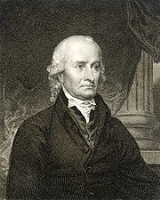
Hugh Williamson

Hugh Williamson

Overview

Discussion
Ask a question about 'Hugh Williamson'
Start a new discussion about 'Hugh Williamson'
Answer questions from other users
Full Discussion Forum
 
Unanswered Questions
Recent Discussions
Encyclopedia

Hugh Williamson was an American politician
Politics of the United States
The United States is a federal constitutional republic, in which the President of the United States , Congress, and judiciary share powers reserved to the national government, and the federal government shares sovereignty with the state governments.The executive branch is headed by the President...

. He is best known for representing North Carolina
North Carolina
North Carolina is a state located in the southeastern United States. The state borders South Carolina and Georgia to the south, Tennessee to the west and Virginia to the north. North Carolina contains 100 counties. Its capital is Raleigh, and its largest city is Charlotte...

 at the Constitutional Convention
Philadelphia Convention
The Constitutional Convention took place from May 14 to September 17, 1787, in Philadelphia, Pennsylvania, to address problems in governing the United States of America, which had been operating under the Articles of Confederation following independence from...

.

Williamson was a scholar of international renown. His erudition had brought him into contact with some of the leading intellectuals of the Patriot
Patriot (American Revolution)
Patriots is a name often used to describe the colonists of the British Thirteen United Colonies who rebelled against British control during the American Revolution. It was their leading figures who, in July 1776, declared the United States of America an independent nation...

 cause and, in turn, with the ferment of political ideas that eventually found expression in the Constitution. During the American Revolution
American Revolution
The American Revolution was the political upheaval during the last half of the 18th century in which thirteen colonies in North America joined together to break free from the British Empire, combining to become the United States of America...

, Will served as physician and natural scientist to the American war effort. His experiences in that preeminent event of his generation transformed the genial scholar into an adroit politician and a determined leader in the campaign for effective national government. This leadership was evident not only at the Convention in Philadelphia but also, with telling effect, during the ratification debates in North Carolina.

Williamson's career demonstrates the rootlessness that characterized the lives of many Americans even in the 18th century. Born on the frontier, he lived for significant periods of his long life in three different regions of the country. This mobility undoubtedly contributed to the development of his nationalistic outlook, an outlook strengthened by wartime service with interstate military forces and reinforced by the interests of the planters and merchants that formed his North Carolina constituency. These experiences convinced him that only a strong central government could adequately protect and foster the political, economic, and intellectual future of the new nation.

Early years


Williamson was born in Chester County in what was then the frontier region of Pennsylvania
Pennsylvania
The Commonwealth of Pennsylvania is a U.S. state that is located in the Northeastern and Mid-Atlantic regions of the United States. The state borders Delaware and Maryland to the south, West Virginia to the southwest, Ohio to the west, New York and Ontario, Canada, to the north, and New Jersey to...

. His fragile health as a youth weighed against his beginning a career in the family's clothier business. His parents instead sent him to a private academy and, in 1754, to the College of Philadelphia (today's University of Pennsylvania
University of Pennsylvania
The University of Pennsylvania is a private, Ivy League university located in Philadelphia, Pennsylvania, United States. Penn is the fourth-oldest institution of higher education in the United States,Penn is the fourth-oldest using the founding dates claimed by each institution...

). Williamson graduated in the school's first class, on May 17, 1757, five days before his father died. After teaching Latin in Philadelphia Academy, Williamson moved to Connecticut
Connecticut
Connecticut is a state in the New England region of the northeastern United States. It is bordered by Rhode Island to the east, Massachusetts to the north, and the state of New York to the west and the south .Connecticut is named for the Connecticut River, the major U.S. river that approximately...

 and obtained a preacher's license, but factional disputes among the local clergy and a resurgence of ill health led him to abandon a career in the ministry. Upon completing a master's degree at Penn in 1760, Williamson joined his alma mater's faculty as a professor of mathematics
Mathematics
Mathematics is the study of quantity, space, structure, and change. Mathematicians seek out patterns and formulate new conjectures. Mathematicians resolve the truth or falsity of conjectures by mathematical proofs, which are arguments sufficient to convince other mathematicians of their validity...

.

In another career shift four years later, Williamson turned to the study of medicine. Armed with a degree from the prestigious University of Utrecht
Utrecht University
Utrecht University is a university in Utrecht, Netherlands. It is one of the oldest universities in the Netherlands and one of the largest in Europe. Established March 26, 1636, it had an enrollment of 29,082 students in 2008, and employed 8,614 faculty and staff, 570 of which are full professors....

 in the Netherlands
Netherlands
The Netherlands is a constituent country of the Kingdom of the Netherlands, located mainly in North-West Europe and with several islands in the Caribbean. Mainland Netherlands borders the North Sea to the north and west, Belgium to the south, and Germany to the east, and shares maritime borders...

, he returned to Philadelphia to open a private practice. At the same time, he pursued a number of independent scientific and educational projects, and his work in these areas eventually led to membership in the American Philosophical Society
American Philosophical Society
The American Philosophical Society, founded in 1743, and located in Philadelphia, Pa., is an eminent scholarly organization of international reputation, that promotes useful knowledge in the sciences and humanities through excellence in scholarly research, professional meetings, publications,...

 as well as acclaim in Europe's intellectual circles.

Interest in science and education indirectly led Williamson to politics and the Patriot cause. Sailing for England in 1773 to raise funds for a local educational project, Williamson stopped en route at Boston. There he witnessed the famous Boston Tea Party
Boston Tea Party
The Boston Tea Party was a direct action by colonists in Boston, a town in the British colony of Massachusetts, against the British government and the monopolistic East India Company that controlled all the tea imported into the colonies...

, in which Patriots dressed as American Indians
Native Americans in the United States
Native Americans in the United States are the indigenous peoples in North America within the boundaries of the present-day continental United States, parts of Alaska, and the island state of Hawaii. They are composed of numerous, distinct tribes, states, and ethnic groups, many of which survive as...

 destroyed a cargo of tea
Tea
Tea is an aromatic beverage prepared by adding cured leaves of the Camellia sinensis plant to hot water. The term also refers to the plant itself. After water, tea is the most widely consumed beverage in the world...

 in protest over a newly enforced Parliamentary tax
Tax
To tax is to impose a financial charge or other levy upon a taxpayer by a state or the functional equivalent of a state such that failure to pay is punishable by law. Taxes are also imposed by many subnational entities...

 on imported commodities. On reaching London
London
London is the capital city of :England and the :United Kingdom, the largest metropolitan area in the United Kingdom, and the largest urban zone in the European Union by most measures. Located on the River Thames, London has been a major settlement for two millennia, its history going back to its...

 he was summoned before the Privy Council to testify on this act of rebellion and on colonial affairs in general.

Williamson came of age politically during this encounter. In response to questions by Council members, who were in the process of formulating punitive measures against Massachusetts
Massachusetts
The Commonwealth of Massachusetts is a state in the New England region of the northeastern United States of America. It is bordered by Rhode Island and Connecticut to the south, New York to the west, and Vermont and New Hampshire to the north; at its east lies the Atlantic Ocean. As of the 2010...

, he bluntly warned that repression would provoke rebellion. He then went on to express the argument that was becoming the core of the Patriot position: Americans were entitled to the full rights of Englishmen, including representation in the decisions of the English government. This testimony brought him to the attention of other Americans in London. A mutual interest in scientific matters cemented a solid working relationship with Benjamin Franklin
Benjamin Franklin
Dr. Benjamin Franklin was one of the Founding Fathers of the United States. A noted polymath, Franklin was a leading author, printer, political theorist, politician, postmaster, scientist, musician, inventor, satirist, civic activist, statesman, and diplomat...

, and Williamson soon found himself joined with the famous American scientist and others in appealing for support among those Englishmen who, in opposition to their own government, sympathized with American claims.

Williamson continued on to the Netherlands where, taking advantage of the cover afforded by his attendance at meetings on scientific and educational subjects, he organized the publication of pamphlets and other papers that supported the Patriot cause. While there he learned that the colonies had declared their independence. Narrowly avoiding capture at sea, he rushed back to Philadelphia in early 1777 and volunteered for service in the Medical Department of the Continental Army. The Department had no opening at that time, so Williamson decided to form a partnership with a younger brother to import medicine
Medicine
Medicine is the science and art of healing. It encompasses a variety of health care practices evolved to maintain and restore health by the prevention and treatment of illness....

s and other scarce items from the West Indies through the British blockade
Blockade
A blockade is an effort to cut off food, supplies, war material or communications from a particular area by force, either in part or totally. A blockade should not be confused with an embargo or sanctions, which are legal barriers to trade, and is distinct from a siege in that a blockade is usually...

. Believing that he could best contribute to the war effort by using his contacts and reputation in this manner, Williamson made Edenton, North Carolina, his base of operations. Settlement in North Carolina soon led to his establishing a medical practice to serve the planters and merchants of the region.

Military physician


These various activities brought Williamson to the attention of North Carolina's political leaders. Facing the threat of a British invasion of the region from the sea and bases in Florida, the state legislature voted to raise a force of 4,000 men to assist South Carolina. When Governor
Governor
A governor is a governing official, usually the executive of a non-sovereign level of government, ranking under the head of state...

 Richard Caswell
Richard Caswell
Richard Caswell was the first and fifth governor of the U.S. State of North Carolina, serving from 1776 to 1780 and from 1784 to 1787....

, with the rank of major general, took to the field at the head of these citizen-soldiers, he named Williamson to serve as the state's Physician and Surgeon General, a post Williamson held until the end of the war.

The capture of Charleston, South Carolina
Charleston, South Carolina
Charleston is the second largest city in the U.S. state of South Carolina. It was made the county seat of Charleston County in 1901 when Charleston County was founded. The city's original name was Charles Towne in 1670, and it moved to its present location from a location on the west bank of the...

 in 1780 not only marked a stunning defeat for American forces, but also signaled the end of the first phase in a new British war strategy. Under this strategy British forces would continue to tie down Washington's main army in the north while a Royal army under General Charles Cornwallis would advance northward. Using Savannah, Georgia
Savannah, Georgia
Savannah is the largest city and the county seat of Chatham County, in the U.S. state of Georgia. Established in 1733, the city of Savannah was the colonial capital of the Province of Georgia and later the first state capital of Georgia. Today Savannah is an industrial center and an important...

 and Charleston as their bases of operations, the British expected their regular units to push through North Carolina and Virginia while a militia composed of local Loyalists secured areas captured by the regular forces. If successful, this strategy would have led to the conquest of the colonies from the south. To counter Cornwallis' efforts, the Continental Congress sent Horatio Gates
Horatio Gates
Horatio Lloyd Gates was a retired British soldier who served as an American general during the Revolutionary War. He took credit for the American victory at the Battle of Saratoga – Benedict Arnold, who led the attack, was finally forced from the field when he was shot in the leg – and...

 to command a small force composed of a division of continentals, Caswell's units from North Carolina, and a group of hastily assembled Virginia militia
Militia
The term militia is commonly used today to refer to a military force composed of ordinary citizens to provide defense, emergency law enforcement, or paramilitary service, in times of emergency without being paid a regular salary or committed to a fixed term of service. It is a polyseme with...

 units.

Gates attempted to attack the British advance base near Camden, South Carolina
Camden, South Carolina
Camden is the fourth oldest city in the U.S. state of South Carolina and is also the county seat of Kershaw County, South Carolina, United States. The population was an estimated 7,103 in 2009...

, but his tired militia units, which were still forming when the battle began, were routed, and the Americans suffered another defeat. Williamson, who witnessed the disaster, volunteered to pass behind enemy lines to care for the American wounded. He spent two months on this mercy mission. When smallpox
Smallpox
Smallpox was an infectious disease unique to humans, caused by either of two virus variants, Variola major and Variola minor. The disease is also known by the Latin names Variola or Variola vera, which is a derivative of the Latin varius, meaning "spotted", or varus, meaning "pimple"...

 threatened the prison camp, he argued strenuously with Cornwallis and other British officers over the proper method to combat the disease. His perseverance and scientific reputation paid off. The British followed his advice, and an epidemic
Epidemic
In epidemiology, an epidemic , occurs when new cases of a certain disease, in a given human population, and during a given period, substantially exceed what is expected based on recent experience...

 was averted.

In the fall of 1780 Williamson returned to the field. Major General Nathanael Greene
Nathanael Greene
Nathanael Greene was a major general of the Continental Army in the American Revolutionary War. When the war began, Greene was a militia private, the lowest rank possible; he emerged from the war with a reputation as George Washington's most gifted and dependable officer. Many places in the United...

, Gates' replacement, had begun his brilliant campaign to recover the south through the joint efforts of continentals and militia. While his main force engaged the British in a series of battles, the militiamen concentrated on picking off small outposts and isolated enemy parties. Francis Marion
Francis Marion
Francis Marion was a military officer who served in the American Revolutionary War. Acting with Continental Army and South Carolina militia commissions, he was a persistent adversary of the British in their occupation of South Carolina in 1780 and 1781, even after the Continental Army was driven...

, nicknamed "Swamp Fox", and others who operated mainly in South Carolina are most remembered for this type of guerrilla warfare
Guerrilla warfare
Guerrilla warfare is a form of irregular warfare and refers to conflicts in which a small group of combatants including, but not limited to, armed civilians use military tactics, such as ambushes, sabotage, raids, the element of surprise, and extraordinary mobility to harass a larger and...

, but North Carolina units also adopted these tactics. Williamson was attached to a force under Brigadier General Isaac Gregory whose mission was to limit British activity in eastern North Carolina. Gregory established his base in the vast reaches of the Dismal Swamp where he could pin the British down in Wilmington without jeopardizing his small force. Williamson's bold innovations in preventive medicine, especially his strenuous efforts to indoctrinate raw troops in the importance of sanitation and diet, kept the command virtually free of disease during the six months that it inhabited the swamp-—a rare feat in 18th-century warfare.

Statesman


In 1782 Williamson's neighbors elected him to the lower house of the North Carolina legislature, where he served for several terms. He sat on numerous committees, including those formed to regulate veterans' rights, and he authored the state's copyright
Copyright
Copyright is a legal concept, enacted by most governments, giving the creator of an original work exclusive rights to it, usually for a limited time...

 law. His fellow legislators also chose Williamson to serve in the Continental Congress
Continental Congress
The Continental Congress was a convention of delegates called together from the Thirteen Colonies that became the governing body of the United States during the American Revolution....

 in 1782. Appointment to this national body represented a natural political progression for Williamson, who was evolving into a champion of federalism
Federalism
Federalism is a political concept in which a group of members are bound together by covenant with a governing representative head. The term "federalism" is also used to describe a system of the government in which sovereignty is constitutionally divided between a central governing authority and...

. His experiences during the Revolution, especially his exposure to the pressing need for interstate cooperation during the 1780 and 1781 campaigns in the Carolinas, had convinced him of the military importance of strong national government. This interest increased when he came to realize the economic benefits that might accrue from binding interstate association. In 1786 North Carolina chose Williamson to attend the Annapolis Convention
Annapolis Convention (1786)
The Annapolis Convention was a meeting in 1786 at Annapolis, Maryland, of 12 delegates from five states that unanimously called for a constitutional convention. The formal title of the meeting was a Meeting of Commissioners to Remedy Defects of the Federal Government...

, a meeting called to settle economic questions affecting the middle Atlantic states. Although he arrived too late to play a role in the Maryland proceedings, he was prepared to discuss interstate issues the following year when his state appointed him as a representative at the Constitutional Convention in Philadelphia.

Williamson, a faithful attendee at Convention sessions, lodged with Alexander Hamilton
Alexander Hamilton
Alexander Hamilton was a Founding Father, soldier, economist, political philosopher, one of America's first constitutional lawyers and the first United States Secretary of the Treasury...

 and James Madison
James Madison
James Madison, Jr. was an American statesman and political theorist. He was the fourth President of the United States and is hailed as the “Father of the Constitution” for being the primary author of the United States Constitution and at first an opponent of, and then a key author of the United...

, two of the country's best-known nationalist leaders. His intellectual stature and international background also propelled him into a leadership role in the North Carolina delegation. A capacity for hard work and his innate good humor made him invaluable to the Federalists as they worked out the many political compromises necessary for consensus on the new instrument of government. On 11th July 1787, Williamson proposed the three fifths compromise. It failed to pass (4:6), but a substantially similar motion was passed two days later.

Shortly before the Convention adjourned, Williamson wrote a series of public letters in defense of a strong federal system. These "Letters of Sylvius" addressed many of the practical concerns of his state, where the rural and frequently debt-ridden farmers favored minimal government regulations, while the mercantile-planter group from the seaboard region wanted an economy strictly regulated by a central government. Using simple examples, Williamson explained to both groups the dual dangers of inflation
Inflation
In economics, inflation is a rise in the general level of prices of goods and services in an economy over a period of time.When the general price level rises, each unit of currency buys fewer goods and services. Consequently, inflation also reflects an erosion in the purchasing power of money – a...

ary finances and of taxes that would stunt the growth of domestic manufacture. He exhorted North Carolinians to support the Constitution as the basis for their future prosperity. The ratification process, he explained, would decide whether the United States would remain a "system of patchwork and a series of expedients" or become "the most flourishing, independent, and happy nation on the face of the earth."

Following adjournment in Philadelphia, Williamson returned to New York to participate in the closing sessions of the Continental Congress and to serve as one of the agents settling North Carolina's accounts with that body. These duties caused him to miss the Hillsboro Convention, where North Carolina first considered and rejected the Constitution, but he played a major role at a second convention that met in Fayetteville in 1789. Here he participated in a successful effort to rally support for the Constitution.


Williamson's neighbors elected him to represent them in the first federal Congress. He served two terms before retiring and settling in New York City, where he continued to pursue a wide range of scholarly interests. He wrote extensively about his research, joined numerous learned societies, and contributed to many charities. He also served as one of the original trustees of the University of North Carolina
University of North Carolina at Chapel Hill
The University of North Carolina at Chapel Hill is a public research university located in Chapel Hill, North Carolina, United States...

.

Thomas Jefferson
Thomas Jefferson
Thomas Jefferson was the principal author of the United States Declaration of Independence and the Statute of Virginia for Religious Freedom , the third President of the United States and founder of the University of Virginia...

 described Williamson's role at the Philadelphia Convention
Philadelphia Convention
The Constitutional Convention took place from May 14 to September 17, 1787, in Philadelphia, Pennsylvania, to address problems in governing the United States of America, which had been operating under the Articles of Confederation following independence from...

in the following terms: "he was a useful member, of an acute mind, attentive to business, and of an high degree of erudition."

Williamson married Maria Apthorpe in January 1789 and died in New York City in 1819. They had two sons, both of whom died young (the older one at the age of 22 in 1811, the younger, shortly thereafter, according to Hosack's Memoir of Hugh Williamson).

External links