
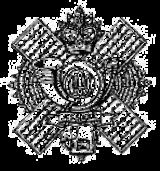
The
Highland Light Infantry was a
regimentA regiment is a military unit, composed of variable numbers of battalions, commanded by a Colonel. A regiment can be broken into two distinct categories, one being an administrative unit which is responsible for non-operational management of battalions , while the other being a deployable combat...
of the
British ArmyThe British Army is the land armed forces branch of the British Armed Forces. It came into being with the unification of the Kingdoms of England and Scotland into the Kingdom of Great Britain in 1707. The new British Army incorporated Regiments that had already existed in England and Scotland and...
from 1881 to 1959. In 1923 the regimental title was expanded to the
Highland Light Infantry (City of Glasgow Regiment)
The regiment was formed as part of the
Childers reformsThe Childers Reforms restructured the infantry regiments of the British army. The reforms were undertaken by Secretary of State for War Hugh Childers in 1881, and were a continuation of the earlier Cardwell reforms....
on 1 July 1881 by the amalgamation of the 71st (Highland) Light Infantry and the 74th (Highland) Regiment of Foot as the city regiment of
GlasgowGlasgow is the largest city in Scotland and third most populous in the United Kingdom. The city is situated on the River Clyde in the country's west central lowlands...
, absorbing the local
militiaThe term militia is commonly used today to refer to a military force composed of ordinary citizens to provide defense, emergency law enforcement, or paramilitary service, in times of emergency without being paid a regular salary or committed to a fixed term of service. It is a polyseme with...
and
rifle volunteerThe Volunteer Force was a citizen army of part-time rifle, artillery and engineer corps, created as a popular movement in 1859. Originally highly autonomous, the units of volunteers became increasingly integrated with the British Army after the Childers Reforms in 1881, before forming part of the...
units.
The
Highland Light Infantry was a
regimentA regiment is a military unit, composed of variable numbers of battalions, commanded by a Colonel. A regiment can be broken into two distinct categories, one being an administrative unit which is responsible for non-operational management of battalions , while the other being a deployable combat...
of the
British ArmyThe British Army is the land armed forces branch of the British Armed Forces. It came into being with the unification of the Kingdoms of England and Scotland into the Kingdom of Great Britain in 1707. The new British Army incorporated Regiments that had already existed in England and Scotland and...
from 1881 to 1959. In 1923 the regimental title was expanded to the
Highland Light Infantry (City of Glasgow Regiment)
The regiment was formed as part of the
Childers reformsThe Childers Reforms restructured the infantry regiments of the British army. The reforms were undertaken by Secretary of State for War Hugh Childers in 1881, and were a continuation of the earlier Cardwell reforms....
on 1 July 1881 by the amalgamation of the 71st (Highland) Light Infantry and the 74th (Highland) Regiment of Foot as the city regiment of
GlasgowGlasgow is the largest city in Scotland and third most populous in the United Kingdom. The city is situated on the River Clyde in the country's west central lowlands...
, absorbing the local
militiaThe term militia is commonly used today to refer to a military force composed of ordinary citizens to provide defense, emergency law enforcement, or paramilitary service, in times of emergency without being paid a regular salary or committed to a fixed term of service. It is a polyseme with...
and
rifle volunteerThe Volunteer Force was a citizen army of part-time rifle, artillery and engineer corps, created as a popular movement in 1859. Originally highly autonomous, the units of volunteers became increasingly integrated with the British Army after the Childers Reforms in 1881, before forming part of the...
units. Its exact status was a somewhat ambiguous one - although the regiment insisted on being classified as a non-kilted Highland regiment, it recruited mainly from Glasgow in Lowland Scotland.
The
HLI (as it was always known) continued in service, actively taking part in the First and Second World Wars, until it was amalgamated with the
Royal Scots Fusiliers-The Earl of Mar's Regiment of Foot :The regiment was raised in Scotland in 1678 by Stuart loyalist Charles Erskine, de jure 5th Earl of Mar for service against the rebel covenanting forces during the Second Whig Revolt . They were used to keep the peace and put down brigands, mercenaries, and...
in 1959 to form the Royal Highland Fusiliers (Princess Margaret's Own Glasgow and Ayrshire Regiment).
The HLI was affiliated with a Canadian militia regiment: The
Highland Light Infantry of CanadaThe Highland Light Infantry of Canada was an infantry regiment of the Canadian Army. Originally founded in 1886 as the 29th Waterloo Battalion of Infantry the regiment went through several name changes including: 1900 - 29th Waterloo Regiment, and; 1915 - 29th Regiment ; acquiring its present title...
.
Regular battalions
On July 1, 1881 the 71st and 74th Regiments of Foot were redesignated as the 1st and 2nd Battalions, Highland Light Infantry respectively. Following the independence of
IndiaIndia, officially the Republic of India , is a country in South Asia. It is the seventh-largest country by geographical area, the second-most populous country, and the most populous democracy in the world. Bounded by the Indian Ocean on the south, the Arabian Sea on the west, and the Bay of Bengal...
, all infantry regiments were reduced to a single regular battalion in 1948. The 1st and 2nd Battalions were merged in Glasgow on September 23 to become the 1st Battalion Highland Light Infantry (71st/74th Foot).
Militia battalions
As part of the Childers scheme, militia regiments became reserve battalions of the new regiments. The 1st Royal Lanark Militia was designated as the 3rd (Militia) Battalion, HLI. In 1883 a 4th (Militia) Battalion was formed. In 1908 the miltia was redesignated as "Special Reserve". The Special Reserve battalions provided drafts for the fighting battalions during the First World War, were placed in suspended animation in 1921 and finally disbanded in 1953.
Territorial battalions
The 1881 reforms also designated the
rifle volunteersThe Volunteer Force was a citizen army of part-time rifle, artillery and engineer corps, created as a popular movement in 1859. Originally highly autonomous, the units of volunteers became increasingly integrated with the British Army after the Childers Reforms in 1881, before forming part of the...
raised in 1859/60 as volunteer battalions. Accordingly, the 5th, 6th, 8th, 9th and 10th 25th Lanarkshire Rifle Volunteers were attached to the HLI, being formally renamed as 1st to 5th Volunteer Battalions in 1887. On the creation of the
Territorial ForceThe Territorial Force was the volunteer reserve component of the British Army from 1908 to 1920, when it became the Territorial Army.-Origins:...
in 1908, they became the 5th (City of Glasgow), 6th (City of Glasgow), 7th (Blythswood), 8th (Lanark) and 9th (
Glasgow HighlandersThe Glasgow Highlanders were a former Territorial Army battalion in the British Army, it eventually became part of The Highland Light Infantry regiment in 1881, which later became the The Royal Highland Fusiliers in 1959...
) Battalions (TF).
During the First World War the territorial battalions formed duplicate "second line" units. At the end of the war the TF was disbanded, being reformed as the Territorial Army in 1920. The 5th, 6th, 7th and 9th Battalions were reformed.
In 1938 the 7th HLI was converted to
Royal ArtilleryThe Royal Artillery is the common name for the Royal Regiment of Artillery, an arm of the British Army. Despite its name, it comprises a number of regiments.-History:...
, leaving three TA battalions. On the doubling of the Territorial Army in the following year the 5th, 6th and 9th HLI formed duplicate 10th, 11th and 2/9th Battalions.
The TA was reformed in 1947, with the HLI having two battalions: the 5th/6th and Glasgow Highlanders. In 1967 both units were amalgamated with other Territorial infantry battalions in the
Lowland BrigadeThe Lowland Brigade is a historical unit of the British Army which has been formed a number of times. It is traditionally Scottish as the name derives from the Scottish Lowlands.-World War II:...
to form the
52nd Lowland VolunteersThe 52nd Lowland Regiment now forms the 6th Battalion of The Royal Regiment of Scotland, also known as 6 SCOTS. Due to its erstwhile association with the 1st Regiment of Foot, it is the senior Territorial line infantry battalion in the British Army...
.
War-formed battalions
The regiment was considerably expanded for both the First and Second World Wars. Twenty-six battalions fought in World War I, with a number of garrison and reserve units also being formed. In the Second World War a lesser expansion took place.
The 16th (Service) Battalion (2nd Glasgow) was formed from former members of Glasgow Battalion of the
Boys' BrigadeFor the 80s New Wave band from Canada, see Boys Brigade .The Boys' Brigade is the world's first uniformed youth organisation. The idea for this interdenominational Christian organisation was conceived by William Alexander Smith, to combine drill and fun activities with Christian values...
on 2 September 1914, and was known as the Glasgow
Boys' BrigadeFor the 80s New Wave band from Canada, see Boys Brigade .The Boys' Brigade is the world's first uniformed youth organisation. The idea for this interdenominational Christian organisation was conceived by William Alexander Smith, to combine drill and fun activities with Christian values...
Battalion.
Battle honours and colours
The following battle honours or honorary distinctions were borne on the
regimental colours, representing actions fought by the 71st and 74th Regiments of Foot or the HLI prior to 1914:
- For the Second Anglo-Mysore War
The Second Anglo-Mysore War was a conflict in India between the Kingdom of Great Britain and the Kingdom of Mysore. At the time, Mysore was a key French ally in India, and the Franco-British conflict raging on account of the American Revolutionary War helped spark Anglo-Mysorean hostilities in...
: "Carnatic", "Hindustan", "Sholingur",
- For the Third Anglo-Mysore War
The Third Anglo-Mysore War was a war in South India between the Kingdom of Mysore and the English East India Company. It was the third of four Anglo-Mysore Wars....
: "Mysore";
- For the Siege of Gibraltar
Gibraltar is a self-governing British overseas territory located on the southern end of the Iberian Peninsula and Europe at the entrance of the Mediterranean overlooking the Strait of Gibraltar. The territory covers and shares a land border with Spain to the north...
: The Castle and Key supescribed "Gibraltar 1780-83"
- For the Fourth Anglo-Mysore War
The Fourth Anglo-Mysore War was a war in South India between the Kingdom of Mysore and the British East India Company under the Earl of Mornington....
: "Seringapatam"
- For the Second Anglo-Maratha War
The Second Anglo-Maratha War was the second conflict between the British East India Company and the Maratha Empire in India.-Background:...
: An elephant superscribed "AssayeThe Battle of Assaye was a major battle of the Second Anglo-Maratha War fought between the Maratha Confederacy and the British East India Company...
",
- "Cape of Good Hope
The Cape of Good Hope is a rocky headland on the Atlantic coast of South Africa. There is a very common misconception that the Cape of Good Hope is the southern tip of Africa and the dividing point between the Atlantic and Indian Oceans, but in fact the southernmost point is Cape Agulhas, about...
1806"
- For the Peninsula War: "Rolica", "Vimiera", "Corunna", "Busaco", "Fuentes d'Onor", "Ciudad Rodrigo", "Badajos"' "Almaraz", "Salamanca", "Vittoria", "Pyrenees", "Nivelle, "Nive", "Orthes", "Toulouse", "Peninsula",
- "Waterloo";
- For the 8th Xhosa War
The Xhosa Wars, also known as the Kaffir Wars or Cape Frontier Wars, were a series of nine wars between the amaXhosa people and European settlers from 1779 to 1879 in what is now the Eastern Cape in South Africa...
: "South Africa 1851-2-3"
- For the Invasion of Egypt "Egypt 1882", "Tel-el-Kebir"
- For the Second Boer War
The Second Boer War , commonly referred to as The Boer War and also known as the South African War , the Anglo-Boer War and in Afrikaans as the Anglo-Boereoorlog or Tweede Vryheidsoorlog , or the Engelse oorlog was fought...
: "Modder River", "South Africa 1899-1902"
Ten representative battle honours for each of the First and Second World Wars were borne on the
queen's colours:
- First World War: "Mons", "Ypres 1914,'15,'17,'18", "Loos", "Somme 1916,'18", "Arras 1917,'18", "Hindenburg Line", "Gallipoli 1915-16", "Palestine 1917-18", "Mesopotamia 1916-18", "Archangel 1919".
- Second World War: "Odon
Odon may refer to:People* Odon of Greater Poland, duke of Greater Poland* Odon de Pins, Grand Master of the Knights HospitallerPlaces*Odon , a river in France*Odon, Indiana, United StatesOther...
", "Scheldt", "Walcheren Causeway", "Rhine", "Reichswald", "North-West Europe 1940, '44-45", "Keren Cauldron", "Landing in Sicily", "Greece 1944-45"
The 74th Foot had been awarded a third colour, known as the "Assaye Colour" by the Governor General of India in 1803. This was a white silk flag bearing an elephant with regimental number "LXXIV" and the honours "Assaye" and "Seringapatam". The colour continued to be carried by the 2nd Battalion HLI from 1881 to 1948, and the 1st Battalion from 1948 to 1959.
Uniform
The HLI was the only Highland regiment to wear
trewsTrews are men's clothing for the legs and lower abdomen, a traditional form of Scottish apparel. Trews could be trimmed with leather, probably buckskin, especially on the inner leg to prevent wear from riding on horseback...
, until 1947 when kilts were authorised. An earlier exception was the
Glasgow HighlandersThe Glasgow Highlanders were a former Territorial Army battalion in the British Army, it eventually became part of The Highland Light Infantry regiment in 1881, which later became the The Royal Highland Fusiliers in 1959...
who wore kilts and were a territorial battalion within the HLI. The HLI's full dress of 1914 was an unusual one; comprising a blue
shakoA shako is a tall, cylindrical military cap, usually with a peak or visor and sometimes tapered at the top...
with diced border and green cords, scarlet doublet with buff facings and trews of the Mackenzie tartan. Officers wore plaids of the same tartan, while in drill order other ranks wore white shell jackets with trews and green glengarry caps.
Sundry
David NivenJames David Graham Niven , known as David Niven, was an English actor and novelist, best known for his roles as Phileas Fogg in Around the World in 80 Days and Sir Charles Litton, a.k.a. "the Phantom," in The Pink Panther.-Early life:David Niven was born in London, England...
, who was a graduate of the Royal Military College, Sandhurst, was commissioned into the HLI as a
subalternA subaltern is a chiefly British military term for a junior officer. Literally meaning "subordinate," subaltern is used to describe commissioned officers below the rank of captain and generally comprises the various grades of lieutenant. In the British Army the senior subaltern rank was...
. He claimed in his memoirs that he was dismayed at the appointment, as he dreaded the prospect of wearing
trewsTrews are men's clothing for the legs and lower abdomen, a traditional form of Scottish apparel. Trews could be trimmed with leather, probably buckskin, especially on the inner leg to prevent wear from riding on horseback...
, and had accordingly written "
Anything but the Highland Light Infantry" on his choice of regiment form. He served with the HLI in Malta and Britain in the 1930s.
External links