
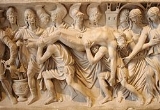
In
Greek mythologyGreek mythology is the body of myths and legends belonging to the ancient Greeks, concerning their gods and heroes, the nature of the world, and the origins and significance of their own cult and ritual practices. They were a part of religion in ancient Greece...
,
Hectōr , or
Hektōr, is a
TrojanTroy was a city, both factual and legendary, located in northwest Anatolia in what is now Turkey, southeast of the Dardanelles and beside Mount Ida...
prince and the greatest fighter for Troy in the
Trojan WarIn Greek mythology, the Trojan War was waged against the city of Troy by the Achaeans after Paris of Troy took Helen from her husband Menelaus, the king of Sparta. The war is among the most important events in Greek mythology and was narrated in many works of Greek literature, including the Iliad...
. As the first-born son of King
PriamPriam was the king of Troy during the Trojan War and youngest son of Laomedon. Modern scholars derive his name from the Luwian compound Priimuua, which means "exceptionally courageous".- Marriage and issue :...
and Queen
HecubaHecuba was a queen in Greek mythology, the wife of King Priam of Troy during the Trojan War, with whom she had 19 children. These children included several major characters of Homer's Iliad such as the warriors Hector and Paris, and the prophetess Cassandra...
, a descendant of
DardanusIn Greek mythology, Dardanus was a son of Zeus and Electra, daughter of Atlas, and founder of the city of Dardania on Mount Ida in the Troad....
, who lived under
Mount IdaIn Greek mythology, two sacred mountains are called Mount Ida, the "Mountain of the Goddess": Mount Ida in Crete; and Mount Ida in the ancient Troad region of western Anatolia which was also known as the Phrygian Ida in classical antiquity and is the mountain that is mentioned in the Iliad of...
, and of Tros, the founder of Troy, he was a prince of the royal house and the
heir apparentAn heir apparent or heiress apparent is a person who is first in line of succession and cannot be displaced from inheriting, except by a change in the rules of succession....
to his father's throne. He was married to
AndromacheIn Greek mythology, Andromache was the wife of Hector and daughter of Eetion, and sister to Podes. She was born and raised in the city of Cilician Thebe, over which her father ruled...
, with whom he had an infant son,
AstyanaxIn Greek mythology, Astyanax was the son of Hector, Crown Prince of Troy and Princess Andromache of Cilician Thebe. His birth name was Scamandrius , but the people of Troy nicknamed him Astyanax In Greek mythology, Astyanax was the son of Hector, Crown Prince of Troy and Princess Andromache of...
. He acts as leader of the Trojans and their allies in the defence of Troy, killing 31 Greek fighters in all. In the European Middle Ages, Hector figures as one of the
Nine WorthiesThe Nine Worthies are nine historical, scriptural and legendary personages who personify the ideals of chivalry as were established in the Middle Ages. All are commonly referred to as 'Princes' in their own right, despite whatever true titles each man may have held...
noted by
Jacques de LonguyonJacques de Longuyon of Lorraine is the author of a chanson de geste, Les Voeux du paon , written for Thibaut de Bar, bishop of Liège in 1312. It was one of the most popular romances of the 14th century, and introduces the concept of the Nine Worthies...
, known not only for his courage but also for his noble and courtly nature. Indeed Homer places Hector as peace-loving, thoughtful as well as bold, a good son, husband and father, and without darker motives. When the Trojans are disputing whether the
omenAn omen is a phenomenon that is believed to foretell the future, often signifying the advent of change...
s are favourable, he retorts: "One omen is best: defending the fatherland" (this is the
mottoA motto is a phrase meant to formally summarize the general motivation or intention of a social group or organization. A motto may be in any language, but Latin is the most used. The local language is usual in the mottoes of governments...
of the Greek Armed Forces to this day).
Etymology
In
GreekGreek is an independent branch of the Indo-European family of languages. Native to the southern Balkans, it has the longest documented history of any Indo-European language, spanning 34 centuries of written records. Its writing system has been the Greek alphabet for the majority of its history;...
,
Héktōr is a derivative of the verb
ékhein, archaic form
hékhein, "to have" or "to hold". Héktōr, or
Éktōr as found in Aeolic poetry, is also an epithet of
ZeusIn the ancient Greek religion, Zeus was the "Father of Gods and men" who ruled the Olympians of Mount Olympus as a father ruled the family. He was the god of sky and thunder in Greek mythology. His Roman counterpart is Jupiter and his Etruscan counterpart is Tinia.Zeus was the child of Cronus...
in his capacity as "he who holds [everything together]".
Greatest Warrior of Troy
According to the
Iliad, Hector did not approve of war between the
GreeksThe Greeks, also known as the Hellenes , are a nation and ethnic group native to Greece, Cyprus and neighboring regions. They also form a significant diaspora, with Greek communities established around the world....
and the Trojans.
For ten years the Achaeans besieged Troy and their allies in the east. Hector commanded the Trojan army, with a number of subordinates including Polydamas, and his brothers
DeiphobusIn Greek mythology, Deiphobus was a son of Priam and Hecuba. He was a prince of Troy, and the greatest of Priam's sons after Hector and Paris...
,
HelenusHelenus was a Trojan soldier and prophet in the Trojan War.In Greek mythology, Helenus was the son of King Priam and Queen Hecuba of Troy, and the twin brother of the prophetess Cassandra. He was also called Scamandrios. According to legend, Cassandra, having been given the power of prophecy by...
and
ParisParis , the son of Priam, king of Troy, appears in a number of Greek legends. Probably the best-known was his elopement with Helen, queen of Sparta, this being one of the immediate causes of the Trojan War...
. However, by all accounts Hector was the best warrior the Trojans and all their allies could field, and his fighting prowess was admired by Greeks and his own people alike.
DiomedesDiomedes or Diomed is a hero in Greek mythology, known for his participation in the Trojan War.He was born to Tydeus and Deipyle and later became King of Argos, succeeding his maternal grandfather, Adrastus. In Homer's Iliad Diomedes is regarded alongside Ajax as one of the best warriors of all...
and
OdysseusOdysseus or Ulysses was a legendary Greek king of Ithaca and the hero of Homer's epic poem the Odyssey. Odysseus also plays a key role in Homer's Iliad and other works in the Epic Cycle....
, when faced with his attack, described him as what
Robert FaglesRobert Fagles was an American professor, poet, and academic, best known for his many translations of ancient Greek classics, especially his acclaimed translations of the epic poems of Homer...
translated as an 'invincible headlong terror', and a 'maniac'.
Duel with Protesilaus
In the
IliadThe Iliad is an epic poem in dactylic hexameters, traditionally attributed to Homer. Set during the Trojan War, the ten-year siege of the city of Troy by a coalition of Greek states, it tells of the battles and events during the weeks of a quarrel between King Agamemnon and the warrior Achilles...
, Hector's exploits in the war prior to the events of the book are recapitulated. He had fought the Greek champion
ProtesilausIn Greek mythology, Protesilaus , was a hero in the Iliad who was venerated at cult sites in Thessaly and Thrace. Protesilaus was the son of Iphicles, a "lord of many sheep"; as grandson of the eponymous Phylacos, he was the leader of the Phylaceans...
in single combat at the start of the war and killed him. A prophecy had stated that the first Greek to land on Trojan soil would die.
AchillesIn Greek mythology, Achilles was a Greek hero of the Trojan War, the central character and the greatest warrior of Homer's Iliad.Plato named Achilles the handsomest of the heroes assembled against Troy....
,
AjaxAjax or Aias was a mythological Greek hero, the son of Telamon and Periboea and king of Salamis. He plays an important role in Homer's Iliad and in the Epic Cycle, a series of epic poems about the Trojan War. To distinguish him from Ajax, son of Oileus , he is called "Telamonian Ajax," "Greater...
and
OdysseusOdysseus or Ulysses was a legendary Greek king of Ithaca and the hero of Homer's epic poem the Odyssey. Odysseus also plays a key role in Homer's Iliad and other works in the Epic Cycle....
thus would not land. Finally, Odysseus threw his shield out and landed on that, and Protesilaus jumped next from his own ship. In the ensuing fight, Hector killed him, fulfilling the prophecy.
Duel with Ajax
At the advice of his brother
HelenusHelenus was a Trojan soldier and prophet in the Trojan War.In Greek mythology, Helenus was the son of King Priam and Queen Hecuba of Troy, and the twin brother of the prophetess Cassandra. He was also called Scamandrios. According to legend, Cassandra, having been given the power of prophecy by...
(who also is divinely inspired) and being told by him that he is not destined to die yet, Hector manages to get both armies seated and challenges any one of the Greek warriors to
single combatSingle combat is a fight between two single warriors which takes place in the context of a battle between two armies, with the two often considered the champions of their respective sides...
. The Argives are initially reluctant to accept the challenge. However, after
NestorIn Greek mythology, Nestor of Gerenia was the son of Neleus and Chloris and the King of Pylos. He became king after Heracles killed Neleus and all of Nestor's siblings...
's chiding, nine Greek
heroA hero , in Greek mythology and folklore, was originally a demigod, their cult being one of the most distinctive features of ancient Greek religion...
es step up to the challenge and draw by lot to see who is to face Hector.
AjaxAjax or Aias was a mythological Greek hero, the son of Telamon and Periboea and king of Salamis. He plays an important role in Homer's Iliad and in the Epic Cycle, a series of epic poems about the Trojan War. To distinguish him from Ajax, son of Oileus , he is called "Telamonian Ajax," "Greater...
wins, and fights Hector to a stalemate for the entire day. With neither able to achieve victory, they express admiration for each other's courage, skill, and strength. Hector gives Ajax his sword, which Ajax will later use to kill himself. Ajax gives Hector his girdle, which will later be used to attach Hector's corpse to Achilles' chariot by which he is dragged around the walls of Troy.
The Greek and the Trojans make a truce to bury the dead. In the early dawn the next day the Greeks take advantage of it to build a wall and ditch around the ships. Zeus is watching in a distance.
Duel with Achilles
Another mention of Hector's exploits in the early years of war was given in the
IliadThe Iliad is an epic poem in dactylic hexameters, traditionally attributed to Homer. Set during the Trojan War, the ten-year siege of the city of Troy by a coalition of Greek states, it tells of the battles and events during the weeks of a quarrel between King Agamemnon and the warrior Achilles...
book 9. During the embassy to
AchillesIn Greek mythology, Achilles was a Greek hero of the Trojan War, the central character and the greatest warrior of Homer's Iliad.Plato named Achilles the handsomest of the heroes assembled against Troy....
, Odysseus,
PhoenixIn Greek mythology, Phoenix , son of Amyntor and Cleobule, is one of the Myrmidons led by Achilles in the Trojan War...
and
AjaxAjax or Aias was a mythological Greek hero, the son of Telamon and Periboea and king of Salamis. He plays an important role in Homer's Iliad and in the Epic Cycle, a series of epic poems about the Trojan War. To distinguish him from Ajax, son of Oileus , he is called "Telamonian Ajax," "Greater...
all try to persuade Achilles to rejoin the fight. In his response, Achilles points out that while Hector was terrorising the Greek forces now, while he himself had fought in their front lines, Hector had 'no wish' to take his force far beyond the walls and out from the Scaean Gate and nearby oak tree. He then claims, 'There he stood up to me alone one day, and he barely escaped my onslaught.'
A 2004 film version of
TroyTroy is a 2004 epic war film written by David Benioff and directed by Wolfgang Petersen based on the events of the Trojan War. Its cast includes Brad Pitt as Achilles, Eric Bana as Hector.It was nominated for the Academy Award for Costume Design.-Plot:...
has Achilles slaying Hector following a duel, whereas in the Iliad it is rather different. Hector remains outside the walls, while his army flees into the city. As Achilles approaches, Hector stands his ground, fights and dies upon looking up at Troy. The film version of his death more resembles the single combat between the champions mentioned by Achilles in the Iliad, book 9.
In the tenth year of the war, observing
ParisParis , the son of Priam, king of Troy, appears in a number of Greek legends. Probably the best-known was his elopement with Helen, queen of Sparta, this being one of the immediate causes of the Trojan War...
avoiding combat with
MenelausMenelaus may refer to;*Menelaus, one of the two most known Atrides, a king of Sparta and son of Atreus and Aerope*Menelaus on the Moon, named after Menelaus of Alexandria.*Menelaus , brother of Ptolemy I Soter...
, Hector upbraids him with having brought trouble on his whole country and now refusing to fight. Paris therefore proposes
single combatSingle combat is a fight between two single warriors which takes place in the context of a battle between two armies, with the two often considered the champions of their respective sides...
between himself and Menelaus, with Helen to go to the victor, ending the war. The duel, however, leads to inconclusive results due to intervention by
AphroditeAphrodite is the Greek goddess of love, beauty, pleasure, and procreation.Her Roman equivalent is the goddess .Historically, her cult in Greece was imported from, or influenced by, the cult of Astarte in Phoenicia....
who leads Paris off the field. After
PandarusPandarus is a Trojan aristocrat who appears in stories about the Trojan War. In Homer's Iliad he is portrayed as an energetic and impetuous warrior, but in medieval literature he becomes a witty and licentious figure who facilitates the affair between Troilus and Cressida...
wounds
MenelausMenelaus may refer to;*Menelaus, one of the two most known Atrides, a king of Sparta and son of Atreus and Aerope*Menelaus on the Moon, named after Menelaus of Alexandria.*Menelaus , brother of Ptolemy I Soter...
with an arrow the fight begins again.
The Greeks attack and drive the Trojans back. Hector must now go out to lead a counter-attack. His wife,
AndromacheIn Greek mythology, Andromache was the wife of Hector and daughter of Eetion, and sister to Podes. She was born and raised in the city of Cilician Thebe, over which her father ruled...
, carrying in her arms their son
AstyanaxIn Greek mythology, Astyanax was the son of Hector, Crown Prince of Troy and Princess Andromache of Cilician Thebe. His birth name was Scamandrius , but the people of Troy nicknamed him Astyanax In Greek mythology, Astyanax was the son of Hector, Crown Prince of Troy and Princess Andromache of...
, intercepts him at the gate, pleading with him not to go out for her sake as well as his son's. Hector knows that Troy and the house of Priam are doomed to fall and that the gloomy fate of his wife and infant son will be to die or go into slavery in a foreign land. With understanding, compassion, and tenderness he explains that he cannot personally refuse to fight, and comforts her with the idea that no one can take him until it is his time to go. The gleaming bronze helmet frightens Astyanax and makes him cry. Hector takes it off, embraces his wife and son, and for her sake prays aloud to
ZeusIn the ancient Greek religion, Zeus was the "Father of Gods and men" who ruled the Olympians of Mount Olympus as a father ruled the family. He was the god of sky and thunder in Greek mythology. His Roman counterpart is Jupiter and his Etruscan counterpart is Tinia.Zeus was the child of Cronus...
that his son might be chief after him and become more glorious in battle than he.
Hector and Paris pass through the gate and rally the Trojans, raising havoc among the Greeks.
Trojan counterattack
Zeus
weighs the fatesThe psychostasia, Greek 'weighing of souls', is a method of divine determination of fate, which persists from the Iliad through to christian theology....
of the two armies in the balance, and that of the Greeks sinks down. The Trojans press the Greeks into their camp over the ditch and wall and would have laid hands on the ships, but
AgamemnonIn Greek mythology, Agamemnon was the son of King Atreus and Queen Aerope of Mycenae, the brother of Menelaus, the husband of Clytemnestra, and the father of Electra and Orestes. Mythical legends make him the king of Mycenae or Argos, thought to be different names for the same area...
rallies the Greeks in person. The Trojans are driven off, night falls, and Hector resolves to take the camp and burn the ships next day. The Trojans bivouac in the field.
- "A thousand camp-fires gleamed upon the plain, ...".
The next day Agamemnon rallies the Greeks and drives the Trojans
- "like a herd of cows maddened with fright when a lion has attacked them ..."
Hector refrains from battle until Agamemnon leaves the field, wounded in the arm by a spear. Then Hector rallies the Trojans:
- "...like some fierce tempest that swoops down upon the sea...."
DiomedesDiomedes or Diomed is a hero in Greek mythology, known for his participation in the Trojan War.He was born to Tydeus and Deipyle and later became King of Argos, succeeding his maternal grandfather, Adrastus. In Homer's Iliad Diomedes is regarded alongside Ajax as one of the best warriors of all...
and
OdysseusOdysseus or Ulysses was a legendary Greek king of Ithaca and the hero of Homer's epic poem the Odyssey. Odysseus also plays a key role in Homer's Iliad and other works in the Epic Cycle....
hinder Hector and win the Greeks some time to retreat, but the Trojans sweep down upon the wall and rain blows upon it. The Greeks in the camp contest the gates to secure entrance for their fleeing warriors. The Trojans try to pull down the ramparts while the Greeks rain arrows upon them. Hector smashes open a gate with a large stone, clears the gate and calls on the Trojans to scale the wall, which they do, and
- "... all was uproar and confusion."
The battle rages inside the camp. Hector goes down, hit by a stone thrown by Ajax, but
ApolloApollo is one of the most important and complex of the Olympian deities in Greek and Roman mythology...
arrives from Olympus and infuses strength into "the shepherd of the people", who orders a chariot attack, with Apollo clearing the way. Many combats, deaths, boasts, threats, epithets, figures of speech, stories, lines of poetry and books of the Iliad later, Hector lays hold of
ProtesilausIn Greek mythology, Protesilaus , was a hero in the Iliad who was venerated at cult sites in Thessaly and Thrace. Protesilaus was the son of Iphicles, a "lord of many sheep"; as grandson of the eponymous Phylacos, he was the leader of the Phylaceans...
' ship and calls for fire. The Trojans cannot bring it to him, as Ajax kills everyone who tries. Eventually, Hector breaks Ajax' spear with his sword, forcing him to give ground, and he sets the ship on fire.
These events are all according to the will of the gods, who have decreed the fall of Troy, and therefore intend to tempt Achilles back into the war.
PatroclusIn Greek mythology, as recorded in the Iliad by Homer, Patroclus, or Patroklos , was the son of Menoetius, grandson of Actor, King of Opus, and was Achilles' beloved comrade and brother-in-arms....
, Achilles' closest companion, disguised in the armor of
AchillesIn Greek mythology, Achilles was a Greek hero of the Trojan War, the central character and the greatest warrior of Homer's Iliad.Plato named Achilles the handsomest of the heroes assembled against Troy....
, enters the combat leading the
MyrmidonsThe Myrmidons or Myrmidones were legendary people of Greek history. They were very brave and skilled warriors commanded by Achilles, as described in Homer's Iliad. Their eponymous ancestor was Myrmidon, a king of Thessalian Phthia, who was the son of Zeus and "wide-ruling" Eurymedousa, a...
and the rest of the Achaeans to force a Trojan withdrawal. After Patroclus has routed the Trojan army, Hector, with the aid of
ApolloApollo is one of the most important and complex of the Olympian deities in Greek and Roman mythology...
and
EuphorbusEuphorbus , the son of Panthous and Phrontis, was a Trojan hero during the Trojan War. He wounded Patroclus before Patroclus was killed by Hector. In the fight for Patroclus' body, Euphorbus was killed by Menelaus. He was apparently one of Troy's finest warriors. Menelaus later took Euphorbus'...
, kills Patroclus, vaunting over him:
- "I am foremost of all the Trojan warriors to stave the day of bondage from off them; as for you, vultures shall devour you here."
The dying Patroclus replies:
- ".. death and the day of your doom are close upon you...".
Hector's last fight
Hector strips the armor of Achilles off the fallen Patroclus and gives it to his men to take back to the city. Glaucus accuses Hector of cowardice for not challenging Ajax. Stung, Hector calls for the armor, puts it on and uses it to rally the Trojans.
ZeusIn the ancient Greek religion, Zeus was the "Father of Gods and men" who ruled the Olympians of Mount Olympus as a father ruled the family. He was the god of sky and thunder in Greek mythology. His Roman counterpart is Jupiter and his Etruscan counterpart is Tinia.Zeus was the child of Cronus...
regards the donning of a hero's armor as an act of insolence by a fool about to die, but makes him strong for now.
The next day Achilles with rage, renouncing the wrath that kept him out of action, routs the Trojans back to the city. Hector chooses to remain outside the gates of Troy and face Achilles, partially because had he listened to Polydamas and retreated with his troops the previous night, Achilles would not have killed so many Trojans. However, when he sees Achilles he is seized by fear, and turns to flee, as Achilles gives chase to him three times around the city. Hector then masters his fear and turns to face Achilles. But Athena, in the disguise of Hector's brother
DeiphobusIn Greek mythology, Deiphobus was a son of Priam and Hecuba. He was a prince of Troy, and the greatest of Priam's sons after Hector and Paris...
, deluded Hector. He requests from Achilles that the victor would return the other's body after the duel, (though Hector himself made it clear he planned to throw Patroclus' body to the dogs) but Achilles refuses. Achilles hurls his spear at Hector, who dodges it, but Athena brought it back to Achilles' hands without Hector noticing. Hector then throws his spear at Achilles; it hits the shield but to no avail. When Hector turns to face his supposed brother to retrieve another spear he sees no one there. At that moment he realizes that he is doomed. Hector decides that he will go down fighting and that men will talk about his bravery in years to come; the desire to achieve ever lasting honor was one of the most fierce for soldiers living in the timocratic (honor based) society of the age.
Hector pulls out his sword, his only weapon now, and charges. Achilles, knowing the weak spot of his old armor, which Hector now wears, is at the neck, stabs his spear through the armor into Hector's throat but misses the vocal chords. Hector, in his final moments, begs Achilles for an honorable burial. However, Achilles replies that he will let dogs and vultures devour Hector's flesh. (Throughout the Homeric poems, several references are made to dogs, vultures, and other creatures devour the dead. It can be seen as another way of saying one will die.) Hector dies, prophesying that Achilles' death will follow soon.
After his death, Achilles slits Hector's heels and passes the girdle that Ajax had given Hector through the slits of the heels. He then fastens the girdle to his chariot and drives his fallen enemy through the dust to the Danaan camp. For the next twelve days, Achilles mistreats the body, but it remains preserved from all injury by
ApolloApollo is one of the most important and complex of the Olympian deities in Greek and Roman mythology...
and
AphroditeAphrodite is the Greek goddess of love, beauty, pleasure, and procreation.Her Roman equivalent is the goddess .Historically, her cult in Greece was imported from, or influenced by, the cult of Astarte in Phoenicia....
. After these twelve days, the gods can no longer stand watching it and send down two messengers:
IrisIn Greek mythology, Iris is the personification of the rainbow and messenger of the gods. As the sun unites Earth and heaven, Iris links the gods to humanity...
, another messenger god, and Thetis, mother to Achilles. Thetis has told Achilles to allow King Priam to come and take the body for ransom. Once King Priam has been notified that Achilles will allow him to claim the body, he goes to his safe to withdraw the ransom for Hector's body. The ransom King Priam offers included twelve fine robes, twelve white mantles, several richly embroidered tunics, ten bars of yellow gold, a special gold cup, and several cauldrons. King Priam himself soon comes to claim the body, and Hermes grants him safe passage by casting a charm that will make anyone who looks at him fall asleep.
Achilles, moved by Priam's actions and following his mother's orders sent by Zeus, returns Hector's body, and promises Priam a truce of twelve days to allow the Trojans to perform funeral rites for Hector. Priam returns to Troy with the body of his son, and it is given full funeral honors. Even Helen mourns Hector, for he had always been kind to her and protected her from spite. The last lines of the
Iliad are dedicated to Hector's funeral. Homer concludes by referring to the Trojan prince as the "tamer of horses."
ApollodorusApollodorus of Athens son of Asclepiades, was a Greek scholar and grammarian. He was a pupil of Diogenes of Babylon, Panaetius the Stoic, and the grammarian Aristarchus of Samothrace...
, Bibliotheke III, xii, 5-6;
ApollodorusApollodorus of Athens son of Asclepiades, was a Greek scholar and grammarian. He was a pupil of Diogenes of Babylon, Panaetius the Stoic, and the grammarian Aristarchus of Samothrace...
,
EpitomeAn epitome is a summary or miniature form; an instance that represents a larger reality, also used as a synonym for embodiment....
IV, 2.
Historical references
There is as of yet little direct evidence of the historical existence of Homeric heroes; i.e., no inscriptions, signatures, eye-witness accounts, etc. Theories about them have to rely on a preponderance of other evidence, which alone are not solid enough to warrant much conclusiveness. The most valuable evidence, if relevant, are the treaties and letters mentioned in
HittiteThe Hittites were a Bronze Age people of Anatolia.They established a kingdom centered at Hattusa in north-central Anatolia c. the 18th century BC. The Hittite empire reached its height c...
cuneiformCuneiform can refer to:*Cuneiform script, an ancient writing system originating in Mesopotamia in the 4th millennium BC*Cuneiform , three bones in the human foot*Cuneiform Records, a music record label...
texts of the same approximate era, which mention an unruly Western Anatolian warlord named
Piyama-RaduPiyamaradu was a warlike aristocratic personage whose name figures prominently in the Hittite archives of the middle and late 13th century BC in western Anatolia. His history is of particular interest because it appears to intertwine with that of the Trojan War...
(possibly Priam) and his successor
AlaksanduAlaksandu was a king of Wilusa who sealed a treaty with Muwatalli II ca. 1280 BC. This treaty implies that Alaksandu had previously secured a treaty with Muwatalli's father, Mursili II, as well....
(possibly Alexander, the nickname of
ParisParis , the son of Priam, king of Troy, appears in a number of Greek legends. Probably the best-known was his elopement with Helen, queen of Sparta, this being one of the immediate causes of the Trojan War...
) both based in
WilusaWilusa was a city of the late Bronze Age Assuwa confederation of western Anatolia.It is known from six references in 13th century BC Hittite sources, including...
(possibly
Ilion/IliosTroy was a city, both factual and legendary, located in northwest Anatolia in what is now Turkey, southeast of the Dardanelles and beside Mount Ida...
), as well as the god
Apaliunas (possibly
ApolloApollo is one of the most important and complex of the Olympian deities in Greek and Roman mythology...
).
Other such pieces of quasi-evidence are names of Trojan heroes in
Linear BLinear B is a syllabic script that was used for writing Mycenaean Greek, an early form of Greek. It pre-dated the Greek alphabet by several centuries and seems to have died out with the fall of Mycenaean civilization...
tablets. Twenty out of fifty-eight men's names also known from Homer, including
e-ko-to (Hector), are Trojan warriors and some, including Hector, are in a servile capacity. No such conclusion that they are the offspring of Trojan captive women is warranted. Generally the public has to be content with the knowledge that these names existed in Greek in Mycenaean times, although Page hypothesizes that Hector "may very well be ... a familiar Greek form impressed on a similar-sounding foreign name."
When
PausaniasPausanias was a Greek traveler and geographer of the 2nd century AD, who lived in the times of Hadrian, Antoninus Pius and Marcus Aurelius. He is famous for his Description of Greece , a lengthy work that describes ancient Greece from firsthand observations, and is a crucial link between classical...
visited
Thebes in BoeotiaThebes is a city in Greece, situated to the north of the Cithaeron range, which divides Boeotia from Attica, and on the southern edge of the Boeotian plain. It played an important role in Greek myth, as the site of the stories of Cadmus, Oedipus, Dionysus and others...
, in the second century AD, he was shown Hector's tomb and was told that the bones had been transported to Thebes according to a
Delphic oracleDelphi is both an archaeological site and a modern town in Greece on the south-western spur of Mount Parnassus in the valley of Phocis.In Greek mythology, Delphi was the site of the Delphic oracle, the most important oracle in the classical Greek world, and a major site for the worship of the god...
.
Moses I. FinleySir Moses I. Finley CBE, FBA was an American and English classical scholar. His most notable work is The Ancient Economy , where he argued that status and civic ideology governed the economy in antiquity rather than rational economic motivations.-Early life and career:He was born in 1912 in New...
observes "this typical bit of fiction must mean that there was an old Theban hero Hector, a Greek, whose myths antedated the Homeric poems. Even after Homer had located Hector in Troy for all time, the Thebans held on to their hero, and the Delphic oracle provided the necessary sanction."
Literature
- In Dante's Inferno, Hector and his family are placed in Limbo
In the theology of the Catholic Church, Limbo is a speculative idea about the afterlife condition of those who die in original sin without being assigned to the Hell of the damned. Limbo is not an official doctrine of the Roman Catholic Church or any other...
, the outer circle wherein the virtuous non-Christians dwell.
- Roland
Roland was a Frankish military leader under Charlemagne who became one of the principal figures in the literary cycle known as the Matter of France. Historically, Roland was military governor of the Breton March, with responsibility for defending the frontier of Francia against the Bretons...
's sword in early 12th century French poem Song of Roland, was named DurendalDurendal or Durandal is the sword of Charlemagne's paladin Roland in the literary cycle known as the Matter of France....
. According to Ludovico AriostoLudovico Ariosto was an Italian poet. He is best known as the author of the romance epic Orlando Furioso . The poem, a continuation of Matteo Maria Boiardo's Orlando Innamorato, describes the adventures of Charlemagne, Orlando, and the Franks as they battle against the Saracens with diversions...
's Orlando FuriosoOrlando Furioso is an Italian epic poem by Ludovico Ariosto which has exerted a wide influence on later culture. The earliest version appeared in 1516, although the poem was not published in its complete form until 1532...
it once belonged to Hector of TroyTroy was a city, both factual and legendary, located in northwest Anatolia in what is now Turkey, southeast of the Dardanelles and beside Mount Ida...
, and was given to Roland by MalagigiIn the Matter of France, Maugris or Maugis was one of the heroes of the chansons de geste and romances of chivalry that tell of the legendary court of King Charlemagne. He is cousin to Renaud de Montauban , son of Beuves of Aygremont and brother to Vivien de Monbranc. He was brought up by Oriande...
(Maugris).
- In William Shakespeare
William Shakespeare was an English poet and playwright, widely regarded as the greatest writer in the English language and the world's pre-eminent dramatist. He is often called England's national poet and the "Bard of Avon"...
's Troilus and CressidaTroilus and Cressida is a tragedy by William Shakespeare, believed to have been written in 1602. It was also described by Frederick S. Boas as one of Shakespeare's problem plays. The play ends on a very bleak note with the death of the noble Trojan Hector and destruction of the love between Troilus...
, Hector's death is used to mark the conclusion of the play. His nobility is shown in stark contrast to the deceit and pridefulness of the Greeks, especially Achilles.
- In David Gemmell
David Andrew Gemmell was a bestselling British author of heroic fantasy. A former journalist and newspaper editor, Gemmell had his first work of fiction published in 1984. He went on to write over thirty novels. Best known for his debut, Legend, Gemmell's works display violence, yet also explore...
's Troy trilogy Hektor is seen as a man of peace and would rather breed his horses than go to war but is forced by King PriamKing Priam is an opera by Michael Tippett, to his own libretto. The story is based on Homer's Iliad, except the birth and childhood of Paris, which are taken from the Fabulae of Hyginus.The premiere was on 29 May 1962, at Coventry...
to fight for the Hittite empire against the egytian's at the battle of Kadesh and other conflicts. In Fall of Kings Hektor kills Patrokles while attacking a supply wagon. Achilles challenges Hektor to a duel through Odyseus. Hektor accepts but only so the women and children of TroyTroy was a city, both factual and legendary, located in northwest Anatolia in what is now Turkey, southeast of the Dardanelles and beside Mount Ida...
could get on ship's to Kypros. They fight in a special designed pit dug especially for the duel. Both Hektor and Achilles are equally matched but both they'r swords are poisoned by Aggamemnon's priest. Both warriors died fighting back to back against Aggamemnon's followers and Achille's Myrmidons carry Hektor back to Troy and Achilles back to their camp and the next morning head back to Thessaly.
Film and television
Hector has been portrayed by a variety of actors in numerous films, including the following:
- Harry Andrews
Harry Fleetwood Andrews, CBE was an English film actor known for his frequent portrayals of tough military officers. His performance as Sergeant Major Wilson in The Hill alongside Sean Connery earned Andrews the 1965 National Board of Review Award for Best Supporting Actor and a nomination for the...
in Helen of TroyHelen of Troy is a 1956 Warner Bros. epic film, based on Homer's Iliad. It was directed by Robert Wise, from a screenplay by Hugh Gray and John Twist, adapted by Hugh Gray and N. Richard Nash...
(1956)
- Jacques Bergerac
Jacques Bergerac is a former French actor with a brief Hollywood film career.Originally a lawyer, Bergerac met and married Ginger Rogers with whom he appeared in Twist of Fate . He then went on to appear as Armand Duval in a television production of Camille for Kraft Television Theatre, opposite...
in The Fury of AchillesThe Fury of Achilles is a 1962 historical drama set in the ninth year of the Trojan War, and is based primarily on Homer's Iliad...
(1962)
- Daniel Lapaine
Daniel Lapaine is an Australian actor.Born in Sydney, Australia, Lapaine graduated from the National Institute of Dramatic Art in 1992. In 1994, he played David Van Arckle in P. J. Hogan's Muriel's Wedding...
in Helen of TroyHelen of Troy is a 2003 television miniseries based upon Homer's story of the Trojan War, as recounted in the epic poem, Iliad. This TV miniseries also shares the name with a 1956 movie starring Stanley Baker...
(2003)
- Eric Bana
Eric Bana is an Australian film and television actor. He began his career as a comedian in the sketch comedy series Full Frontal before gaining critical recognition in the biopic Chopper...
in TroyTroy is a 2004 epic war film written by David Benioff and directed by Wolfgang Petersen based on the events of the Trojan War. Its cast includes Brad Pitt as Achilles, Eric Bana as Hector.It was nominated for the Academy Award for Costume Design.-Plot:...
(2004)
Miscellaneous
- Hector is given his heraldry of a seated lion holding a sword in the Enfances Hector of the early 14th century.
- Hector is commemorated as the face of the Jack of diamonds
A Jack, also Knave, is a playing card with a picture of a man on it. The usual rank of a jack, within its suit, is as if it were an 11 ....
in French playing cards.