
All Topics  
Heat pipe

 
Heat Pipe

   Email Print
   Bookmark   Link


Heat pipe


A heat pipe is a heat transfer mechanism that can transport large quantities of heat with a very small difference in temperature
Temperature

In physics, temperature is a physical property of a Physical system that underlies the common notions of hot and cold; something that feels hotter generally has the greater temperature....
 between the hotter and colder interfaces.

Inside a heat pipe, at the hot interface a fluid turns to vapour and the gas naturally flows and condenses on the cold interface.


Discussion
Ask a question about 'Heat pipe'
Start a new discussion about 'Heat pipe'
Answer questions from other users
Full Discussion Forum


Encyclopedia


Heat Pipe
A heat pipe is a heat transfer mechanism that can transport large quantities of heat with a very small difference in temperature
Temperature

In physics, temperature is a physical property of a Physical system that underlies the common notions of hot and cold; something that feels hotter generally has the greater temperature....
 between the hotter and colder interfaces.

Inside a heat pipe, at the hot interface a fluid turns to vapour and the gas naturally flows and condenses on the cold interface. The liquid falls or is moved by capillary action
Capillary action

Capillary action, capillarity, capillary motion, or wicking refers to two phenomena:# The movement of liquids in thin tubes...
 back to the hot interface to evaporate again and repeat the cycle.

Structure, Design and Construction

Heat Pipe Mechanism
A typical heat pipe consists of a sealed pipe or tube made of a material with high thermal conductivity
Thermal conductivity

In physics, thermal conductivity, , is the List of materials properties of a material that indicates its ability to conduct heat. It appears primarily in Heat conduction#Fourier's law for heat conduction....
 such as copper
Copper

Copper is a chemical element with the symbol Cu and atomic number 29.It is a ductile metal with very high thermal and electrical conductivity....
 or aluminium
Aluminium

Aluminium or aluminum is a silvery white and ductile member of the boron group of chemical elements. It has the symbol Al; its atomic number is 13....
. A vacuum pump
Vacuum pump

A vacuum pump is a device that removes gas molecules from a sealed volume in order to leave behind a partial vacuum. The vacuum pump was invented in 1650 by Otto von Guericke....
 is used to remove all air from the empty heat pipe, and then the pipe is filled with a fraction of a percent by volume of working fluid, (or coolant
Coolant

A coolant is a fluid which flows through a device in order to prevent its overheating, transferring the heat produced by the device to other devices that utilize or dissipate it....
), chosen to match the operating temperature. Some example fluids are water
Water

Water is a common chemical substance that is essential for the survival of all known forms of life. In typical usage, water refers only to its liquid form or States of matter, but the substance also has a solid state, ice, and a gaseous state, water vapor or steam....
, ethanol
Ethanol

Ethanol, also called ethyl alcohol, pure alcohol, grain alcohol, or drinking alcohol, is a volatility , flammable, colorless liquid....
, acetone
Acetone

Acetone is the organic compound with the chemical formula OC2. This colorless, mobile, flammable liquid is the simplest example of the ketones....
, sodium
Sodium

Sodium is an element which has the symbol Na , atomic number 11, atomic mass 23 amu , and a common oxidation number +1. Sodium is a soft, silvery white, highly reactive element and is a member of the alkali metals within "group 1" ....
, or mercury
Mercury (element)

Mercury , also called quicksilver or hydrargyrum , is a chemical element with the symbol Hg and atomic number 80. A heavy, silvery d-block metal, mercury is one of six elements that are liquid at or near room temperature and pressure....
. Due to the partial vacuum that is near or below the vapor pressure of the fluid, some of the fluid will be in the liquid phase and some will be in the gas phase.

Inside the pipe's walls, an optional wick structure exerts a capillary pressure
Capillary pressure

In fluid statics, capillary pressure is the difference in pressure across the interface between two immiscible fluids, and thus defined as.In oil-water systems, water is typically the wetting phase, while for gas-oil systems, oil is typically the wetting phase....
 on the liquid phase of the working fluid. This is typically a sintered
Sintering

Sintering is a method for making objects from Powder , by heating the material below its melting point until its particles adhesion to each other....
 metal powder or a series of grooves parallel to the pipe axis, but it may be any material capable of exerting capillary pressure on the condensed liquid to wick it back to the heated end. The heat pipe may not need a wick structure if gravity or some other source of acceleration is sufficient to overcome surface tension
Surface tension

Surface tension is an attractive property of the surface of a liquid. It is what causes the surface portion of liquid to be attracted to another surface, such as that of another portion of liquid ....
 and cause the condensed liquid to flow back to the heated end.

A heat pipe is not a thermosiphon
Thermosiphon

Thermosiphon refers to a method of passive heat exchange based on natural convection which circulates liquid in a vertical closed-loop circuit without requiring a conventional pump....
, because there is no siphon
Siphon

A siphon is a continuous tube that allows liquid to drain from a reservoir through an intermediate point that is higher, or lower, than the reservoir, the flow being driven only by the difference in hydrostatic pressure without any need for pumping....
. Thermosiphons transfer heat by single-phase convection
Convection

Convection in the most general terms refers to the movement of molecules within fluids . Convection is one of the major modes of heat transfer and mass transfer....
. (See also: Perkins Tube, after Jacob Perkins
Jacob Perkins

Jacob Perkins was an Anglo-American inventor, mechanical engineer and physicist. Born in Newburyport, Massachusetts , Perkins was apprenticed to a goldsmith....
.)

Heat pipes contain no mechanical moving parts and typically require no maintenance, though non-condensing gases (that diffuse through the pipe's walls, result from breakdown of the working fluid, or exist as impurities in the materials) may eventually reduce the pipe's effectiveness at transferring heat. This is significant when the working fluid's vapour pressure is low.

The materials chosen depend on the temperature conditions in which the heat pipe must operate, with coolants ranging from liquid helium
Liquid helium

Helium exists in liquid form only at very low temperatures. The boiling point and critical point depend on the isotope of the helium; see the table below for values....
 for extremely low temperature applications (2–4 K) to mercury
Mercury (element)

Mercury , also called quicksilver or hydrargyrum , is a chemical element with the symbol Hg and atomic number 80. A heavy, silvery d-block metal, mercury is one of six elements that are liquid at or near room temperature and pressure....
 (523–923 K) & sodium
Sodium

Sodium is an element which has the symbol Na , atomic number 11, atomic mass 23 amu , and a common oxidation number +1. Sodium is a soft, silvery white, highly reactive element and is a member of the alkali metals within "group 1" ....
 (873–1473 K) and even indium
Indium

Indium is a chemical element with chemical symbol In and atomic number 49. This rare, soft, malleable and easily Fusible alloy Post-transition metal is chemically similar to aluminium or gallium but more closely resembles zinc ....
 (2000–3000 K) for extremely high temperatures. The vast majority of heat pipes for low temperature applications use some combination of ammonia
Ammonia

Ammonia is a chemical compound with the chemical formula nitrogenhydrogen. It is normally encountered as a gas with a characteristic pungent odor....
 (213–373 K), alcohol
Alcohol

In chemistry, an alcohol is any organic compound in which a hydroxyl Functional group is bound to a carbon atom of an alkyl or substituted alkyl group....
 (methanol
Methanol

Methanol, also known as methyl alcohol, carbinol, wood alcohol, wood naphtha or wood spirits, is a chemical compound with chemical formula carbonhydrogen3oxygenhydrogen ....
 (283–403 K) or ethanol
Ethanol

Ethanol, also called ethyl alcohol, pure alcohol, grain alcohol, or drinking alcohol, is a volatility , flammable, colorless liquid....
 (273–403 K)) or water
Water

Water is a common chemical substance that is essential for the survival of all known forms of life. In typical usage, water refers only to its liquid form or States of matter, but the substance also has a solid state, ice, and a gaseous state, water vapor or steam....
 (303–473 K) as working fluid.

The advantage of heat pipes is their great efficiency in transferring heat. They are a much better heat conductor than an equivalent cross-section of solid copper. A heat flux
Flux

In the various subfields of physics, there exist two common usages of the term flux, both with rigorous mathematical frameworks.*In the study of transport phenomena , flux is defined as the amount that flows through a unit area per unit time....
 of more than 230 MW/m˛ has been recorded (nearly four times the heat flux at the surface of the sun).

Active control of heat flux can be effected by adding a variable volume liquid reservoir to the evaporator section. Variable conductance heat pipes employ a large reservoir of inert immiscible gas attached to the condensing section. Varying the gas reservoir pressure changes the volume of gas charged to the condenser which in turn limits the area available for vapor condensation. Thus a wider range of heat fluxes and temperature gradients can be accommodated with a single design.

A modified heat pipe with a reservoir having no capillary connection to the heat pipe wick at the evaporator end can also be used as a thermal diode
Thermal diode

The term thermal diode is sometimes used to describe a device which causes heat to flow preferentially in one direction. Or, the term may be used to describe an electrical diode in reference to a thermal effect or function....
. This heat pipe will transfer heat in one direction, acting as an insulator in the other.

Flat heat pipes

Thin planar heat pipes (heat spreaders) have the same primary components as tubular heat pipes. These components are a hermetically sealed hollow vessel, a working fluid, and a closed-loop capillary recirculation system.

Compared to a one-dimensional tubular heat pipe, the width of a two-dimensional heat pipe allows an adequate cross section for heat flow even with a very thin device. These thin planar heat pipes are finding their way into “height sensitive” applications, such as notebook computers, and surface mount circuit board cores. It is possible to produce flat heat pipes as thin as 0.5 mm (thinner than a credit card
ISO 7813

ISO 7813 defines standards for banking cards, such as the thickness and the rounding for the corners. It is an extension of ISO 7810. This standard also defines the Magnetic stripe card on each financial institution card such as Automated teller machine or credit card....
).

Heat transfer

Heat pipes employ evaporative cooling to transfer thermal energy from one point to another by the evaporation
Evaporation

Evaporation is the slow vaporization of a liquid and the reverse of condensation. A type of phase transition, it is the process by which molecules in a liquid State of matter spontaneously become gaseous ....
 and condensation
Condensation

Condensation is the change of the physical state of aggregation of matter from gaseous phase into liquid phase. When the transition happens from the gaseous phase into the solid phase directly, bypassing the liquid phase the change is called Deposition , which is the opposite of sublimation....
 of a working fluid or coolant. Heat pipes rely on a temperature difference between the ends of the pipe, and cannot lower temperatures at either end beyond the ambient temperature (hence they tend to equalise the temperature within the pipe).

When one end of the heat pipe is heated the working fluid inside the pipe at that end evaporates and increases the vapour pressure inside the cavity of the heat pipe. The latent heat
Latent heat

In thermochemistry, latent heat is the amount of energy in the form of heat released or absorbed by a chemical substance during a change of state of matter , or a phase transition....
 of evaporation absorbed by the vaporisation of the working fluid reduces the temperature at the hot end of the pipe.

The vapour pressure over the hot liquid working fluid at the hot end of the pipe is higher than the equilibrium vapour pressure over condensing working fluid at the cooler end of the pipe, and this pressure difference drives a rapid mass transfer to the condensing end where the excess vapour condenses, releases its latent heat, and warms the cool end of the pipe. Non-condensing gases (caused by contamination for instance) in the vapour impede the gas flow and reduce the effectiveness of the heat pipe, particularly at low temperatures, where vapour pressures are low. The velocity of molecules in a gas is approximately the speed of sound and in the absence of non condensing gases, this is the upper velocity with which they could travel in the heat pipe. In practice, the speed of the vapour through the heat pipe is dependent on the rate of condensation at the cold end.

The condensed working fluid then flows back to the hot end of the pipe. In the case of vertically-oriented heat pipes the fluid may be moved by the force of gravity. In the case of heat pipes containing wicks, the fluid is returned by capillary action
Capillary action

Capillary action, capillarity, capillary motion, or wicking refers to two phenomena:# The movement of liquids in thin tubes...
.

When making heat pipes, there is no need to create a vacuum in the pipe. One simply boils the working fluid in the heat pipe until the resulting vapour has purged the non condensing gases from the pipe and then seals the end.

An interesting property of heat pipes is the temperature over which they are effective. Initially, it might be suspected that a water charged heat pipe would only work when the hot end reached the boiling point (100 °C) and steam was transferred to the cold end. However, the boiling point of water is dependent on absolute pressure inside the pipe. In an evacuated pipe, water will boil just slightly above its melting point
Melting point

The melting point of a solid is the temperature range at which it changes states of matter from solid to liquid. At the melting point the solid and liquid phase exist in equilibrium....
 (0 °C). The heat pipe will operate, therefore, when the hot end is just slightly warmer than the melting point of the working fluid. Similarly, a heat pipe with water as a working fluid can work well above the boiling point (100 °C), if the cold end is low enough in temperature to condense the fluid.

The main reason for the effectiveness of heat pipes is the evaporation and condensation of the working fluid. The heat of vaporization greatly exceeds the sensible heat capacity. Using water as an example, the energy needed to evaporate one gram of water is equivalent to the amount of energy needed to raise the temperature of that same gram of water by 540 °C (hypothetically, if the water was under extremely high pressure so it didn't vaporize or freeze over this temperature range). Almost all of that energy is rapidly transferred to the "cold" end when the fluid condenses there, making a very effective heat transfer system with no moving parts.

Origins and research in the United States

The general principle of heat pipes using gravity (commonly classified as two phase thermosiphon
Thermosiphon

Thermosiphon refers to a method of passive heat exchange based on natural convection which circulates liquid in a vertical closed-loop circuit without requiring a conventional pump....
s) dates back to the steam age. The modern concept for a capillary driven heat pipe was first suggested by R.S. Gaugler of General Motors in 1942 who patented the idea.The benefits of employing capillary action were independently developed and first demonstrated by George Grover at Los Alamos National Laboratory
Los Alamos National Laboratory

Los Alamos National Laboratory is a United States Department of Energy United States Department of Energy National Labs, managed and operated by Los Alamos National Security, LLC , located in Los Alamos, New Mexico....
 in 1963 and subsequently published in the Journal of Applied Physics
Journal of Applied Physics

Journal of Applied Physics is a scientific journal published by the American Institute of Physics . Its emphasis is on the understanding of the founding physics underpinning modern technology....
 in 1964. Grover noted in his notebook:

"Heat transfer via capillary movement of fluids. The "pumping" action of surface tension forces may be sufficient to move liquids from a cold temperature zone to a high temperature zone (with subsequent return in vapor form using as the driving force, the difference in vapor pressure at the two temperatures) to be of interest in transferring heat from the hot to the cold zone. Such a closed system, requiring no external pumps, may be of particular interest in space reactors in moving heat from the reactor core to a radiating system. In the absence of gravity, the forces must only be such as to overcome the capillary and the drag of the returning vapor through its channels."


Between 1964 and 1966, RCA was the first corporation to undertake research and development of heat pipes for commercial applications (though their work was mostly funded by the US government). During the late 1960s NASA played a large role in heat pipe development by funding a significant amount of research on their applications and reliability in space flight following from Grover's suggestion. NASA
NASA

The National Aeronautics and Space Administration is an agency of the Federal government of the United States, responsible for the nation's public list of space agencies....
’s attraction to heat pipe cooling systems was understandable given their low weight, high heat flux, and zero power draw. Their primary interest however was based on the fact that the system wouldn’t be adversely affected by operating in a zero gravity environment. The first application of heat pipes in the space program was in thermal equilibration of satellite transponders. As satellite
Satellite

In the context of spaceflight, a satellite is an Physical body which has been placed into orbit by human endeavor. Such objects are sometimes called artificial satellites to distinguish them from natural satellites such as the Moon....
s orbit one side is exposed to the direct radiation of the sun while the opposite side is completely dark and exposed to the deep cold of outer space
Outer space

Outer space comprises the relatively empty regions of the universe outside the atmospheres of celestial bodies. Outer space is used to distinguish it from airspace and terrestrial locations....
. This causes severe discrepancies in the temperature (and thus reliability and accuracy) of the transponders. The heat pipe cooling system designed for this purpose managed the high heat fluxes and demonstrated flawless operation with and without the influence of gravity. The developed cooling system was the first description and usage of variable conductance heat pipes to actively regulate heat flow or evaporator temperature.

Corporate R&D

Publications in 1967 and 1968 by Feldman, Eastman, & Katzoff first discussed applications of heat pipes to areas outside of government concern and that did not fall under the high temperature classification such as; air conditioning, engine cooling, and electronics cooling. These papers also made the first mentions of flexible, arterial, and flat plate heat pipes. 1969 publications introduced the concepts of the rotational heat pipe with its applications to turbine blade cooling and the first discussions of heat pipe applications to cryogenic processes.

Starting in the 1980s Sony began incorporating heat pipes into the cooling schemes for some of its commercial electronic products in place of both forced convection and passive finned heat sinks. Initially they were used in tuners & amplifiers, soon spreading to other high heat flux electronics applications. During the late 1990s increasingly hot microcomputer CPUs spurred a threefold increase in the number of U.S. heat pipe patent applications. As heat pipes transferred from a specialized industrial heat transfer component to a consumer commodity most development and production moved from the U.S. to Asia. Modern CPU heat pipes are typically made from copper and use water as the working fluid.

Applications

Alaska Pipeline Closeup Underneath
Grover and his colleagues were working on cooling systems for nuclear power cells
Atomic battery

The terms atomic battery, nuclear battery, tritium battery and radioisotope battery are used to describe a device which uses the emissions from a radioactive isotope to generate electricity....
 for space craft
Spacecraft

A spacecraft is a Craft or machine designed for spaceflight. On a sub-orbital spaceflight, a spacecraft enters outer space then returns to the Earth....
, where extreme thermal conditions are found. Heat pipes have since been used extensively in spacecraft as a means for managing internal temperature conditions.

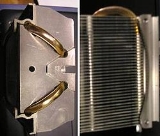
Heat pipes are extensively used in many modern computer systems, where increased power requirements and subsequent increases in heat emission have resulted in greater demands on cooling systems. Heat pipes are typically used to move heat away from components such as CPUs and GPU
Graphics processing unit

A graphics processing unit or GPU is a dedicated graphics rendering device for a personal computer, workstation, or game console. Modern GPUs are very efficient at manipulating and displaying computer graphics, and their highly parallel structure makes them more effective than general-purpose Central processing unit for a range of com...
s to heat sinks where thermal energy may be dissipated into the environment.

Solar Thermal

Heat pipes are also being widely used in solar thermal water heating applications in combination with evacuated tube solar collector arrays. In these applications, distilled water is commonly used as the heat transfer fluid inside a sealed length of copper tubing that is located within an evacuated glass tube and oriented towards the sun.

In solar thermal water heating applications, an evacuated tube collector can deliver up to 40% more efficiency compared to more traditional "flat plate" solar water heaters. Evacuated tube collectors eliminate the need for anti-freeze additives to be added as the vacuum helps prevent heat loss. These types of solar thermal water heaters are frost protected down to more than -3 °C and are being used in Antarctica
Antarctica

Antarctica is Earth's southernmost continent, overlying the South Pole. It is situated in the Antarctica of the southern hemisphere, almost entirely south of the Antarctic Circle, and is surrounded by the Southern Ocean....
 to heat water.

Pipelines over permafrost

Heat pipes are used to dissipate heat on the Trans-Alaska Pipeline System
Trans-Alaska Pipeline System

The Trans-Alaska Pipeline System , usually called the Alyeska Pipeline in Alaska or the Alaska Pipeline elsewhere, is a major United States Petroleum pipeline transport connecting oil fields in Alaska's North Slope to a North Pacific seaport where the oil can be shipped to the Lower 48 states for refining....
. Without them residual ground heat remaining in the oil as well as that produced by friction and turbulence in the moving oil would conduct down the pipe's support legs. This would likely melt the permafrost on which the supports are anchored. This would cause the pipeline to sink and possibly sustain damage. To prevent this each vertical support member has been mounted with 4 vertical heat pipes.

Limitations

Heat pipes must be tuned to particular cooling conditions. The choice of pipe material, size and coolant all have an effect on the optimal temperatures in which heat pipes work.

When heated above a certain temperature, all of the working fluid in the heat pipe will vaporize and the condensation process will cease to occur; in such conditions, the heat pipe's thermal conductivity
Thermal conductivity

In physics, thermal conductivity, , is the List of materials properties of a material that indicates its ability to conduct heat. It appears primarily in Heat conduction#Fourier's law for heat conduction....
 is effectively reduced to the heat conduction
Heat conduction

Heat conduction or thermal conduction is the spontaneous heat transfer through matter, from a region of higher temperature to a region of lower temperature, and acts to equalize temperature differences....
 properties of its solid metal casing alone. As most heat pipes are constructed of copper
Copper

Copper is a chemical element with the symbol Cu and atomic number 29.It is a ductile metal with very high thermal and electrical conductivity....
 (a metal with high heat conductivity), an overheated heatpipe will generally continue to conduct heat at around 1/80 of the original conductivity.

In addition, below a certain temperature, the working fluid will not undergo phase change, and the thermal conductivity will be reduced to that of the solid metal casing. One of the key criteria for the selection of a working fluid is the desired operational temperature range of the application. The lower temperature limit typically occurs a few degrees above the freezing point of the working fluid.

Most manufacturers cannot make a traditional heat pipe smaller than 3mm in diameter due to material limitations (though 1.6mm thin sheets can be fabricated). Experiments have been conducted with micro heat pipes, which use piping with sharp edges, such as triangular or rhombus-like tubing. In these cases, the sharp edges transfer the fluid through capillary action, and no wick is necessary.

See also

  • Thermosiphon
    Thermosiphon

    Thermosiphon refers to a method of passive heat exchange based on natural convection which circulates liquid in a vertical closed-loop circuit without requiring a conventional pump....
    : A similar mechanism in which thermal energy is transferred by fluid buoyancy
    Buoyancy

    In physics, buoyancy is the upward force that keeps things afloat. The net upward buoyancy force is equal to the magnitude of the weight of fluid displaced by the body....
     rather than evaporation and condensation.
  • Vapor-compression refrigeration
    Vapor-compression refrigeration

    Vapor-compression refrigeration is one of the many refrigeration cycles available for use. It has been and is the most widely used method for air conditioning of large public buildings, private residences, hotels, hospitals, theaters, restaurants and automobiles....
  • Evaporative cooling
  • Heat sink
    Heat sink

    A heat sink is an environment or object that absorbs and dissipates heat from another object using thermal contact . Heat sinks are used in a wide range of applications wherever efficient heat dissipation is required; major examples include refrigeration, heat engines, Thermal management of electronic devices and systems and lasers....
  • CPU cooling
  • Aircooling
    Aircooling

    Air cooling is a method of dissipating heat. It works by making the object to be cooled have a larger surface area or have an increased flow of air over its surface, or both....
  • Watercooling
    Watercooling

    Water cooling is a method of heat removal from components. As opposed to air cooling, water is used as the heat transmitter. Water cooling is commonly used for cooling internal combustion engines in automobiles and large electrical generators....
  • Peltier or thermoelectric cooling
    Thermoelectric cooling

    Thermoelectric cooling uses the Peltier effect to create a heat flux between the junction of two different types of materials. A Peltier cooler, heater, or thermoelectric heat pump is a solid-state active heat pump which transfers heat from one side of the device to the other side against the temperature gradient , with consumption of electri...
  • Loop heat pipe
    Loop heat pipe

    A loop heat pipe is a two-phase heat transfer device that uses capillary action to remove heat from a source and passively move it to a condenser or radiator....


External links