

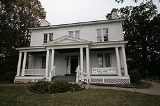
Harriet Beecher Stowe House

Encyclopedia
The Harriet Beecher Stowe House is a historic home in Ohio which was once the residence of influential antislavery
author Harriet Beecher Stowe
(1811-1896), writer of Uncle Tom's Cabin
.
to Cincinnati, which was an area active in the abolitionist movement, where her father became the first president of Lane Theological Seminary
founded in 1830. Rev. Lyman Beecher
(October 12, 1775 - January 10, 1865) was a Congregationalist
minister who accepted an offer to teach at the Lane Seminary in Walnut Hills area of Cincinnati.
The house was part of the former Lane Seminary. It was completed in 1833 to house the president of seminary. The house was provided by the seminary to the Beechers. Harriet and most of her brothers and sisters (11 Beecher children lived to adulthood) lived with their father in this house.
Harriet lived here for various periods of time from 1833 until her marriage to professor Calvin Ellis Stowe
in 1836. Her first two children, twins Eliza and Harriet, were born in the house in 1836. It is open to the public, located in small park, and operated as an historical and cultural site, focusing on Harriet Beecher Stowe
, the Lane Seminary, abolitionists, and the Underground Railroad
. The site also presents African-American history.
Harriet's brother, Henry Ward Beecher
, also resided in the Cincinnati Beecher House. He was recently the subject of a Pulitzer-prize winning biography entitled The Most Famous Man in America, written by Debby Applegate. Rev. Henry Ward Beecher was an early leader in the women's suffrage movement and popular Protestant minister.
The Beechers and Stowes were some of the most well-known families of the 19th century and were involved in important social movements of their day. They authored dozens of books on topics ranging from Harriet's works of fiction, managing a household, and preparing for the ministry.
. It is located in the Walnut Hills neighborhood (Dana or Taft Road exits from Interstate 71) at 2950 Gilbert Avenue, Cincinnati, OH 45206 and is operated by volunteers with the Friends of the Harriet Beecher Stowe House, Inc. http://www.ohiohistory.org/places/stowe/
Abolitionism
Abolitionism is a movement to end slavery.In western Europe and the Americas abolitionism was a movement to end the slave trade and set slaves free. At the behest of Dominican priest Bartolomé de las Casas who was shocked at the treatment of natives in the New World, Spain enacted the first...
author Harriet Beecher Stowe
Harriet Beecher Stowe
Harriet Beecher Stowe was an American abolitionist and author. Her novel Uncle Tom's Cabin was a depiction of life for African-Americans under slavery; it reached millions as a novel and play, and became influential in the United States and United Kingdom...
(1811-1896), writer of Uncle Tom's Cabin
Uncle Tom's Cabin
Uncle Tom's Cabin; or, Life Among the Lowly is an anti-slavery novel by American author Harriet Beecher Stowe. Published in 1852, the novel "helped lay the groundwork for the Civil War", according to Will Kaufman....
.
History
In 1832, the Stowe family moved from Litchfield, ConnecticutLitchfield, Connecticut
Litchfield is a town in and former county seat of Litchfield County, Connecticut, United States, and is known as an affluent summer resort. The population was 8,316 at the 2000 census. The boroughs of Bantam and Litchfield are located within the town...
to Cincinnati, which was an area active in the abolitionist movement, where her father became the first president of Lane Theological Seminary
Lane Theological Seminary
Lane Theological Seminary was established in the Walnut Hills section of Cincinnati, Ohio, in 1829 to educate Presbyterian ministers. It was named in honor of Ebenezer and William Lane, who pledged $4,000 for the new school, which was seen as a forward outpost of the Presbyterian Church in the...
founded in 1830. Rev. Lyman Beecher
Lyman Beecher
Lyman Beecher was a Presbyterian minister, American Temperance Society co-founder and leader, and the father of 13 children, many of whom were noted leaders, including Harriet Beecher Stowe, Henry Ward Beecher, Charles Beecher, Edward Beecher, Isabella Beecher Hooker, Catharine Beecher, and Thomas...
(October 12, 1775 - January 10, 1865) was a Congregationalist
Congregational church
Congregational churches are Protestant Christian churches practicing Congregationalist church governance, in which each congregation independently and autonomously runs its own affairs....
minister who accepted an offer to teach at the Lane Seminary in Walnut Hills area of Cincinnati.
The house was part of the former Lane Seminary. It was completed in 1833 to house the president of seminary. The house was provided by the seminary to the Beechers. Harriet and most of her brothers and sisters (11 Beecher children lived to adulthood) lived with their father in this house.
Harriet lived here for various periods of time from 1833 until her marriage to professor Calvin Ellis Stowe
Calvin Ellis Stowe
thumb|Calvin Ellis Stowe, circa 1850Calvin Ellis Stowe was an American Biblical scholar who helped spread public education in the United States, and the husband and literary agent of Harriet Beecher Stowe.-Life and career:...
in 1836. Her first two children, twins Eliza and Harriet, were born in the house in 1836. It is open to the public, located in small park, and operated as an historical and cultural site, focusing on Harriet Beecher Stowe
Harriet Beecher Stowe
Harriet Beecher Stowe was an American abolitionist and author. Her novel Uncle Tom's Cabin was a depiction of life for African-Americans under slavery; it reached millions as a novel and play, and became influential in the United States and United Kingdom...
, the Lane Seminary, abolitionists, and the Underground Railroad
Underground Railroad
The Underground Railroad was an informal network of secret routes and safe houses used by 19th-century black slaves in the United States to escape to free states and Canada with the aid of abolitionists and allies who were sympathetic to their cause. The term is also applied to the abolitionists,...
. The site also presents African-American history.
Harriet's brother, Henry Ward Beecher
Henry Ward Beecher
Henry Ward Beecher was a prominent Congregationalist clergyman, social reformer, abolitionist, and speaker in the mid to late 19th century...
, also resided in the Cincinnati Beecher House. He was recently the subject of a Pulitzer-prize winning biography entitled The Most Famous Man in America, written by Debby Applegate. Rev. Henry Ward Beecher was an early leader in the women's suffrage movement and popular Protestant minister.
The Beechers and Stowes were some of the most well-known families of the 19th century and were involved in important social movements of their day. They authored dozens of books on topics ranging from Harriet's works of fiction, managing a household, and preparing for the ministry.
The house today
The Harriet Beecher Stowe House in Cincinnati is owned by the Ohio Historical SocietyOhio Historical Society
The Ohio Historical Society is a non-profit organization incorporated in 1885 as The Ohio State Archaeological and Historical Society "to promote a knowledge of archaeology and history, especially in Ohio"...
. It is located in the Walnut Hills neighborhood (Dana or Taft Road exits from Interstate 71) at 2950 Gilbert Avenue, Cincinnati, OH 45206 and is operated by volunteers with the Friends of the Harriet Beecher Stowe House, Inc. http://www.ohiohistory.org/places/stowe/
External links
- Stowe House Official site
- Stowe House at "Aboard the Underground Railroad"
- Friends of the Harriet Beecher Stowe House (Cincinnati)