


Harmonice Musices Odhecaton

Encyclopedia
Song
In music, a song is a composition for voice or voices, performed by singing.A song may be accompanied by musical instruments, or it may be unaccompanied, as in the case of a cappella songs...
s published by Ottaviano Petrucci
Ottaviano Petrucci
Ottaviano Petrucci was an Italian printer. His Harmonice Musices Odhecaton, a collection of chansons printed in 1501, is commonly misidentified as the first book of sheet music printed from movable type. Actually that distinction belongs to the Roman printer Ulrich Han's Missale Romanum of 1476...
in 1501 in Venice
Venice
Venice is a city in northern Italy which is renowned for the beauty of its setting, its architecture and its artworks. It is the capital of the Veneto region...
. It was the first book of music
Music
Music is an art form whose medium is sound and silence. Its common elements are pitch , rhythm , dynamics, and the sonic qualities of timbre and texture...
ever to be printed using movable type
Movable type
Movable type is the system of printing and typography that uses movable components to reproduce the elements of a document ....
, and was hugely influential both in publishing in general, and in dissemination of the Franco-Flemish
Franco-Flemish School
In music, the Franco-Flemish School or more precisely the Netherlandish School refers, somewhat imprecisely, to the style of polyphonic vocal music composition in Europe in the 15th and 16th centuries, and to the composers who wrote it...
musical style.
Seeing the business potential for music printing
Sheet music
Sheet music is a hand-written or printed form of music notation that uses modern musical symbols; like its analogs—books, pamphlets, etc.—the medium of sheet music typically is paper , although the access to musical notation in recent years includes also presentation on computer screens...
, in 1498 Petrucci had obtained an exclusive 20-year license for all printing activities related to music anywhere in the Venetian Republic. Three years later, in 1501, he brought out his first anthology, 96 secular songs, mostly polyphonic
Polyphony
In music, polyphony is a texture consisting of two or more independent melodic voices, as opposed to music with just one voice or music with one dominant melodic voice accompanied by chords ....
French chanson
Chanson
A chanson is in general any lyric-driven French song, usually polyphonic and secular. A singer specialising in chansons is known as a "chanteur" or "chanteuse" ; a collection of chansons, especially from the late Middle Ages and Renaissance, is also known as a chansonnier.-Chanson de geste:The...
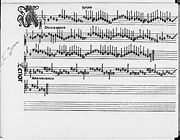
s, for three or four voice parts, calling it the Harmonice musices odhecaton. For this work he printed two parts on the right-hand side of a page, and two parts on the left, so that four singers or instrumentalists could read from the same sheet. The type was probably designed, cut, and cast by Francesco Griffo and Jacomo Ungaro, both of whom were in Venice at the time. The collection included music by some of the most famous composers of the time, including Johannes Ockeghem
Johannes Ockeghem
Johannes Ockeghem was the most famous composer of the Franco-Flemish School in the last half of the 15th century, and is often considered the most...
, Josquin des Prez
Josquin Des Prez
Josquin des Prez [Josquin Lebloitte dit Desprez] , often referred to simply as Josquin, was a Franco-Flemish composer of the Renaissance...
, Antoine Brumel
Antoine Brumel
Antoine Brumel was a French composer. He was one of the first renowned French members of the Franco-Flemish school of the Renaissance, and, after Josquin des Prez, was one of the most influential composers of his generation....
, Antoine Busnois
Antoine Busnois
Antoine Busnois was a French composer and poet of the early Renaissance Burgundian School. While also noted as a composer of sacred music, such as motets, he was one of the most renowned 15th-century composers of secular chansons...
, Alexander Agricola
Alexander Agricola
Alexander Agricola was a Franco-Flemish composer of the Renaissance. A prominent member of the Grande chapelle, the Habsburg musical establishment, he was a renowned composer in the years around 1500, and his music was widely distributed throughout Europe...
, Jacob Obrecht
Jacob Obrecht
Jacob Obrecht was a Flemish composer of the Renaissance. He was the most famous composer of masses in Europe in the late 15th century, being eclipsed by only Josquin des Prez after his death.-Life:...
, and many others, and was edited by Petrus Castellanus, a Dominican
Dominican Order
The Order of Preachers , after the 15th century more commonly known as the Dominican Order or Dominicans, is a Catholic religious order founded by Saint Dominic and approved by Pope Honorius III on 22 December 1216 in France...
friar who was maestro di cappella of San Giovanni e Paolo
Basilica di San Zanipolo
The Basilica di San Giovanni e Paolo, known in the Venetian dialect as San Zanipolo, is a church in Venice, northern Italy. One of the largest churches in the city, it has the status of a minor basilica...
. Inclusion of composers in this famous collection did much to enhance their notability, since the prints, and the technology, were to spread around Europe in the coming decades.
The Odhecaton used the triple-impression technique, in which first the musical staff was printed, then the text, and then the notes. Most of the 96 pieces, although they were written as songs, were not provided with the text, implying that instrumental performance was intended for many of them. Texts for most can be found in other manuscript sources or later publications.
The first edition of the Odhecaton (Harmonice Musices Odhecaton A) does not survive complete, and the exact publication date is not known, but it includes a dedication dated May 15, 1501. The second and third editions were printed on January 14, 1503 and May 25, 1504, respectively. Each corrected several errors of the previous editions. Petrucci published two further anthologies, the Canti B and Canti C, in 1502 and 1504, respectively.
Petrucci's publication not only revolutionized music distribution: it contributed to making the Franco-Flemish style the international musical language of Europe for the next century, since even though Petrucci was working in Italy, he chiefly chose the music of Franco-Flemish composers for inclusion in the Odhecaton, as well as in his next several publications. A few years later he published several books of native Italian frottole
Frottola
The frottola was the predominant type of Italian popular, secular song of the late fifteenth and early sixteenth century. It was the most important and widespread predecessor to the madrigal...
, a popular song style which was the predecessor to the madrigal
Madrigal (music)
A madrigal is a secular vocal music composition, usually a partsong, of the Renaissance and early Baroque eras. Traditionally, polyphonic madrigals are unaccompanied; the number of voices varies from two to eight, and most frequently from three to six....
, but the inclusion of Franco-Flemish composers in his many publications was decisive on the diffusion of the musical language.
External links
- Amherst Early Music has published a spiral-bound performance edition of the Odhecaton which lies flat and contains no page turns.