

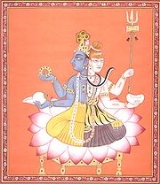
Harihara

Encyclopedia

Vishnu
Vishnu is the Supreme god in the Vaishnavite tradition of Hinduism. Smarta followers of Adi Shankara, among others, venerate Vishnu as one of the five primary forms of God....
(Hari) and Shiva
Shiva
Shiva is a major Hindu deity, and is the destroyer god or transformer among the Trimurti, the Hindu Trinity of the primary aspects of the divine. God Shiva is a yogi who has notice of everything that happens in the world and is the main aspect of life. Yet one with great power lives a life of a...
(Hara) from the Hindu
Hinduism
Hinduism is the predominant and indigenous religious tradition of the Indian Subcontinent. Hinduism is known to its followers as , amongst many other expressions...
tradition. Also known as Shankaranarayana ("Shankara" is Shiva, and "Narayana" is Vishnu), Harihara is thus worshipped by both Vaishnavites
Vaishnavism
Vaishnavism is a tradition of Hinduism, distinguished from other schools by its worship of Vishnu, or his associated Avatars such as Rama and Krishna, as the original and supreme God....
and Shaivities
Shaivism
Shaivism is one of the four major sects of Hinduism, the others being Vaishnavism, Shaktism and Smartism. Followers of Shaivism, called "Shaivas," and also "Saivas" or "Saivites," revere Shiva as the Supreme Being. Shaivas believe that Shiva is All and in all, the creator, preserver, destroyer,...
as a form of the Supreme God, as well as being a figure of worship for other Hindu traditions in general. Harihara is also sometimes used as a philosophical term to denote the unity of Vishnu and Shiva as different aspects of the same Supreme God. The exact nature of both Vishnu and Shiva (from their associated stories in Vedic
Vedas
The Vedas are a large body of texts originating in ancient India. Composed in Vedic Sanskrit, the texts constitute the oldest layer of Sanskrit literature and the oldest scriptures of Hinduism....
and Puranic scriptures), and their position of difference or unity (or both), is a subject of some debate amongst the different philosophical schools.
Different concepts
Due to the fluid and diverse nature of Hinduism there are a wide variety of beliefs and traditions associated with both Vishnu and Shiva. Some schools hold that only Vishnu (including his associated AvatarAvatar
In Hinduism, an avatar is a deliberate descent of a deity to earth, or a descent of the Supreme Being and is mostly translated into English as "incarnation," but more accurately as "appearance" or "manifestation"....
s) is the Supreme God, and others that Shiva (including his different incarnations) is actually the Supreme being. Some argue that both Shiva and Vishnu are the Supreme God - both being different aspects of the one person; and there are others still who regard the Supreme God as being ultimately formless (advaita, no material form) and thus see both Vishnu and Shiva as different facets of the one formless Brahman
Brahman
In Hinduism, Brahman is the one supreme, universal Spirit that is the origin and support of the phenomenal universe. Brahman is sometimes referred to as the Absolute or Godhead which is the Divine Ground of all being...
, with no material form.
Depending on which scriptures (and translations) are quoted, evidence is available to support each of the different arguments. In most cases, even if one personality is taken as being superior over the other, much respect is still offered to both Vishnu and Shiva by the other's worshippers (i.e. Shiva is still regarded as being above the level of an ordinary jiva
Jiva
In Hinduism and Jainism, a jiva is a living being, or more specifically, the immortal essence of a living organism which survives physical death. It has a very similar usage to atma, but whereas atma refers to "the cosmic self", jiva is used to denote an individual 'living entity' or 'living...
and 'the greatest of the Vaishnavas' by Vaishnavas who worship only Vishnu).
One and the same
Sivananda states: "Shiva and Vishnu are one and the same entity. They are essentially one and the same. They are the names given to the different aspects of the all-pervading Supreme Soul or the Absolute. ‘Sivasya hridayam vishnur-vishnoscha hridayam sivah—Vishnu is the heart of Siva and likewise Siva is the heart of Vishnu’."Swaminarayan holds that Vishnu and Shiva are different aspects of the same God; Notably, the Swaminarayan view is a minority view among Vaishnavites, but the dominant view in contemporary Hinduism
Hinduism
Hinduism is the predominant and indigenous religious tradition of the Indian Subcontinent. Hinduism is known to its followers as , amongst many other expressions...
which follows the Smarta view in general.
Depiction in art
Harihara is depicted in art as split down the middle, one half representing Shiva, the other half representing Vishnu. The Shiva half will have the matted locks of a yogic master piled high on his head and sometimes will wear a tiger skin, reserved for the most revered ascetics. Shiva's pale skin may be read as ash-covered in his role as an ascetic. The Vishnu half will wear a tall crownCrown (headgear)
A crown is the traditional symbolic form of headgear worn by a monarch or by a deity, for whom the crown traditionally represents power, legitimacy, immortality, righteousness, victory, triumph, resurrection, honour and glory of life after death. In art, the crown may be shown being offered to...
and other jewelry, representing his responsibility for maintaining world order. Vishnu's black skin represents holiness. Broadly, these distinctions serve to represent the duality of humble religious influence in the ascetic and authoritative secular power in the king or householder. However, in other aspects Shiva also takes on the authoritative position of householder, a position which is directly at odds with the ascetic position depicted in his Harihara manifestation.
Nature of Shiva and Vishnu
- Shiva and Vishnu as One and the Same (dlshq.org)
- Vishnu and Shiva as different aspects of the one and same God. (Shaivite guru, Bodhinatha)
Harihara images
- Harihara - Photograph of Carving from Hoysaleshvara Temple, Halebid (art-and-archaeology.com)
- http://www.thailex.info/THAILEX/THAILEXENG/LEXICON/Harihara.htm Bronze Harihara from Thailand