

Hand axe

Encyclopedia
Biface
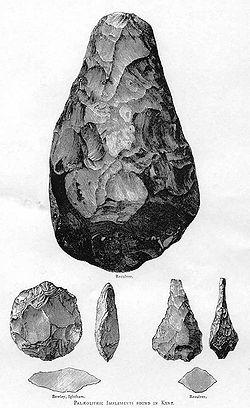
In archaeology, a biface is a two-sided stone tool and is used as a multi purposes knife, manufactured through a process of lithic reduction, that displays flake scars on both sides. A profile view of the final product tends to exhibit a lenticular shape...
Stone tool
Stone tool
A stone tool is, in the most general sense, any tool made either partially or entirely out of stone. Although stone tool-dependent societies and cultures still exist today, most stone tools are associated with prehistoric, particularly Stone Age cultures that have become extinct...
typical of the lower (Acheulean
Acheulean
Acheulean is the name given to an archaeological industry of stone tool manufacture associated with early humans during the Lower Palaeolithic era across Africa and much of West Asia, South Asia and Europe. Acheulean tools are typically found with Homo erectus remains...
) and middle Palaeolithic (Mousterian
Mousterian
Mousterian is a name given by archaeologists to a style of predominantly flint tools associated primarily with Homo neanderthalensis and dating to the Middle Paleolithic, the middle part of the Old Stone Age.-Naming:...
), and is the longest-used tool
Tool
A tool is a device that can be used to produce an item or achieve a task, but that is not consumed in the process. Informally the word is also used to describe a procedure or process with a specific purpose. Tools that are used in particular fields or activities may have different designations such...
of human history.
Distribution
Hand axeAxe
The axe, or ax, is an implement that has been used for millennia to shape, split and cut wood; to harvest timber; as a weapon; and as a ceremonial or heraldic symbol...
s are found mainly in Africa, Europe and Northern Asia, while South Asia retained flake-industries such as the Hoabinhian
Hoabinhian
The term Hoabinhian was first used by French archaeologists working in Northern Vietnam to describe Holocene period archaeological assemblages excavated from rock shelters. It has become a common term in the English based literature to describe stone artifact assemblages in Southeast Asia that...
.
New archaeological evidence from Baise, China
China
Chinese civilization may refer to:* China for more general discussion of the country.* Chinese culture* Greater China, the transnational community of ethnic Chinese.* History of China* Sinosphere, the area historically affected by Chinese culture...
shows that there were also hand axes in eastern Asia.
Production
Older hand axes were produced by direct percussion with a stone hammer and can be distinguished by their thickness and a sinuous border. Later MousterianMousterian
Mousterian is a name given by archaeologists to a style of predominantly flint tools associated primarily with Homo neanderthalensis and dating to the Middle Paleolithic, the middle part of the Old Stone Age.-Naming:...
handaxes were produced with a soft billet
Billet
A billet is a term for living quarters to which a soldier is assigned to sleep. Historically, it referred to a private dwelling that was required to accept the soldier....
of antler
Antler
Antlers are the usually large, branching bony appendages on the heads of most deer species.-Etymology:Antler originally meant the lowest tine, the "brow tine"...
or wood and are much thinner, more symmetrical and have a straight border.
An experienced flintknapper
Flintknapper
Knapping is the shaping of flint, chert, obsidian or other conchoidal fracturing stone through the process of lithic reduction to manufacture stone tools, strikers for flintlock firearms, or to produce flat-faced stones for building or facing walls, and flushwork decoration.- Method :Flintknapping...
needs less than 15 minutes to produce a good quality hand axe. A simple hand axe can be made from a beach pebble in less than 3 minutes.
Raw materials
Hand axes are mainly made of flintFlint
Flint is a hard, sedimentary cryptocrystalline form of the mineral quartz, categorized as a variety of chert. It occurs chiefly as nodules and masses in sedimentary rocks, such as chalks and limestones. Inside the nodule, flint is usually dark grey, black, green, white, or brown in colour, and...
, but rhyolite
Rhyolite
This page is about a volcanic rock. For the ghost town see Rhyolite, Nevada, and for the satellite system, see Rhyolite/Aquacade.Rhyolite is an igneous, volcanic rock, of felsic composition . It may have any texture from glassy to aphanitic to porphyritic...
s, phonolite
Phonolite
Phonolite is a rare igneous, volcanic rock of intermediate composition, with aphanitic to porphyritic texture....
s, quartzite
Quartzite
Quartzite is a hard metamorphic rock which was originally sandstone. Sandstone is converted into quartzite through heating and pressure usually related to tectonic compression within orogenic belts. Pure quartzite is usually white to gray, though quartzites often occur in various shades of pink...
s and other rather coarse rocks were used as well. Obsidian
Obsidian
Obsidian is a naturally occurring volcanic glass formed as an extrusive igneous rock.It is produced when felsic lava extruded from a volcano cools rapidly with minimum crystal growth...
, natural volcanic glass, shatters easily and was rarely used.
Shapes
Several basic shapes, like cordate, oval, or triangular have been distinguished, but their chronological significance is not agreed upon.Function
As most hand axes have a sharp border all around, there is no firm agreement about their use. Interpretations range from cutting and chopping tools to digging implements, flake cores, even the use in traps and a purely ritual significance (such as courting behaviour). The current majority scientific view of their use however, is some form of chopping or tool for general purpose use, probably for cutting meat and extracting bone marrow (which would explain the pointed end) and general hacking through bone and muscle fiber. Experiments at BoxgroveBoxgrove
Boxgrove is a village and civil parish in the Chichester District of the English county of West Sussex, about five kilometres north east of the city of Chichester. The village is just south of the A285 road which follows the line of the Roman road Stane Street.The parish has an area of...
appear to back this up.
H.G. Wells proposed in 1899 that handaxes were used as missile weapons to hunt prey - an interpretation supported by William H. Calvin
William H. Calvin
William H. Calvin, Ph.D., is an American theoretical neurophysiologist and professor at the University of Washington in Seattle. He is a well-known popularizer of neuroscience and evolutionary biology, including the hybrid of these two fields, neural Darwinism...
. Calvin maintains that some of the rounder examples could have served as "killer frisbees" meant to be thrown at a herd of animals at a water hole so as to stun one of them. There are few indications of hand axe hafting, and some artifacts are far too large for that. However a thrown hand axe would not usually have penetrated deeply enough to cause very serious injuries. Additionally many hand axes are very small. There is very little evidence of impact damage in most handaxes.
Tony Baker suggested that the hand axe was not a tool, but a core from which flakes had been removed and used as tools(http://www.ele.net/acheulean/handaxe.htm flake core] theory). However, hand axes are often found with retouch
Retouch
Retouch may refer to:*Retouch , the work done to a flint implement after its preliminary roughing-out*Retouching, editing photographic imagery...
such as sharpening or shaping, casting doubt on this idea.
Other theories suggest the shape is part tradition and partly a byproduct of the way it is manufactured. Since many early hand axes appear to be made from simple rounded pebbles (from river or beach deposits), it is necessary to detach a 'starting flake', often much larger than the rest of the flakes (due to the oblique angle of a rounded pebble requiring greater force to detach it), thus creating an asymmetry in the hand axe. When the asymmetry is corrected by removing extra material from the other faces, a trend toward a more pointed (oval) form factor is achieved. (Knapping a completely circular hand axe requires considerable correction of the shape.) Studies in the 1990s at Boxgrove
Boxgrove
Boxgrove is a village and civil parish in the Chichester District of the English county of West Sussex, about five kilometres north east of the city of Chichester. The village is just south of the A285 road which follows the line of the Roman road Stane Street.The parish has an area of...
, in which a butcher attempted to cut up a carcass with a hand axe, revealed that the hand axe was perfect for getting at bone marrow
Bone marrow
Bone marrow is the flexible tissue found in the interior of bones. In humans, bone marrow in large bones produces new blood cells. On average, bone marrow constitutes 4% of the total body mass of humans; in adults weighing 65 kg , bone marrow accounts for approximately 2.6 kg...
.
Marek Kohn
Marek Kohn
Marek Kohn is a British science writer on evolution, biology and society. His first two books were on drugs, their cultural history, and their politics. He is the author of seven books and hundreds of articles. He holds an undergraduate degree in neurobiology from the University of Sussex, and a...
and Steven Mithen
Steven Mithen
Steve Mithen is a Professor of Archaeology at the University of Reading. He has written a number of books including The Singing Neanderthals and The Prehistory of the Mind: The Cognitive Origins of Art, Religion and Science.-See also:...
have independently arrived at the explanation that symmetric handaxes have been favored by sexual selection
Sexual selection
Sexual selection, a concept introduced by Charles Darwin in his 1859 book On the Origin of Species, is a significant element of his theory of natural selection...
as fitness indicators
Fitness (biology)
Fitness is a central idea in evolutionary theory. It can be defined either with respect to a genotype or to a phenotype in a given environment...
. Kohn in his book As we know it wrote that the handaxe is "a highly visible indicator of fitness, and so becomes a criterion of mate choice." Evolutionary psychologist Geoffrey Miller follows on their example and has said that handaxes have characteristics which make them suitable for being subject to sexual selection forces, such as that they were made for over a million years throughout Africa, Europe and Asia, they were made in large numbers, and most were impractical for utilitarian use. He says that a single design persisting across such a span of time and space cannot be explained by cultural imitation and draws a parallel between bowerbirds
Bowerbird
Bowerbirds make up the bird family Ptilonorhynchidae. The family has 20 species in eight genera. These are medium-sized passerines, ranging from the Golden Bowerbird to the Great Bowerbird...
' bowers (built to attract potential mates and used only during courtship) and Pleistocene
Pleistocene
The Pleistocene is the epoch from 2,588,000 to 11,700 years BP that spans the world's recent period of repeated glaciations. The name pleistocene is derived from the Greek and ....
hominids' handaxes. He calls handaxe building a "genetically inherited propensity to construct a certain type of object." He discards the idea that they were used as missile weapons as there were more efficient weapons at the time, such as javelins, and although he accepts that some handaxes may have been used for practical reasons, he agrees with Kohn and Mithen who have shown that many handaxes show a considerable degree of skill, design and symmetry beyond the demands for utility, some were too big (such as the handaxe found in Furze Platt, England which is over a foot long) or too small (less than two inches, therefore of little practical use), they feature symmetry far beyond practical use and show evidence for excessive attention to form and finish. Miller thinks that the most important clue is that most handaxes show no signs of use or evidence of edge wear under electron microscopes. Furthermore, handaxes can be good handicaps in Amotz Zahavi
Amotz Zahavi
Amotz Zahavi is an Israeli evolutionary biologist, a Professor Emeritus at the Zoology Department of Tel Aviv University, and one of the founders of the Society for the Protection of Nature in Israel...
's handicap principle
Handicap principle
The handicap principle is a hypothesis originally proposed in 1975 by biologist Amotz Zahavi to explain how evolution may lead to "honest" or reliable signaling between animals who have an obvious motivation to bluff or deceive each other...
theory: the learning costs are high, there are risks of injury, they require physical strength, hand-eye coordination, planning, patience, pain tolerance, and resistance to infection from cuts and bruises when making or using such a handaxe.
External links
- Mid-Pleistocene Acheulean-like Stone Technology of the Bose Basin, South China ScienceMag.org
- http://id-archserve.ucsb.edu/anth3/courseware/LithicTech/6_Lower_Paleolithic_Tool.html
- http://www.150.si.edu/150trav/remember/r111a.htm