

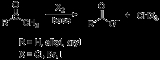
Haloform reaction

Overview
Halogen
The halogens or halogen elements are a series of nonmetal elements from Group 17 IUPAC Style of the periodic table, comprising fluorine , chlorine , bromine , iodine , and astatine...
) is produced by the exhaustive halogenation
Halogenation
Halogenation is a chemical reaction that incorporates a halogen atom into a molecule in substitution of hydrogen atom. Halogenation takes place in the gas phase. There are four types of halogenation: fluorination, chlorination, bromination, and iodination...
of a methyl ketone
Ketone
In organic chemistry, a ketone is an organic compound with the structure RCR', where R and R' can be a variety of atoms and groups of atoms. It features a carbonyl group bonded to two other carbon atoms. Many ketones are known and many are of great importance in industry and in biology...
(a molecule containing the R-CO-CH3 group) in the presence of a base
Base (chemistry)
For the term in genetics, see base A base in chemistry is a substance that can accept hydrogen ions or more generally, donate electron pairs. A soluble base is referred to as an alkali if it contains and releases hydroxide ions quantitatively...
. R may be , alkyl or aryl
Aryl
In the context of organic molecules, aryl refers to any functional group or substituent derived from an aromatic ring, be it phenyl, naphthyl, thienyl, indolyl, etc....
. The reaction can be used to produce CHCl3
Chloroform
Chloroform is an organic compound with formula CHCl3. It is one of the four chloromethanes. The colorless, sweet-smelling, dense liquid is a trihalomethane, and is considered somewhat hazardous...
, CHBr3
Bromoform
Bromoform is a pale yellowish liquid with a sweet odor similar to chloroform, a halomethane or haloform. Its refractive index is 1.595 . Bromoform is produced naturally by phytoplankton and seaweeds in the ocean and this is thought to be the predominant source to the environment...
or CHI3
Iodoform
Iodoform is the organoiodine compound with the formula CHI3. A pale yellow, crystalline, volatile substance, it has a penetrating odor and, analogous to chloroform, sweetish taste. It is occasionally used as a disinfectant...
.
Substrates that successfully undergo the haloform reaction are methyl ketones and secondary alcohols oxidizable to methyl ketones, such as isopropanol.
Unanswered Questions
