
All Topics  
Halftone


   Email Print
   Bookmark   Link


Halftone


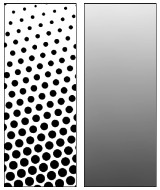
Halftone is the reprographic technique that simulates continuous tone
Continuous tone

A continuous tone image is one where each color at any point in the image is reproduced as a single tone, and not as discrete halftones, such as one single color for monochromatic prints, or a combination of halftones for color prints....
 imagery through the use of dots, varying either in size or in spacing. 'Halftone' can also be used to refer specifically to the image that is produced by this process.

Where continuous tone imagery (film photography
Photographic film

Photographic film is a sheet of plastic coated with an emulsion containing light-sensitive silver halide salts with variable crystal sizes that determine the sensitivity, contrast and of the film....
, for example) contains an infinite range of color
Color

Color or colour is the visual perception property corresponding in humans to the categories called red, yellow, blue and others....
s or grey
Grey

Grey or gray describes the tints and shades ranging from black to white. These, including white and black, are known as achromatic colors or neutral colors....
s, the halftone process reduces visual reproductions to a binary
Binary numeral system

The binary numeral system, or notation with a radix of 2. Owing to its straightforward implementation in digital electronic circuitry using logic gates, the binary system is used internally by all modern computers....
 image that is printed with only one color of ink.


Discussion
Ask a question about 'Halftone'
Start a new discussion about 'Halftone'
Answer questions from other users
Full Discussion Forum


Recent Posts


Encyclopedia


Halftoning Introduction
Halftone is the reprographic technique that simulates continuous tone
Continuous tone

A continuous tone image is one where each color at any point in the image is reproduced as a single tone, and not as discrete halftones, such as one single color for monochromatic prints, or a combination of halftones for color prints....
 imagery through the use of dots, varying either in size or in spacing. 'Halftone' can also be used to refer specifically to the image that is produced by this process.

Where continuous tone imagery (film photography
Photographic film

Photographic film is a sheet of plastic coated with an emulsion containing light-sensitive silver halide salts with variable crystal sizes that determine the sensitivity, contrast and of the film....
, for example) contains an infinite range of color
Color

Color or colour is the visual perception property corresponding in humans to the categories called red, yellow, blue and others....
s or grey
Grey

Grey or gray describes the tints and shades ranging from black to white. These, including white and black, are known as achromatic colors or neutral colors....
s, the halftone process reduces visual reproductions to a binary
Binary numeral system

The binary numeral system, or notation with a radix of 2. Owing to its straightforward implementation in digital electronic circuitry using logic gates, the binary system is used internally by all modern computers....
 image that is printed with only one color of ink. This binary reproduction relies on a basic optical illusion
Optical illusion

An optical illusion is characterized by visual perception images that differ from objective reality. The information gathered by the eye is processed in the brain to give a percept that does not tally with a physical measurement of the stimulus source....
—that these tiny halftone dots are blended into smooth tones by the human eye.

(At a microscopic level, developed black and white photographic film also consists of only two colors, and not an infinite range of continuous tones. For details, see film grain
Film grain

Film grain or granularity is the random optical texture of processed photographic film due to the presence of small grains of a metallic silver developed from silver halide that have received enough photons....
.)

Just as color photography
Color photography

Color photography is photography that uses media capable of representing colors which are produced chemically during the Photographic processes phase....
 evolved with the addition of filters
Filter (optics)

Optical filters, generally, belong to one of two categories. The simplest, physically, is the absorptive filter, while the latter category, that of interference or dichroic filters, can be quite complex....
 and film layers, color printing is made possible by repeating the halftone process for each subtractive color
Subtractive color

A subtractive color model explains the mixing of paints, dyes, inks, and natural colorants to create a range of colors, where each such color is caused by the mixture absorbing some wavelengths of light and reflecting others....
—most commonly using what is called the 'CMYK color model
CMYK color model

CMYK is a subtractive color color model, used in color printing, also used to describe the printing process itself. Though it varies by print house, press operator, press manufacturer and press run, ink is typically applied in the order of the abbreviation....
.' The semi-opaque property of ink
Ink

An ink is a liquid containing various pigments and/or dyes used for coloring a surface to produce an , writing, or design. Ink is used for drawing and/or writing with a pen, brush or quill....
 allows halftone dots of different colors to create another optical effect—full-color imagery.

History

The idea of halftone printing is due to William Fox Talbot
William Fox Talbot

File:William Henry Fox Talbot, by John Moffat, 1864.jpgWilliam Henry Fox Talbot , was the inventor of the negative / positive photographic process, the precursor to most photographic processes of the 19th and 20th centuries....
. In the early 1850s, he suggested using "photographic screens or veils" in connection with a photographic intaglio
Intaglio (printmaking)

Intaglio is a family of printmaking techniques in which the image is incised into a surface, known as the matrix or plate. Normally, copper or zinc plates are used as a surface, and the incisions are created by etching, engraving, drypoint, aquatint or mezzotint....
 process.

Several different kinds of screens were proposed during the following decades. One of the well known attempts was by Stephen H. Horgan
Stephen H. Horgan

Stephen H Horgan, b. February 12, 1854, d. August 30, 1941, was the inventor of the half tone process of engraving while working as the art direcor for the New York Herald....
 while working for the New York Daily Graphic. The first printed photograph was an image of Steinway Hall
Steinway Hall

File:Charles Dickens Readings at Steinway Hall, Boston, Mass., 1867.jpgSteinway Hall is the name of concert halls housing Steinway & Sons piano showrooms and sales departments in one building....
 in Manhattan
Manhattan

Manhattan is one of the five borough of New York City, located primarily on Manhattan Island at the mouth of the Hudson River.With a United States Census of 1,620,867 living in a land area of 22.96 square miles , Manhattan, coextensive with New York County, is the most population density county in the United States, w...
 published on December 2, 1873. The Graphic then published "the first reproduction of a photograph with a full tonal range in a newspaper" on March 4 1880 (entitled "A Scene in Shantytown") with a crude halftone screen.

The first truly successful commercial method was patented by Frederic Ives
Frederic Eugene Ives

Frederick Eugene Ives was a United States of America inventor, born at Litchfield, Connecticut, Connecticut. In 1874?78 he had charge of the photographic laboratory at Cornell University....
 of Philadelphia in 1881. Although he found a way of breaking up the image into dots of varying sizes, he did not make use of a screen. In 1882 the German George Meisenbach patented a halftone process in England. His invention was based on the previous ideas of Berchtold and Swan. He used single lined screens which were turned during exposure to produce cross-lined effects. He was the first to achieve any commercial success with relief
Relief print

A relief print is an image created by a printmaking process, such as woodcut, where the areas of the matrix that are to show printed black are on the original surface; the parts of the matrix that are to be blank having been cut away, or otherwise removed....
 halftones.

Shortly afterwards, Ives, this time in collaboration with Louis and Max Levy, improved the process further with the invention and commercial production of quality cross-lined screens.

The relief
Relief print

A relief print is an image created by a printmaking process, such as woodcut, where the areas of the matrix that are to show printed black are on the original surface; the parts of the matrix that are to be blank having been cut away, or otherwise removed....
 halftone process proved almost immediately to be a success. The use of halftone blocks in popular journals became regular during the early 1890s.

Traditional screening

The most common method of creating screens—amplitude modulation
Amplitude modulation

Amplitude modulation is a technique used in electronic communication, most commonly for transmitting information via a radio carrier wave....
—produces a regular grid of dots that vary in size.

The other method of creating screens—frequency modulation—is used in a process named "stochastic screening."

Resolution of halftone screens

Typical Halftone Resolutions
Screen Printing 45-65 lpi
Laser Printer (300dpi) 65 lpi
Laser Printer (600dpi) 85-105 lpi
Offset Press (newsprint paper) 85 lpi
Offset Press (coated paper) 85-185 lpi
The resolution of a halftone screen is measured in lines per inch
Lines per inch

Lines per inch is a measurement of printing resolution in systems that use a halftone screen. Specifically, it is a measure of how close together the lines in a halftone grid are....
 (lpi)
. This is the number of lines of dots in one inch, measured parallel with the screen's angle. Known as the screen ruling, the resolution of a screen is written either with the suffix lpi or a hash mark. E.g. 150lpi or 150#.

The higher the pixel resolution of a source file, the greater the detail that can be reproduced. However, such increase also requires a corresponding increase in screen ruling or the output will suffer from posterization
Posterization

Posterization of an image occurs when a region of an image with a continuous gradation of tone is replaced with several regions of fewer tones, resulting in an abrupt change from one tone to another....
. Therefore file resolution is matched to the output resolution.

Multiple screens and color halftoning


When different screens are combined, a number of distracting visual effects can occur, including the edges being overly emphasized, as well as a moiré pattern
Moiré pattern

In physics, a moir? pattern is an interference pattern created, for example, when two grids are overlaid at an angle, or when they have slightly different mesh sizes....
. This problem can be reduced by rotating the screens in relation to each other. This screen angle is another common measurement used in printing, measured in degrees clockwise from a line running to the left (9 o'clock is zero degrees).

Halftoning is also commonly used for printing color pictures. The general idea is the same, by varying the density of the four primary printing colors, cyan, magenta, yellow and black (abbreviation CMYK), any particular shade can be reproduced. In this case there is an additional problem that can occur. In the simple case, one could create a halftone using the same techniques used for printing shades of grey, but in this case the different printing colors have to remain physically close to each other to fool the eye into thinking they are a single color. To do this the industry has standardized on a set of known angles, which result in the dots forming into small circles or rosettes.

The dots cannot easily be seen by the naked eye, but can be discerned through a microscope or a magnifying glass.

Digital halftoning

Digital halftoning has been replacing photographic halftoning since the 1970s when 'electronic dot generators' were developed for the film recorder units linked to color drum scanners made by companies such as Crosfield Electronics, Hell and Linotype-Paul.

In the 1980s halftoning became available in the new generation of 'imagesetter' film and paper recorders that had been developed from earlier 'laser typesetters'. Unlike pure scanners or pure typesetters, imagesetters could generate all the elements in a page including type, photographs and other graphic objects. Early examples were the widely used Linotype Linotronic
Linotronic

The Linotronic s are a now common type of high-quality Computer printer, capable of printing at resolutions of up to 2540 dots per inch. The Linotronic allowed graphic artists to cheaply set type that exceeded the quality of many phototypesetting systems in use at the time....
 300 and 100 introduced in 1984, which were also the first to offer PostScript
PostScript

PostScript is a dynamically typed concatenative programming language programming language created by John Warnock and Charles Geschke in 1982. PostScript is best known for its use as a page description language in the electronic and desktop publishing areas....
 RIP
Raster image processor

A raster image processor is a component used in a printing system which produces a raster graphics image also known as a bitmap. The bitmap is then sent to a printing device for output....
s in 1985.

Early laser printers from the late 1970s onward could also generate halftones but their original 300 dpi resolution limited the screen ruling to about 65 lpi. This was improved as higher resolutions of 600 dpi and above, and dither
Dither

Dither is an intentionally applied form of noise, used to randomize quantization error, thereby preventing large-scale patterns such as contouring that are more objectionable than uncorrelated noise....
ing techniques, were introduced.

All halftoning uses a high frequency/low frequency dichotomy. In photographic halftoning, the low frequency attribute is a local area of the output image designated a halftone cell. Each equal-sized cell relates to a corresponding area (size and location) of the continuous-tone input image. Within each cell, the high frequency attribute is a centered variable-sized halftone dot composed of ink or toner. The ratio of the inked area to the non-inked area of the output cell corresponds to the luminance or graylevel of the input cell. From a suitable distance, the human eye averages both the high frequency apparent gray level approximated by the ratio within the cell and the low frequency apparent changes in gray level between adjacent equally-spaced cells and centered dots.

Digital halftoning uses a raster
Raster graphics

In computer graphics, a raster graphics image or bitmap, is a data structure representing a generally Rectangle grid of pixels, or points of color, viewable via a Computer display, paper, or other display medium....
 image or bitmap within which each monochrome picture element or pixel
Pixel

In digital imaging, a pixel is the smallest item of information in an image. Pixels are normally arranged in a 2-dimensional grid, and are often represented using dots, squares, or rectangles....
 may be on or off, ink or no ink. Consequently, to emulate the photographic halftone cell, the digital halftone cell must contain groups of monochrome pixels within the same-sized cell area. The fixed location and size of these monochrome pixels compromises the high frequency/low frequency dichotomy of the photographic halftone method. Clustered multi-pixel dots cannot "grow" incrementally but in jumps of one whole pixel. In addition, the placement of that pixel is slightly off-center. To minimize this compromise, the digital halftone monochrome pixels must be quite small, numbering from 600 to 2,540, or more, pixels per inch. However, digital image processing has also enabled more sophisticated dithering algorithms
Dither

Dither is an intentionally applied form of noise, used to randomize quantization error, thereby preventing large-scale patterns such as contouring that are more objectionable than uncorrelated noise....
 to decide which pixels to turn black or white, some of which yield better results than digital halftoning.

See also

  • Raster image processor (RIP)
    Raster image processor

    A raster image processor is a component used in a printing system which produces a raster graphics image also known as a bitmap. The bitmap is then sent to a printing device for output....
  • Error diffusion
    Error diffusion

    Error diffusion is a type of halftone in which the quantization residual is distributed to neighboring pixels which have not yet been processed....
  • Screentone
    Screentone

    Screentone is a technique for applying Texture s and shades to drawings, used as an alternative to hatching. In the conventional process, patterns are transferred to paper from preprinted sheets, but the technique is also simulated in computer graphics....
  • Dot gain
    Dot gain

    Dot gain is a phenomenon in printing and graphic arts whereby printed dots are perceived and actually printed bigger than intended. This causes a darkening of the screened images or textures, especially in the mid tones and shadows....
  • Benday dots
    Benday Dots

    File:Benday Dots.svgThe Ben-day Dots printing process, named after illustrator and printer Benjamin Day, is similar to Pointillism. Depending on the effect, color and optical illusion needed, small colored dots are closely-spaced, widely-spaced or overlapping....


External links