
All Topics  
HadCM3


   Email Print
   Bookmark   Link


HadCM3


HadCM3 (Hadley Centre Coupled Model, version 3) is a coupled atmosphere-ocean general circulation model (AOGCM) developed at the Hadley Centre in the United Kingdom
United Kingdom

The United Kingdom of Great Britain and Northern Ireland, commonly known as the United Kingdom , the UK or Britain,is a sovereign state located off the northwestern coast of continental Europe....
. It was one of the major models used in the IPCC TAR
IPCC Third Assessment Report

The IPCC Third Assessment Report, Climate Change 2001, is an assessment of available scientific and socio-economic information on climate change by an intergovermental panel established by the United Nations Environment Programme and the UN's World Meteorological Organization ....
 in 2001.

Unlike earlier AOGCMs at the Hadley Centre and elsewhere (including its predecessor HadCM2), HadCM3 does not need flux adjustment (additional "artificial" heat and freshwater fluxes at the ocean surface) to produce a good simulation.


Discussion
Ask a question about 'HadCM3'
Start a new discussion about 'HadCM3'
Answer questions from other users
Full Discussion Forum


Recent Posts


Encyclopedia


HadCM3 (Hadley Centre Coupled Model, version 3) is a coupled atmosphere-ocean general circulation model (AOGCM) developed at the Hadley Centre in the United Kingdom
United Kingdom

The United Kingdom of Great Britain and Northern Ireland, commonly known as the United Kingdom , the UK or Britain,is a sovereign state located off the northwestern coast of continental Europe....
. It was one of the major models used in the IPCC TAR
IPCC Third Assessment Report

The IPCC Third Assessment Report, Climate Change 2001, is an assessment of available scientific and socio-economic information on climate change by an intergovermental panel established by the United Nations Environment Programme and the UN's World Meteorological Organization ....
 in 2001.

Unlike earlier AOGCMs at the Hadley Centre and elsewhere (including its predecessor HadCM2), HadCM3 does not need flux adjustment (additional "artificial" heat and freshwater fluxes at the ocean surface) to produce a good simulation. The higher ocean resolution of HadCM3 is a major factor in this; other factors include a good match between the atmospheric and oceanic components; and an improved ocean mixing scheme (Gent and McWilliams). HadCM3 has been run for over a thousand years, showing little drift in its surface climate.

HadCM3 is composed of two components: the atmospheric model HadAM3 and the ocean model (which includes a sea ice model).

Atmosphere model (HadAM3)


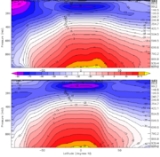
Hadcm3 Jja Djf Zonal Mean T
HadAM3 is a grid point model and has a horizontal resolution of 2.5x3.75 degrees in latitude x longitude. This gives 96x73 grid points on the scalar (pressure, temperature and moisture) grid; the vector (wind velocity) grid is offset by 1/2 a grid box. . This gives a resolution of approximately 300 km, roughly equal to T42 in a spectral model
Gaussian grid

A Gaussian grid is used in the earth sciences as a grid graph for scientific modeling on a sphere . The grid is rectangular, with a set number of orthogonal coordinates , such that they can be easily accessed in a fixed array....
. There are 19 levels in the vertical.

The timestep is 30 minutes (with three sub-timesteps per timestep in the dynamics). Near the poles, fields are fourier-filtered to prevent instabilities due to the CFL criterion.

This is the model behind PRECIS (Providing Regional Climates for Impacts Studies)
PRECIS (Providing Regional Climates for Impacts Studies)

The United Nations Framework Convention on Climate Change requires participating nations to assess the potential effects of Climate change upon their countries....


Ocean model (HadOM3)


Hadcm3 Ann Ocean T 180
The ocean model has a resolution of 1.25x1.25 degrees and a timestep of 1 hour. Thus there are 6 ocean grid points for every atmospheric one. For ease of coupling the two models the grids are aligned and the ocean coastline is forced to be aligned to the atmospheric grid.

Coupling


The atmospheric model is run for a day, and the fluxes (of heat, moisture and momentum) at the atmos-ocean interface are accumulated. Then the ocean model is run for a day, with the reverse fluxes accumulated. This then repeats through the length of the run. Unlike its predecessor HadCM2 there is no need for flux correction - the model climate remains stable and does not significantly drift. The lack of flux correction is cited by the IPCC as one of the advances in modelling since the SAR
IPCC Second Assessment Report

The Second Assessment Report of the Intergovernmental Panel on Climate Change was published in 1995. It was followed by the TAR in 2001.The report consists of the reports of the three working groups:...
 .

The ocean model incorporates a thermodynamic-dynamic seaice model with a primitive (ocean drift) dynamics.

Slab model (HadSM3)


The atmospheric model may be run coupled to a simpler "slab ocean" rather than the full dynamic ocean. This is faster (and requires less memory) than the full model, but lacks dynamical feedbacks from the ocean, which are incorporated into the full coupled-ocean-atmosphere models used to make projections of climate change out to 2100. To do this the model needs a calibration phase in which the ocean temperatures are held to climatology while it calculates the "flux correction"; extra ocean-atmosphere fluxes that would be needed to keep the model ocean in balance (the model ocean does not include currents; these fluxes to some extent replace the heat that would be transported by the missing currents). Then the model may be run in climate mode.

See also

  • Climateprediction.net
    Climateprediction.net

    Climateprediction.net, or CPDN, is a distributed computing project to investigate and reduce uncertainties in Global climate model. It aims to do this by running hundreds of thousands of different models using the donated idle time of ordinary personal computers, thereby leading to a better understanding of how models are affected by small...
  • Attribution of recent climate change
    Attribution of recent climate change

    Attribution of recent climate change is the effort to scientific method mechanisms responsible for relatively recent changes observed in the Earth's climate....
  • Earth Simulator
    Earth Simulator

    The Earth Simulator was the fastest supercomputer in the world from 2002 to 2004. The system was developed for Japan Aerospace Exploration Agency, Japan Atomic Energy Research Institute, and Japan Marine Science and Technology Center in 1997 for running global climate models to evaluate the effects of global warming and problems in solid ear...
  • NCAR
  • EdGCM
    EdGCM

    is a global climate model that has been ported for use on desktop computers and integrated with a relational database, a graphical user interface, and scientific visualization utllities, all of which are aimed at helping improve the quality of teaching and learning of climatology....


External links