
All Topics  
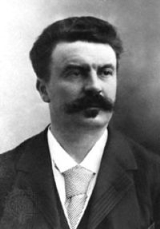
Guy de Maupassant

 
Guy De Maupassant

   Email Print
   Bookmark   Link


Guy de Maupassant


Guy de Maupassant (5 August 1850 – 6 July 1893) was a popular 19th-century French
France

France , officially the French Republic , is a country whose Metropolitan France is located in Western Europe and that also comprises various Overseas departments and territories of France....
 writer
Writer

A writer is anyone who creates a written work, although the word usually designates those who write creatively or professionally, as well as those who have written in many different forms....
 and considered one of the fathers of the modern short story
Short story

The short story refers to a work of fiction that is usually written in prose, usually in narrative format. This format or medium tends to be more pointed than longer works of fiction, such as novellas and novels or books....
.

A protégé of Flaubert
Gustave Flaubert

Gustave Flaubert was a France writer who is counted among the greatest Western literature. He is known especially for his first published novel, Madame Bovary , and for his scrupulous devotion to his art and style....
, Maupassant's stories are characterized by their economy of style and their efficient, effortless dénouement
Denouement

In literature, a d?nouement consists of a series of events that follow the climax of a drama or narrative, and thus serves as the conclusion of the story....
. Many of the stories are set during the Franco-Prussian War
Franco-Prussian War

The Franco-Prussian War or Franco-German War, often referred to in France as the 1870 War was a conflict between Second French Empire and Kingdom of Prussia, while Prussia was backed by the North German Confederation, of which it was a member, and the South German states of Grand Duchy of Baden, History of W?rttemberg#The Kingdom...
 of the 1870s and several describe the futility of war and the innocent civilians who, caught in the conflict, emerge changed.


Discussion
Ask a question about 'Guy de Maupassant'
Start a new discussion about 'Guy de Maupassant'
Answer questions from other users
Full Discussion Forum


Recent Posts


Quotations


Anguish of suspense made men even desire the arrival of enemies.

"Boule de Suif"

Legitimized love always despises its easygoing brother.

"Boule de Suif"

Let them respect my convictions, and I will respect theirs!

"Friend Joseph"

Our memory is a more perfect world than the universe: it gives back life to those who no longer exist.

"Suicides"

There is only one good thing in life, and that is love. And how you misunderstand it! how you spoil it! You treat it as something solemn like a sacrament, or something to be bought, like a dress.

"The Love of Long Ago"

You have the army of mediocrities followed by the multitude of fools. As the mediocrities and the fools always form the immense majority, it is impossible for them to elect an intelligent government.

"Sundays of a Bourgeois"


Encyclopedia


Guy de Maupassant (5 August 1850 – 6 July 1893) was a popular 19th-century French
France

France , officially the French Republic , is a country whose Metropolitan France is located in Western Europe and that also comprises various Overseas departments and territories of France....
 writer
Writer

A writer is anyone who creates a written work, although the word usually designates those who write creatively or professionally, as well as those who have written in many different forms....
 and considered one of the fathers of the modern short story
Short story

The short story refers to a work of fiction that is usually written in prose, usually in narrative format. This format or medium tends to be more pointed than longer works of fiction, such as novellas and novels or books....
.

A protégé of Flaubert
Gustave Flaubert

Gustave Flaubert was a France writer who is counted among the greatest Western literature. He is known especially for his first published novel, Madame Bovary , and for his scrupulous devotion to his art and style....
, Maupassant's stories are characterized by their economy of style and their efficient, effortless dénouement
Denouement

In literature, a d?nouement consists of a series of events that follow the climax of a drama or narrative, and thus serves as the conclusion of the story....
. Many of the stories are set during the Franco-Prussian War
Franco-Prussian War

The Franco-Prussian War or Franco-German War, often referred to in France as the 1870 War was a conflict between Second French Empire and Kingdom of Prussia, while Prussia was backed by the North German Confederation, of which it was a member, and the South German states of Grand Duchy of Baden, History of W?rttemberg#The Kingdom...
 of the 1870s and several describe the futility of war and the innocent civilians who, caught in the conflict, emerge changed. He also wrote six short novel
Novel

File:2009 stapelweise Neuerscheinungen im Buchladen.JPGA novel is today a long narrative in literary prose. The genre has historical roots both in the fields of the medieval and early modern Romance and in the tradition of the novella....
s.

Biography

Maupassant was most likely born at the Château
Château

A ch?teau is a manor house or residence of the lord of the manor or a country house of nobility or gentry, with or without fortifications, originally - and still most frequently - in French language-speaking regions....
 de Miromesnil, near Dieppe
Dieppe, Seine-Maritime

Dieppe is a town and Communes of France in the Seine-Maritime Departments of France and Haute-Normandie Regions of France of France. At the 1999 census the town had 34,653 inhabitants , while the population of the whole Dieppe urban area was 81,419....
 in the Seine-Inférieure (now Seine-Maritime
Seine-Maritime

Seine-Maritime is a France departments of France in Normandy. Before 1955 it was known as Seine-Inf?rieure....
) department. The Maupassants were an old Lorraine
Lorraine (province)

Lorraine is a historical area in present-day northeast France. Some of the main cities are Metz, France, Nancy and Verdun....
 family who had settled in Normandy
Normandy

Normandy is a geographical region corresponding to the former Duchy of Normandy. It is situated along the coast of France south of the English Channel between Brittany and Picardy and comprises territory in northern France and the Channel Islands....
 in the middle of the 18th century. In 1846 his father had married Laure Le Poittevin. With her brother Alfred, she had been the playmate of the novelist Gustave Flaubert
Gustave Flaubert

Gustave Flaubert was a France writer who is counted among the greatest Western literature. He is known especially for his first published novel, Madame Bovary , and for his scrupulous devotion to his art and style....
, who was destined to have a guiding influence on her son's life. She was a woman of no common literary accomplishments, but was very fond of classic literature, especially Shakespeare
William Shakespeare

William Shakespeare was an English people poet and playwright, widely regarded as the greatest writer in the English language and the world's preeminent dramatist....
. After separating from her husband, Le Poittevin kept her two sons, the elder Guy and younger Hervé.

Until the age of thirteen, Guy happily lived with his mother, to whom he was deeply devoted, at Étretat
Étretat

?tretat is a commune in France in the Seine-Maritime d?partement in France of France....
, in the Villa des Verguies, where between the sea and the luxuriant countryside, he grew very fond of fishing and outdoor activities; he went fishing with the fishermen off the coast and spoke Norman
Norman language

Norman is a Romance languages and one of the Langues d'o?l. The northern Norman can be classified in the septentrional O?l languages with Picard language and Walloon language....
 with the peasants. At the age of 14 he ate roast monkey with Algernon Charles Swinburne
Algernon Charles Swinburne

Algernon Charles Swinburne was an English poet, controversial in his own day....
, the famous poet. As he entered junior high school, he met the great author Gustave Flaubert
Gustave Flaubert

Gustave Flaubert was a France writer who is counted among the greatest Western literature. He is known especially for his first published novel, Madame Bovary , and for his scrupulous devotion to his art and style....
.

He first entered a seminary
Seminary

A seminary, theological college, or divinity school is a specialized and often live-in higher education institution for the purpose of instructing students in philosophy, theology, spirituality and the religious life, usually in order to prepare them to become members of the clergy....
 at Yvetot
Yvetot

Yvetot is a communes of the Seine-Maritime d?partement in the Seine-Maritime d?partement in France in the Haute-Normandie region of France....
, but deliberately got himself expelled. From his early education he retained a marked hostility to religion
Religion

A religion is an organized approach to human spirituality which usually encompasses a set of myth, symbols, beliefs and practices, often with a supernatural or transcendence quality, that give meaning to the practitioner's experiences of life through reference to a higher power or truth....
. Then he was sent to the Rouen Lycée, where he proved a good scholar indulging in poetry and taking a prominent part in theatricals.

The Franco-Prussian War
Franco-Prussian War

The Franco-Prussian War or Franco-German War, often referred to in France as the 1870 War was a conflict between Second French Empire and Kingdom of Prussia, while Prussia was backed by the North German Confederation, of which it was a member, and the South German states of Grand Duchy of Baden, History of W?rttemberg#The Kingdom...
 broke out soon after his graduation from college in 1870; he enlisted as a volunteer and fought bravely. Afterwards, in 1871, he left Normandy and moved to Paris
Paris

Paris is the Capital of France and the country's largest city. It is situated on the river Seine, in northern France, at the heart of the ?le-de-France Regions of France ....
 where he spent ten years as a clerk in the Navy Department. During these ten tedious years his only recreation and relaxation was canoeing on the Seine
Seine

The Seine is a slow flowing major river and commercial waterway within Regions of France of ?le-de-France and Haute-Normandie in France and famous as a romantic backdrop in photographs of Paris, France....
 on Sundays and holidays.

Gustave Flaubert
Gustave Flaubert

Gustave Flaubert was a France writer who is counted among the greatest Western literature. He is known especially for his first published novel, Madame Bovary , and for his scrupulous devotion to his art and style....
 took him under his protection and acted as a kind of literary guardian to him, guiding his debut in journalism and literature. At Flaubert's home he met Émile Zola
Émile Zola

?mile Fran?ois Zola was an influential France writer, the most important exemplar of the literary school of Naturalism , an important contributor to the development of Naturalism , and a major figure in the political liberalization of France and in the exoneration of the falsely accused and convicted army officer Alfred Dreyfus....
 and the Russian novelist Ivan Turgenev
Ivan Turgenev

'Ivan Sergeyevich Turgenev was a Russian novelist and playwright. His novel Fathers and Sons is regarded as one of the major works of 19th-century fiction....
, as well as many of the protagonists of the realist
Realism (arts)

Realism in the visual arts and literature is the depiction of subjects as they appear in everyday life, without embellishment or interpretation....
 and naturalist
Naturalism (literature)

Naturalism is a Literature Literary movement that seeks to replicate a Verisimilitude everyday life, as opposed to such movements as Romanticism or Surrealism, in which subjects may receive highly symbolic, idealistic, or even supernatural treatment....
 schools.

In 1878 he was transferred to the Ministry of Public Instruction and became a contributing editor of several leading newspapers such as Le Figaro
Le Figaro

Le Figaro is one of the leading France morning daily newspapers. Its editorial line is Conservatism and has generally been supportive of the Rally for the Republic political party and its successor, the Union for a Popular Movement ....
, Gil Blas
Gil Blas (periodical)

Gil Blas was a Parisian literary periodical founded by Augustin-Alexandre Dumont in November 1879, and which stayed in publication until 1914....
, Le Gaulois
Le Gaulois

Le Gaulois was a French daily newspaper, founded in 1868 by Edmond Tarbe and Henri de Pene. After a printing stoppage, it was revived by Arthur Meyer in 1882 with notable collaborators Paul Bourget, Abel Hermant, and Ernest Daudet....
 and l'Echo de Paris. He devoted his spare time to writing novels and short stories.

In 1880 he published what is considered his first masterpiece, "Boule de Suif
Boule de Suif

Boule de Suif is a short story by the late-19th century France writer Guy de Maupassant. It is arguably his most famous short-story, and is the title story for his collection on the Franco-Prussian War, entitled "Boule de Suif et Autres Contes de la Guerre" ....
", which met with an instant and tremendous success. Flaubert characterized it as "a masterpiece that will endure." This was Maupassant's first piece of short fiction set during the Franco-Prussian War
Franco-Prussian War

The Franco-Prussian War or Franco-German War, often referred to in France as the 1870 War was a conflict between Second French Empire and Kingdom of Prussia, while Prussia was backed by the North German Confederation, of which it was a member, and the South German states of Grand Duchy of Baden, History of W?rttemberg#The Kingdom...
, and was followed by short stories such as "Deux Amis
Deux Amis

Deux Amis or Two Friends is a short story by French language author Guy de Maupassant, published in 1882. The story is set in Paris during the Franco-Prussian War, when the city Siege of Paris....
," "Mother Savage," and "Mademoiselle Fifi."

The decade from 1880 to 1891 was the most fertile period of Maupassant's life. Made famous by his first short story, he worked methodically and produced two or sometimes four volumes annually. He combined talent and practical business sense, which made him wealthy.

In 1881 he published his first volume of short stories under the title of La Maison Tellier; it reached its twelfth edition within two years; in 1883 he finished his first novel, Une Vie (translated into English as A Woman's Life), 25,000 copies of which were sold in less than a year. In his novels, he concentrated all his observations scattered in his short stories. His second novel Bel-Ami, which came out in 1885, had thirty-seven printings in four months.

His editor, Havard, commissioned him to write new masterpieces and Maupassant continued to produce them without the slightest apparent effort. At this time he wrote what many consider to be his greatest novel, Pierre et Jean
Pierre et Jean

Pierre et Jean is a naturalism or psycho-realist work written by Guy de Maupassant in ?tretat in his native Normandy between June and September 1887 ....
.

With a natural aversion to society, he loved retirement, solitude, and meditation. He traveled extensively in Algeria
Algeria

Algeria , officially the People's Democratic Republic of Algeria, is a country located in North Africa. It is the largest country of the Mediterranean sea, second largest in the Arab World, and the second largest on the African continent and the eleventh-largest country in the world in terms of land area....
, Italy
Italy

Italy , officially the Italian Republic , is a country located on the Italian Peninsula in Southern Europe and on the two largest islands in the Mediterranean Sea, Sicily and Sardinia....
, England
England

native_name =|conventional_long_name = England|common_name = England|image_flag = Flag of England.svg|image_coat = England COA.svg|symbol_type = Royal Coat of Arms...
, Brittany
Brittany

Brittany is a former independent Celtic nations monarchy and duchy, now incorporated into France. It is also, more generally, the name of the cultural area whose limits correspond to the historic province and independent duchy....
, Sicily
Sicily

Sicily is an Autonomous regions with special statute of Italy. Of all the regions of Italy, Sicily covers the largest land area at 25,708 km? and currently has just over five million inhabitants....
, Auvergne
Auvergne (province)

Auvergne was a historic province of France in south central France. It was originally the feudal domain of the List of rulers of Auvergne. It is now the geographical and cultural area that corresponds to the former province....
, and from each voyage he brought back a new volume. He cruised on his private yacht "Bel-Ami," named after his earlier novel. This feverish life did not prevent him from making friends among the literary celebrities of his day: Alexandre Dumas, fils
Alexandre Dumas, fils

Alexandre Dumas, fils was a French author and dramatist. He was the son of Alexandre Dumas, p?re, also a writer and playwright....
 had a paternal affection for him; at Aix-les-Bains
Aix-les-Bains

Aix-les-Bains is a Communes of France in the Savoie Departments of France in southeastern France. It lies near the Lac du Bourget, by rail north of Chamb?ry....
 he met Hippolyte Taine
Hippolyte Taine

Hippolyte Adolphe Taine was a France critic and historian. He was the chief theoretical influence of French Naturalism , a major proponent of sociological positivism, and one of the first practitioners of historicism criticism....
 and fell under the spell of the philosopher-historian.

Flaubert continued to act as his literary godfather. His friendship with the Goncourts was of short duration; his frank and practical nature reacted against the ambience of gossip, scandal, duplicity, and invidious criticism that the two brothers had created around them in the guise of an 18th-century style salon.

Maupassant was but one of a fair number of 19th-century Parisians who did not care for the Eiffel tower
Eiffel Tower

The Eiffel Tower is an Puddle iron tower built on the Champ de Mars beside the Seine River in Paris. The tower has become a global Cultural icon of France and is one of the most recognizable structures in the world....
; indeed, he often ate lunch in the restaurant
Restaurant

A restaurant prepares and serves food and drink to customers. Meals are generally served and eaten on premises, but many restaurants also offer take-out and Delivery ....
 at its base, not out of any preference for the food, but because it was only there that he could avoid seeing its otherwise unavoidable profile. Moreover, he and forty-six other Parisian literary and artistic notables attached their names to letter of protest, ornate as it was irate, against the tower's construction to the then Minister of Public Works.

In his later years he developed a constant desire for solitude, an obsession for self-preservation, and a fear of death and crazed paranoia of persecution, that came from the syphilis
Syphilis

Syphilis is a sexually transmitted disease caused by the spirochete bacterium Treponema pallidum subspecies pallidum. The route of transmission of syphilis is almost always through sexual contact, although there are examples of congenital syphilis via transmission from mother to child in utero....
 he had contracted in his early days. On January 2, in 1892, Maupassant tried to commit suicide by cutting his throat and was committed to the celebrated private asylum of Dr. Esprit Blanche at Passy, in Paris, where he died on July 6, 1893.

Guy De Maupassant penned his own epitaph: "I have coveted everything and taken pleasure in nothing." He is buried in Section 26 of the Cimetière du Montparnasse, Paris
Paris

Paris is the Capital of France and the country's largest city. It is situated on the river Seine, in northern France, at the heart of the ?le-de-France Regions of France ....
.

Significance

Maupassant is considered one of the fathers of the modern short story. He delighted in clever plotting, and served as a model for Somerset Maugham and O. Henry
O. Henry

O. Henry was the pen name of United States writer William Sydney Porter . O. Henry short stories are known for wit, wordplay, warm characterization and clever twist endings....
 in this respect. His stories about real or fake jewels ("La Parure
The Necklace

The Necklace or The Diamond Necklace is a short story by Guy de Maupassant, first published in 1884 in the French newspaper Le Gaulois....
", "Les Bijoux") are imitated with a twist by Maugham ("Mr Know-All", "A String of Beads") and Henry James
Henry James

Henry James, Order of Merit , son of theologian Henry James Sr., brother of the philosopher and psychologist William James and diarist Alice James, was an United States author....
.

Taking his cue from Balzac, Maupassant wrote comfortably in both the high-Realist and fantastic
Fantasy

Fantasy is a genre that uses magic and other supernatural forms as a primary element of Plot , Theme , and/or Setting . Fantasy is generally distinguished from science fiction and horror by the expectation that it steers clear of technological and macabre themes, respectively, though there is a great deal of overlap between the three ....
 modes; stories and novels such as "L'Héritage" and Bel-Ami aim to recreate Third Republic
French Third Republic

The French Third Republic was the political regime of France between the Second French Empire and the Vichy France. It was a republican parliamentary democracy that was created on 4 September 1870 following the collapse of the Empire of Napoleon III of France in the Franco-Prussian War....
 France
France

France , officially the French Republic , is a country whose Metropolitan France is located in Western Europe and that also comprises various Overseas departments and territories of France....
 in a realistic way, whereas many of the short stories (notably "Le Horla", cited as an inspiration for H. P. Lovecraft
H. P. Lovecraft

Howard Phillips Lovecraft was an United States author of horror fiction, fantasy fiction, and science fiction, known then simply as weird fiction....
's "The Call of Cthulhu
The Call of Cthulhu

"The Call of Cthulhu" is one of H. P. Lovecraft's best-known short story. Written in the summer of 1926 in literature, it was first published in Weird Tales, February 1928 in literature....
", and "Qui sait?") describe apparently supernatural phenomena.

The supernatural in Maupassant, however, is often implicitly a symptom of the protagonists' troubled minds; Maupassant was fascinated by the burgeoning discipline of psychiatry
Psychiatry

Psychiatry is a Medicine Specialty devoted to the Treatment of mental disorders, Biomedical research and Prevention of mental disorder. The term was first coined by the German physician Johann Christian Reil in 1808....
, and attended the public lectures of Jean-Martin Charcot
Jean-Martin Charcot

Jean-Martin Charcot was a French neurology and professor of anatomical pathology. He is known as "the founder of modern neurology" and is "associated with at least 15 medical eponyms", including Charcot-Marie-Tooth disease and amyotrophic lateral sclerosis ....
 between 1885 and 1886. This interest is reflected in his fiction.

Criticism

De Maupassant is notable as the subject of one of Leo Tolstoy
Leo Tolstoy

Leo Tolstoy, or Count Lev Nikolayevich Tolstoy Tolstoy's further talents as essayist, dramatist and Education reform made him the most influential member of the aristocracy Tolstoy....
's essays on art:

Bibliography


Novels

  • Une vie (1883)
  • Bel-Ami (1885)
  • Mont-Oriol (1887)
  • Pierre et Jean
    Pierre et Jean

    Pierre et Jean is a naturalism or psycho-realist work written by Guy de Maupassant in ?tretat in his native Normandy between June and September 1887 ....
     (1888)
  • Fort comme la mort (1889)
  • Notre Coeur (1890)


Short story collections

  • Les Soirées de Médan
    Les Soirées de Médan

    Les Soir?es de M?dan is a collection of six short stories by six different writers associated with Naturalism , first published in 1880. All the stories concern the Franco-Prussian War....
     (with Zola, Huysmans et al. Contains Boule de Suif
    Boule de Suif

    Boule de Suif is a short story by the late-19th century France writer Guy de Maupassant. It is arguably his most famous short-story, and is the title story for his collection on the Franco-Prussian War, entitled "Boule de Suif et Autres Contes de la Guerre" ....
    " by Maupassant) (1880)
  • La Maison Tellier
    La Maison Tellier

    La Maison Tellier may refer to:* La Maison Tellier , a short story by Guy de Maupassant, published in 1881 in literature.* La Maison Tellier , a Franco-Spanish film, directed by Pierre Chevalier , released in 1981 in film....
     (1881)
  • Mademoiselle Fifi
    Mademoiselle Fifi (book)

    Mademoiselle Fifi is a short story by French language writer Guy de Maupassant, published in 1882 in a Mademoiselle Fifi . Like many of his short stories, such as Boule de Suif and Deux Amis, the story is set during the Franco-Prussian War and explores themes of class barriers, contrasts between the French people and Germans participa...
     (1882)
  • Contes de la bécasse (1883)
  • Miss Harriet (1884)
  • Les Soeurs Rondoli (1884)
  • Clair de lune (1884) (contains "Les Bijoux")
  • Yvette (1884)
  • Toine (1885)
  • Contes du jour et de la nuit (1885) (contains "La Parure" or "The Necklace")
  • Monsieur Parent (1886)
  • La petite Roque (1886)
  • Le Horla (1887)
  • Le Rosier de Madame Husson (1888)
  • La Main gauche (1889)
  • L'Inutile Beauté (1890)


Travel writing

  • Au soleil (1884)
  • Sur l'eau (1888)
  • La Vie errante (1890)


Poetry

  • Des Vers (1880)


External links

  • : text, concordances and frequency list