
All Topics  
Greek mythology

 
Greek Mythology

   Email Print
   Bookmark   Link


Greek mythology


Greek mythology is the body of myths and legend
Legend

A legend is a narrative of human actions that are perceived both by teller and listeners to take place within human history and to possess certain qualities that give the tale verisimilitude ....
s belonging to the ancient Greeks
Ancient Greece

The term Ancient Greece refers to the period of History of Greece lasting from the Greek Dark Ages ca. 1100 BC and the Dorian invasion, to 146 BC and the Roman Republic conquest of Greece after the Battle of Corinth ....
 concerning their gods
List of Greek mythological figures

A listing of Greek mythology figures. See also family tree of the Greek gods and the list of Greek mythological creatures. For a list of the deities of many cultures , see list of deities....
 and heroes
Greek hero cult

Hero cults were one of the most distinctive features of ancient Greek religion. In Homeric Greek, "hero" refers to any man who was fighting on either side of the Trojan War....
, the nature of the world
Cosmology

Cosmology is study of the Universe in its totality, and by extension, humanity's place in it. Though the word cosmology is recent , study of the Universe has a long history involving science, philosophy, esotericism, and religion....
, and the origins and significance of their own cult
Cult (religious practice)

In traditional usage, the cult of a religion, quite apart from its sacred writings , its theology or mythologys, or the personal faith of its believers, is the totality of external religious practice and observance, the neglect of which is the definition of impiety....
 and ritual
Ritual

A ritual is a set of repeated actions, often thought to have symbolic value, the performance of which is usually prescribed by a religion or by the traditions of a community by religious or political laws because of the perceived efficacy of those actions....
 practices. They were a part of religion in ancient Greece. Modern scholars refer to the myths and study them in an attempt to throw light on the religious and political institutions of Ancient Greece
Ancient Greece

The term Ancient Greece refers to the period of History of Greece lasting from the Greek Dark Ages ca. 1100 BC and the Dorian invasion, to 146 BC and the Roman Republic conquest of Greece after the Battle of Corinth ....
, on the Ancient Greek civilization, and to gain understanding of the nature of myth-making itself.

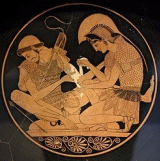
Greek mythology is embodied explicitly in a large collection of narratives and implicitly in representational arts, such as vase-paintings
Pottery of Ancient Greece

Thanks to its relative durability, pottery is a large part of the archaeological record of Ancient Greece, and because we have so much of it it has exerted a disproportionately large influence on our understanding of Greek society....
 and votive gifts.


Discussion
Ask a question about 'Greek mythology'
Start a new discussion about 'Greek mythology'
Answer questions from other users
Full Discussion Forum


Recent Posts


Encyclopedia


Greek mythology is the body of myths and legend
Legend

A legend is a narrative of human actions that are perceived both by teller and listeners to take place within human history and to possess certain qualities that give the tale verisimilitude ....
s belonging to the ancient Greeks
Ancient Greece

The term Ancient Greece refers to the period of History of Greece lasting from the Greek Dark Ages ca. 1100 BC and the Dorian invasion, to 146 BC and the Roman Republic conquest of Greece after the Battle of Corinth ....
 concerning their gods
List of Greek mythological figures

A listing of Greek mythology figures. See also family tree of the Greek gods and the list of Greek mythological creatures. For a list of the deities of many cultures , see list of deities....
 and heroes
Greek hero cult

Hero cults were one of the most distinctive features of ancient Greek religion. In Homeric Greek, "hero" refers to any man who was fighting on either side of the Trojan War....
, the nature of the world
Cosmology

Cosmology is study of the Universe in its totality, and by extension, humanity's place in it. Though the word cosmology is recent , study of the Universe has a long history involving science, philosophy, esotericism, and religion....
, and the origins and significance of their own cult
Cult (religious practice)

In traditional usage, the cult of a religion, quite apart from its sacred writings , its theology or mythologys, or the personal faith of its believers, is the totality of external religious practice and observance, the neglect of which is the definition of impiety....
 and ritual
Ritual

A ritual is a set of repeated actions, often thought to have symbolic value, the performance of which is usually prescribed by a religion or by the traditions of a community by religious or political laws because of the perceived efficacy of those actions....
 practices. They were a part of religion in ancient Greece. Modern scholars refer to the myths and study them in an attempt to throw light on the religious and political institutions of Ancient Greece
Ancient Greece

The term Ancient Greece refers to the period of History of Greece lasting from the Greek Dark Ages ca. 1100 BC and the Dorian invasion, to 146 BC and the Roman Republic conquest of Greece after the Battle of Corinth ....
, on the Ancient Greek civilization, and to gain understanding of the nature of myth-making itself.

Greek mythology is embodied explicitly in a large collection of narratives and implicitly in representational arts, such as vase-paintings
Pottery of Ancient Greece

Thanks to its relative durability, pottery is a large part of the archaeological record of Ancient Greece, and because we have so much of it it has exerted a disproportionately large influence on our understanding of Greek society....
 and votive gifts. Greek myth explains the origins of the world and details the lives and adventures of a wide variety of gods, goddesses, heroes, heroines
List of Greek mythological figures

A listing of Greek mythology figures. See also family tree of the Greek gods and the list of Greek mythological creatures. For a list of the deities of many cultures , see list of deities....
, and other mythological creatures
List of Greek mythological creatures

Creatures of Greek mythology.See also list of Greek mythological figures.* Amphisbaena* Argus Panoptes* Athos * Calydonian Boar* Centaur...
. These accounts initially were disseminated in an oral-poetic tradition
Oral tradition

Oral tradition, oral culture and oral lore are messages or testimony transmitted orally from one generation to another. The messages or testimony are verbally transmitted in speech or song and may take the form, for example, of folktales, sayings, ballads, songs, or chants....
; today the Greek myths are known primarily from Greek literature
Greek literature

Greek literature refers to those writings autochthonic to the areas of Greeks influence, typically though not necessarily in one of the Greek dialects, throughout the whole period in which the Greek language people have existed....
.

The oldest known Greek literary sources, the epic poem
Epic poetry

An epic is a lengthy narrative poem, ordinarily concerning a serious subject containing details of heroic deeds and events significant to a culture or nation....
s Iliad
ILiad

The iLiad is an electronic handheld device, or e-book device, which can be used for document reading and editing. Like the Sony Reader or Amazon Kindle, the iLiad makes use of an electronic paper display....
 and Odyssey
Odyssey

The Odyssey is one of two major ancient Hellenic civilization epic poetrys attributed to Homer. It is, in part, a sequel to the Iliad, the other work traditionally ascribed to Homer....
, focus on events surrounding the Trojan War
Trojan War

In Greek mythology, the Trojan War was waged against the city of Troy by the Achaeans after Paris of Troy stole Helen from her husband Menelaus, the king of Sparta....
. Two poems by Homer
Homer

Homer is traditionally held to be the author of the ancient Greek language epic poems the Iliad and the Odyssey, as well as of the Homeric Hymns....
's near contemporary Hesiod
Hesiod

Hesiod was a Greek language oral poet, his date is uncertain but leading scholars agree that Hesiod lived in the latter half of the Eighth-century BCE....
, the Theogony
Theogony

The Theogony is a poem by Hesiod describing the origins and genealogy of the polytheism of the ancient Greeks, composed circa 700 BC....
 and the Works and Days
Works and Days

Works and Days is a Greek poem of some 800 verses written by Hesiod . The poem revolves around two general truths: labour is the universal lot of Man, but he who is willing to work will get by....
, contain accounts of the genesis of the world, the succession of divine rulers, the succession of human ages, the origin of human woes, and the origin of sacrificial practices. Myths also are preserved in the Homeric Hymns
Homeric Hymns

The thirty-three anonymous Homeric Hymns celebrating individual gods are a collection of ancient Greek language hymns, "Homeric" in the sense that they employ the same epic meter? dactylic hexameter? as the Iliad and Odyssey, use many similar formulas and are couched in the same dialect....
, in fragments of epic poems of the Epic Cycle, in lyric poems
Lyric poetry

Lyric poetry refers to a usually short poem that expresses personal feelings, which may or may not be set to music. Aristotle, in Poetics , contrasted lyric poetry with drama and epic poetry....
, in the works of the tragedians of the fifth century BC, in writings of scholars and poets of the Hellenistic Age
Hellenistic civilization

File:Diadochen1.pngHellenistic civilization represents the zenith of Ancient Greece influence in the Classical Antiquity from 323 BC to about 146 BC ....
 and in texts from the time of the Roman Empire
Roman Empire

The Roman Empire was the Roman Republic phase of the Ancient Rome, characterised by an autocracy form of government and large territorial holdings in Europe and around the Mediterranean....
 by writers such as Plutarch
Plutarch

Lucius Mestrius Plutarchus , c. AD 46 ? 120 ? commonly known in English as Plutarch ? was a Ancient Rome historian , biographer, essayist, and Middle Platonism....
 and Pausanias
Pausanias (geographer)

Pausanias was a Roman Greece traveller and geographer of the 2nd century AD, who lived in the times of Hadrian, Antoninus Pius and Marcus Aurelius....
.

Archaeological evidence is a principal source of detail about Greek mythology, with gods and heroes featuring prominently in the decoration of many artifacts. Geometric designs on pottery of the eighth century BCE depict scenes from the Trojan cycle as well as the adventures of Heracles
Heracles

In Greek mythology, Heracles or Herakles meaning "glory of Hera", or "Glorious through Hera" Alcides or Alcaeus " was a hero, the son of Zeus and Alcmene, foster son of Amphitryon and great-grandson of Perseus....
. In the succeeding Archaic
Archaic period in Greece

The archaic period in Greece is a period of Ancient Greece history. The term originated in the 18th century and has been standard since. This term arose from the study of Greek art, where it refers to styles mainly of Decorative art and Plastic arts, falling in time between Geometric Art and the art of Classical Greece....
, Classical
Ancient Greece

The term Ancient Greece refers to the period of History of Greece lasting from the Greek Dark Ages ca. 1100 BC and the Dorian invasion, to 146 BC and the Roman Republic conquest of Greece after the Battle of Corinth ....
, and Hellenistic
Hellenistic Greece

In the context of Ancient Greek art, architecture, and culture, Hellenistic Greece corresponds to the period between the death of Alexander the Great in 323 BC and the annexation of the Classical Greece heartlands by Roman Republic in 146 BC....
 periods, Homeric and various other mythological scenes appear, supplementing the existing literary evidence.

Greek mythology has exerted an extensive influence on the culture, the arts, and the literature of Western civilization
Western culture

File:Clash of Civilizations map.pngWestern culture are terms which are used to refer to cultures of European origin. This terminology originated as a way of describing what was different about the Graeco-Roman culture and its descendants, in contrast to the older neighboring civilizations of the Middle East, which in many ways continued...
 and remains part of Western heritage and language. Poets and artists from ancient times to the present have derived inspiration from Greek mythology and have discovered contemporary significance and relevance in these mythological themes.

Sources of Greek mythology


Greek mythology is known today primarily from Greek literature
Greek literature

Greek literature refers to those writings autochthonic to the areas of Greeks influence, typically though not necessarily in one of the Greek dialects, throughout the whole period in which the Greek language people have existed....
 and representations on visual media dating from the Geometric period
Geometric Style

Geometric Art is a phase of Greek art, characterised largely by geometric motifs in vase painting, that flourished towards the end of the Greek Dark Ages, circa 900 BCE to 800 BCE....
 dating from c. 900-800 BC onward.

Literary sources

Mythical narration plays an important role in nearly every genre of Greek literature. Nevertheless, the only general mythographical handbook to survive from Greek antiquity was the Library
Bibliotheca (Pseudo-Apollodorus)

The Bibliotheca , in three books, provides a grand summary of traditional Greek mythology and heroic legends, "the most valuable mythographical work that has come down from ancient times," Aubrey Diller observed, whose "stultifying purpose" was neatly expressed in the epigram noted by Patriarch Photius I of Constantinople:...
 of Pseudo-Apollodorus
Apollodorus

Apollodorus of Athens son of Asclepiades, was a Greeks scholar and grammarian. He was a pupil of Diogenes of Babylon, Panaetius, and the grammarian Aristarchus of Samothrace....
, which attempts to reconcile the contradictory tales of the poets and provides a grand summary of traditional Greek mythology and heroic legends. Apollodorus lived from c. 180-120 BC and wrote on many of these topics, however the "Library" discusses events that occurred long after his death, hence the name Pseudo-Apollodorus. Perhaps, his writings formed the basis of the collection.

Among the earliest literary sources are Homer
Homer

Homer is traditionally held to be the author of the ancient Greek language epic poems the Iliad and the Odyssey, as well as of the Homeric Hymns....
's two epic poems, the Iliad and the Odyssey. Other poets completed the "epic cycle", but these later and lesser poems now are lost almost entirely. Despite their traditional name, the Homeric Hymns have no connection with Homer. They are choral hymns from the earlier part of the so-called Lyric age
Lyric poetry

Lyric poetry refers to a usually short poem that expresses personal feelings, which may or may not be set to music. Aristotle, in Poetics , contrasted lyric poetry with drama and epic poetry....
. Hesiod
Hesiod

Hesiod was a Greek language oral poet, his date is uncertain but leading scholars agree that Hesiod lived in the latter half of the Eighth-century BCE....
, a possible contemporary with Homer, offers in his Theogony
Theogony

The Theogony is a poem by Hesiod describing the origins and genealogy of the polytheism of the ancient Greeks, composed circa 700 BC....
 
(Origin of the Gods) the fullest account of the earliest Greek myths, dealing with the creation of the world; the origin of the gods, Titans
Titan (mythology)

In Greek mythology, the Titans ; were a race of powerful deities that ruled during the legendary golden age. Their role as Elder Gods was overthrown by a race of younger gods, the Twelve Olympians, effected a mythological paradigm shift that the Greeks borrowed from the Ancient Near East....
, and Giant
Giant (mythology)

The mythology and legends of many different cultures include monsters of human appearance but prodigious size and strength. "Giant" is the English word commonly used for such beings, derived from one of the most famed examples: the gigantes of Greek mythology....
s; as well as elaborate genealogies, folktales, and etiological myths. Hesiod's Works and Days, a didactic poem about farming life, also includes the myths of Prometheus
Prometheus

In Greek mythology, Prometheus is a Titan known for his wily intelligence, who stole fire from Zeus and gave it to human beings for their use....
, Pandora
Pandora

[Image:Pandora.jpg|right|thumb|300px|"The Creation of "[A]NESIDORA" on a white-ground kylix by the Tarquinia Painter, ca 460 BC In Greek mythology, Pandora was the first woman....
, and the Four Ages
Ages of Man

The Ages of Man are the stages of human existence on the Earth according to Classical mythology. Two classical authors in particular offer accounts of the successive ages of mankind, which tend to progress from an original, long-gone age in which humans enjoyed a nearly divine existence to the current age of the writer, in which humans are be...
. The poet gives advice on the best way to succeed in a dangerous world, rendered yet more dangerous by its gods.

Lyrical poets sometimes take their subjects from myth, but their treatment becomes gradually less narrative and more allusive. Greek lyric poets including Pindar
Pindar

Pindar , was an Ancient Greek Lyric poetry poet.Of the canonical nine lyric poets of ancient Greece, Pindar is the one whose work is by far the best preserved, and critics in antiquity tended to regard him as the greatest....
, Bacchylides
Bacchylides

Bacchylides was an Ancient Greek Lyric poetry poet. Later Greeks included him in the canonical list of nine lyric poets which included his uncle Simonides....
, Simonides
Simonides of Ceos

Simonides of Ceos , Greek Lyric poetry poet, was born at Ioulis on Kea . He was included, along with Sappho and Pindar, in the canonical list of nine lyric poets by the scholars of Hellenistic Alexandria....
 and bucolic poets such as Theocritus
Theocritus

Theocritus , the creator of ancient Greek bucolic poetry, flourished in the 3rd century BC....
 and Bion, relate individual mythological incidents. Additionally, myth was central to classical Athenian drama
Drama

Drama is the specific Mode of fiction Mimesis in performance. The term comes from a Ancient Greek word meaning "Action " , which is derived from "to do" ....
. The tragic playwrights Aeschylus
Aeschylus

Aeschylus was an Ancient Greece playwright. He is often recognized as the father or the founder of tragedy, and is the earliest of the three Greek tragedy whose Play survive extant, the others being Sophocles and Euripides....
, Sophocles
Sophocles

Sophocles was the second of the three classical Greece tragedy whose work has survived. His first plays were written later than those of Aeschylus and earlier than those of Euripides....
, and Euripides
Euripides

Euripides was the last of the three great tragedy of classical Athens . Ancient scholars thought that Euripides had written ninety-five plays, although four of those were probably written by Critias....
 took their plots from myths of the age of heroes and the Trojan War. Many of the great tragic stories (e.g. Agamemnon
Agamemnon

In Greek mythology, Agamemnon / is the son of King Atreus of Mycenae and Queen Aerope, the brother of Menelaus and the husband of Clytemnestra; different mythological versions make him the king either of Mycenae or of Argos....
 and his children, Oedipus
Oedipus

Oedipus was a Greek mythology monarch of Thebes, Greece. He fulfilled a prophecy that said he would kill his father and marry his mother, and thus brought disaster on his city and family....
, Jason
Jason

Jason was a late ancient Greece Greek mythology figure, famous as the leader of the Argonauts and their quest for the Golden Fleece. He was the son of Aeson, the rightful king of Iolcus....
, Medea
Medea

Medea is a woman in Greek mythology. She was the daughter of Aeetes of Colchis, niece of Circe, granddaughter of the sun god Helios, and later wife to the hero Jason, with whom she had two children: Mermeros and Pheres....
, etc.) took on their classic form in these tragic plays. For his part, the comic playwright Aristophanes
Aristophanes

Aristophanes , son of Philippus, of the deme Cydathenaus, was a prolific and much acclaimed comedy playwright of ancient Athens. Eleven of his forty plays have come down to us virtually complete....
 used myths, as in The Birds
The Birds (play)

The Birds is a Greek comedy written by the Ancient Greek playwright Aristophanes in 414 BC, and performed that year for the Dionysia....
 or The Frogs
The Frogs

Frogs is a Greek comedy written by the Ancient Greek playwright Aristophanes. It was performed at the Lenaia, one of the Festivals of Dionysus, in 405 BC, and received first place....
.

Historians Herodotus
Herodotus

Herodotus of Halicarnassus was a Greeks historian who lived in the 5th century BC and is regarded as the "Father of History" in Western culture....
 and Diodorus Siculus
Diodorus Siculus

Diodorus Siculus , was a Roman Greece historian who flourished in the 1st century BC. According to Diodorus' own work, he was born at Agira in Sicily ....
, and geographers Pausanias
Pausanias (geographer)

Pausanias was a Roman Greece traveller and geographer of the 2nd century AD, who lived in the times of Hadrian, Antoninus Pius and Marcus Aurelius....
 and Strabo
Strabo

Strabo was a Ancient Greeks history, geography and philosophy....
, who traveled throughout the Greek world and noted the stories they heard, supplied numerous local myths, often giving little-known alternative versions. Herodotus in particular, searched the various traditions presented him and found the historical or mythological roots in the confrontation between Greece and the East. Herodotus attempted to reconcile origins and the blending of differing cultural concepts.

The poetry of the Hellenistic
Hellenistic civilization

File:Diadochen1.pngHellenistic civilization represents the zenith of Ancient Greece influence in the Classical Antiquity from 323 BC to about 146 BC ....
 and Roman
Ancient Rome

Ancient Rome was a civilization that grew out of a small agricultural community founded on the Italian Peninsula as early as the 10th century BC....
 ages, although composed as a literary rather than cultic exercise, nevertheless contains many important details that would otherwise be lost. This category includes the works of:
  1. The Roman poets Ovid
    Ovid

    Publius Ovidius Naso was a Roman Empire poet known as Ovid to the English language-speaking world, who wrote about love, seduction, and Roman mythology transformation....
    , Statius
    Statius

    Publius Papinius Statius was a Roman poet of the Silver Age of Latin literature, born in Naples, Italy. Besides his poetry, he is best known for his appearance as a major character in the Purgatorio section of Dante Alighieri epic poem The Divine Comedy....
    , Valerius Flaccus
    Gaius Valerius Flaccus

    Gaius Valerius Flaccus was a Roman Empire poet who flourished in the "Silver Age of Latin literature" under the emperors Vespasian and Titus and wrote a Latin Argonautica that owes a great deal to Apollonius of Rhodes' more famous epic....
    , Seneca
    Seneca the Younger

    Lucius Annaeus Seneca was a Ancient Rome Stoicism philosopher, statesman, dramatist, and in one work humorist, of the Silver Age of Latin literature....
    , and Virgil
    Virgil

    Publius Vergilius Maro was a classical Roman poet, best known for three major works?the Bucolics , the Georgics and the Aeneid?although several Appendix Vergiliana are also attributed to him....
     with Servius's commentary.
  2. The Greek poets of the Late Antique
    Late Antiquity

    Late Antiquity is a periodization used by historians to describe the transitional centuries from Classical antiquity to the Middle Ages, in both mainland Europe and the Mediterranean world: generally from the end of the Roman Empire's Crisis of the Third Century to the Islamic conquests and the re-organization of the Byzantine Empire under...
     period: Nonnus
    Nonnus

    Nonnus , was a Greek language epic poet. He was a native of Panopolis in the Egyptian Thebaid, and probably lived at the end of the 4th or early 5th century....
    , Antoninus Liberalis
    Antoninus Liberalis

    Antoninus Liberalis was an Ancient Greece grammarian who probably flourished between AD 100 and 300.His only surviving work is the Metamorphoses, , a collection of forty-one very briefly summarised tales about mythical metamorphoses effected by offended deities, unique in that they are couched in prose, not verse....
    , and Quintus Smyrnaeus
    Quintus Smyrnaeus

    Quintus Smyrnaeus was a Greece Epic poetry poet whose Posthomerica, following "after Homer" continues the narration of the Trojan War.The dates of Smyrnaeus's life are controversial, but they are traditionally placed in the latter part of the fourth century....
    .
  3. The Greek poets of the Hellenistic period: Apollonius of Rhodes
    Apollonius of Rhodes

    Apollonius of Rhodes, also known as Apollonius Rhodius , early 3rd century BCE - after 246 BCE, was a librarian at the Library of Alexandria....
    , Callimachus
    Callimachus

    Callimachus was a native of the Greek colony of Cyrene, Libya, Libya. He was a noted poet, critic and scholar of the Library of Alexandria and enjoyed the patronage of ancient Egyptian Greeks Pharaohs Ptolemy II Philadelphus and Ptolemy III Euergetes....
    , Pseudo-Eratosthenes
    Eratosthenes

    Eratosthenes of Cyrene was a Greeks mathematician, poet, sportsperson, geographer and astronomer. He made several discoveries and inventions including a system of latitude and longitude....
    , and Parthenius
    Parthenius of Nicaea

    Parthenius of Nicaea in Bithynia was a Greeks grammarian and poet. He was taken prisoner by Cinna in the Mithridatic Wars and carried to Rome in 72 BC....
    .
  4. The ancient novels of Greeks and Romans such as Apuleius
    Apuleius

    Lucius Apuleius Platonicus was a Roman Empire Berber people who described himself as "half-Numidian half-Gaetulian", remembered most for his ribaldry Picaresque novel Latin novel, the Metamorphoses, otherwise known as The Golden Ass or, in Latin, the Asinus Aureus ....
    , Petronius
    Petronius

    Gaius Petronius Arbiter was a Roman Empire courtier during the reign Nero. He is speculated to be the author of the Satyricon, a satire believed to have been written during the Neronian age....
    , Lollianus
    Lollianus

    Lollianus is a Roman personal name which can refer to many figures of classical antiquity, including:*Lollianus , a general proclaimed emperor by his soldiers in Gaul and very soon murdered; he is one of the Thirty Tyrants whose lives are briefly sketched in the Historia Augusta....
    , and Heliodorus
    Heliodorus of Emesa

    Heliodorus of Emesa, from Emesa, Syria, was a Roman and Byzantine Greece writer generally dated to the third century AD who is known for the ancient Greek romance or novel called the Aethiopica or sometimes "Theagenes and Chariclea"....
    .


The Fabulae and Astronomica of the Roman writer styled as Pseudo-Hyginus
Gaius Julius Hyginus

Gaius Julius Hyginus was a Latin author, though whether a native of Spain or of Alexandria it is not clear, a pupil of the famous Alexander Cornelius, and a freedman of Caesar Augustus, by whom he was made superintendent of the Palatine library, according to Suetonius' minor works, De Grammaticis, 20....
 are two important, non-poetical compendiums of myth. The Imagines of Philostratus
Philostratus

Philostratus, was the name of four Greek sophists of the Roman Empire:# "Philostratus I": Very minor author, known only for a dialogue Nero, possibly written by Philostratus II....
 the Elder and Younger and the Descriptions of Callistratus, are two other useful sources that were drawn upon for themes.

Finally, the Christian apologist Arnobius
Arnobius

Arnobius of Sicca was an Early Christian apologetics, during the reign of Diocletian . According to Jerome's Chronicle, Arnobius, before his conversion, was a distinguished rhetorician at Sicca Veneria , a major Christian center in Proconsular Africa , and owed his conversion to a premonitory dream....
, who quoted cult practices in order to disparage them, and a number of Byzantine Greek writers provide important details of myth, some of it derived from lost Greek works. These preservers of myth include a lexicon of Hesychius
Hesychius of Alexandria

Hesychius of Alexandria , a grammarian who flourished probably in the 5th century CE, compiled the richest lexicon of unusual and obscure Greek words that has survived ....
, the Suda
Suda

The Suda or Souda is a massive 10th century Byzantine Empire Medieval Greek historical encyclopedia of the ancient Mediterranean world. It is an Encyclopedia lexicon with 30,000 entries, many drawing from ancient sources that have since been lost, and often derived from medieval Christian compilers....
, and the treatises of John Tzetzes
John Tzetzes

John Tzetzes , was a Byzantine Empire poet and grammarian, known to have lived at Constantinople during the 12th century.Tzetzes was Georgians on his mother's side ....
 and Eustathius
Eustathius of Thessalonica

Eustathius of Thessalonica was a native of Constantinople who became archbishop of Thessalonica. After being a monk in the monastery of St. Florus, he was appointed to the offices of superintendent of peti?tions , professor of rhetoric , and deacon of the church of Constantinople....
. The Christian moralizing view of Greek myth is encapsulated in the saying, / en panti muthoi kai to Daidalou musos ("In every myth there is also the defilement of Daidalos"). In this fashion, the encyclopedic Sudas
Sudas

Sudas is a king from the Rig Veda. He is a descendant of Divodasa. Divodasa is a descendant of Srnjaya, who in turn is a descendant of Devavata....
 reported the role of Daedalus
Daedalus

In Greek mythology, Daedalus was a most skillful artificer, or craftsman, so skillful that he was said to have invented images that seemed to move about....
 in satisfying the "unnatural lust" of Pasiphaë
Pasiphaë

In Greek mythology, Pasipha? , "wide-shining" was the daughter of Helios, the Sun, by the eldest of the Oceanids, Perse; Like her doublet Europa, her origins were in the East, in her case at Colchis, the palace of the Sun; she was given in marriage to King Minos of Crete....
 for the bull of Poseidon: "Since the origin and blame for these evils were attributed to Daidalos and he was loathed for them, he became the subject of the proverb."

Archaeological sources

The discovery of the Mycenaean civilization
Mycenaean Greece

Mycenaean Greece is a cultural period of ancient Greece taking its name from the archaeological site of Mycenae in northeastern Argolis, in the Peloponnese of southern Greece....
 by the German amateur archaeologist
Archaeology

Archaeology, archeology, or arch?ology is the science that studies Homo cultures through the recovery, documentation, analysis, and interpretation of material remains and environmental data, including architecture, Artifact , features, Biofact s, and cultural landscape....
, Heinrich Schliemann
Heinrich Schliemann

Heinrich Schliemann...
, in the nineteenth century, and the discovery of the Minoan civilization
Minoan civilization

The Minoan civilization was a Bronze Age civilization which arose on the island of Crete. The Minoan culture flourished from approximately 27th century BC to 1450 BC; afterwards, Mycenaean Greece culture became dominant at Minoan sites in Crete....
 in Crete
Crete

Crete is the largest of the Greek islands and the List of islands in the Mediterranean largest island in the Mediterranean Sea at 8,336 km? ....
 by British archaeologist, Sir Arthur Evans
Arthur Evans

Sir Arthur John Evans was a British archaeologist most famous for unearthing the palace of Knossos on the Greece island of Crete at Kephala Hill and for creating the concept of Minoan civilization from the structures and artifacts there and elsewhere in Crete and the eastern Mediterranean....
, in the twentieth century, helped to explain many existing questions about Homer's epics and provided archaeological evidence for many of the mythological details about gods and heroes. Unfortunately, the evidence about myth and ritual at Mycenaean and Minoan sites is entirely monumental, as the Linear B
Linear B

Linear B is a script that was used for writing Mycenaean language, an early form of Greek language. It predated the Greek alphabet by several centuries and seems to have died out with the fall of Mycenaean Greece civilization....
 script (an ancient form of Greek found in both Crete and Greece) was used mainly to record inventories, although the names of gods and heroes doubtfully have been revealed.

Geometric designs on pottery of the eighth century BC depict scenes from the Trojan cycle, as well as the adventures of Heracles. These visual representations of myths are important for two reasons. For one, many Greek myths are attested on vases earlier than in literary sources: of the twelve labors of Heracles, for example, only the Cerberus
Cerberus

Cerberus is the name given to the entity which, in Greek mythology and Roman mythology, is a multi-headed dog which guards the gates of Hades, to prevent those who have crossed the river Styx from ever escaping....
 adventure occurs in a contemporary literary text. In addition, visual sources sometimes represent myths or mythical scenes that are not attested in any extant literary source. In some cases, the first known representation of a myth in geometric art predates its first known representation in late archaic poetry, by several centuries. In the Archaic (c. 750–c. 500 BC), Classical (c. 480–323 BC), and Hellenistic (323–146 BC) periods, Homeric and various other mythological scenes appear, supplementing the existing literary evidence.

Survey of mythic history

Greek mythology has changed over time to accommodate the evolution of their culture, of which mythology, both overtly and in its unspoken assumptions, is an index of the changes. In Greek mythology's surviving literary forms, as found mostly at the end of the progressive changes, is inherently political, as Gilbert Cuthbertson has urged.

The earlier inhabitants of the Balkan Peninsula
Balkans

The Balkans is the historical name of a geographic subregion of southeastern Europe. The region takes its name from the Balkan Mountains, which run through the centre of Bulgaria into eastern Serbia....
 were an agricultural people who, using Animism
Animism

Animism is a philosophical, religious or spiritual idea that souls or spirits exist not only in humans and animals but also in plants, rock s, natural phenomena such as thunder, geographic features such as mountains or rivers, or other entities of the natural environment, a proposition also known as hylozoism in philosophy....
, assigned a spirit to every aspect of nature. Eventually, these vague spirits assumed human forms and entered the local mythology as gods. When tribes from the north of the Balkan Peninsula invaded, they brought with them a new pantheon
Pantheon

Pantheon may refer to:*Pantheon , a word used to describe the set of gods of a particular religion, mythology, or fictional universe* A temple, dedicated to all gods, or to all the gods of a given religion...
 of gods, based on conquest, force, prowess in battle, and violent heroism. Other older gods of the agricultural world fused with those of the more powerful invaders or else faded into insignificance.

After the middle of the Archaic period, myths about relationships between male gods and male heroes become more and more frequent, indicating the parallel development of pedagogic pederasty
Pederasty in ancient Greece

Greek pederasty, as idealised by the Ancient Greece from Archaic period in Greece onward, was a relationship and bond between an adolescent boy and an adult man outside of his immediate family....
 (Eros paidikos, pa?d???? ????), thought to have been introduced around 630 BC. By the end of the fifth century BC, poets had assigned at least one eromenos
Eromenos

In the Pederasty in ancient Greece of Athens, the eromenos was an adolescence boy who was in a love relationship with an adult man, known as the erastes ....
, an adolescent boy who was their sexual companion, to every important god except Ares
Ares

In Greek mythology, Ares is the son of Zeus and Hera. Though often referred to as the Twelve Olympians God of warfare, he is more accurately the god of bloodlust, or slaughter personified: "Ares is apparently an ancient abstract noun meaning throng of battle, war."...
 and to many legendary figures. Previously existing myths, such as those of Achilles
Achilles

In Greek mythology, Achilles was a Greeks hero of the Trojan War, the central character and the greatest warrior of Homer's Iliad, which takes for its theme ; the Wrath of Achilles....
 and Patroclus
Patroclus

In Greek mythology, as recorded in the Iliad by Homer, Patroclus, or Patroklos , son of Menoetius , was Achilles? beloved comrade and, according to some , his lover....
, also then were cast in a pederastic light. Alexandrian poets at first, then more generally literary mythographers in the early Roman Empire, often readapted stories of Greek mythological characters in this fashion.

The achievement of epic poetry was to create story-cycles and, as a result, to develop a new sense of mythological chronology. Thus Greek mythology unfolds as a phase in the development of the world and of humans. While self-contradictions in these stories make an absolute timeline impossible, an approximate chronology may be discerned. The resulting mythological "history of the world" may be divided into three or four broader periods:
  1. The myths of origin or age of gods (Theogonies, "births of gods"): myths about the origins of the world, the gods, and the human race.
  2. The age when gods and mortals mingled freely: stories of the early interactions between gods, demigod
    Demigod

    The term "demigod", meaning "half-god", is used to describe mythological figures whose one parent was a god and whose other parent was human. Demi-gods include the Celtic hero C?chulainn, Gilgamesh, and Heracles....
    s, and mortals.
  3. The age of heroes (heroic age), where divine activity was more limited. The last and greatest of the heroic legends is the story of the Trojan War and after (which is regarded by some researchers as a separate fourth period).


While the age of gods often has been of more interest to contemporary students of myth, the Greek authors of the archaic and classical eras had a clear preference for the age of heroes, establishing a chronology and record of human accomplishments after the questions of how the world came into being were explained. For example, the heroic Iliad and Odyssey dwarfed the divine-focused Theogony and Homeric Hymns in both size and popularity. Under the influence of Homer the "hero cult" leads to a restructuring in spiritual life, expressed in the separation of the realm of the gods from the realm of the dead (heroes), of the the Chthonic
Chthonic

Chthonic designates, or pertains to, deities or spirits of the underworld, especially in relation to Ancient Greek religion.Greek khthon is one of several words for "earth"; it typically refers to the interior of the soil, rather than the living surface of the Landscape or the land as territory ....
 from the Olympian. In the Works and Days, Hesiod makes use of a scheme of Four Ages of Man
Ages of Man

The Ages of Man are the stages of human existence on the Earth according to Classical mythology. Two classical authors in particular offer accounts of the successive ages of mankind, which tend to progress from an original, long-gone age in which humans enjoyed a nearly divine existence to the current age of the writer, in which humans are be...
 (or Races): Golden, Silver, Bronze, and Iron. These races or ages are separate creations of the gods, the Golden Age belonging to the reign of Cronus, the subsequent races the creation of Zeus. Hesiod intercalates the Age (or Race) of Heroes just after the Bronze Age
Bronze Age

The Bronze Age is, with respect to a given prehistory, the period in that society when the most advanced metalworking included smelting copper and tin from naturally-occurring outcroppings of copper and tin ores, creating a bronze alloy by melting those metals together, and casting them into bronze artifact s....
. The final age was the Iron Age
Iron Age

In archaeology, the Iron Age was the stage in the development of any people in which tools and weapons whose main ingredient was iron were prominent....
, the contemporary period during which the poet lived. The poet regards it as the worst; the presence of evil was explained by the myth of Pandora
Pandora

[Image:Pandora.jpg|right|thumb|300px|"The Creation of "[A]NESIDORA" on a white-ground kylix by the Tarquinia Painter, ca 460 BC In Greek mythology, Pandora was the first woman....
, when all of the best of human capabilities, save hope, had been spilled out of her overturned jar. In Metamorphoses, Ovid follows Hesiod's concept of the four ages.

Age of gods


Cosmogony and cosmology
Michelangelo Caravaggio 003
"Myths of origin" or "creation myths" represent an attempt to render the universe comprehensible in human terms and explain the origin of the world. The most widely accepted version today, although a philosophical account of the beginning of things, is reported by Hesiod
Hesiod

Hesiod was a Greek language oral poet, his date is uncertain but leading scholars agree that Hesiod lived in the latter half of the Eighth-century BCE....
, in his Theogony
Theogony

The Theogony is a poem by Hesiod describing the origins and genealogy of the polytheism of the ancient Greeks, composed circa 700 BC....
. He begins with Chaos
Chaos (mythology)

In Greek myth, Chaos or Khaos is the original state of existence from which the first gods appeared. In other words, the dark void of space....
, a yawning nothingness. Out of the void emerged Eurynome
Eurynome

In Greek mythology, there were many women with the name Eur?nom?, with the possible significance "far-wandering" .#The Eurynome , or daughter of Oceanus....
,
Gaia (mythology)

Gaia Gaia is a Greek primordial gods and chthonic deity in the Ancient Greek Pantheon and considered a Mother Goddess or Great Goddess....
 or Gaia
Gaia (mythology)

Gaia Gaia is a Greek primordial gods and chthonic deity in the Ancient Greek Pantheon and considered a Mother Goddess or Great Goddess....
 (the Earth) and some other primary divine beings: Eros
EROS

EROS may refer to:* Center for Earth Resources Observation and Science, the Center for Earth Resources Observation and Science, the United States national archive of remotely sensed images of the Earth's land surface...
 (Love), the Abyss
Abyss (religion)

An abyss is a bottomless depth or deep place. In Bible the word is usually used to refer to a pit; to the underworld; to the deepest ocean floor; or to hell....
 (the Tartarus
Tartarus

In classic Roman mythology, below Heaven, Earth, and Pontus is Tartarus, or Tartaros . It is a deep, gloomy place, a pit, or an abyss used as a dungeon of torment and suffering that resides beneath the Hades....
), and the Erebus
Erebus

In Greek mythology, Erebus or Erebos or Erebes was the son of a primordial god, Chaos , and represented the personification of darkness and shadow, which filled in all the corners and crannies of the world....
. Without male assistance, Gaia gave birth to Uranus
Uranus (mythology)

Uranus is the Latinized form of Ouranos , the Greek language word for sky. In Greek mythology Uranus , or Father Sky, is personified as the son and husband of Gaia , Mother Earth ....
 (the Sky) who then fertilized her. From that union were born first the Titan
Titan (mythology)

In Greek mythology, the Titans ; were a race of powerful deities that ruled during the legendary golden age. Their role as Elder Gods was overthrown by a race of younger gods, the Twelve Olympians, effected a mythological paradigm shift that the Greeks borrowed from the Ancient Near East....
s—six males: Coeus
Coeus

In Greek mythology, Coeus was one of the Titan , the giant sons and daughters of Uranus and Gaia ; his equivalent in Latin poetry?though he scarcely makes an appearance in Roman mythology? was Polus, the embodiment of the celestrial axis around which the heavens revolve....
, Crius
Crius

In Greek mythology, Crius was one of the Titan in the list given in Hesiod's Theogony, a son of Uranus and Gaia . The least individualized among them, he was overthrown in the Titanomachy....
, Cronus
Cronus

Cronus or Kronos, , was the leader and the youngest of the first generation of Titan , divine descendants of Gaia , the earth, and Uranus , the sky....
, Hyperion
Hyperion (mythology)

Hyperion is one of the twelve Titan gods of Ancient Greece, which were later supplanted by the Olympians. He was the son of Gaia and Uranus , and was referred to in early mythological writings as Helios Hyperion, 'Sun High-one'....
, Iapetus
Iapetus (mythology)

In Greek mythology, Iapetus, also Iapetos or Japetus , was a Titan , the son of Uranus and Gaia , and father of Atlas , Prometheus, Epimetheus , and Menoetius and through Prometheus, Epimetheus and Atlas an ancestor of the human race....
, and Oceanus
Oceanus

Oceanus was believed to be the World Ocean in classical antiquity, which the Ancient Rome and Ancient Greece considered to be an enormous river encircling the world....
; and six females: Mnemosyne
Mnemosyne

Mnemosyne was the personification of memory in Greek mythology. This titan was the daughter of Gaia and Uranus and the mother of the Muses by Zeus....
, Phoebe
Phoebe (mythology)

In Greek mythology "golden-wreathed" Phoebe , in her very name simply the feminine counterpart of Phoebus, was one of the original Titan , one set of sons and daughters of Uranus and Gaia ....
, Rhea
Rhea (mythology)

This page is about the Greek mythological figure. For the bird, see Rhea .Rhea was the Titan daughter of Ouranos , the sky, and Gaia , the earth, in Classical Greece mythology....
, Theia
Theia

In Greek mythology, Theia, goddess or divine, , also called Euryphaessa, wide-shining, was a Titan . The name Theia alone means simply, "goddess"; Theia Euryphaessa brings overtones of extent and brightness....
, Themis
Themis

Themis is an Greek mythology. She is described as "of good counsel", and was the embodiment of divine order, law, and custom. Themis means "law of nature" rather than human ordinance, literally "that which is put in place", from the verb t?????, t?themi, to put....
, and Tethys
Tethys (mythology)

File:Tethys mosaic 83d40m Phillopolis mid4th century -p2fx.2.jpgIn Greek mythology, Tethys , daughter of Uranus and Gaia was an archaic Titan ess and Greek sea gods sea goddess, invoked in classical Greek poetry but no longer venerated in cult....
. They were followed by the one-eyed Cyclopes
Cyclops

In Greek mythology and later Roman mythology, a cyclops , is a member of a primordial race of giant , each with a single eye in the middle of its forehead....
 and the Hecatonchires
Hecatonchires

The Hecatonchires, or Hekatonkheires, were three gargantuan figures of an archaic stage of Greek mythology. According to Hesiod they were children of Gaia and Uranus , simply the issue of Earth and Sky, or of Earth and Sea thus part of the very beginning of things in the submerged prehistory of Greek myth, though they played no part...
 or Hundred-Handers. Cronus ("the wily, youngest and most terrible of [Gaia's] children" ) castrated his father and became the ruler of the gods with his sister-wife Rhea as his consort, and the other Titans became his court.

A motif of father-against-son conflict was repeated when Cronus was confronted by his son, Zeus
Zeus

Zeus in Greek mythology is the king of the gods, the ruler of Mount Olympus and the god of the sky father and List of thunder gods. His symbols are the thunderbolt, eagle, bull , and oak....
. Because Cronus had betrayed his father, he feared that his offspring would do the same, and so each time Rhea gave birth, he snatched up the child and ate it. Rhea hated this and tricked him by hiding Zeus and wrapping a stone in a baby's blanket, which Cronus ate. When Zeus was grown, he fed his father a drugged drink which caused Cronus to vomit, throwing up Rhea's other children and the stone, which had been sitting in Cronus' stomach all along. Then Zeus challenged Cronus to war for the kingship of the gods. At last, with the help of the Cyclopes (whom Zeus freed from Tartarus), Zeus and his siblings were victorious, while Cronus and the Titans were hurled down to imprisonment in Tartarus
Tartarus

In classic Roman mythology, below Heaven, Earth, and Pontus is Tartarus, or Tartaros . It is a deep, gloomy place, a pit, or an abyss used as a dungeon of torment and suffering that resides beneath the Hades....
.

Zeus was plagued by the same concern and, after a prophecy that the offspring of his first wife, Metis
Metis (mythology)

In Greek mythology, Metis was of the Titan generation and, like several primordial figures, an Oceanid, in the sense that M?tis was born of Oceanus and Tethys , of an earlier age than Zeus and his siblings....
, would give birth to a god "greater than he"—Zeus swallowed her. She was already pregnant with Athene, however, and they made him miserable until Athene burst forth from his head—fully-grown and dressed for war. This "rebirth" from Zeus was used as an excuse for why he was not "superseded" by a child of the next generation of gods, but accounted for the presence of Athene. It is likely that cultural changes already in progress absorbed the long-standing local cult of Athene at Athens into the changing Olympic pantheon without conflict because it could not be overcome.

The earliest Greek thought about poetry considered the theogonies to be the prototypical poetic genre—the prototypical mythos—and imputed almost magical powers to it. Orpheus
Orpheus

Orpheus was a legendary figure, probably from Thracian origin, venerated by the Greeks and Thracians of the Classical age as a chief among poets and musicians, and the perfector of the lyre invented by Hermes....
, the archetypal poet, also was the archetypal singer of theogonies, which he uses to calm seas and storms in Apollonius' Argonautica, and to move the stony hearts of the underworld gods in his descent to Hades
Hades

Hades refers both to the ancient Greek underworld, the abode of Hades, and to the god of the underworld. Hades in Homer referred just to the god; the genitive case , Haidou, was an elision to denote locality: "[the house/dominion] of Hades"....
. When Hermes
Hermes

Hermes is the messenger of the gods in Greek mythology. An Twelve Olympians, he is also the patron of boundaries and of the travelers who cross them, of shepherds and cowherds, of thieves and road travelers, of orators and wit, of literature and poets, of athletics, of weights and measures, of invention, of general commerce, and of the cunni...
 invents the lyre
Lyre

The lyre is a string instrument well known for its use in classical antiquity and later. The recitations of the Ancient Greece were accompanied by lyre playing....
 in the Homeric Hymn to Hermes, the first thing he does is sing about the birth of the gods. Hesiod's Theogony is not only the fullest surviving account of the gods, but also the fullest surviving account of the archaic poet's function, with its long preliminary invocation to the Muse
Muse

File:Muse reading Louvre CA2220.jpgThe Muses in Greek mythology, poetry, and literature are the goddesses or spirits who inspire the creation of literature and the arts....
s. Theogony also was the subject of many lost poems, including those attributed to Orpheus, Musaeus
Musaeus

Musaeus was the name attributed to three Greek poets....
, Epimenides
Epimenides

Epimenides of Knossos was a semi-Greek mythology 6th century BC Greeks prophet and philosopher-Poetry, who is said to have fallen asleep for fifty-seven years in a Cretan cave sacred to Zeus, after which he reportedly awoke with the gift of prophecy....
, Abaris
Abaris the Hyperborean

Abaris the Hyperborean , son of Seuthes, was a legendary sage, Iatromantis, and priest of Apollo known to the Ancient Greece. He was supposed to have learned his skills in his homeland of Hyperborea, near the Caucasus, which he fled during a plague....
, and other legendary seers, which were used in private ritual purifications and mystery-rites
Mystery religion

Mystery Religions, Sacred Mysteries or simply Mysteries, were "religious Cult of the Graeco-Roman world, full admission to which was restricted to those who had gone through certain secret initiation rites."...
. There are indications that Plato
Plato

Plato , was a Classical Greece Greeks philosopher, mathematician, writer of philosophical dialogues, and founder of the Platonic Academy in Ancient Athens, the first institution of higher learning in the western world....
 was familiar with some version of the Orphic theogony. A silence would have been expected about religious rites and beliefs, however, and that nature of the culture would not have been reported by members of the society while the beliefs were held. After they ceased to become religious beliefs, few would have known the rites and rituals. Allusions often existed, however, to aspects that were quite public.

Images existed on pottery and religious artwork that were interpreted and more likely, misinterpreted in many diverse myths and tales. A few fragments of these works survive in quotations by Neoplatonist
Neoplatonism

Neoplatonism is the modern term for a school of religious and mystical philosophy that took shape in the 3rd century AD, founded by Plotinus and based on the teachings of Plato and earlier Platonism....
 philosophers and recently unearthed papyrus
Papyrus

Papyrus is a thick paper material produced from the pith of the papyrus plant, Cyperus papyrus, a wetland Cyperaceae that was once abundant in the Nile Delta of Egypt....
 scraps. One of these scraps, the Derveni Papyrus
Derveni papyrus

The Derveni papyrus is an ancient Greek papyrus scroll that was found in 1962. It is a philosophical treatise that is an allegorical commentary on an Orphic poem, a theogony concerning the birth of the gods, produced in the circle of the philosopher Anaxagoras in the second half of the 5th century BC, making it "the most important new piece...
 now proves that at least in the fifth century BC a theogonic-cosmogonic poem of Orpheus was in existence. This poem attempted to outdo Hesiod's Theogony and the genealogy of the gods was extended back to Nyx
Nyx

In Greek mythology, Nyx was the primordial goddess of the night. A shadowy figure, Nyx stood at or near the beginning of creation, and was the mother of personification gods such as Hypnos and Thanatos ....
 (Night) as an ultimate female beginning before Eurynome, Uranus, Cronus, and Zeus.* G. Betegh, The Derveni Papyrus, 147 Night and Darkness could equate with Chaos.

The first philosophical cosmologists reacted against, or sometimes built upon, popular mythical conceptions that had existed in the Greek world for some time. Some of these popular conceptions can be gleaned from the poetry of Homer and Hesiod. In Homer, the Earth was viewed as a flat disk afloat on the river of Oceanus
Oceanus

Oceanus was believed to be the World Ocean in classical antiquity, which the Ancient Rome and Ancient Greece considered to be an enormous river encircling the world....
 and overlooked by a hemispherical sky with sun, moon, and stars. The Sun (Helios
Helios

Helios is the god of sun.In Greek mythology the sun was personified as Helios . Homer often calls him simply Titan or Hyperion , while Hesiod and the Homeric Hymn separate him as a son of the Titans Hyperion and Theia or Euryphaessa and brother of the goddesses Selene, the moon, and Eos, the dawn....
) traversed the heavens as a charioteer and sailed around the Earth in a golden bowl at night. Sun, earth, heaven, rivers, and winds could be addressed in prayers and called to witness oaths. Natural fissures were popularly regarded as entrances to the subterranean house of Hades and his predecessors, home of the dead.* K. Algra, The Beginnings of Cosmology, 45 Influences from other cultures always afforded new themes.

Greek pantheon

Olympians
According to Classical-era mythology, after the overthrow of the Titans, the new pantheon
Pantheon (gods)

A pantheon is a set of all the gods of a particular polytheistic religion or mythology.Max Weber's 1922 opus, Economy and Society discusses the link between a pantheon of gods and the development of monotheism....
 of god
God (male deity)

God, as a male deity, contrasts with female deities, or "goddesses". While the term 'goddess' specifically refers to a female deity, words like 'gods' and 'deities' can be applied to all gods collectively, regardless of gender....
s and goddess
Goddess

A goddess is a female deity. Often deities are part of a polytheism system that includes several deities in a pantheon .Common associations of goddesses are the Earth goddess, the Mother Goddess, Love goddess, and the hearth goddess, reflecting historical gender roles....
es was confirmed. Among the principal Greek gods were the Olympians, residing atop Mount Olympus
Mount Olympus

Mount Olympus is the highest mountain in Greece at 2,919 metres high . Since its base is located at sea level, it is one of the highest mountains in Europe in terms of topographic prominence, the relative altitude from base to top....
 under the eye of Zeus. (The limitation of their number to twelve seems to have been a comparatively modern idea.) Besides the Olympians, the Greeks worshipped various gods of the countryside, the goat-god Pan
Pan (mythology)

Pan , in Ancient Greek religion and Greek mythology, is the companion of the nymphs, god of shepherds and flocks, of mountain wilds, hunting and rustic music....
, Nymph
Nymph

In Greek mythology, a nymph is any member of a large class of mythological entities in human form. They were typically associated with a particular location or landform....
s (spirits of rivers), Naiad
Naiad

In Greek mythology, the Naiads or Naiades were a type of nymph who presided over fountains, wells, springs, streams, and brooks.They are distinct from river gods, who embodied rivers, and the very ancient spirits that inhabited the still waters of marshes, ponds and lagoon-lakes, such as pre-Mycenaean Lerna in the Argolid....
s (who dwelled in springs), Dryad
Dryad

Dryads are Tree nymphs in Greek mythology. In Greek drys signifies 'oak,' from an Indo-European root *derew- 'tree' or 'wood'. Thus dryads are specifically the nymphs of oak trees, though the term has come to be used for all tree nymphs in general....
s (who were spirits of the trees), Nereids (who inhabited the sea), river gods, Satyr
Satyr

In Greek mythology, satyrs are a troop of male companions of Pan and Dionysus ? "satyresses" were a late invention of poets ? that roamed the woods and mountains....
s, and others. In addition, there were the dark powers of the underworld, such as the Erinyes
Erinyes

In Greek mythology the Erinyes or Eumenides or Furies in Roman mythology were female, chthonic deities of revenge or supernatural personifications of the anger of the dead....
 (or Furies), said to pursue those guilty of crimes against blood-relatives. In order to honor the Ancient Greek pantheon, poets composed the Homeric Hymns (a group of thirty-three songs). Gregory Nagy
Gregory Nagy

Gregory Nagy , born in Budapest Hungary, is an United States professor of Classics at Harvard, specializing in Homer and archaic Greek poetry. Nagy is known for extending Milman Parry and Albert Lord's theories about the oral composition-in-performance of the Iliad and Odyssey....
 regards "the larger Homeric Hymns as simple preludes (compared with Theogony), each of which invokes one god".

In the wide variety of myths and legends that Greek mythology consists of, the gods that were native to the Greek peoples are described as having essentially corporeal but ideal bodies. According to Walter Burkert
Walter Burkert

Walter Burkert , a scholar of Greek mythology and Cult , is an emeritus professor of classics at the University of Zurich, Switzerland, and also has taught in the United Kingdom and the United States....
, the defining characteristic of Greek anthropomorphism is that "the Greek gods are persons, not abstractions, ideas or concepts". Regardless of their underlying forms, the Ancient Greek gods have many fantastic abilities; most significantly, the gods are not affected by disease, and can be wounded only under highly unusual circumstances. The Greeks considered immortality as the distinctive characteristic of their gods; this immortality, as well as unfading youth, was insured by the constant use of nectar and ambrosia
Ambrosia

In ancient Greek mythology, ambrosia is sometimes the food, sometimes the drink, of the Greek gods, often depicted as conferring ageless immortality upon whoever consumes it....
, by which the divine blood was renewed in their veins.
Leda
Each god descends from his or her own genealogy, pursues differing interests, has a certain area of expertise, and is governed by a unique personality; however, these descriptions arise from a multiplicity of archaic local variants, which do not always agree with one another. When these gods are called upon in poetry, prayer or cult, they are referred to by a combination of their name and epithet
Epithet

An epithet is a descriptive word or phrase accompanying or occurring in place of the name of a person or thing, which has become a fixed formula....
s, that identify them by these distinctions from other manifestations of themselves (e.g. Apollo Musagetes is "Apollo
Apollo

In Greek mythology and Roman mythology, Apollo , is one of the most important and many-sided of the Twelve Olympians. The ideal of the kouros , Apollo has been variously recognized as a god of light and the sun; truth and prophecy; archery; medicine and healing; music, poetry, and the arts; and more....
, [as] leader of the Muse
Muse

File:Muse reading Louvre CA2220.jpgThe Muses in Greek mythology, poetry, and literature are the goddesses or spirits who inspire the creation of literature and the arts....
s"). Alternatively the epithet may identify a particular and localized aspect of the god, sometimes thought to be already ancient during the classical epoch of Greece.

Most gods were associated with specific aspects of life. For example, Aphrodite
Aphrodite

Aphrodite is the classical Greek mythology goddess of love, sex, and beauty. According to Greek oral poet Hesiod, she was born when Uranus was castrated by his son Cronus....
 was the goddess of love and beauty, Ares
Ares

In Greek mythology, Ares is the son of Zeus and Hera. Though often referred to as the Twelve Olympians God of warfare, he is more accurately the god of bloodlust, or slaughter personified: "Ares is apparently an ancient abstract noun meaning throng of battle, war."...
 was the god of war, Hades
Hades

Hades refers both to the ancient Greek underworld, the abode of Hades, and to the god of the underworld. Hades in Homer referred just to the god; the genitive case , Haidou, was an elision to denote locality: "[the house/dominion] of Hades"....
 the god of the dead, and Athena
Athena

In Greek mythology, Athena is the shrewd companion of Hero and the goddess of Hero endeavour. She is the virgin patron of Athens, which built the Parthenon to worship her....
 the goddess of wisdom and courage. Some gods, such as Apollo
Apollo

In Greek mythology and Roman mythology, Apollo , is one of the most important and many-sided of the Twelve Olympians. The ideal of the kouros , Apollo has been variously recognized as a god of light and the sun; truth and prophecy; archery; medicine and healing; music, poetry, and the arts; and more....
 and Dionysus
Dionysus

In classical mythology, Dionysus or Dionysos , is the God of wine, the inspirer of ritual madness and ecstasy, and a major figure of Greek mythology, and one of the twelve Olympians, among whom Greek mythology treated Dionysus as a late arrival....
, revealed complex personalities and mixtures of functions, while others, such as Hestia
Hestia

In Greek mythology, virginal Hestia, daughter of Cronus and Rhea , is the goddess of the hearth, of the right ordering of domesticity and the family, who received the first offering at every sacrifice in the household....
 (literally "hearth") and Helios
Helios

Helios is the god of sun.In Greek mythology the sun was personified as Helios . Homer often calls him simply Titan or Hyperion , while Hesiod and the Homeric Hymn separate him as a son of the Titans Hyperion and Theia or Euryphaessa and brother of the goddesses Selene, the moon, and Eos, the dawn....
 (literally "sun"), were little more than personifications. The most impressive temples
Greek temple

Greek temples were structures built to house deity statues within Greek sanctuaries in Greek paganism. The temples themselves did usually not directly serve a cult purpose, since the sacrifices and rituals dedicated to the respective deity took place outside them....
 tended to be dedicated to a limited number of gods, who were the focus of large pan-Hellenic cults. It was, however, common for individual regions and villages to devote their own cults to minor gods. Many cities also honored the more well-known gods with unusual local rites and associated strange myths with them that were unknown elsewhere. During the heroic age, the cult of heroes (or demi-gods) supplemented that of the gods.

Age of gods and mortals

Bridging the age when gods lived alone and the age when divine interference in human affairs was limited was a transitional age in which gods and mortals moved together. These were the early days of the world when the groups mingled more freely than they did later. Most of these tales were later told by Ovid's Metamorphoses and they are often divided into two thematic groups: tales of love, and tales of punishment.

Tales of love often involve incest, or the seduction or rape of a mortal woman by a male god, resulting in heroic offspring. The stories generally suggest that relationships between gods and mortals are something to avoid; even consenting relationships rarely have happy endings. In a few cases, a female divinity mates with a mortal man, as in the Homeric Hymn to Aphrodite, where the goddess lies with Anchises
Anchises

In Greek mythology, Anchises was a son of Capys and Themiste or Hieromneme, a naiad. His major claim to fame in Greek mythology is that he was a mortal lover of the goddess Aphrodite ....
 to produce Aeneas
Aeneas

This article is about the Roman hero. For other uses, see Aeneas .In Greco-Roman mythology, Aeneas was a Troy hero, the son of prince Anchises and the goddess Venus_....
.

The second type (tales of punishment) involves the appropriation or invention of some important cultural artifact, as when Prometheus
Prometheus

In Greek mythology, Prometheus is a Titan known for his wily intelligence, who stole fire from Zeus and gave it to human beings for their use....
 steals fire from the gods, when Tantalus
Tantalus

In Greek mythology Tantalus was a son of Zeus and the nymph Plouto. Thus he was a king in the primordial world, the father of a son Broteas whose very name signifies "mortals" ....
 steals nectar and ambrosia
Ambrosia

In ancient Greek mythology, ambrosia is sometimes the food, sometimes the drink, of the Greek gods, often depicted as conferring ageless immortality upon whoever consumes it....
 from Zeus' table and gives it to his own subjects—revealing to them the secrets of the gods, when Prometheus
Prometheus

In Greek mythology, Prometheus is a Titan known for his wily intelligence, who stole fire from Zeus and gave it to human beings for their use....
 or Lycaon
Lycaon (mythology)

Lycaon was the son of Pelasgus and Mece in the form of a wolf was the origin of the myth that Lycaon, the founder of his cult, became a wolf, i.e....
 invents sacrifice, when Demeter
Demeter

File:Demeter in horse chariot w daughter kore 83d40m wikiC Tempio Y di Selinunte sec VIa.JPGDemeter , in Greek mythology, is the Goddess of cereal and fertility, the pure....
 teaches agriculture
Agriculture

Agriculture refers to the production of food and goods through farming and forestry. Agriculture was the key development that led to the rise of civilization, with the animal husbandry of domestication animals and plants creating food surpluses that enabled the development of more Population density and Social stratification societies....
 and the Mysteries
Eleusinian Mysteries

The Eleusinian Mysteries were initiation ceremony held every year for the Cult of Demeter and Persephone based at Eleusis in ancient Greece. Of all the mysteries celebrated in ancient times, these were held to be the ones of greatest importance....
 to Triptolemus
Triptolemus

Triptolemus , in Greek mythology always connected with Demeter of the Eleusinian Mysteries, might be accounted the son of King Celeus of Eleusis in Attica, Greece, or, according to the Pseudo-Apollodorus , the son of Gaia and Okeanos?another way of saying he was "primordial man"....
, or when Marsyas
Marsyas

In Greek mythology, the satyr Marsyas is a central figure in two stories involving music: in one, he picked up the double flute that had been abandoned by Athena and played it; in the other, he challenged Apollo to a contest of music and lost his hide and life....
 invents the aulos
Aulos

An aulos or tibia was an ancient Greece musical instrument. Different kinds of instruments bore the name, including a single pipe without a reed called the monaulos , and a single pipe held horizontally, as the modern flute, called the plagiaulos , but the most common variety must have been a reed instrument....
 and enters into a musical contest with Apollo
Apollo

In Greek mythology and Roman mythology, Apollo , is one of the most important and many-sided of the Twelve Olympians. The ideal of the kouros , Apollo has been variously recognized as a god of light and the sun; truth and prophecy; archery; medicine and healing; music, poetry, and the arts; and more....
. Ian Morris considers Prometheus' adventures as "a place between the history of the gods and that of man". An anonymous papyrus fragment, dated to the third century, vividly portrays Dionysus
Dionysus

In classical mythology, Dionysus or Dionysos , is the God of wine, the inspirer of ritual madness and ecstasy, and a major figure of Greek mythology, and one of the twelve Olympians, among whom Greek mythology treated Dionysus as a late arrival....
' punishment of the king of Thrace
Thrace

Thrace is a historical and geographic area in southeast Europe. Today the name Thrace designates a region spread over southern Bulgaria , northeastern Greece , and European Turkey ....
, Lycurgus
Lycurgus (Thrace)

Lycurgus was a king of the Edoni in Thrace, and the son of Dryas, the "oak" . He banned the cult of Dionysus. When Lycurgus heard that Dionysus was in his kingdom, he imprisoned Dionysus' followers, the Maenads....
, whose recognition of the new god came too late, resulting in horrific penalties that extended into the afterlife. The story of the arrival of Dionysus to establish his cult in Thrace was also the subject of an Aeschylean trilogy. In another tragedy, Euripides' The Bacchae
The Bacchae

The Bacchae is an Classical Greece tragedy by the Classical Athens playwright Euripides. It premiered posthumously at the Theatre of Dionysus in 405 BCE as part of a tetralogy that also included Iphigeneia at Aulis, and which Euripides' son or nephew probably directed....
, the king of Thebes
Thebes, Greece

Thebes is a city in Greece, situated to the north of the Cithaeron range, which divides Boeotia from Attica, Greece, and on the southern edge of the Boeotian plain....
, Pentheus
Pentheus

In Greek mythology, Pentheus was a king of Thebes, Greece, son of the strongest of the Spartes, Echion, and of Agave , daughter of Cadmus, the founder of Thebes, and the goddess Harmonia....
, is punished by Dionysus, because he disrespected the god and spied on his Maenad
Maenad

In Greek mythology, Maenads were the female followers of Dionysus, the most significant members of the Thiasus, the retinue of Dionysus. Their name literally translates as "raving ones"....
s, the female worship
Worship

Worship usually refers to acts of religion devotion typically directed to one or more deity. It is the informal term in English for what sociology of religion call cult —traditional beliefs and practices, the individual study of which is one of the chief concerns of theology....
pers of the god.

In another story, based on an old folktale-motif, and echoeing a similar theme, Demeter
Demeter

File:Demeter in horse chariot w daughter kore 83d40m wikiC Tempio Y di Selinunte sec VIa.JPGDemeter , in Greek mythology, is the Goddess of cereal and fertility, the pure....
 was searching for her daughter, Persephone
Persephone

In Greek mythology, Persephone was the embodiment of the Earth's fertility at the same time that she was the Queen of the Greek Underworld, the kore , and the parthenogenesis daughter of Demeter and, in later Classical myths, a daughter of Demeter and Zeus....
, having taken the form of an old woman called Doso, and received a hospitable welcome from Celeus
Celeus

Celeus was the king of Eleusis in Greek mythology. While Demeter was searching for her daughter, having taken the form of an old woman called Doso, she received a hospitable welcome from Celeus, the king of Eleusis in Attica, Greece....
, the King of Eleusis in Attica. As a gift to Celeus, because of his hospitality, Demeter planned to make his son Demophon
Demophon

In Greek mythology, Demophon referred to two different persons:*Demophon , a king of Athens, Greece, according to Pindar, son of Theseus and half brother of Acamas, fought in the Trojan War and was one of those to be in the Trojan Horse...
 a god, but she was unable to complete the ritual because his mother Metanira
Metanira

In Greek mythology, Metanira was a queen of Eleusis and wife of Celeus. While Demeter was searching for her daughter, having taken the form of an old woman called Doso, she received a hospitable welcome from Celeus, the King of Eleusis in Attica, Greece....
 walked in and saw her son in the fire and screamed in fright, which angered Demeter, who lamented that foolish mortals do not understand the concept and ritual.

Heroic age

The age in which the heroes lived is known as the heroic age. The epic and genealogical poetry created cycles of stories clustered around particular heroes or events and established the family relationships between the heroes of different stories; they thus arranged the stories in sequence. According to Ken Dowden, "there is even a saga effect: we can follow the fates of some families in successive generations".

After the rise of the hero cult, gods and heroes constitute the sacral sphere and are invoked together in oaths and prayers which are addressed to them. In contrast to the age of gods, during the heroic age the roster of heroes is never given fixed and final form; great gods are no longer born, but new heroes can always be raised up from the army of the dead. Another important difference between the hero cult and the cult of gods is that the hero becomes the centre of local group identity.

The monumental events of Heracles are regarded as the dawn of the age of heroes. To the Heroic Age are also ascribed three great military events: the Argonautic
Argonauts

In Greek mythology, the Argonauts were a band of heroes who, in the years before the Trojan War, accompanied Jason to Colchis in his quest to find the Golden Fleece....
 expedition, the Theban War and the Trojan War.* H.J. Rose, A Handbook of Greek Mythology, 340

Heracles and the Heracleidae
For more details on this topic, see Heracles
Heracles

In Greek mythology, Heracles or Herakles meaning "glory of Hera", or "Glorious through Hera" Alcides or Alcaeus " was a hero, the son of Zeus and Alcmene, foster son of Amphitryon and great-grandson of Perseus....
 and Heracleidae
Heracleidae

In Greek mythology, the Heracleidae or Heraclids were the numerous descendants of Heracles , especially applied in a narrower sense to the descendants of Hyllus, the eldest of his four sons by Deianira ....


Some scholars believe that behind Heracles' complicated mythology there was probably a real man, perhaps a chieftain-vassal of the kingdom of Argos
Argos

Argos is a city in Greece in the Peloponnese near Nafplion, which was its historic harbour, named for Nauplius ....
. Some scholars suggest the story of Heracles is an allegory for the sun's yearly passage through the twelve constellations of the zodiac. Others point to earlier myths from other cultures, showing the story of Heracles as a local adaptation of hero myths already well established. Traditionally, Heracles was the son of Zeus and Alcmene
Alcmene

In Greek mythology, Alcmene or Alcmena was the mother of Heracles....
, granddaughter of Perseus
Perseus

Perseus , the legendary founder of Mycenae and of the Mycenae there, was the first of the mythic heroes of Greek mythology whose exploits in defeating various archaic monsters provided the founding myths in the cult of the Twelve Olympians....
. His fantastic solitary exploits, with their many folk-tale
Folklore

Folklore is the body of expressive culture, including tales, music, dance, legends, oral history, proverbs, jokes, superstitions, customs, and so forth within a particular population comprising the traditions of that culture, subculture, or group ....
 themes, provided much material for popular legend. He is portrayed as a sacrificier, mentioned as a founder of altars, and imagined as a voracious eater himself; it is in this role that he appears in comedy, while his tragic end provided much material for tragedy — Heracles
Heracles (Euripides)

Heracles or Hercules Furens is a play by Euripides . While Heracles is in the underworld obtaining Cerberus for one of his labors, his father Amphitryon, wife Megara, and children are sentenced to death in Thebes, Greece by Lycus....
 is regarded by Thalia Papadopoulou as "a play of great significance in examination of other Euripidean dramas".* T. Papadopoulou, Heracles and Euripidean Tragedy, 1 In art and literature Heracles was represented as an enormously strong man of moderate height; his characteristic weapon was the bow but frequently also the club. Vase paintings demonstrate the unparalleled popularity of Heracles, his fight with the lion being depicted many hundreds of times.

Heracles also entered Etruscan and Roman mythology and cult, and the exclamation "mehercule" became as familiar to the Romans as "Herakleis" was to the Greeks. In Italy
Italy

Italy , officially the Italian Republic , is a country located on the Italian Peninsula in Southern Europe and on the two largest islands in the Mediterranean Sea, Sicily and Sardinia....
 he was worshipped as a god of merchants and traders, although others also prayed to him for his characteristic gifts of good luck or rescue from danger.

Heracles attained the highest social prestige through his appointment as official ancestor of the Dorian kings. This probably served as a legitimation for the Dorian migrations into the Peloponnese
Peloponnese

The Peloponnese or Peloponnesus is a large peninsula and Regions of Greece in southern Greece, forming the part of the country south of the Gulf of Corinth....
. Hyllus
Hyllus

In Greek mythology, Hyllus was the son of Heracles and Deianira, husband of Iole, nursed by Abia .Heracles, whom Zeus had originally intended to be ruler of Argos, Lacedaemon and Messenian Pylos, had been supplanted by the cunning of Hera, and his intended possessions had fallen into the hands of Eurystheus, king of Mycenae....
, the eponymous hero of one Dorian phyle
Phyle

Phyle is an ancient Greek term for clan or tribe. They were usually ruled by a basileus. Some of them can be classified by their geographic location: the Geleontes, the Argadeis, the Hopletes, and the Agikoreis, in Ionia ; the Hylleans, the Pamphyles, the Dymanes, in the Dorian region....
, became the son of Heracles and one of the Heracleidae or Heraclids (the numerous descendants of Heracles, especially the descendants of Hyllus
Hyllus

In Greek mythology, Hyllus was the son of Heracles and Deianira, husband of Iole, nursed by Abia .Heracles, whom Zeus had originally intended to be ruler of Argos, Lacedaemon and Messenian Pylos, had been supplanted by the cunning of Hera, and his intended possessions had fallen into the hands of Eurystheus, king of Mycenae....
 — other Heracleidae included Macaria
Macaria

In Greek mythology, Macaria was one of the Heracleidae, children of Heracles. She was in Heracleidae , a play by Euripides. She and her brothers and sisters hid from Eursytheus in Athens, Greece, ruled by King Demophon....
, Lamos
Lamos

Lamos is a name variously applied in Greek mythology and in classical geographical writings.* Lamos , a small river on the summit of Mount Helicon according to Pausanias ....
, Manto
Manto (Greek Mythology)

There are two figures in Greek mythology named Manto, one a daughter of Tiresias, the other a daughter of Heracles. The name Manto derives from Ancient Greek Mantis , "seer, prophet" ....
, Bianor
Bianor

Bianor is a genus of spider.Bianor may also refer to:*Papilio bianor, a species of butterfly*Bianor, one of the Heracleidae, the descendants of Heracles...
, Tlepolemus
Tlepolemus

Tlepolemus, or Tl?p?lemos, in Greek mythology was the son of Heracles by Astyocheia, daughter of the King of Ephyra. Either that or he was the son of Melite and the second of the two sons of Hercules who goes by the name of Hyllus....
, and Telephus
Telephus

A Greek mythology, Telephus or Telephos was one of the Heraclidae, the sons of Heracles, who were venerated as founders of cities. Telephos was by far the most famous of these heroes, and the various sites at which libations were offered to placate his spirit occasioned etiology of travels around the Greek mainland, in Magna Graecia a...
). These Heraclids conquered the Peloponnesian
Peloponnese

The Peloponnese or Peloponnesus is a large peninsula and Regions of Greece in southern Greece, forming the part of the country south of the Gulf of Corinth....
 kingdoms of Mycenae
Mycenae

Mycenae , is an archaeology in Greece, located about 90 km south-west of Athens, in the north-eastern Peloponnese. Argos is 6 km to the south; Corinth, 48 km to the north....
, Sparta
Sparta

Sparta was a city-state in ancient Greece, situated on the Eurotas River in the southern part of the Peloponnese. From circa 650 BC it rose to become the dominant military power in the region and as such was recognized as the overall leader of the combined Greek forces during the Greco-Persian Wars....
 and Argos
Argos

Argos is a city in Greece in the Peloponnese near Nafplion, which was its historic harbour, named for Nauplius ....
, claiming, according to legend, a right to rule them through their ancestor. Their rise to dominance is frequently called the "Dorian invasion
Dorian invasion

The Dorian invasion is a concept devised by historians of Ancient Greece to explain the replacement of pre-classical dialects and traditions in southern Greece by the ones that prevailed in Classical Greece....
". The Lydian and later the Macedonian kings, as rulers of the same rank, also became Heracleidae.* W. Burkert, Greek Religion, 211

Other members of this earliest generation of heroes, such as Perseus, Deucalion
Deucalion

In Greek mythology, Deucalion was a son of Prometheus and Pronoia. When the anger of Zeus was ignited against the hubris of the Pelasgians, Zeus decided to put an end to the Ages of Man with the Deluge #The flood of Deucalion....
, Theseus
Theseus

For other uses, see Theseus Theseus was a legendary king of Athens, son of Aethra , and fathered by Aegeus and Poseidon, with whom Aethra lay in one night....
 and Bellerophon
Bellérophon

Bell?rophon is an opera with music by Jean-Baptiste Lully and a libretto by Thomas Corneille and Bernard le Bovier de Fontenelle first performed at the Palais Royal, Paris on 31 January 1679....
, have many traits in common with Heracles. Like him, their exploits are solitary, fantastic and border on fairy tale
Fairy tale

A fairy tale is a fictional story that may feature folklore characters such as Fairy, goblins, Elf, trolls, giant , and talking animals, and usually enchanted, often involving a far-fetched sequence of events....
, as they slay monsters such as the Chimera
Chimera (mythology)

This article is about the Greek_Mythology creature. For other uses, see Chimera.In Greek mythology, the Chimera was a monstrous creature of Lycia in Asia Minor, composed of the parts of multiple animals: upon the body of a lioness with a tail that terminated in a snake's head, the head of a goat arose on her back at the center of her...
 and Medusa
Medusa

In Greek mythology, Medusa was a gorgon, a chthonic female monster; gazing upon her would turn onlookers to stone. She was beheaded by the hero Perseus, who thereafter used her head as a weapon until giving it to the goddess Athena to place on her Aegis....
. Bellerophon's adventures are commonplace types, similar to the adventures of Heracles and Theseus. Sending a hero to his presumed death is also a recurrent theme of this early heroic tradition, used in the cases of Perseus and Bellerophon.

Argonauts

The only surviving Hellenistic epic, the Argonautica of Apollonius of Rhodes (epic poet, scholar, and director of the Library of Alexandria
Library of Alexandria

The Royal Library of Alexandria or Ancient Library of Alexandria in Alexandria, Egypt, was once the largest Great libraries of the ancient world....
) tells the myth of the voyage of Jason
Jason

Jason was a late ancient Greece Greek mythology figure, famous as the leader of the Argonauts and their quest for the Golden Fleece. He was the son of Aeson, the rightful king of Iolcus....
 and the Argonauts to retrieve the Golden Fleece
Golden Fleece

In Greek mythology, the Golden Fleece is the fleece of the winged ram Chrysomallos . It figures in the tale of Jason and his band of Argonauts, who set out on a quest for the fleece in order to place Jason rightfully on the throne of Iolcus in Thessaly....
 from the mythical land of Colchis
Colchis

In ancient geography, Colchis or Kolkhis was an ancient Georgia , state monarchy and region in the Western Georgia , which played an important role in the ethnic and cultural formation of the Georgians and its subgroups....
. In the Argonautica, Jason is impelled on his quest by king Pelias
Pelias

Pelias was king of Iolcus in Greek mythology, the son of Tyro, daughter of Aleus, and of either Poseidon or Cretheus. His wife is recorded as either Anaxibia, daughter of Bias , or Phylomache, daughter of Amphion....
, who receives a prophecy that a man with one sandal would be his nemesis
Nemesis (mythology)

Nemesis , also called Rhamnousia/Rhamnusia , at her sanctuary at Rhamnous, north of Marathon, Greece, in Greek mythology was the spirit of divine punitive justice against those who succumb to hubris, vengeful fate personified as a remorseless goddess....
. Jason loses a sandal in a river, arrives at the court of Pelias, and the epic is set in motion. Nearly every member of the next generation of heroes, as well as Heracles, went with Jason in the ship Argo
Argo

In Greek mythology, the Argo was the ship on which Jason and the Argonauts sailed from Iolcus to retrieve the Golden Fleece....
 to fetch the Golden Fleece. This generation also included Theseus
Theseus

For other uses, see Theseus Theseus was a legendary king of Athens, son of Aethra , and fathered by Aegeus and Poseidon, with whom Aethra lay in one night....
, who went to Crete
Crete

Crete is the largest of the Greek islands and the List of islands in the Mediterranean largest island in the Mediterranean Sea at 8,336 km? ....
 to slay the Minotaur
Minotaur

In Greek mythology, the Minotaur was a creature that was part man and part Bull . It dwelt at the center of the Labyrinth, which was an elaborate maze-like construction built for King Minos of Crete and designed by the architect Daedalus and his son Icarus who were ordered to build it to hold the Minotaur....
; Atalanta
Atalanta

Atalanta is a character from ancient Greek mythology.After being told by an oracle she would be ruined if she were to marry, Atalanta set up a contest to win her hand in marriage....
, the female heroine; and Meleager
Meleager

In Greek mythology, Meleager was the son of Althaea and Oeneus and, according to some accounts father of Parthenopeus and Polydora. His story has similarities with the Scandinavian Norna-Gests ??ttr....
, who once had an epic cycle of his own to rival the Iliad and Odyssey. Pindar, Apollonius and Apollodorus endeavor to give full lists of the Argonauts.* Apollonius, Argonautica, I,
* Pindar, Pythian Odes, Pythian 4.

Although Apollonius wrote his poem in the 3rd century BC, the composition of the story of the Argonauts is earlier than Odyssey, which shows familiarity with the exploits of Jason (the wandering of Odysseus may have been partly founded on it).* P. Grimmal, The Dictionary of Classical Mythology, 58 In ancient times the expedition was regarded as a historical fact, an incident in the opening up of the Black Sea
Black Sea

The Black Sea is an inland sea sea bounded by southeastern Europe, the Caucasus and the Anatolia and is ultimately connected to the Atlantic Ocean via the Mediterranean Sea and Aegean Seas and various straits....
 to Greek commerce and colonization. It was also extremely popular, forming a cycle to which a number of local legends became attached. The story of Medea, in particular, caught the imagination of the tragic poets.

House of Atreus and Theban Cycle
Cadmus Teeth
In between the Argo and the Trojan War, there was a generation known chiefly for its horrific crimes. This includes the doings of Atreus
Atreus

In Greek mythology, Atreus was the son of Pelops and Hippodamia, a king of Mycenae, and the father of Agamemnon and Menelaus. Collectively, his descendants are known as Atreidai or Atreidae....
 and Thyestes
Thyestes

In Greek mythology, Thyestes was the son of Pelops, King of Olympia, Greece, and Hippodamia and father of Pelopia and Aegisthus. Thyestes and his twin brother, Atreus, were exiled by their father for having murdered their half-brother, Chrysippus in their desire for the throne of Olympia, Greece....
 at Argos. Behind the myth of the house of Atreus (one of the two principal heroic dynasties with the house of Labdacus
Labdacus

In Greek mythology, Labdacus was the only son of Polydorus and a king of Thebes . Labdacus was a grandson of Thebes' founder, Cadmus. His mother was Nycteis, daughter of Nycteus....
) lies the problem of the devolution of power and of the mode of accession to sovereignty. The twins Atreus and Thyestes with their descendants played the leading role in the tragedy of the devolution of power in Mycenae.

The Theban Cycle deals with events associated especially with Cadmus
Cadmus

Cadmus or Kadmos , in Greek mythology mythology, was a Phoenician prince, the son of Agenor and the brother of Phoenix , Cilix and Europa ....
, the city's founder, and later with the doings of Laius
Laius

In Greek mythology, King Laius, or Laios of Thebes was a divine hero and key personage in the Theban founding myth. Son of Labdacus, he was raised by the regent Lycus after the death of his father....
 and Oedipus
Oedipus

Oedipus was a Greek mythology monarch of Thebes, Greece. He fulfilled a prophecy that said he would kill his father and marry his mother, and thus brought disaster on his city and family....
 at Thebes; a series of stories that lead to the eventual pillage of that city at the hands of the Seven Against Thebes and Epigoni
Epigoni

In Greek mythology, 'Epigoni' are the sons of the Argive heroes who had fought and been killed in the first Theban war, the subject of the Thebaid , in which Polynices and six allies attacked Thebes, Greece because Polynices' brother, Eteocles, refused to give up the throne as promised....
. (It is not known whether the Seven Against Thebes figured in early epic.) As far as Oedipus is concerned, early epic accounts seem to have him continuing to rule at Thebes after the revelation that Iokaste
Jocasta

In Greek mythology, Jocasta, also known as Jocaste , Epikast?, or Iokast? was a daughter of Menoeceus and Queen consort of Thebes, Greece....
 was his mother, and subsequently marrying a second wife who becomes the mother of his children — markedly different from the tale known to us through tragedy (e.g. Sophocles' Oedipus the King
Oedipus the King

Oedipus the King is an Classical Athens tragedy by Sophocles that was first performed c. 429 B.C.E. It was the second of Sophocles' three Theban plays to be produced, but it comes first in the internal chronology, followed by Oedipus at Colonus and then Antigone ....
) and later mythological accounts.

Trojan War and aftermath
the Rage of Achilles By Giovanni Battista Tiepolo
:For more details on this topic, see Trojan War
Trojan War

In Greek mythology, the Trojan War was waged against the city of Troy by the Achaeans after Paris of Troy stole Helen from her husband Menelaus, the king of Sparta....
 and Epic Cycle


Greek mythology culminates in the Trojan War, fought between the Greeks and Troy
Troy

Troy is a legendary city and center of the Trojan War, as described in the Epic Cycle, and especially in the Iliad, one of the two epic poems attributed to Homer....
, and its aftermath. In Homer's works the chief stories have already taken shape and substance, and individual themes were elaborated later, especially in Greek drama. The Trojan War also elicited great interest in the Roman culture
Culture of ancient Rome

Ancient Rome culture evolved throughout the almost 1200-year history of that civilization. The term refers to the culture of the Roman Republic, later the Roman Empire, which, at peak, covered an area from Cumbria and Morocco to the Euphrates....
 because of the story of Aeneas
Aeneas

This article is about the Roman hero. For other uses, see Aeneas .In Greco-Roman mythology, Aeneas was a Troy hero, the son of prince Anchises and the goddess Venus_....
, a Trojan hero whose journey from Troy led to the founding of the city that would one day become Rome, as recounted in Virgil's Aeneid
Aeneid

The Aeneid is a Latin Epic poetry written by Virgil in the late 1st century BC that tells the legendary story of Aeneas, a Troy who traveled to Italy, where he became the ancestor of the Rome....
 (Book II of Virgil's Aeneid contains the best-known account of the sack of Troy). Finally there are two pseudo-chronicles written in Latin that passed under the names of Dictys Cretensis
Dictys Cretensis

Dictys Cretensis was the legendary companion of Idomeneus during the Trojan War, and the purported author of a diary of its events, that deployed some of the same materials worked up by Homer for the Iliad....
 and Dares Phrygius
Dares Phrygius

Dares Phrygius, according to Homer, was a Troy priest of Hephaestus. He was supposed to have been the author of an account of the destruction of Troy, and to have lived before Homer....
.

The Trojan War cycle, a collection of epic poems
Epic poetry

An epic is a lengthy narrative poem, ordinarily concerning a serious subject containing details of heroic deeds and events significant to a culture or nation....
, starts with the events leading up to the war: Eris
Eris (mythology)

Eris is the Greek mythology goddess of strife, her name being translated into Latin as Discordia. Her Greek opposite is Harmonia , whose Latin counterpart is Concordia ....
 and the golden apple
Golden apple

The golden apple is an element that appears in some countries' legends or fairy tales. Usually, a hero has to retrieve the golden apple s hidden or stolen by an antagonist like a dragon or other monster....
 of Kallisti
Apple of Discord

An apple of discord is a reference to the Golden Apple of Discord which, according to Greek mythology, the goddess Eris said that she would give "to the fairest" at the wedding of Peleus and Thetis, sparking a vanity-fueled dispute between Hera, Athena and Aphrodite that eventually led to the Trojan War ....
, the Judgement of Paris
Judgement of Paris

The Judgement of Paris is a story from Greek mythology, which was one of the events that led up to the Trojan War and to the foundation of Rome....
, the abduction of Helen, the sacrifice of Iphigenia at Aulis
Avlida

Avlida is a municipality in Euboea, Greece. The population was 8,300 inhabitants at the 2001 census, and the land area is 122.235 km?. The seat of the municipality is in Vathy....
. To recover Helen, the Greeks launched a great expedition under the overall command of Menelaus
Menelaus

Menelaus may refer to;*Menelaus, one of the two most known Atrides, a king of Sparta and son of Atreus and Aerope*Menelaus on the Moon, named after Menelaus of Alexandria....
' brother, Agamemnon, king of Argos or Mycenae
Mycenae

Mycenae , is an archaeology in Greece, located about 90 km south-west of Athens, in the north-eastern Peloponnese. Argos is 6 km to the south; Corinth, 48 km to the north....
, but the Trojans refused to return Helen. The Iliad, which is set in the tenth year of the war, tells of the quarrel between Agamemnon and Achilles, who was the finest Greek warrior, and the consequent deaths in battle of Achilles' friend Patroclus
Patroclus

In Greek mythology, as recorded in the Iliad by Homer, Patroclus, or Patroklos , son of Menoetius , was Achilles? beloved comrade and, according to some , his lover....
 and Priam
Priam

In Greek mythology, Priam was the king of Troy during the Trojan War and youngest son of Laomedon. Modern scholars derive his name from the Luwian compound Priimuua, which means "exceptionally courageous"....
's eldest son, Hector
Hector

In Greek mythology, Hector , or Hektor, is a Troy prince and one of the greatest fighters in the Trojan War. He is the son of Priam and Hecuba, descendant of Dardanus, who lived under Mount Ida, and of Tros, the founder of Troy....
. After Hector's death the Trojans were joined by two exotic allies, Penthesilea
Penthesilea

In Greek mythology, Penthesilea or Penthesileia was an Amazons queen, daughter of Ares and Otrera, and sister of Hippolyta, Antiope and Melanippe....
, queen of the Amazons
Amazons

The Amazons , ) are a nation of all-female warriors in Classical and Greek mythology, who were possibly historical. Herodotus placed them in a region bordering Scythia in Sarmatians....
, and Memnon
Memnon (mythology)

In Greek mythology, Memnon was an Ethiopia king and son of Tithonus and Eos. At the Trojan War, he brought an army to Troy's defense and was killed by Achilles in retribution for killing Antilochus....
, king of the Ethiopians
People of Ethiopia

Ethiopia's population is highly diverse. Most of its people speak a Semitic languages or Cushitic languages. The Oromo, Amhara people, and Tigray-Tigrinya people make up more than three-fourths of the population, but there are more than 80 different ethnic groups within Ethiopia....
 and son of the dawn-goddess Eos
Eos

Eos is, in Greek mythology, the Titan goddess of the dawn, who rose from her home at the edge of Oceanus, the Ocean that surrounds the world, to herald her brother Helios, the sun....
. Achilles killed both of these, but Paris then managed to kill Achilles with an arrow. Before they could take Troy, the Greeks had to steal from the citadel the wooden image of Pallas Athena (the Palladium
Palladium (mythology)

In Greek mythology and Roman mythology, a palladium or palladion was an Cult image of great antiquity on which the safety of a city was said to depend....
). Finally, with Athena's help, they built the Trojan Horse
Trojan Horse

The "Trojan Horse" refers to the stratagem that allowed the Greeks to finally enter the city of Troy during the Trojan War. In the best-known version of this Bronze Age story, after a fruitless 10-year siege of Troy, the Greeks built a huge figure of a horse, in which a select force of men hid....
. Despite the warnings of Priam's daughter Cassandra
Cassandra

In Greek mythology, Cassandra was the daughter of King Priam and Queen Hecuba of Troy. Her beauty caused Apollo to grant her the gift of prophecy....
, the Trojans were persuaded by Sinon
Sinon

In Greek mythology, Sinon, a son of Aesimus , or of the crafty Sisyphus, was a Greek warrior during the Trojan War. He pretended to have deserted the Greeks and, as a Trojan captive, told the Trojans that the giant wooden horse the Greeks had left behind was intended as a gift to the gods to ensure their safe voyage home....
, a Greek who feigned desertion, to take the horse
Horse

The horse is a hoofed mammal, a subspecies of one of seven extant species of the family Equidae. The horse has evolution of the horse over the past 45 to 55 million years from a small multi-toed creature into the large, odd-toed ungulate animal of today....
 inside the walls of Troy as an offering to Athena; the priest Laocoon, who tried to have the horse destroyed, was killed by sea-serpents. At night the Greek fleet returned, and the Greeks from the horse opened the gates of Troy. In the total sack that followed, Priam and his remaining sons were slaughtered; the Trojan women passed into slavery in various cities of Greece. The adventurous homeward voyages of the Greek leaders (including the wanderings of Odysseus
Odysseus

Odysseus or Ulysses , in Greek mythology , was a legendary Greeks king of Ithaca and the hero of Homer's Epic poetry, the Odyssey. Odysseus also plays a key role in Homer's Iliad and other works in the Epic Cycle....
 and Aeneas (the Aeneid), and the murder of Agamemnon) were told in two epics, the Returns (the lost Nostoi
Nostoi

The Nostoi is a lost Epic poetry of ancient Greek literature. It was one of the Epic Cycle, that is, the "Trojan" cycle, which told the entire history of the Trojan War in epic verse....
) and Homer's Odyssey. The Trojan cycle also includes the adventures of the children of the Trojan generation (e.g. Orestes
Orestes (mythology)

In Greek mythology, Orestes was the son of Clytemnestra and Agamemnon. He is the subject of several Ancient Greek theatre and of various legends connected with his madness and purification....
 and Telemachus
Telemachus

Telemachus is a figure in Greek mythology, the son of Odysseus and Penelope, and a central character in Homer's Odyssey. The first four books in particular focus on Telemachus's journeys in search of news about his father; they are, therefore, traditionally accorded the collective title Telemachy....
). The Trojan War provided a variety of themes and became a main source of inspiration for Ancient Greek artists (e.g. metope
Metope (architecture)

In classical architecture, a metope is a rectangular architectural element that fills the space between two triglyphs in a Doric order frieze, which is a decorative band of alternating triglyphs and metopes above the architrave of a building of the Doric order....
s on the Parthenon
Parthenon

The Parthenon is a Greek temple of the Greek gods Athena, built in the 5th century BC on the Acropolis of Athens. It is the most important surviving building of Classical Greece, generally considered to be the culmination of the development of the Doric order....
 depicting the sack of Troy); this artistic preference for themes deriving from the Trojan Cycle indicates its importance to the Ancient Greek civilization. The same mythological cycle also inspired a series of posterior European literary writings. For instance, Trojan Medieval European writers, unacquainted with Homer at first hand, found in the Troy legend a rich source of heroic and romantic storytelling and a convenient framework into which to fit their own courtly and chivalric ideals. 12th century authors, such as Benoît de Sainte-Maure
Benoît de Sainte-Maure

'Beno?t de Sainte-Maure' was a 12th century France poet, from either Sainte-Maure near Poitiers, or Sainte-More near Tours, France. His 40,000 line poem Le Roman de Troie , written between 1155 and 1160, was a medieval retelling on the epic theme of the Trojan War which inspired a body of literature in the genre called the roman antique'...
 (Roman de Troie [Romance of Troy, 1154–60]) and Joseph of Exeter
Joseph of Exeter

Joseph of Exeter was a twelfth century Latin poet from Exeter, England. Around 1180, he left to study at Gueldres, where he began his lifelong friendship with Guibert of Florennes, who later became Abbot of Florennes....
 (De Bello Troiano [On the Trojan War, 1183]) describe the war while rewriting the standard version they found in Dictys and Dares. They thus follow Horace
Horace

This article is about the Roman poet Horace. For other uses, see Horace .Quintus Horatius Flaccus, , known in the English language world as Horace, was the leading Roman Empire Lyric poetry during the time of Augustus....
's advice and Virgil's example: they rewrite a poem of Troy instead of telling something completely new.

Greek and Roman conceptions of myth

Mythology was at the heart of everyday life in Ancient Greece. Greeks regarded mythology as a part of their history. They used myth to explain natural phenomena, cultural variations, traditional enmities and friendships. It was a source of pride to be able to trace one's leaders' descent from a mythological hero or a god. Few ever doubted that there was truth behind the account of the Trojan War in the Iliad and Odyssey. According to Victor Davis Hanson
Victor Davis Hanson

Victor Davis Hanson is a military historian, columnist, political essayist and former classics professor, notable as a scholar of ancient warfare....
, a military historian
Historian

A historian is an individual who studies and writes about history, and is regarded as an authority on it. Historians are concerned with the continuous, systematic narrative and research of past events as relating to the human race; as well as the study of all events in time....
, columnist
Columnist

A columnist is a journalist who writes for publication in a series, creating copy that can sometimes be strongly opinionated. Column appear in newspapers, magazines and other publications, including blogs on the Internet....
, political essayist and former Classics
Classics

Classics is the branch of the Humanities comprising the languages, literature, philosophy, history, art, and other culture of the ancient Mediterranean World; especially Ancient Greece and Ancient Rome during Classical Antiquity ....
 professor, and John Heath, associate professor of Classics at Santa Clara University
Santa Clara University

Santa Clara University is a private, co-educational Jesuit-affiliated university located in Santa Clara, California, California. Chartered by the state of California and accredited by the Western Association of Schools and Colleges, it operates in collaboration with the Society of Jesus , whose members founded the school in 1851....
, the profound knowledge of the Homeric epos
Epic poetry

An epic is a lengthy narrative poem, ordinarily concerning a serious subject containing details of heroic deeds and events significant to a culture or nation....
 was deemed by the Greeks the basis of their acculturation. Homer was the "education of Greece" (????d?? pa?de?s??), and his poetry "the Book".

Philosophy and myth

Plato Raphael
After the rise of philosophy, history, prose and rationalism
Rationalism

In epistemology and in its modern sense, rationalism is "any view appealing to reason as a source of knowledge or justification" . In more technical terms it is a method or a theory "in which the criterion of the truth is not sensory but intellectual and deductive" ....
 in the late 5th century BC, the fate of myth became uncertain, and mythological genealogies gave place to a conception of history which tried to exclude the supernatural (such as the Thucydidean
Thucydides

Thucydides was a Greeks history and author of the History of the Peloponnesian War, which recounts the 5th century B.C. war between Sparta and Athens to the year 411 B.C....
 history). While poets and dramatists were reworking the myths, Greek historians and philosophers were beginning to criticize them.

A few radical philosophers like Xenophanes
Xenophanes

of Colophon was a Greece philosopher, poet, and social and religious critic. Our knowledge of his views comes from fragments of his poetry, surviving as quotations by later Greek writers....
 of Colophon were already beginning to label the poets' tales as blasphemous lies in the 6th century BC; Xenophanes had complained that Homer and Hesiod attributed to the gods "all that is shameful and disgraceful among men; they steal, commit adultery, and deceive one another". This line of thought found its most sweeping expression in Plato
Plato

Plato , was a Classical Greece Greeks philosopher, mathematician, writer of philosophical dialogues, and founder of the Platonic Academy in Ancient Athens, the first institution of higher learning in the western world....
's Republic and Laws
Laws (dialogue)

The Laws is Plato's last and longest dialogue. The question asked at the beginning is not "What is law?" as one would expect. That is the question of the Minos ....
. Plato created his own allegorical myths (such as the vision of Er in the Republic), attacked the traditional tales of the gods' tricks, thefts and adulteries as immoral, and objected to their central role in literature. Plato's criticism was the first serious challenge to the Homeric mythological tradition, referring to the myths as "old wives' chatter". For his part Aristotle criticized the Pre-socratic quasi-mythical philosophical approach and underscored that "Hesiod and the theological writers were concerned only with what seemed plausible to themselves, and had no respect for us ... But it is not worth taking seriously writers who show off in the mythical style; as for those who do proceed by proving their assertions, we must cross-examine them".

Nevertheless, even Plato did not manage to wean himself and his society from the influence of myth; his own characterization for Socrates
Socrates

Socrates was a Classical Greece Philosophy. Credited as one of the founders of Western philosophy, he is an enigmatic figure known only through the classical accounts of his students....
 is based on the traditional Homeric and tragic patterns, used by the philosopher to praise the righteous life of his teacher:

Hanson and Heath estimate that Plato's rejection of the Homeric tradition was not favorably received by the grassroots Greek civilization. The old myths were kept alive in local cults; they continued to influence poetry, and to form the main subject of painting and sculpture.

More sportingly, the 5th century BC tragedian
Tragedy

Tragedy is a form of The arts based on human suffering that offers its audience pleasure. While most cultures have developed forms that provoke this paradoxical response, tragedy refers to a specific Poetic tradition of drama that has played a unique and important role historically in the self-definition of Western culture....
 Euripides often played with the old traditions, mocking them, and through the voice of his characters injecting notes of doubt. Yet the subjects of his plays were taken, without exception, from myth. Many of these plays were written in answer to a predecessor's version of the same or similar myth. Euripides mainly impugns the myths about the gods and begins his critique with an objection similar to the one previously expressed by Xenocrates
Xenocrates

Xenocrates of Chalcedon was a Ancient Greece philosopher, mathematician, and leader of the Platonic Academy from 339 to 314 BC. His teachings followed those of Plato's, which he attempted to define more closely, often with mathematical elements....
: the gods, as traditionally represented, are far too crassly anthropomorphic
Anthropomorphism

Anthropomorphism is the attribution of uniquely human characteristics to non-human creatures and beings, natural and supernatural phenomena, material states and objects or abstract concepts....
.

Hellenistic and Roman rationalism

Cicerobust
During the Hellenistic period
Hellenistic period

The Hellenistic period describes the era which followed the conquests of Alexander the Great. During this time, Greek cultural influence and power was at its zenith in Europe and Asia....
, mythology took on the prestige of elite knowledge that marks its possessors as belonging to a certain class. At the same time, the skeptical turn of the Classical age became even more pronounced. Greek mythographer Euhemerus
Euhemerus

Euhemerus was a Greek Mythography at the court of Cassander, the king of Macedon. Euhemerus' birthplace is disputed, with Messina in Sicily or Messene in the Peloponnese as the most probable locations, while others champion Chios, or Tegea....
 established the tradition of seeking an actual historical basis for mythical beings and events. Although his original work (Sacred Scriptures) is lost, much is known about it from what is recorded by Diodorus and Lactantius
Lactantius

Lucius Caelius Firmianus Lactantius was an early Christian author ....
.

Rationalizing hermeneutics
Hermeneutics

Hermeneutics is the study of interpretation theory. Traditional hermeneutics - which includes Biblical hermeneutics - refers to the study of the interpretation of written texts, especially texts in the areas of literature, religion and law....
 of myth became even more popular under the Roman Empire
Roman Empire

The Roman Empire was the Roman Republic phase of the Ancient Rome, characterised by an autocracy form of government and large territorial holdings in Europe and around the Mediterranean....
, thanks to the physicalist theories of Stoic
Stoicism

Stoicism was a school of Hellenistic philosophy founded in Athens by Zeno of Citium in the early third century B.C. The stoics considered passionate emotions to be the result of errors in judgment, and that a Sage , or person of "moral and intellectual perfection," would not have such emotions....
 and Epicurean
Epicureanism

Epicureanism is a system of philosophy based upon the teachings of Epicurus , founded around 307 BC. Epicurus was an atomism materialism, following in the steps of Democritus....
 philosophy. Stoics presented explanations of the gods and heroes as physical phenomena, while the Euhemerists rationalized them as historical figures. At the same time, the Stoics and the Neoplatonists
Neoplatonism

Neoplatonism is the modern term for a school of religious and mystical philosophy that took shape in the 3rd century AD, founded by Plotinus and based on the teachings of Plato and earlier Platonism....
 promoted the moral significations of the mythological tradition, often based on Greek etymologies. Through his Epicurean message, Lucretius
Lucretius

Titus Lucretius Carus was a Roman Republic poet and philosopher. His only known work is the epic philosophical poem on Epicureanism De rerum natura, translated into English as On the Nature of Things....
 had sought to expel superstitious fears from the minds of his fellow-citizens. Livy
Livy

Titus Livius , known as Livy in English language, was a Ancient Rome historian who wrote a monumental history of Rome, Ab Urbe Condita, from its founding through the reign of Augustus in Livy's own time....
, too, is skeptical about the mythological tradition and claims that he does not intend to pass judgement on such legends (fabulae). The challenge for Romans with a strong and apologetic sense of religious tradition
Roman religion

The term Roman religion may refer to:*Religion in ancient Rome*religions of the Roman Empire period **Imperial cult *** Sol Invictus**Mithraism...
 was to defend that tradition while conceding that it was often a breeding-ground for superstition. The antiquarian Varro
Marcus Terentius Varro

Marcus Terentius Varro , also known as Varro Reatinus to distinguish him from his younger contemporary Varro Atacinus, was a Ancient Rome scholar and writer....
, who regarded religion as a human institution with great importance for the preservation of good in society, devoted rigorous study to the origins of religious cults. In his Antiquitates Rerum Divinarum (which has not survived, but Augustine's City of God indicates its general approach) Varro argues that whereas the superstitious man fears the gods, the truly religious person venerates them as parents. In his work he distinguished three kinds of gods:
  1. The gods of nature: personifications of phenomena like rain and fire.
  2. The gods of the poets: invented by unscrupulous bards to stir the passions.
  3. The gods of the city: invented by wise legislators to soothe and enlighten the populace.


Roman Academic Cotta ridicules both literal and allegorical acceptance of myth, declaring roundly that myths have no place in philosophy. Cicero
Cicero

Marcus Tullius Cicero was a Ancient Rome philosopher, statesman, lawyer, political theorist, and Constitution of the Roman Republic. Cicero is widely considered one of Rome's greatest rhetoric and prose stylists....
 is also generally disdainful of myth, but, like Varro, he is emphatic in his support for the state religion and its institutions. It is difficult to know how far down the social scale this rationalism extended. Cicero asserts that no one (not even old women and boys) is so foolish as to believe in the terrors of Hades or the existence of Scylla
Scylla

Scylla , also known as Scylle , was one of the two monsters in Greek mythology that lived on either side of a narrow channel of water. The two sides of the strait were within an arrow's range of each other?so close that sailors attempting to avoid Charybdis would pass too close to Scylla and vice versa....
s, centaur
Centaur

In Greek mythology, the centaurs are a race of creatures composed of part human and part horse. In early Attica Pottery of ancient Greece, they are depicted with the torso of a human joined at the waist to the horse's withers, where the horse's neck would be....
s or other composite creatures, but, on the other hand, the orator elsewhere complains of the superstitious and credulous character of the people. De Natura Deorum is the most comprehensive summary of Cicero's line of thought.

Syncretizing trends

Lycian Apollo Louvre Left
In Ancient Roman
Ancient Rome

Ancient Rome was a civilization that grew out of a small agricultural community founded on the Italian Peninsula as early as the 10th century BC....
 times, a new Roman mythology was born through syncretization of numerous Greek and other foreign gods. This occurred because the Romans had little mythology
Roman mythology

Roman mythology, or more appropriately, Latin mythology, refers to the mythology beliefs of the Italic people inhabiting the region of Latium and its main city, Rome....
 of their own and inheritance of the Greek mythological tradition caused the major Roman gods to adopt characteristics of their Greek equivalents. The gods Zeus
Zeus

Zeus in Greek mythology is the king of the gods, the ruler of Mount Olympus and the god of the sky father and List of thunder gods. His symbols are the thunderbolt, eagle, bull , and oak....
 and Jupiter
Jupiter (mythology)

In Roman mythology, Jupiter or Jove was the king of the gods,and the god of sky and thunder. He is the equivalent of Zeus in the Greek pantheon....
 are an example of this mythological overlap. In addition to the combination of the two mythological traditions, the association of the Romans with eastern religions led to further syncretizations. For instance, the cult of Sun was introduced in Rome after Aurelian
Aurelian

Lucius Domitius Aurelianus , known in English as Aurelian, Roman Emperor , was the second of several highly successful "soldier-emperors" who helped the Roman Empire regain its power during the latter part of the third century and the beginning of the fourth....
's successful campaigns in Syria
Syria

Syria , officially the Syrian Arab Republic , is an Arab-majority country in Southwest Asia, bordering Lebanon and the Mediterranean Sea to the west, Israel to the southwest, Jordan to the south, Iraq to the east, and Turkey to the north....
. The Asiatic divinities Mithras (that is to say, the Sun) and Ba'al were combined with Apollo and Helios into one Sol Invictus
Sol Invictus

Sol Invictus was the Roman official religion sun god created by the emperor Aurelian in 274 and continued, overshadowing other Eastern cults in importance, until the abolition of paganism under Theodosius I....
, with conglomerated rites and compound attributes. Apollo might be increasingly identified in religion with Helios or even Dionysus, but texts retelling his myths seldom reflected such developments. The traditional literary mythology was increasingly dissociated from actual religious practice.

The surviving 2nd century collection of Orphic Hymns
Orphism (religion)

Orphism is the name given to a set of religious beliefs and practices in the ancient Greek and Thracian world, associated with literature ascribed to the mythical poet Orpheus, who descended into Hades and returned....
 and Macrobius
Ambrosius Theodosius Macrobius

Ambrosius Theodosius Macrobius was a Roman Empire grammarian and Neoplatonist philosopher who flourished c. 430 AD....
's Saturnalia are influenced by the theories of rationalism and the syncretizing trends as well. The Orphic Hymns are a set of pre-classical poetic compositions, attributed to Orpheus, himself the subject of a renowned myth. In reality, these poems were probably composed by several different poets, and contain a rich set of clues about prehistoric European mythology. The stated purpose of the Saturnalia is to transmit the Hellenic culture Macrobius has derived from his reading, even though much of his treatment of gods is colored by Egyptian and North African mythology and theology (which also affect the interpretation of Virgil). In Saturnalia reappear mythographical comments influenced by the Euhemerists, the Stoics and the Neoplatonists.

Modern interpretations

The genesis of modern understanding of Greek mythology is regarded by some scholars as a double reaction at the end of the eighteenth century against "the traditional attitude of Christian animosity", in which the Christian reinterpretation of myth as a "lie" or fable
Fable

A fable is a succinct story, in prose or verse, that features animals, plants, inanimate, or nature which are anthropomorphized , and that illustrates a moral lesson , which may at the end be expressed explicitly in a pithy maxim ....
 had been retained. In Germany, by about 1795, there was a growing interest in Homer and Greek mythology. In Göttingen
Göttingen

G?ttingen is a college town in Lower Saxony, Germany. It is the Capital of the district of G?ttingen . The Leine river runs through the town. In 2006 the population was 129,686....
, Johann Matthias Gesner
Johann Matthias Gesner

Johann Matthias Gesner , was a Germany classical scholar and schoolmaster.He was born at Roth an der Rednitz near Ansbach. He studied at the University of Jena, and in 1714 published a work on the Philopatiis ascribed to Lucian....
 began to revive Greek studies, while his successor, Christian Gottlob Heyne
Christian Gottlob Heyne

Christian Gottlob Heyne was a Germany classical scholar and archaeologist as well as long-time director of the G?ttingen State and University Library....
, worked with Johann Joachim Winckelmann
Johann Joachim Winckelmann

Johann Joachim Winckelmann a Germany art historian and archaeologist, was a pioneering Hellenism who first articulated the difference between Greek, Greco-Roman and Roman art....
, and laid the foundations for mythological research both in Germany and elsewhere.

Comparative and psychoanalytic approaches

The development of comparative philology in the 19th century, together with ethnological discoveries in the 20th century, established the science of myth. Since the Romantics, all study of myth has been comparative. Wilhelm Mannhardt
Wilhelm Mannhardt

Wilhelm Mannhardt was a German scholar and folklorist. He is known for his work on Baltic mythology, as a collector, and for his championing of the solar theory....
, Sir James Frazer, and Stith Thompson
Stith Thompson

Stith Thompson was an American scholar of folklore and the "Thompson" of the Aarne-Thompson classification system. He was born in Bloomfield, Kentucky, Kentucky, the son of John Warden and Eliza Thompson....
 employed the comparative approach to collect and classify the themes of folklore and mythology. In 1871 Edward Burnett Tylor
Edward Burnett Tylor

Sir Edward Burnett Tylor , was an England anthropologist.Tylor is considered representative of cultural evolutionism. In his works Primitive culture and Anthropology, he defined the context of scientific study of anthropology, based on the evolutionary theories of Charles Darwin....
 published his Primitive Culture, in which he applied the comparative method and tried to explain the origin and evolution of religion.* R.A. Segal, Theorizing about Myth, 16 Tylor's procedure of drawing together material culture, ritual and myth of widely separated cultures influenced both Carl Jung
Carl Jung

Carl Gustav Jung was a Swiss psychiatrist, an influential thinker and the founder of Analytical psychology. Jung's approach to psychology has been influential in the field of depth psychology and in counterculture movements across the globe....
 and Joseph Campbell
Joseph Campbell

Joseph John Campbell was an United States mythologist, writer, and lecturer best known for his work in the fields of comparative mythology and comparative religion....
. Max Müller
Max Müller

Friedrich Max M?ller , more commonly known as Max M?ller, was a German Confederation philologist and Orientalist, one of the founders of the western academic field of Indology and the discipline of comparative religion....
 applied the new science of comparative mythology to the study of myth, in which he detected the distorted remains of Aryan
Aryan

Aryan is an English language loanword. As the American Heritage Dictionary of the English Language states at the beginning of its definition, "[it] is one of the ironies of history that Aryan, a word nowadays referring to the blond-haired, blue-eyed physical ideal of Nazi Germany, originally referred to a people who looked vastly di...
 nature worship
Natural theology

Natural theology is a branch of theology based on reason and ordinary experience. Thus it is distinguished from revealed theology which is based on scripture and religious experiences of various kinds; and also from transcendental theology, theology from a priori reasoning ....
. Bronislaw Malinowski
Bronislaw Malinowski

Bronislaw Kasper Malinowski was a Poles anthropology widely considered to be one of the most important anthropologists of the twentieth century because of his pioneering work on ethnography fieldwork, with which he also gave a major contribution to the study of Melanesia, and the study of Reciprocity ....
 emphasized the ways myth fulfills common social functions. Claude Lévi-Strauss
Claude Lévi-Strauss

Claude L?vi-Strauss is a French anthropologist....
 and other structuralists
Structuralism

Structuralism is an approach to the human sciences that attempts to analyze a specific field as a complex system of interrelated parts. It began in linguistics with the work of Ferdinand de Saussure....
 have compared the formal relations and patterns in myths throughout the world.

Kerenyi Karoly
Sigmund Freud
Sigmund Freud

Sigmund Freud , born Sigismund Schlomo Freud , was an Austrian psychiatrist who founded the psychoanalysis of psychology. Freud is best known for his theories of the unconscious mind and the defense mechanism of Psychological repression and for creating the clinical practice of psychoanalysis for curing psychopathology through dialogue...
 introduced a transhistorical and biological conception of man and a view of myth as an expression of repressed ideas. Dream interpretation is the basis of Freudian myth interpretation and Freud's concept of dreamwork recognizes the importance of contextual relationships for the interpretation of any individual element in a dream. This suggestion would find an important point of rapprochment between the structuralist and psychoanalytic approaches to myth in Freud's thought. Carl Jung
Carl Jung

Carl Gustav Jung was a Swiss psychiatrist, an influential thinker and the founder of Analytical psychology. Jung's approach to psychology has been influential in the field of depth psychology and in counterculture movements across the globe....
 extended the transhistorical, psychological approach with his theory of the "collective unconscious" and the archetypes (inherited "archaic" patterns), often encoded in myth, that arise out of it. According to Jung, "myth-forming structural elements must be present in the unconscious psyche". Comparing Jung's methodology with Joseph Campbell
Joseph Campbell

Joseph John Campbell was an United States mythologist, writer, and lecturer best known for his work in the fields of comparative mythology and comparative religion....
's theory, Robert A. Segal concludes that "to interpret a myth Campbell simply identifies the archetypes in it. An interpretation of the Odyssey, for example, would show how Odysseus’s life conforms to a heroic pattern. Jung, by contrast, considers the identification of archetypes merely the first step in the interpretation of a myth". Karl Kerényi, one of the founders of modern studies in Greek mythology, gave up his early views of myth, in order to apply Jung's theories of archetypes to Greek myth.

Origin theories

Ingresjupiterandthetis
There are various modern theories about the origins of Greek mythology. According to the Scriptural Theory, all mythological legends are derived from the narratives of the Scriptures, although the real facts have been disguised and altered. According to the Historical Theory all the persons mentioned in mythology were once real human beings, and the legends relating to them are merely the additions of later times. Thus the story of Aeolus
Aeolus

Aeolus , Latinized as ?olus was the ruler of the winds in Greek mythology. In fact this name was shared by three mythic characters. These three personages are often difficult to tell apart, and even the ancient mythographers appear to have been perplexed about which Aeolus was which....
 is supposed to have arisen from the fact that Aeolus was the ruler of some islands in the Tyrrhenian Sea
Tyrrhenian Sea

The Tyrrhenian Sea is part of the Mediterranean Sea off the western coast of Italy.It is bounded by Corsica and Sardinia , Tuscany, Lazio, Campania, and Calabria , and Sicily ....
. The Allegorical Theory supposes that all the ancient myths were allegorical and symbolical; while the Physical Theory subscribed to the idea that the elements of air, fire, and water were originally the objects of religious adoration, thus the principal gods were personifications of these powers of nature. Max Müller attempted to understand an Indo-European religious form by tracing it back to its Aryan
Indo-Aryans

Indo-Aryan is an ethno-linguistic term referring to the wide collection of peoples united as native speakers of the Indo-Iranian languages of the family of Indo-European languages....
, "original" manifestation. In 1891, he claimed that "the most important discovery which has been made during the nineteenth century with respect to the ancient history of mankind ... was this sample equation: Sanskrit
Sanskrit

Sanskrit is a historical Indo-Aryan language, one of the liturgical languages of Hinduism and Buddhism, and one of the 22 official languages of India....
 Dyaus-pitar
Dyaus Pita

In the historical vedic religion is the Sky Father, husband of Prithvi and father of Agni and Indra .Derivatives can be found in the Proto-Indo-European religion sky god *Dyeus, who appears in Greek language as Zeus pater , in Latin as Jupiter , in Slavic mythology as Rod , and Germanic and Norse mythology as Tyr or Ziu....
 = Greek Zeus = Latin Jupiter
Jupiter (mythology)

In Roman mythology, Jupiter or Jove was the king of the gods,and the god of sky and thunder. He is the equivalent of Zeus in the Greek pantheon....
 = Old Norse Tyr
Tyr

File:T?r by Fr?lich.jpgT?r is the god of single combat, victory and heroic glory in Norse mythology, portrayed as a one-handed man. In the late Icelandic Eddas, he is portrayed, alternately, as the son of Odin or of Hymir , while the origins of his name and his possible relationship to Tuisto suggest he was once considered the father of...
". In other cases, close parallels in character and function suggest a common heritage, yet lack of linguistic evidence makes it difficult to prove, as in the comparison between Uranus and the Sanskrit Varuna
Varuna

In Historical Vedic religion, Varuna or Waruna is a god of the sky, of waters and of the celestial ocean, as well as a god of law and of the underworld....
 or the Moirae
Moirae

The Moirae or Moerae , in Greek mythology, were the white-robed personifications of destiny . The Greek word moira literally means a part or portion, and by extension one's portion in life or destiny....
 and the Norns
Norns

The Norns are a kind of d?sir, numerous female beings who rule the fates of the various races of Norse mythology.According to Snorri Sturluson's interpretation of the V?lusp?, the three most important norns, Ur?r , Ver?andi and Skuld come out from a hall standing at the Well of Ur?r and they draw water from the well and take sand t...
.* A. Winterbourne, When the Norns Have Spoken, 87
Aphrodite Adonis Louvre Mnb2109
Archaeology and mythography, on the other hand, have revealed that the Greeks were inspired by some of the civilizations of Asia Minor and the Near East. Adonis
Adonis

Adonis is a figure of West Semitic origin, where he is a central cult figure in various mystery religions, who enters Greek mythology in Hellenistic culture....
 seems to be the Greek counterpart — more clearly in cult than in myth — of a Near Eastern "dying god". Cybele
Cybele

Cybele , was the Phrygian deification of the Earth Mother. As with Greek Gaia , or her Minoan civilization equivalent Rhea , Cybele embodies the fertile Earth, a goddess of caverns and mountains, walls and fortresses, nature, wild animals ....
 is rooted in Anatolia
Anatolia

Anatolia or Asia Minor is a region of Western Asia, comprising most of the modern Republic of Turkey. It is a geographic region bounded by the Black Sea to the north, the Caucasus to the northeast, the Aegean Sea to the west, the Mediterranean Sea to the south, and the Iranian plateau to the east and southeast....
n culture while much of Aphrodite's iconography
Iconography

Iconography is the branch of art history which studies the identification, description, and the interpretation of the content of images. The word iconography literally means "image writing", and comes from the Ancient Greek e???? and ??afe?? ....
 springs from Semitic goddesses. There are also possible parallels between the earliest divine generations (Chaos and its children) and Tiamat
Tiamat

In Babylonian mythology, Tiamat is a goddess who personifies the sea. Tiamat is considered the monstrous embodiment of primordial chaos. Although there are no early precedents for it, some sources identify her with images of a sea serpent or dragon, In the En?ma Elish, the Babylonian Epic poetry of Creation myth, she gives birth to the fi...
 in the Enuma Elish.* R.A. Segal, A Greek Eternal Child, 64 According to Meyer Reinhold, "near Eastern theogonic concepts, involving divine succession through violence and generational conflicts for power, found their way ... into Greek mythology". In addition to Indo-European and Near Eastern origins, some scholars have speculated on the debts of Greek mythology to the pre-Hellenic societies: Crete, Mycenae, Pylos
Pylos

This article is about the Greek geographical feature and town. For the mythological figure see Pylus . For board game see Pylos .Pylos, or P?los , is a large bay and a town on the west coast of the Peloponnese, in the district of Messenia in southern Greece....
, Thebes and Orchomenus. Historians of religion were fascinated by a number of apparently ancient configurations of myth connected with Crete (the god as bull, Zeus and Europa, Pasiphaë
Pasiphaë

In Greek mythology, Pasipha? , "wide-shining" was the daughter of Helios, the Sun, by the eldest of the Oceanids, Perse; Like her doublet Europa, her origins were in the East, in her case at Colchis, the palace of the Sun; she was given in marriage to King Minos of Crete....
 who yields to the bull and gives birth to the Minotaur
Minotaur

In Greek mythology, the Minotaur was a creature that was part man and part Bull . It dwelt at the center of the Labyrinth, which was an elaborate maze-like construction built for King Minos of Crete and designed by the architect Daedalus and his son Icarus who were ordered to build it to hold the Minotaur....
 etc.) Professor Martin P. Nilsson concluded that all great classical Greek myths were tied to Mycenaen centres and were anchored in prehistoric times. Nevertheless, according to Burkert, the iconography of the Cretan Palace Period has provided almost no confirmation for these theories.

Motifs in Western art and literature

Sandro Botticelli 046
The widespread adoption of Christianity
Christianity

Christianity is a Monotheistic religion #Christian view religion centered on the life and teachings of Jesus as New Testament view on Jesus' life....
 did not curb the popularity of the myths. With the rediscovery of classical antiquity in the Renaissance
Renaissance

The Renaissance was a cultural movement that spanned roughly the 14th to the 17th century, beginning in Italy in the late Middle Ages and later spreading to the rest of Europe....
, the poetry of Ovid became a major influence on the imagination of poets, dramatists, musicians and artists.* L. Burn, Greek Myths, 75 From the early years of Renaissance, artists such as Leonardo da Vinci
Leonardo da Vinci

Leonardo di ser Piero da Vinci was an Italy polymath, being a scientist, mathematician, engineer, inventor, anatomist, Painting, sculptor, architect, botanist, musician and writer....
, Michelangelo
Michelangelo

Michelangelo di Lodovico Buonarroti Simoni , commonly known as Michelangelo, was an Italian Renaissance Painting, sculptor, architect, poet, and engineer....
, and Raphael
Raphael

Raphael Sanzio, usually known by his first name alone was an Italy Painting and architect of the High Renaissance, celebrated for the perfection and grace of his paintings and drawings....
, portrayed the pagan
Paganism

Paganism is the blanket term given to describe religions and spiritual practices of pre-Christian Europe, and by extension a term for polytheistic?traditions or folk religion?worldwide seen from a Western or Christian viewpoint....
 subjects of Greek mythology alongside more conventional Christian themes. Through the medium of Latin and the works of Ovid, Greek myth influenced medieval and Renaissance poets such as Petrarch
Petrarch

Francesco Petrarca , known in English language as Petrarch, was an Italy scholar, poet and one of the earliest Renaissance humanism. Petrarch is often popularly called the "Father of Humanism"....
, Boccaccio
Giovanni Boccaccio

Giovanni Boccaccio was an Italy author and poet, a friend and correspondent of Petrarch, an important Renaissance humanism and the author of a number of notable works including the Decameron, On Famous Women, and his poetry in the Italian vernacular....
 and Dante
Dante Alighieri

Durante degli Alighieri , commonly known as Dante Alighieri, was a Florence poet of the Middle Ages. His Magnum opus, the Divine Comedy , is often considered the greatest literary work composed in the Italian language and a masterpiece of world literature....
 in Italy.

In Northern Europe, Greek mythology never took the same hold of the visual arts, but its effect was very obvious on literature. The English imagination was fired by Greek mythology starting with Chaucer
Geoffrey Chaucer

Geoffrey Chaucer was an English author, poet, philosopher, Bureaucracy, Noble court and diplomat. Although he wrote many works, he is best remembered for his unfinished frame narrative The Canterbury Tales....
 and John Milton
John Milton

John Milton II was an English poet, author, polemicist and civil servant for the Commonwealth of England. He is best known for his Epic poetry Paradise Lost and for his treatise condemning censorship, Areopagitica....
 and continuing through Shakespeare
William Shakespeare

William Shakespeare was an English people poet and playwright, widely regarded as the greatest writer in the English language and the world's preeminent dramatist....
 to Robert Bridges
Robert Bridges

Robert Seymour Bridges, Order of Merit , was an English poet, and poet laureate from 1913 to 1930....
 in the 20th century. Racine
Jean Racine

Jean Racine was a France dramatist, one of the "big three" of 17th century France , and one of the most important literary figures in the Western tradition....
 in France
France

France , officially the French Republic , is a country whose Metropolitan France is located in Western Europe and that also comprises various Overseas departments and territories of France....
 and Goethe
Johann Wolfgang von Goethe

was a Germans writer and according to George Eliot, "Germany's greatest man of letters? and the last true polymath to walk the earth." Goethe's works span the fields of poetry, drama, literature, theology, philosophy, humanism and science....
 in Germany
Germany

Germany , officially the Federal Republic of Germany , is a country in Central Europe. It is bordered to the north by the North Sea, Denmark, and the Baltic Sea; to the east by Poland and the Czech Republic; to the south by Austria and Switzerland; and to the west by France, Luxembourg, Belgium, and the Netherlands....
 revived Greek drama, reworking the ancient myths. Although during the Enlightenment
Age of Enlightenment

The Age of Enlightenment or The Enlightenment is a term used to describe a time in Western philosophy and cultural life centered upon the eighteenth century, in which rationalism was advocated as the primary source and legitimacy for authority....
 of the 18th century reaction against Greek myth spread throughout Europe, the myths continued to provide an important source of raw material for dramatists, including those who wrote the libretti
Libretto

A libretto is the text used in an extended musical work such as an opera, operetta, masque, sacred or secular oratorio and cantata, Musical theater, and ballet....
 for many of Handel
George Frideric Handel

George Frideric Handel was an England Baroque music composer of Germany birth who is famous for his operas, oratorios, and concerto grosso. His life and music may justly be described as "cosmopolitan": he was born in Germany, trained in Italy, and spent most of his life in England....
's and Mozart
Wolfgang Amadeus Mozart

Wolfgang Amadeus Mozart Mozart showed prodigious ability from his earliest childhood in Salzburg. Already competent on keyboard and violin, he composed from the age of five and performed before European royalty; at seventeen he was engaged as a court musician in Salzburg, but grew restless and traveled in search of a better position, always...
's operas. By the end of the 18th century, Romanticism
Romanticism

Romanticism is a complex artistic, literary, and intellectual movement that originated in the second half of the 18th century in Western Europe, and gained strength during the Industrial Revolution....
 initiated a surge of enthusiasm for all things Greek, including Greek mythology. In Britain, new translations of Greek tragedies and Homer inspired contemporary poets (such as Alfred Lord Tennyson
Alfred Tennyson, 1st Baron Tennyson

Alfred Tennyson, 1st Baron Tennyson was Poet Laureate of the United Kingdom and remains one of the most popular English poets.Tennyson excelled at penning short lyrics, including "In the valley of Cauteretz", "Break, break, break", "The Charge of the Light Brigade ", "Tears, Idle Tears" and "Crossing the Bar"....
, Keats
John Keats

John Keats was an England poetry who became one of the principal poets of the English Romanticism movement during the early nineteenth century....
, Byron
George Gordon Byron, 6th Baron Byron

George Gordon Byron, later Noel, 6th Baron Byron Royal Society was a United Kingdom poet and a leading figure in Romanticism. Amongst Byron's best-known works are the brief poems She Walks in Beauty, When We Two Parted, and So, we'll go no more a roving, in addition to the narrative poems Childe Harold's Pilgrimage and...
 and Shelley
Percy Bysshe Shelley

Percy Bysshe Shelley was one of the major England Romantic poets and is widely considered to be among the finest Lyric poetry in the English language....
) and painters (such as Lord Leighton
Frederic Leighton, 1st Baron Leighton

Frederic Leighton, 1st Baron Leighton, Royal Academy was an English Painting and sculpture. His works depicted historical, biblical and classical antiquity subject matter....
 and Lawrence Alma-Tadema
Lawrence Alma-Tadema

Sir Lawrence Alma-Tadema, Order of Merit , Royal Academy was one of the most renowned painters of late nineteenth-century United Kingdom of Great Britain and Ireland....
). Christoph Gluck
Christoph Willibald Gluck

Christoph Willibald Ritter von Gluck was an opera composer of the early classical period. After many years at the Habsburg court at Vienna, Gluck brought about the practical reform of opera's dramaturgical practices that many intellectuals had been campaigning for over the years....
, Richard Strauss
Richard Strauss

Richard Georg Strauss was a German composer of the late Romantic music and early modern eras, particularly of operas, Lieder and tone poems. Strauss was also a prominent Conducting....
, Jacques Offenbach
Jacques Offenbach

File:Offencolor.jpgJacques Offenbach was a Germany-born France composer and cello of the Romantic music era and one of the originators of the operetta form....
 and many others set Greek mythological themes to music. American authors of the 19th century, such as Thomas Bulfinch
Thomas Bulfinch

Thomas Bulfinch was an United States writer, born in Newton, Massachusetts. Bulfinch belonged to a well educated Bostonian merchant family of modest means....
 and Nathaniel Hawthorne
Nathaniel Hawthorne

Nathaniel Hawthorne was an American novelist and short story writer.Nathaniel Hathorne was born in 1804 in the city of Salem, Massachusetts to Nathaniel Hathorne and Elizabeth Clarke Manning Hathorne....
, held that the study of the classical myths was essential to the understanding of English and American literature. In more recent times, classical themes have been reinterpreted by dramatists Jean Anouilh
Jean Anouilh

Jean Marie Lucien Pierre Anouilh was a France dramatist....
, Jean Cocteau
Jean Cocteau

Jean Maurice Eug?ne Cl?ment Cocteau was a French poet, novelist, dramatist, designer, boxing manager, playwright and filmmaker. Along with other Surrealists of his generation Cocteau grappled with the "algebra" of verbal codes old and new, mise en sc?ne language and technologies of modernism to create a paradox: a classical avant-garde....
, and Jean Giraudoux
Jean Giraudoux

Hippolyte Jean Giraudoux was a French novelist, essayist, diplomat and playwright. He is considered among the most important French dramatists of the period between World War I and World War II....
 in France, Eugene O'Neill
Eugene O'Neill

Eugene Gladstone O'Neill was an American playwright, and Nobel laureate in Nobel Prize in Literature. His plays are among the first to introduce into American drama the techniques of Realism , associated with Russian playwright Anton Chekhov, Norwegian playwright Henrik Ibsen, and Swedish playwright August Strindberg....
 in America, and T. S. Eliot
T. S. Eliot

'Thomas Stearns Eliot', Order of Merit , was a poet, dramatist, and literary critic. He received the Nobel Prize in Literature in 1948. Among his most famous writings are the poems The Love Song of J....
 in Britain and by novelists such as James Joyce
James Joyce

James Augustine Aloysius Joyce was an Ireland expatriate author of the 20th century. He is best known for his landmark novel Ulysses and its controversial successor Finnegans Wake , as well as the short story collection Dubliners and the semi-autobiographical novel A Portrait of the Artist as a Young Man ....
 and André Gide
André Gide

Andr? Paul Guillaume Gide was a France author and winner of the Nobel Prize in literature in 1947. Gide's career ranged from its beginnings in the Symbolism movement, to the advent of Anti-imperialism between the two World Wars....
.

Primary sources (Greek and Roman)


Secondary sources


Further reading


External links

  • A collection of Greek mythological stories.
  • biographies of characters from myth with quotes from original sources and images from classical art
  • translations of works of classical literature
  • provides information and tales from classical literature.
  • provides databases dedicated to graeco-roman mythology and its iconography.