

Gold Museum

Encyclopedia
Museum
A museum is an institution that cares for a collection of artifacts and other objects of scientific, artistic, cultural, or historical importance and makes them available for public viewing through exhibits that may be permanent or temporary. Most large museums are located in major cities...
located in Bogotá
Bogotá
Bogotá, Distrito Capital , from 1991 to 2000 called Santa Fé de Bogotá, is the capital, and largest city, of Colombia. It is also designated by the national constitution as the capital of the department of Cundinamarca, even though the city of Bogotá now comprises an independent Capital district...
, Colombia
Colombia
Colombia, officially the Republic of Colombia , is a unitary constitutional republic comprising thirty-two departments. The country is located in northwestern South America, bordered to the east by Venezuela and Brazil; to the south by Ecuador and Peru; to the north by the Caribbean Sea; to the...
. It displays an extraordinary selection of its pre-Hispanic
Pre-Columbian
The pre-Columbian era incorporates all period subdivisions in the history and prehistory of the Americas before the appearance of significant European influences on the American continents, spanning the time of the original settlement in the Upper Paleolithic period to European colonization during...
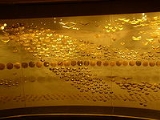
gold work collection - the biggest in the world - in its exhibition rooms on the second and third floors. Together with other pottery
Pottery
Pottery is the material from which the potteryware is made, of which major types include earthenware, stoneware and porcelain. The place where such wares are made is also called a pottery . Pottery also refers to the art or craft of the potter or the manufacture of pottery...
, stone
Rock (geology)
In geology, rock or stone is a naturally occurring solid aggregate of minerals and/or mineraloids.The Earth's outer solid layer, the lithosphere, is made of rock. In general rocks are of three types, namely, igneous, sedimentary, and metamorphic...
, shell, wood
Wood
Wood is a hard, fibrous tissue found in many trees. It has been used for hundreds of thousands of years for both fuel and as a construction material. It is an organic material, a natural composite of cellulose fibers embedded in a matrix of lignin which resists compression...
and textile
Textile
A textile or cloth is a flexible woven material consisting of a network of natural or artificial fibres often referred to as thread or yarn. Yarn is produced by spinning raw fibres of wool, flax, cotton, or other material to produce long strands...
archaeological
Archaeology
Archaeology, or archeology , is the study of human society, primarily through the recovery and analysis of the material culture and environmental data that they have left behind, which includes artifacts, architecture, biofacts and cultural landscapes...
objects, these items, made of what to indigenous cultures was a sacred metal
Metal
A metal , is an element, compound, or alloy that is a good conductor of both electricity and heat. Metals are usually malleable and shiny, that is they reflect most of incident light...
, testify to the life and thought of different societies which inhabited what is now known as Colombia
Colombia
Colombia, officially the Republic of Colombia , is a unitary constitutional republic comprising thirty-two departments. The country is located in northwestern South America, bordered to the east by Venezuela and Brazil; to the south by Ecuador and Peru; to the north by the Caribbean Sea; to the...
before contact was made with Europe
Europe
Europe is, by convention, one of the world's seven continents. Comprising the westernmost peninsula of Eurasia, Europe is generally 'divided' from Asia to its east by the watershed divides of the Ural and Caucasus Mountains, the Ural River, the Caspian and Black Seas, and the waterways connecting...
.
In 1939 the Bank of the Republic began helping to protect the archaeological
Archaeology
Archaeology, or archeology , is the study of human society, primarily through the recovery and analysis of the material culture and environmental data that they have left behind, which includes artifacts, architecture, biofacts and cultural landscapes...
patrimony
National patrimony
The store of wealth or accumulated reserves of a national economy. The term often refers to a nation's non-monetary wealth or reserves, such as its artistic heritage.- China :...
of Colombia
Colombia
Colombia, officially the Republic of Colombia , is a unitary constitutional republic comprising thirty-two departments. The country is located in northwestern South America, bordered to the east by Venezuela and Brazil; to the south by Ecuador and Peru; to the north by the Caribbean Sea; to the...
. The object known as Poporo Quimbaya
Poporo Quimbaya
Poporo Quimbaya is a precolumbian artpiece of the classic quimbaya period, currently exhibited in the Gold Museum in Bogotá, Colombia. Its primary use was as a ceremonial device for chewing of coca leaves during religious ceremonies...
was the first one in a collection. It has been on exhibition for 65 years.
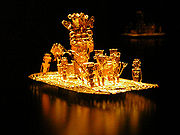
The museum houses the famous [Muisca]'s golden raft found in Pasca
Pasca
Pasca is a town and municipality in the Cundinamarca department of Colombia located over the Andes mountains. It belongs to the Sumapaz province.- Name :Pasca in the chibchan language means father's fence, according to Acosta Ortegón....
, Colombia
Colombia
Colombia, officially the Republic of Colombia , is a unitary constitutional republic comprising thirty-two departments. The country is located in northwestern South America, bordered to the east by Venezuela and Brazil; to the south by Ecuador and Peru; to the north by the Caribbean Sea; to the...
, that represents the El Dorado
El Dorado
El Dorado is the name of a Muisca tribal chief who covered himself with gold dust and, as an initiation rite, dived into a highland lake.Later it became the name of a legendary "Lost City of Gold" that has fascinated – and so far eluded – explorers since the days of the Spanish Conquistadors...
ceremony. The heir to the chieftaincy assumed power with a great offering to the gods. In this representation he is seen standing at the centre of a raft, surrounded by the principal chieftains, all of them adorned with gold
Gold
Gold is a chemical element with the symbol Au and an atomic number of 79. Gold is a dense, soft, shiny, malleable and ductile metal. Pure gold has a bright yellow color and luster traditionally considered attractive, which it maintains without oxidizing in air or water. Chemically, gold is a...
and feathers.
The museum has a collection of 55,000 pieces. 6,000 pieces are on display in their expanded building. There are bilingual descriptions of almost all exhibits. On the first floor is the museum's main entrance, the shop and a restaurant, The Gold Museum Restaurant and Café.
On the second floor the exposition begins, the Main Room is called People and Gold in prehispanic Colombia
Colombia
Colombia, officially the Republic of Colombia , is a unitary constitutional republic comprising thirty-two departments. The country is located in northwestern South America, bordered to the east by Venezuela and Brazil; to the south by Ecuador and Peru; to the north by the Caribbean Sea; to the...
. Through its glass cases it displays the goldsmith work of the different cultures which inhabited Colombia before the Spanish people arrived; the room is divided into different halls for every culture; Calima, Quimbaya
Quimbaya
Quimbaya is a Pre-Columbian term. It may mean:*The Quimbaya civilization of western Colombia*Quimbaya, Quindío, a municipality in the department of Quindío in Colombia*Quimbaya, an extinct Choco language...
, Muisca
Muisca
Muisca was the Chibcha-speaking tribe that formed the Muisca Confederation of the central highlands of present-day Colombia. They were encountered by the Spanish Empire in 1537, at the time of the conquest...
, Zenu, Tierradentro, San Augustín, Tolima, Tayrona and Uraba, and a special room called After Columbus
Christopher Columbus
Christopher Columbus was an explorer, colonizer, and navigator, born in the Republic of Genoa, in northwestern Italy. Under the auspices of the Catholic Monarchs of Spain, he completed four voyages across the Atlantic Ocean that led to general European awareness of the American continents in the...
(Despues de Colón).
The exposition continues on the third floor, with The Flying Chamanic and The Offering. The first shows the process of Chaman's Ceremony with its different gold pieces, the second is divided into three parts; the Offering Room, the Offering Boat and the Lake.
At the end of the exposition there's a Profunditation Room with artistic videos about the most important gold pieces of the museum.
External links
Gold Museum www.museodeloro.web.com.co Visita virtual Places To Go in Bogotá: Gold Museum video and informationEnglish Guided Tours
Monday to Saturday (closed Tuesday) 11:00 a.m. and 4:00 p.m.Sunday: 1:00 p.m.
See also
- Bank of the Republic Quimbaya museumQuimbaya museumQuimbaya Museum is a museum located in Armenia designed by Colombian architect Rogelio Salmona. It displays a large collection of precolumbian artcrafts , about 390 gold objects. 104 pottery, 22 stone sculptures, carved woods, and other issues, mainly from precolumbian Quimbaya civilization, ...