
All Topics  
Glycosylation


   Email Print
   Bookmark   Link


Glycosylation


Glycosylation is the enzymatic process that links saccharides to produce glycans
Glycans

The term glycan refers to a polysaccharide or oligosaccharide. Glycan may also be used to refer to the carbohydrate portion of a glycoconjugate, such as a glycoprotein, glycolipid, or a proteoglycan....
, either free or attached to protein
Protein

Proteins are organic compounds made of amino acids arranged in a linear chain and joined together by peptide bonds between the carboxyl and amino groups of adjacent amino acid Residue ....
s and lipid
Lipid

Lipids are broadly defined as any fat-soluble , naturally-occurring molecule, such as fats, oils, waxes, cholesterol, sterols, fat-soluble vitamins , monoglycerides, diglycerides, phospholipids, and others....
s. This enzymatic process produces one of four fundamental components of all cells (along with nucleic acids, proteins, and lipids) and also provides a co-translational and post-translational modification mechanism that modulates the structure and function of membrane and secreted proteins.


Discussion
Ask a question about 'Glycosylation'
Start a new discussion about 'Glycosylation'
Answer questions from other users
Full Discussion Forum


Encyclopedia


Glycosylation is the enzymatic process that links saccharides to produce glycans
Glycans

The term glycan refers to a polysaccharide or oligosaccharide. Glycan may also be used to refer to the carbohydrate portion of a glycoconjugate, such as a glycoprotein, glycolipid, or a proteoglycan....
, either free or attached to protein
Protein

Proteins are organic compounds made of amino acids arranged in a linear chain and joined together by peptide bonds between the carboxyl and amino groups of adjacent amino acid Residue ....
s and lipid
Lipid

Lipids are broadly defined as any fat-soluble , naturally-occurring molecule, such as fats, oils, waxes, cholesterol, sterols, fat-soluble vitamins , monoglycerides, diglycerides, phospholipids, and others....
s. This enzymatic process produces one of four fundamental components of all cells (along with nucleic acids, proteins, and lipids) and also provides a co-translational and post-translational modification mechanism that modulates the structure and function of membrane and secreted proteins. The majority of proteins synthesized in the rough ER
Endoplasmic reticulum

The endoplasmic reticulum is a eukaryote organelle that forms an interconnected network of tubules, vesicle , and cisternae within cell . The lacey membranes of the endoplasmic reticulum were first seen by Keith R....
 undergo glycosylation. It is an enzyme
Enzyme

Enzymes are biomolecules that catalysis chemical reactions. Almost all enzymes are proteins. In enzymatic reactions, the molecules at the beginning of the process are called Substrate , and the enzyme converts them into different molecules, the products....
-directed site-specific process, as opposed to the non-enzymatic chemical reaction of glycation
Glycation

Glycation is the result of a sugar molecule, such as fructose or glucose, bonding to a protein or lipid molecule without the controlling action of an enzyme....
. Glycosylation is also present in the cytoplasm and nucleus as the O-GlcNAc modification. Six classes of glycans are produced: N-linked glycans attached to the amide
Amide

In chemistry, an amide is one of three kinds of compounds:* the organic chemistry functional group characterized by a carbonyl group linked to a nitrogen atom , or a compound that contains this functional group ; or...
 nitrogen
Nitrogen

Nitrogen is a chemical element that has the symbol N and atomic number 7 and atomic mass 14.00674?. Elemental nitrogen is a colorless, odorless, tasteless and mostly inert diatomic gas at standard conditions, constituting 78% by volume of Earth's atmosphere....
 of asparagine
Asparagine

Asparagine is one of the 20 most common natural amino acids on Earth. It has carboxamide as the side chain's functional group. It is not an essential amino acid....
 side chain
Side chain

A side chain in organic chemistry and biochemistry is a part of a molecule that is attached to a core structure. The placeholder R is often used as a generic placeholder for side chains, the R historically being derived from radical or rest....
s, O-linked glycans attached to the hydroxy
Hydroxy

'Hydroxy' can refer to:* In chemical nomenclature, the prefix "hydroxy-" shows the presence of a hydroxyl functional group * An abbreviation for the medication hydroxyzine, which is commonly sold under the brand names Atarax, Ucerax, Serecid, and Vistaril....
 oxygen
Oxygen

Oxygen no O2 produced; 2) O2 produced, but absorbed in oceans & seabed rock; 3) O2 starts to gas out of the oceans, but is absorbed by land surfaces and formation of ozone layer; 4-5) O2 sinks filled and the gas accumulates]]...
 of serine
Serine

Serine is an organic compound with the chemical formula hydrogenoxygen2carbonCHCH2OH....
 and threonine
Threonine

Threonine is an a-amino acid with the chemical formula HO2CCHCHCH3. Its codons are ACU, ACA, ACC, and ACG. This essential amino acid is classified as Chemical polarity....
  side chains; glycosaminoglycans attached to the hydroxy
Hydroxy

'Hydroxy' can refer to:* In chemical nomenclature, the prefix "hydroxy-" shows the presence of a hydroxyl functional group * An abbreviation for the medication hydroxyzine, which is commonly sold under the brand names Atarax, Ucerax, Serecid, and Vistaril....
 oxygen
Oxygen

Oxygen no O2 produced; 2) O2 produced, but absorbed in oceans & seabed rock; 3) O2 starts to gas out of the oceans, but is absorbed by land surfaces and formation of ozone layer; 4-5) O2 sinks filled and the gas accumulates]]...
 of serine
Serine

Serine is an organic compound with the chemical formula hydrogenoxygen2carbonCHCH2OH....
; glycolipids in which the glycans are attached to ceramide, hyaluronan which is unattached to either protein or lipid, and GPI anchors which link proteins to lipids through glycan linkages.

Purpose


The polysaccharide chains attached to the target proteins serve various functions. For instance, some proteins do not fold correctly unless they are glycosylated first. Also, polysaccharides linked at the amide nitrogen
Nitrogen

Nitrogen is a chemical element that has the symbol N and atomic number 7 and atomic mass 14.00674?. Elemental nitrogen is a colorless, odorless, tasteless and mostly inert diatomic gas at standard conditions, constituting 78% by volume of Earth's atmosphere....
 of asparagine
Asparagine

Asparagine is one of the 20 most common natural amino acids on Earth. It has carboxamide as the side chain's functional group. It is not an essential amino acid....
 in the protein confer stability on some secreted glycoproteins. Experiments have shown that glycosylation in this case is not a strict requirement for proper folding, but the unglycosylated protein degrades quickly. Glycosylation may play a role in cell-cell adhesion (a mechanism employed by cells of the immune system
Immune system

An immune system is a collection of biological processes within an organism that protects against disease by identifying and killing pathogens and tumour cells....
), as well.

Mechanisms


There are various mechanisms for glycosylation, although all share several common features:
  • Glycosylation is an enzymatic process;
  • The donor molecule is an activated nucleotide sugar
    Nucleotide sugar

    Nucleotide sugars are biochemicals that act as donors of sugar residues in nucleotide sugars metabolism. They are substrates for glycosyltransferases....
    ;
  • The process is site-specific.


N-linked glycosylation

N-linked glycosylation is important for the folding of some eukaryotic proteins. The N-linked glycosylation process occurs in eukaryotes and widely in archaea
Archaea

The Archaea are a group of single-celled microorganisms. A single individual or species from this domain is called an archaeon . Archaea, like bacteria, are prokaryotic....
, but very rarely in bacteria
Bacteria

The Bacteria are a large group of unicellular microorganisms. Typically a few micrometres in length, bacteria have a wide range of shapes, ranging from spheres to rods and spirals....
.

For N-linked oligosaccharides, a 14-sugar precursor is first added to the asparagine in the polypeptide chain of the target protein. The structure of this precursor is common to most eukaryote
Eukaryote

Animals, plants, fungus, and protists are eukaryotes , organisms whose Cell are organized into complex structures enclosed within Cell membrane....
s, and contains 3 glucose
Glucose

Glucose , a monosaccharide also known as grape sugar, blood sugar, or corn sugar, is a very important carbohydrate in biology....
, 9 mannose
Mannose

Mannose is a sugar monomer of the hexose series of carbohydrates....
, and 2 N-acetylglucosamine molecules. A complex set of reactions attaches this branched chain to a carrier molecule called dolichol
Dolichol

Dolichol refers to any of a group of long-chain mostly unsaturated compound organic compounds which are made up of varying numbers of isoprene units terminating in an a-saturated isoprenoid group, containing an alcohol functional group....
, and then it is transferred to the appropriate point on the polypeptide chain as it is translocated into the ER lumen.

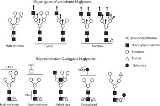
There are three major types of N-linked saccharides: high-mannose oligosaccharides, complex oligosaccharides and hybrid oligosaccharides.

  • High-mannose is, in essence, just two N-acetylglucosamines with many mannose residues, often almost as many as are seen in the precursor oligosaccharides before it is attached to the protein.


  • Complex oligosaccharides are so named because they can contain almost any number of the other types of saccharides, including more than the original two N-acetylglucosamines.


Proteins can be glycosylated by both types of oligos on different portions of the protein. Whether an oligosaccharide is high-mannose or complex is thought to depend on its accessibility to saccharide-modifying proteins in the Golgi
Golgi apparatus

The Golgi apparatus is an organelle found in most eukaryote Cell . It was identified in 1898 by the Italian physician Camillo Golgi and was named after him....
. If the saccharide is relatively inaccessible, it will most likely stay in its original high-mannose form. If it is accessible, then it is likely that many of the mannose residues will be cleaved off and the saccharide will be further modified by the addition of other types of group as discussed above.

The oligosaccharide
Oligosaccharide

An oligosaccharide is a saccharide polymer containing a small number of component sugars, also known as simple sugars. The name derived from the Greek oligos, meaning "a few"....
 chain is attached by oligosaccharyltransferase
Oligosaccharyltransferase

Oligosaccharyltransferase or OST is a membrane protein protein complex that transfers a 14-sugar oligosaccharide from dolichol to nascent protein....
 to asparagine
Asparagine

Asparagine is one of the 20 most common natural amino acids on Earth. It has carboxamide as the side chain's functional group. It is not an essential amino acid....
 occurring in the tripeptide
Peptide

Peptides are short polymers formed from the linking, in a defined order, of a-amino acids. The link between one amino acid residue and the next is known as an amide chemical bond or a peptide bond....
 sequence Asn
Asparagine

Asparagine is one of the 20 most common natural amino acids on Earth. It has carboxamide as the side chain's functional group. It is not an essential amino acid....
-X-Ser
Serine

Serine is an organic compound with the chemical formula hydrogenoxygen2carbonCHCH2OH....
, Asn
Asparagine

Asparagine is one of the 20 most common natural amino acids on Earth. It has carboxamide as the side chain's functional group. It is not an essential amino acid....
-X-Thr
Threonine

Threonine is an a-amino acid with the chemical formula HO2CCHCHCH3. Its codons are ACU, ACA, ACC, and ACG. This essential amino acid is classified as Chemical polarity....
 or Asn
Asparagine

Asparagine is one of the 20 most common natural amino acids on Earth. It has carboxamide as the side chain's functional group. It is not an essential amino acid....
-X-Cys
Cysteine

Cysteine is an a-amino acid with the chemical formula HO2CCHCH2SH. It is a non-essential amino acid, which means that humans can synthesize it....
, where X could be any amino acid
Amino acid

In chemistry, an amino acid is a molecule containing both amine and carboxyl functional groups. These molecules are particularly important in biochemistry, where this term refers to alpha-amino acids with the general formula H2NCHRCOOH, where R is an organic substituent....
 except Pro
Proline

Proline is an a-amino acid, one of the twenty DNA-encoded amino acids. Its codons are CCU, CCC, CCA, and CCG. It is not an essential amino acid, which means that humans can synthesize it....
. This sequence is known as a glycosylation sequon
Sequon

A sequon is a sequence of three consecutive amino acids in a proteinthat can serve as the attachment site to a polysaccharide called anN-linked-Glycan....
. After attachment, once the protein is correctly folded, the three glucose residues are removed from the chain and the protein is available for export from the ER. The glycoprotein thus formed is then transported to the Golgi where removal of further mannose residues may take place. However, glycosylation itself does not seem to be as necessary for correct transport targeting of the protein, as one might think. Studies involving drugs that block certain steps in glycosylation, or mutant cells deficient in a glycosylation enzyme, still produce otherwise-structurally-normal proteins that are correctly targeted, and this interference does not seem to interfere severely with the viability of the cells. Mature glycoproteins may contain a variety of oligomannose N-linked oligosaccharides containing between 5 and 9 mannose residues. Further removal of mannose residues leads to a 'core' structure containing 3 mannose
Mannose

Mannose is a sugar monomer of the hexose series of carbohydrates....
, and 2 N-acetylglucosamine residues, which may then be elongated with a variety of different monosaccharides including galactose
Galactose

Galactose is a type of Carbohydrate which is less sweetness than glucose. It is considered a nutritive sweetener because it has food energy.Galactan is a polymer of the sugar galactose....
, N-acetylglucosamine
N-Acetylglucosamine

N-Acetylglucosamine is a monosaccharide derivative of glucose. Chemically it is an amide between glucosamine and acetic acid. It has a molecular formula of carbon8hydrogen15nitrogenoxygen6, a molar mass of 221.21 g/mol, and it is significant in several biological systems....
, N-acetylgalactosamine
N-Acetylgalactosamine

N-Acetylgalactosamine is a monosaccharide derivative of galactose....
, fucose
Fucose

Fucose is a hexose deoxy sugar with the chemical formula C6H12O5. It is found on N-linked glycans on the mammalian, insect and plant cell surface, and is the fundamental sub-unit of the fucoidan polysaccharide....
 and sialic acid
Sialic acid

Sialic acid is a generic term for the N- or O-substituted derivatives of neuraminic acid, a monosaccharide with a nine-carbon backbone....
.

O-linked glycosylation


O-N-acetylgalactosamine (O-GalNAc)
O-linked glycosylation occurs at a later stage during protein processing, probably in the Golgi apparatus
Golgi apparatus

The Golgi apparatus is an organelle found in most eukaryote Cell . It was identified in 1898 by the Italian physician Camillo Golgi and was named after him....
. This is the addition of N-acetyl-galactosamine to serine
Serine

Serine is an organic compound with the chemical formula hydrogenoxygen2carbonCHCH2OH....
 or threonine
Threonine

Threonine is an a-amino acid with the chemical formula HO2CCHCHCH3. Its codons are ACU, ACA, ACC, and ACG. This essential amino acid is classified as Chemical polarity....
 residues by the enzyme UDP-N-acetyl-D-galactosamine:polypeptide N-acetylgalactosaminyltransferase , followed by other carbohydrates (such as galactose
Galactose

Galactose is a type of Carbohydrate which is less sweetness than glucose. It is considered a nutritive sweetener because it has food energy.Galactan is a polymer of the sugar galactose....
 and sialic acid
Sialic acid

Sialic acid is a generic term for the N- or O-substituted derivatives of neuraminic acid, a monosaccharide with a nine-carbon backbone....
). This process is important for certain types of proteins such as proteoglycan
Proteoglycan

File:PBB Protein ACAN image.jpgProteoglycans represent a special class of glycoproteins that are heavily glycosylation. They consist of a core protein with one or more covalent bond attached glycosaminoglycan chain....
s, which involves the addition of glycosaminoglycan chains to an initially unglycosylated "proteoglycan core protein." These additions are usually serine O-linked glycoproteins, which seem to have one of two main functions. One function involves secretion to form components of the extracellular matrix
Extracellular matrix

In biology, the extracellular matrix is the extracellular part of animal tissue that usually provides structural support to the animal Cell in addition to performing various other important functions....
, adhering one cell to another by interactions between the large sugar complexes of proteoglycans. The other main function is to act as a component of mucosal secretions, and it is the high concentration of carbohydrates that tends to give mucus its "slimy" feel. Proteins that circulate in the blood are not normally O-glycosylated, with the exception of IgA
IGA

IGA may stand for:Acronyms* Islamic Golden Age, also known as the Islamic Renaissance* Irish Games Association* International Gamers Award...
1 and IgD
IGD

IGD can refer to:*Internet Gateway Device Protocol as defined in UPnP.*IGD, Ilerici Gen?ler Dernegi, Progressive Young Association of Turkey*Immunoglobulin D, an antibody protein involved in the maturation of B cells....
 (two types of antibody) and C1-inhibitor
C1-inhibitor

C1-inhibitor is a serine protease inhibitor protein, the main function of which is the inhibition of the complement system to prevent spontaneous activation....
.

O-fucose
O-fucose is added between the second and third conserved cysteines of EGF-like repeats in the Notch
Notch

Notch may refer to:*Notch , a Hip hop, R&B, reggae, dancehall and reggaeton artist*Notch signaling pathway, a cell signaling system present in most multicellular organisms...
 protein, and possibly other substrates by GDP-fucose protein O-fucosyltransferase 1
GDP-fucose Protein O-fucosyltransferase 1

GDP-fucose protein O-fucosyltransferase 1 is an enzyme responsible for adding fucose sugars in O linkage to serine or threonine residues between the second and third conserved cysteines in Epidermal growth factor-like repeats on the Notch protein....
, and to Thrombospondin repeats by GDP-fucose protein O-fucosyltransferase 2
GDP-fucose protein O-fucosyltransferase 2

GDP-fucose protein O-fucosyltransferase 2 is an enzyme responsible for adding fucose sugars in O linkage to serine or threonine residues in Thrombospondin repeats....
. In the case of EGF-like repeats, the O-fucose
Fucose

Fucose is a hexose deoxy sugar with the chemical formula C6H12O5. It is found on N-linked glycans on the mammalian, insect and plant cell surface, and is the fundamental sub-unit of the fucoidan polysaccharide....
 may be further elongated to a tetrasaccharide by sequential addition of N-acetylglucosamine
N-Acetylglucosamine

N-Acetylglucosamine is a monosaccharide derivative of glucose. Chemically it is an amide between glucosamine and acetic acid. It has a molecular formula of carbon8hydrogen15nitrogenoxygen6, a molar mass of 221.21 g/mol, and it is significant in several biological systems....
 (GlcNAc), galactose
Galactose

Galactose is a type of Carbohydrate which is less sweetness than glucose. It is considered a nutritive sweetener because it has food energy.Galactan is a polymer of the sugar galactose....
, and sialic acid
Sialic acid

Sialic acid is a generic term for the N- or O-substituted derivatives of neuraminic acid, a monosaccharide with a nine-carbon backbone....
, and for Thrombospondin repeats, may be elongated to a disaccharide by the addition of glucose
Glucose

Glucose , a monosaccharide also known as grape sugar, blood sugar, or corn sugar, is a very important carbohydrate in biology....
. Both of these fucosyltransferases have been localized to the endoplasmic reticulum
Endoplasmic reticulum

The endoplasmic reticulum is a eukaryote organelle that forms an interconnected network of tubules, vesicle , and cisternae within cell . The lacey membranes of the endoplasmic reticulum were first seen by Keith R....
, which is unusual for glycosyltransferases, most of which function in the Golgi
Golgi

Golgi may refer to the physician Camillo Golgi or one of the structures named after him:*Golgi apparatus in some cells*Golgi tendon organ...
 apparatus.

O-glucose
O-glucose is added between the first and second conserved cysteines of EGF-like repeats in the Notch
Notch

Notch may refer to:*Notch , a Hip hop, R&B, reggae, dancehall and reggaeton artist*Notch signaling pathway, a cell signaling system present in most multicellular organisms...
 protein, and possibly other substrates by an unidentified O-glucosyltransferase.

O-N-acetylglucosamine (O-GlcNAc)
O-GlcNAc is added to serines or threonines by O-GlcNAc transferase. O-GlcNAc appears to occur on serines and threonines that would otherwise be phosphorylated by serine/threonine kinases. Thus, if phosphorylation
Phosphorylation

Phosphorylation is the addition of a phosphate group to a protein or other organic molecule. Protein phosphorylation in particular plays a significant role in a wide range of cellular processes....
 occurs, O-GlcNAc does not, and vice versa. This is an incredibly important finding because phosphorylation/dephosphorylation has become a scientific paradigm for the regulation of signaling within cells. A massive amount of cancer research is focused on phosphorylation. Ignoring the involvement of this form of glycosylation, which clearly appears to act in concert with phosphorylation, means that a lot of current research is missing at least half of the picture. O-GlcNAc addition and removal also appear to be key regulators of the pathways that are deregulated in diabetes mellitus. The gene encoding the O-GlcNAc removal enzyme has been linked to non-insulin dependent diabetes mellitus. It is the terminal step in a nutrient-sensing hexosamine signaling pathway.

GPI anchor


A special form of glycosylation is the GPI anchor. This form of glycosylation functions to attach a protein to a hydrophobic lipid anchor, via a glycan chain. (see also prenylation
Prenylation

Prenylation or isoprenylation or lipidation is the addition of hydrophobic molecules to a protein. It is usually assumed that prenyl groups facilitate attachment to cell membranes, similar to lipid anchored protein like the GPI anchor, though direct evidence is missing....
)

C-mannosylation

A mannose
Mannose

Mannose is a sugar monomer of the hexose series of carbohydrates....
 sugar is added to tryptophan
Tryptophan

Tryptophan is one of the 20 List of standard amino acids, as well as an essential amino acid in the human diet. It is encoded in the standard genetic code as the codon UGG....
 residues in Thrombospondin
Thrombospondin

Thrombospondins are secreted proteins with antiangiogenic abilities....
 repeats. This is an unusual modification both because the sugar is linked to a carbon
Carbon

Carbon is a chemical element with chemical symbol C and atomic number 6. As a member of group 14 on the periodic table, it is nonmetallic and tetravalence?making four electrons available to form covalent bond chemical bonds....
 rather than a reactive atom like a nitrogen
Nitrogen

Nitrogen is a chemical element that has the symbol N and atomic number 7 and atomic mass 14.00674?. Elemental nitrogen is a colorless, odorless, tasteless and mostly inert diatomic gas at standard conditions, constituting 78% by volume of Earth's atmosphere....
 or oxygen
Oxygen

Oxygen no O2 produced; 2) O2 produced, but absorbed in oceans & seabed rock; 3) O2 starts to gas out of the oceans, but is absorbed by land surfaces and formation of ozone layer; 4-5) O2 sinks filled and the gas accumulates]]...
 and because the sugar is linked to a tryptophan
Tryptophan

Tryptophan is one of the 20 List of standard amino acids, as well as an essential amino acid in the human diet. It is encoded in the standard genetic code as the codon UGG....
 residue rather than an asparagine
Asparagine

Asparagine is one of the 20 most common natural amino acids on Earth. It has carboxamide as the side chain's functional group. It is not an essential amino acid....
 or serine
Serine

Serine is an organic compound with the chemical formula hydrogenoxygen2carbonCHCH2OH....
/threonine
Threonine

Threonine is an a-amino acid with the chemical formula HO2CCHCHCH3. Its codons are ACU, ACA, ACC, and ACG. This essential amino acid is classified as Chemical polarity....
.

See also

  • Glycation
    Glycation

    Glycation is the result of a sugar molecule, such as fructose or glucose, bonding to a protein or lipid molecule without the controlling action of an enzyme....
  • Advanced glycation endproduct
    Advanced glycation endproduct

    Advanced Glycation End products are the result of a chain of chemical reactions after an initial glycation reaction. The intermediate products are known, variously, as Amadori product, Schiff base and Maillard reaction products, named after the researchers who first described them....


External links