
All Topics  
Globe Theatre

 
Globe Theatre

   Email Print
   Bookmark   Link


Globe Theatre


The Globe Theatre was a theatre
Theatre

Theatre is the branch of the performing arts defined by Bernard Beckerman as what "occurs when one or more actor, isolated in time and/or Theater , present themselves to Audience." By this broad definition, theatre has existed since the dawn of man, as a result of human tendency for story telling....
 in London associated with William Shakespeare
William Shakespeare

William Shakespeare was an English people poet and playwright, widely regarded as the greatest writer in the English language and the world's preeminent dramatist....
. It was built in 1599 by Shakespeare's playing company
Playing company

In English Renaissance London, playing company was the usual term for a company of actors. These companies were organized around a group of ten or so shareholders , who performed in the plays but were also responsible for management....
, the Lord Chamberlain's Men
Lord Chamberlain's Men

The Lord Chamberlain's Men was a playing company that William Shakespeare worked at as an actor and playwright for most of his career. Formed at the end of a period of flux in the theatrical world of London, it had become, by 1603, one of the two leading companies of the city and was subsequently patronized by James I of England....
, and was destroyed by fire on 29 June 1613. A second Globe Theatre was rebuilt on the same site by June 1614 and closed in 1642.

A modern reconstruction of the Globe, named "Shakespeare's Globe
Shakespeare's Globe

Shakespeare's Globe Theatre, which officially opened in 1997, is a reconstruction of The Globe Theatre, an Elizabethan playhouse in the London Borough of Southwark, on the south bank of the River Thames....
", opened in 1997. It is approximately from the site of the original theatre.

Globe was owned by actors who were also shareholders in the Lord Chamberlain's Men
Lord Chamberlain's Men

The Lord Chamberlain's Men was a playing company that William Shakespeare worked at as an actor and playwright for most of his career. Formed at the end of a period of flux in the theatrical world of London, it had become, by 1603, one of the two leading companies of the city and was subsequently patronized by James I of England....
.


Discussion
Ask a question about 'Globe Theatre'
Start a new discussion about 'Globe Theatre'
Answer questions from other users
Full Discussion Forum


Recent Posts


Encyclopedia


The Globe Theatre was a theatre
Theatre

Theatre is the branch of the performing arts defined by Bernard Beckerman as what "occurs when one or more actor, isolated in time and/or Theater , present themselves to Audience." By this broad definition, theatre has existed since the dawn of man, as a result of human tendency for story telling....
 in London associated with William Shakespeare
William Shakespeare

William Shakespeare was an English people poet and playwright, widely regarded as the greatest writer in the English language and the world's preeminent dramatist....
. It was built in 1599 by Shakespeare's playing company
Playing company

In English Renaissance London, playing company was the usual term for a company of actors. These companies were organized around a group of ten or so shareholders , who performed in the plays but were also responsible for management....
, the Lord Chamberlain's Men
Lord Chamberlain's Men

The Lord Chamberlain's Men was a playing company that William Shakespeare worked at as an actor and playwright for most of his career. Formed at the end of a period of flux in the theatrical world of London, it had become, by 1603, one of the two leading companies of the city and was subsequently patronized by James I of England....
, and was destroyed by fire on 29 June 1613. A second Globe Theatre was rebuilt on the same site by June 1614 and closed in 1642.

A modern reconstruction of the Globe, named "Shakespeare's Globe
Shakespeare's Globe

Shakespeare's Globe Theatre, which officially opened in 1997, is a reconstruction of The Globe Theatre, an Elizabethan playhouse in the London Borough of Southwark, on the south bank of the River Thames....
", opened in 1997. It is approximately from the site of the original theatre.

History

The Globe was owned by actors who were also shareholders in the Lord Chamberlain's Men
Lord Chamberlain's Men

The Lord Chamberlain's Men was a playing company that William Shakespeare worked at as an actor and playwright for most of his career. Formed at the end of a period of flux in the theatrical world of London, it had become, by 1603, one of the two leading companies of the city and was subsequently patronized by James I of England....
. Two of the six Globe shareholders, Richard Burbage
Richard Burbage

Richard Burbage was an actor and theatre owner. He was the younger brother of Cuthbert Burbage. They were both actors in drama.Burbage came from a poor family and was a popular actor by his early 20s....
 and his brother Cuthbert Burbage
Cuthbert Burbage

Cuthbert Burbage was an England theatrical figure, son of impresario James Burbage and elder brother of famous actor Richard Burbage. Most famous for his central role in the construction of the Globe Theatre, he was for four decades a significant agent in the success and endurance of Shakespeare's company, the King's Men ....
, owned double shares of the whole, or 25% each; the other four men, Shakespeare, John Heminges
John Heminges

John Heminges was an English Renaissance actor. Most famous now as one of the editors of Shakespeare's 1623 in literature First Folio, Heminges served in his time as an actor and financial manager for the King's Men ....
, Augustine Phillips, and Thomas Pope
Thomas Pope (16th-century actor)

Thomas Pope was an English Renaissance theatre actor, a member of the Lord Chamberlain's Men and a colleague of William Shakespeare. Pope was a "comedian and acrobat."...
, owned a single share, or 12.5%. (Originally William Kempe
William Kempe

William Kempe , also spelled Kemp, was an England actor and dancer best known for being one of the original actors in William Shakespeare's plays....
 was intended to be the seventh partner, but he sold out his share to the four minority sharers, leaving them with more than the originally planned 10%). These initial proportions changed over time as new sharers were added. Shakespeare's share diminished from 1/8 to 1/14, or roughly 7%, over the course of his career.

The Globe was built in 1599 using timber from an earlier theatre, The Theatre
The Theatre

The Theatre was an Elizabethan theatre located in Shoreditch , just outside the City of London. It was the second permanent theatre ever built in England, after the Red Lion , and the first successful one....
, which had been built by Richard Burbage's father, James Burbage
James Burbage

James Burbage, or Burbadge was an England actor, theatre impresario, and theatre builder in the English Renaissance theatre. He built The Theatre, the facility famous as the first permanent dedicated theatre built in England since Roman times....
, in Shoreditch
Shoreditch

Shoreditch is an area of London within the London Borough of Hackney. It is a built-up part of the inner city immediately to the north of the City of London, located north east of Charing Cross....
 in 1576. The Burbages originally had a 21-year lease
Lease

A lease is a legal document, but can be an speech communication arrangement, which confers a right on one person to possession property ownership to another person to the exclusion of the owner landlord....
 of the site on which The Theatre was built but owned the building outright. However, the landlord, Giles Allen, claimed that the building had become his with the expiry of the lease. On 28 December 1598, while Allen was celebrating Christmas at his country home, carpenter Peter Street, supported by the players and their friends, dismantled The Theatre beam by beam and transported it to Street's waterfront warehouse near Bridewell. With the onset of more favourable weather in the following spring, the material was ferried over the Thames
River Thames

The Thames is a major river flowing through southern England. While best known because its lower reaches flow through central London, the river flows through several other towns and cities, including Oxford, Reading, Berkshire and Windsor, Berkshire....
 to reconstruct it as The Globe on some marshy gardens to the south of Maiden Lane, Southwark.

On 29 June 1613 the Globe Theatre went up in flames during a performance of Henry the Eighth
Henry VIII (play)

The Famous History of the Life of King Henry the Eighth is a history play by William Shakespeare, based on the life of Henry VIII of England....
. A theatrical cannon, set off during the performance, misfired, igniting the wooden beams and thatching. According to one of the few surviving documents of the event, no one was hurt except a man whose burning breeches were put out with a bottle of ale. It was rebuilt in the following year.

Like all the other theatres in London, the Globe was closed down by the Puritan
Puritan

A Puritan of 16th and 17th century England was an associate of any number of religious groups advocating for more "purity" of worship and doctrine, as well as personal and group pietism....
s in 1642. It was pulled down in 1644, or slightly later, to make room for tenements.

Examination of old property records has identified the plot of land occupied by the Globe as extending from the west side of modern-day Southwark Bridge Road
Southwark Bridge Road

Southwark Bridge Road is a road in Southwark, London London SE1, between Newington Causeway near Elephant and Castle and Southwark Bridge across the River Thames, leading to the City of London....
 eastwards as far as Porter Street and from Park Street southwards as far as the back of Gatehouse Square. The precise location of the building however, remained unknown until a small part of the foundations, including one original pier base, was discovered in 1989 beneath the car park at the rear of Anchor Terrace
Anchor Terrace

Anchor Terrace is an early-19th-century building on the east side of Southwark Bridge Road in London, situated very close to the River Thames. Built in the mid-1830s, its original inhabitants were senior employees of the nearby Anchor Brewery, Southwark, which was then owned by Barclay and Perkins & Co....
 on Park Street. The shape of the foundations is now replicated on the surface. As the majority of the foundations lie beneath Anchor Terrace itself, which is a listed building
Listed building

A listed building in the United Kingdom is a building or other structure officially designated as being of special architectural, historical or cultural significance....
, no further excavations have been permitted.

Layout


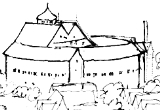
The Globe's actual dimensions are unknown, but its shape and size can be approximated from scholarly inquiry over the last two centuries. The evidence suggests that it was a three-storey, open-air amphitheatre
Amphitheatre

An amphitheatre is an open-air venue for spectator sports, concerts, rallies, or theatrical performances. There are two similar, but distinct types of amphitheatres: Ancient amphitheatres, built by the ancient Rome, were large central performance spaces surrounded by ascending seating, and were commonly used for spectator sports; these comp...
 approximately in diameter that could house up to 3,000 spectators. The Globe is shown as round on Wenceslas Hollar
Wenceslas Hollar

V?clav Hollar , known in England as Wenceslaus an in Germany as Wenzel Hollar , was a Czechs etcher. He was born in Prague, and died in London, being buried at St Margaret's church, Westminster....
's sketch of the building, later incorporated into his engraved "Long View" of London in 1647. However, in 1988-89, the uncovering of a small part of the Globe's foundation suggested that it was a polygon of 20 sides.

At the base of the stage, there was an area called the pit, (or, harking back to the old inn-yards
Inn-yard theatre

In the historical era of English Renaissance theatre, an Inn-yard theatre or Inn-theatre was a common inn that provided a venue for the presentation of stage plays....
, yard) where, for a penny, people (the "groundlings") would stand on the rush-strewn earthen floor to watch the performance. During the excavation of the Globe in 1989 a layer of nutshells was found, pressed into the dirt flooring so as to form a new surface layer. Around the yard were three levels of stadium-style seats, which were more expensive than standing room.
Globe Galleries
A rectangle stage platform
Thrust stage

In theater, a thrust stage is one that extends into the audience on three sides and is connected to the backstage area by its Stage #Stage directions end....
, also known as an 'apron stage', thrust out into the middle of the open-air yard. The stage measured approximately in width, in depth and was raised about off the ground. On this stage, there was a trap door for use by performers to enter from the "cellarage" area beneath the stage.

Large columns on either side of the stage supported a roof over the rear portion of the stage. The ceiling under this roof was called the "heavens," and was painted with clouds and the sky. A trap door in the heavens enabled performers to descend using some form of rope and harness. The back wall of the stage had two or three doors on the main level, with a curtained inner stage in the centre and a balcony above it. The doors entered into the "tiring house" (backstage area) where the actors dressed and awaited their entrances. The balcony housed the musicians and could also be used for scenes requiring an upper space, such as the balcony scene in Romeo and Juliet. Rush matting covered the stage, although this may only have been used if the setting of the play demanded it.

See also

  • Elizabethan Theatre


External links

  • The structure of the Globe by extrapolation from Hollar's sketch. University of Sydney.