
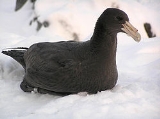
Giant petrels is a
genusIn biology, a genus is a low-level taxonomic rank used in the biological classification of living and fossil organisms, which is an example of definition by genus and differentia...
,
Macronectes, from the family
ProcellariidaeThe family Procellariidae is a group of seabirds that comprises the fulmarine petrels, the gadfly petrels, the prions, and the shearwaters. This family is part of the bird order Procellariiformes , which also includes the albatrosses, the storm-petrels, and the diving petrels.The procellariids are...
and consist of two species. They are the largest birds from this family. Both species are restricted to the
Southern HemisphereThe Southern Hemisphere is the part of Earth that lies south of the equator. The word hemisphere literally means 'half ball' or "half sphere"...
, and though their distributions overlap greatly with both species breeding on the
Prince Edward IslandsThe Prince Edward Islands are two small islands in the sub-antarctic Indian Ocean that are part of South Africa. The islands, named Marion Island and Prince Edward Island, are located at ....
,
Crozet IslandsThe Crozet Islands are a sub-antarctic archipelago of small islands in the southern Indian Ocean. They form one of the five administrative districts of the French Southern and Antarctic Lands.-Geography:...
,
Kerguelen IslandsThe Kerguelen Islands , also known as the Desolation Islands, are a group of islands in the southern Indian Ocean constituting the emerged part of the otherwise submerged Kerguelen Plateau. The islands, along with Adélie Land, the Crozet Islands and the Amsterdam and Saint Paul Islands are part of...
,
Macquarie IslandMacquarie Island lies in the southwest corner of the Pacific Ocean, about half-way between New Zealand and Antarctica, at 54°30S, 158°57E. Politically, it has formed part of the Australian state of Tasmania since 1900 and became a Tasmanian State Reserve in 1978. In 1997 it became a world heritage...
and South Georgia, many Southern Giant Petrel nest further south, with colonies as far south as
Antarctica. Giant petrels are aggressive predators and
scavengerScavenging is both a carnivorous and herbivorous feeding behavior in which individual scavengers search out dead animal and dead plant biomass on which to feed. The eating of carrion from the same species is referred to as cannibalism. Scavengers play an important role in the ecosystem by...
s, which has led to the other common name they were known as, the
Stinker, and the whalers used to call them
gluttons.
Taxonomy
The giant petrels are two large
seabirdSeabirds are birds that have adapted to life within the marine environment. While seabirds vary greatly in lifestyle, behaviour and physiology, they often exhibit striking convergent evolution, as the same environmental problems and feeding niches have resulted in similar adaptations...
s from the
genusIn biology, a genus is a low-level taxonomic rank used in the biological classification of living and fossil organisms, which is an example of definition by genus and differentia...
Macronectes. Long considered to be conspecific (they were not established as separate species until 1966), the two species, the
Southern Giant PetrelThe Southern Giant Petrel , also known as the Antarctic Giant Petrel, Giant Fulmar, Stinker, and Stinkpot, is a large seabird of the southern oceans. Its distribution overlaps broadly with the similar Northern Giant Petrel, though it overall is centered slightly further south...
,
Macronectes giganteus, and
Northern Giant PetrelThe Northern Giant Petrel , also known as the Hall's Giant Petrel, is a large seabird of the southern oceans. Its distribution overlaps broadly with the similar Southern Giant Petrel, though it overall is centered slightly further north.-Taxonomy:The Northern Giant Petrel along with its...
,
Macronectes halli, are considered with the two
fulmarFulmars are seabirds of the family Procellariidae. The family consists of two extant species and two that are extinct.-Taxonomy:As members of Procellaridae and then the order Procellariiformes, they share certain traits. First, they have nasal passages that attach to the upper bill called...
s,
Fulmarus, to form a distinct sub-group within Procellariidae, and if you add in the
Antarctic PetrelThe Antarctic Petrel is a boldly marked dark brown and white petrel, found in Antarctica, most commonly in the Ross and Weddell seas. They eat Antarctic krill, fish, and small squid...
,
Cape PetrelThe Cape Petrel also called Cape Pigeon or Pintado Petrel, is a common seabird of the Southern Ocean from the family Procellariidae. It is the only member of the genus Daption, and is allied to the fulmarine petrels, and the Giant Petrels. It is also sometimes known as the Cape Fulmar...
, and the
Snow PetrelThe Snow Petrel is the only member of the genus Pagodroma. It is one of only three birds that breed exclusively in Antarctica and has been seen at the South Pole. It has the most southerly breeding distribution of any bird.-Taxonomy:...
, they form a separate group from the rest of the family.
Description
Giant petrels earn their name. The
Southern Giant Petrel is slightly larger at 3 to 8 kg (6.6 to 17.6 lb), 180 to 210 cm (70.9 to 82.7 in) across the wings and 86 to 100 cm (33.9 to 39.4 in). The
Northern Giant Petrel is 3 to 5 kg (6.6 to 11 lb), 150 to 210 cm (59.1 to 82.7 in) across the wings and 80 to 95 cm (31.5 to 37.4 in). They superficially resemble the
albatrossAlbatrosses, of the biological family Diomedeidae, are large seabirds allied to the procellariids, storm-petrels and diving-petrels in the order Procellariiformes . They range widely in the Southern Ocean and the North Pacific...
, and are the only procellarids who can equal them in size. They can be separated from the albatrosses by their
billThe beak, bill or rostrum is an external anatomical structure of birds which is used for eating and for grooming, manipulating objects, killing prey, fighting, probing for food, courtship and feeding young...
; the two tube nostrils are joined together on the top of the bill, unlike on albatross where they are separated and on the side of the bill. They are also the only members of the Procellariidae family to have strong enough legs to walk effectively on land. They are also much darker and more mottled brown (except for the white morph Southern, which are whiter than any albatross) and have a more hunch-backed look. The bills of Procellariiformes are also unique in that they are split into between 7 and 9 horny plates. The Petrels have a hooked bill called the maxillary unguis which can hold slippery food. They produce a stomach oil made up of
wax esterAn ester of a fatty acid and a long-chain alcohol. These oils have similar properties as triglycerides, but are indigestible. They are found in some fish such as orange roughy, oilfish, escolar, black oreo, smooth oreo and other deep water fish. They are also present in marine copepods. Wax...
s and triglycerides that is stored in the
proventriculusThe proventriculus is part of the digestive system of birds, invertebrates and insects.-Birds:The proventriculus is a standard part of avian anatomy...
. This is used against predators as well as an energy rich food source for chicks and for the adults during their long flights. Finally, they have a salt gland that is situated above the nasal passage and helps desalinate their bodies, due to the high amount of ocean water that they imbibe. It excretes a high saline solution from their nose.
They are harder to tell from each other, possessing similar long pale orange bills and uniform mottled grey
plumagePlumage refers both to the layer of feathers that cover a bird and the pattern, colour, and arrangement of those feathers. The pattern and colours of plumage vary between species and subspecies and can also vary between different age classes, sexes, and season. Within species there can also be a...
(except for 15% of Southern Petrels, which are almost completely white). The billtip of
halli is reddish-pink and that of
giganteus is pale green, appearing slightly darker and lighter than the rest of the bill, respectively. The underside of older
halli is paler and more uniform than
giganteus, the latter showing a contrast between paler head and neck and darker belly. Additionally, adult
halli typically appear pale-eyed, while adult
giganteus of the normal morph typically appear dark-eyed (occasionally flecked paler). Classic examples of Northern Giant are identifiable at some range. Unfortunately young birds of both species are all dark and very hard to distinguish unless bill tip colour can be seen. Some relatively young Northern Giant Petrels can appear to be paler on the head suggesting Southern Giant and thus this species is harder to confirm.
Etymology
Macronectes comes from the
GreekGreek is an independent branch of the Indo-European family of languages. Native to the southern Balkans, it has the longest documented history of any Indo-European language, spanning 34 centuries of written records. Its writing system has been the Greek alphabet for the majority of its history;...
words
makros meaning
long and
nēktēs meaning
swimmer. Also
Petrel is derived from
St. Peter and the story of his walking on water as they appear to run on the water when they take off.
Feeding
Giant petrels are highly opportunistic feeders, uniquely for procellarids they will feed on land as well as at sea, in fact they find most of their food near the coast. On land they feed on
carrionCarrion refers to the carcass of a dead animal. Carrion is an important food source for large carnivores and omnivores in most ecosystems. Examples of carrion-eaters include vultures, hawks, eagles, hyenas, Virginia Opossum, Tasmanian Devils, coyotes, Komodo dragons, and burying beetles...
, particularly that of
sealsPinnipeds or fin-footed mammals are a widely distributed and diverse group of semiaquatic marine mammals comprising the families Odobenidae , Otariidae , and Phocidae .-Overview: Pinnipeds are typically sleek-bodied and barrel-shaped...
and
penguinPenguins are a group of aquatic, flightless birds living almost exclusively in the southern hemisphere, especially in Antarctica. Highly adapted for life in the water, penguins have countershaded dark and white plumage, and their wings have become flippers...
s. They also display their dominance over carcasses with a "sealmaster posture": the head and the wings are held outstretched, the head pointing at the opponent and the wingtips pointing slightly back; the tail is raised to a vertical position. They are also capable of killing other seabirds, even those as large as an albatross, which they kill either by battering them to death (most commonly chicks of other species during the breeding season) or drowning. At sea they feed on
krillKrill is the common name given to the order Euphausiacea of shrimp-like marine crustaceans. Also known as euphausiids, these small invertebrates are found in all oceans of the world...
,
squidSquid are cephalopods of the order Teuthida, which comprises around 300 species. Like all other cephalopods, squid have a distinct head, bilateral symmetry, a mantle, and arms. Squid, like cuttlefish, have eight arms arranged in pairs and two, usually longer, tentacles...
and fish, often attending
fishing fleetA fishing fleet is an aggregate of commercial fishing vessels. The term may be used of all vessels operating out of a particular port, all vessels engaged in a particular type of fishing , or all fishing vessels of a country or region.Although fishing vessels are not formally organized as if they...
s in the hope of picking up
offalOffal , also called, especially in the United States, variety meats or organ meats, refers to the internal organs and entrails of a butchered animal. The word does not refer to a particular list of edible organs, which varies by culture and region, but includes most internal organs other than...
.
Reproduction
The Southern Giant Petrel is more likely to form loose colonies than the Northern, both species laying a single egg in a rough
nestA bird nest is the spot in which a bird lays and incubates its eggs and raises its young. Although the term popularly refers to a specific structure made by the bird itself—such as the grassy cup nest of the American Robin or Eurasian Blackbird, or the elaborately woven hanging nest of the...
built about 50 cm (19.7 in) off the ground. The
eggBird eggs are laid by females and incubated for a time that varies according to the species; a single young hatches from each egg. Average clutch sizes range from one to about 17...
is
incubateIncubation refers to the process by which certain oviparous animals hatch their eggs, and to the development of the embryo within the egg. The most vital factor of incubation is the constant temperature required for its development over a specific period. Especially in domestic fowl, the act of...
d for about 60 days, once hatched the chick is brooded for 3 weeks. Chicks
fledgeFledge is the stage in a young bird's life when the feathers and wing muscles are sufficiently developed for flight. It also describes the act of a chick's parents raising it to a fully grown state...
after about 4 months, but do not achieve sexual maturity for another 6–7 years after fledging.
Conservation
While both species are listed as
Near ThreatenedNear Threatened is a conservation status assigned to species or lower taxa that may be considered threatened with extinction in the near future, although it does not currently qualify for the threatened status...
in the 2008 Red List by the IUCN, recent evidence suggests they are less threatened than previously believed, and the populations of both actually appear to have increased, at least locally. Consequently they will be listed as
Least ConcernLeast Concern is an IUCN category assigned to extant taxon or lower taxa which have been evaluated but do not qualify for any other category. As such they do not qualify as threatened, Near Threatened, or Conservation Dependent...
on the 2009 Red List.
The Southern Giant Petrel is listed as
endangered on the Australian
Environment Protection and Biodiversity Conservation Act 1999The Environment Protection and Biodiversity Conservation Act 1999 is an Act of the Parliament of Australia that provides a framework for protection of the Australian environment, including its biodiversity and its natural and culturally significant places...
, while the Northern Giant Petrel is listed on the same Act as
vulnerable. Their conservation status also varies from state to state within Australia. For example:
- Both the Southern and Northern Giant Petrels are listed as threatened on the Victorian Flora and Fauna Guarantee Act (1988). Under this Act, Action Statements for the recovery and future management of these species have been prepared.
- On the 2007 advisory list of threatened vertebrate fauna in Victoria, the Southern Giant Petrel is listed as vulnerable, while the Northern Giant Petrel is listed as near threatened.