

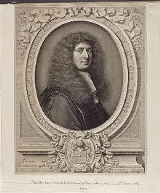
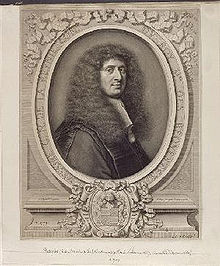
Gabriel Nicolas de la Reynie

Encyclopedia
Police
The police is a personification of the state designated to put in practice the enforced law, protect property and reduce civil disorder in civilian matters. Their powers include the legitimized use of force...
.
Early career
Born in 1625 in LimogesLimoges
Limoges |Limousin]] dialect of Occitan) is a city and commune, the capital of the Haute-Vienne department and the administrative capital of the Limousin région in west-central France....
, France to a poor family, Gabriel Nicolas made a wealthy marriage in 1645 and took the name of Reynie, a minor lordship with an annual income of 200 pounds. He was a magistrate at Angoulême
Angoulême
-Main sights:In place of its ancient fortifications, Angoulême is encircled by boulevards above the old city walls, known as the Remparts, from which fine views may be obtained in all directions. Within the town the streets are often narrow. Apart from the cathedral and the hôtel de ville, the...
, then president of the court at Bordeaux
Bordeaux
Bordeaux is a port city on the Garonne River in the Gironde department in southwestern France.The Bordeaux-Arcachon-Libourne metropolitan area, has a population of 1,010,000 and constitutes the sixth-largest urban area in France. It is the capital of the Aquitaine region, as well as the prefecture...
. He avoided entanglement in the Fronde
Fronde
The Fronde was a civil war in France, occurring in the midst of the Franco-Spanish War, which had begun in 1635. The word fronde means sling, which Parisian mobs used to smash the windows of supporters of Cardinal Mazarin....
(the last rebellion carried out by the nobles of France against the King) and acted as intendant to the governor of Guyenne
Guyenne
Guyenne or Guienne , , ; Occitan Guiana ) is a vaguely defined historic region of south-western France. The Province of Guyenne, sometimes called the Province of Guyenne and Gascony, was a large province of pre-revolutionary France....
, Jean Louis de Nogaret de La Valette
Jean Louis de Nogaret de La Valette
Jean Louis de Nogaret de La Valette , created Duke of Épernon, was a powerful member of the French nobility at the turn of the 17th century. He was deeply involved in plots and politics throughout his life....
, Duke of Épernon, who introduced him to court. In 1661, he bought for 320 000 pounds the office of Maître des requêtes
Maître des requêtes
Masters of Requests are high-level judicial officers of administrative law in France and other European countries that have existed in one form or another since the Middle Ages.-Old Regime France:...
to the King's Council
Conseil du Roi
The Conseil du Roi or King's Council is a general term for the administrative and governmental apparatus around the king of France during the Ancien Régime designed to prepare his decisions and give him advice...
.
Lieutenant General of Police
Jean-Baptiste ColbertJean-Baptiste Colbert
Jean-Baptiste Colbert was a French politician who served as the Minister of Finances of France from 1665 to 1683 under the rule of King Louis XIV. His relentless hard work and thrift made him an esteemed minister. He achieved a reputation for his work of improving the state of French manufacturing...
, minister to the King, inaugurated the new office of Lieutenant General of Police of Paris in 1667. The edict which Colbert presented to Louis XIV in March 1667 resulted from several centuries' evolution of French attitudes towards public safety. He envisioned a complete solution to crime; from a situation inherited from the Middle Ages, he distilled the foundations of the modern police force under the Ancien Régime. The purpose of the office of Lieutenant General of Police was to create an autonomous force to take care of the nicer areas of the city, and curb the growth of the Cour des miracles
Cour des miracles
Cour des miracles was a French term which referred to slum districts of Paris, France where the unemployed migrants from rural areas resided...
. Paris was the first city to take such measures. Originally concerned mainly with requests from the Council of State, the position had complete authority over existing institutions of law enforcement and civil protection. In particular, the Lieutenant General of Police supported the various governmental bureaus (trades, markets, schools, archives, etc.). Appointed by the king, the office of Lieutenant General of Police is revocable ad nutum (at will).
Tenure and views
Nicolas de la Reynie was the first Lieutenant General of the Paris police, an office which he held from March 1667 to January 1697. His views on law enforcement were advanced, and form the basis for modern police forces today. "Policing consists in ensuring the safety of the public and of private individuals, by protecting the city from that which causes disorder." Reynie vigorously suppressed the printing and sale of seditious writings, crimes which he judged himself directly (and very severely).Accomplishments
While the edict conferred on Reynie certain responsibilities it allowed him the freedom to organize his administration by gathering under its authority the old institutions. At that time, four "police forces" competed within Paris: police chiefs, archers and freemen of the guet royal(?), the company of the criminal lieutenant, and the Provost of the city. De la Reynie reorganized these forces and took them under his wing. They were charged with ensuring the safety of the streets of Paris and supervising the environs of Paris. In addition to this, Reynie re-establishied royal authority in place of the Governor of Paris, those who held fiefdoms within Paris, and the Parlement, which had until then dealt with police, commercial, and municipal regulation.The chief inspectors in the Châtelet
Grand Châtelet
The Grand Châtelet was a stronghold in Ancien Régime Paris, on the right bank of the Seine, on the site of what is now the Place du Châtelet; it contained a court and police headquarters and a number of prisons....
became Police Chiefs of the force and were increased in number to 48. Distributed between the 17 districts of Paris, they gave a daily account of their activity to the General Lieutenant. Nicolas de la Reynie also relied on a network of paid informers known as "flies" outside and "sheep" in the prisons. He was authorized to call on the armed forces, either the constabulary of Isle-de-France or the guard of Paris (approximately a thousand guards that worked the gates and walls(?) of Paris).
Responsible for the execution of royal lettres de cachets
Lettre de cachet
Lettres de cachet were letters signed by the king of France, countersigned by one of his ministers, and closed with the royal seal, or cachet...
, he was an enforcer of government policy such as when he ensured the corn supply of Paris, defended Protestants against persecution (even after the revocation of the Edict of Nantes he saved Protestants from interference, sometimes at the risk of his own life and safety), giving aid rather than punishment to beggars and vagabonds, and seeing to the proper retrieval and care of abandoned infants, often left in the streets to die.
De la Reynie also served as judge or prosecutor in lawsuits involving the aristocracy, such as that of the Chevalier de Rohan, decapitated for conspiracy, and the Affair of the Poisons (l'affaire des poisons) involving the Marquise de Brinvilliers
Marie-Madeleine-Marguerite d'Aubray, Marquise de Brinvilliers
Marie-Madeleine-Marguerite d'Aubray, Marquise de Brinvilliers was a French serial killer.-Crimes:Marie-Madeleine-Marguerite d'Aubray conspired with her lover, army captain Godin de Sainte-Croix to poison her father Antonine Dreux d'Aubray in 1666 and two of her brothers, Antoine d'Aubray and...
and other high-ranking French nobility.
Paris owes to de la Reynie its system of street lighting which made the streets safer (and from whence arose the expression "Paris, the City of Light"), the first rules of circulation and parking, the paving of the streets and the water conveyance(?). It was he who first investigated the many mysterious deaths of the Affair of the Poisons.
Later life
In private life, Reynie was known as an important and discerning collector of ancient Greek and Roman manuscripts, which he himself collated and reconstructed, and as a bibliophile, assembling one of the finest private libraries in Paris. Reynie became a Councillor of State in 1680. In 1697 he was succeeded as Lieutenant-General of Police by the Marquis d'ArgensonMarc-René de Voyer de Paulmy d'Argenson (1652-1721)
Marc-René de Voyer de Paulmy, 1st marquis d'Argenson was a French politician.-Biography:Argenson was born in Venice where his father, also Marc-René, was ambassador...
, to whom many of Reynie's innovations are popularly attributed. Reynie died in 1709 in Paris.