
|
|
|
|
Freshwater Crocodile
|
| |
|
| |
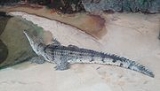
The freshwater crocodile (Crocodylus johnsoni), also known as the Australian freshwater crocodile, Johnston's crocodile or colloquially as freshie, is a species of reptile endemic to Australia. Found in the northern regions of Australia, it is much smaller than the other Australian species, the saltwater crocodile, which is responsible for attacks on people.
Although they will bite if disturbed or feel threatened, freshwater crocodiles are not known as man-eaters and their jaws are not big enough to seriously harm humans.

Discussion
Ask a question about 'Freshwater Crocodile'
Start a new discussion about 'Freshwater Crocodile'
Answer questions from other users
|
Recent Posts

Encyclopedia
The freshwater crocodile (Crocodylus johnsoni), also known as the Australian freshwater crocodile, Johnston's crocodile or colloquially as freshie, is a species of reptile endemic to Australia. Found in the northern regions of Australia, it is much smaller than the other Australian species, the saltwater crocodile, which is responsible for attacks on people.
Although they will bite if disturbed or feel threatened, freshwater crocodiles are not known as man-eaters and their jaws are not big enough to seriously harm humans. They will usually ignore people when sunning themselves beside a swimming hole, provided they have a relatively peaceful spot.
Anatomy and appearance
The Australian freshwater crocodile is a relatively small crocodilian. Males can grow 3 meters (10 ft) long, while females reach a maximum size of 2.1 metres (7 ft). The body colour is light brown with darker bands on the body and tail - these tend to be broken up near the neck. Some individuals possess distinct bands or speckling on the snout. Body scales are relatively large, with wide, closely-knit armoured plates on the back. Rounded, pebbly scales cover the flanks and outsides of the legs.
Attacks on humans
The Freshwater Crocodile is not capable of killing or even seriously harming a human. There has only been one recorded attack by a freshwater crocodile on a human; this attack took place at Barramundi Gorge (also known as Maguk) in Kakadu National Park and resulted in very minor injuries to the victim, who managed to swim and walk away from the attack. It is believed the victim swam directly over the small crocodile, in general it is still considered safe to swim with this species.
Distribution and habitat
They are found in the states of Western Australia, Queensland, and the Northern Territory. Main habitats include freshwater wetlands, billabongs, rivers, and creeks. It competes poorly with Saltwater crocodiles but is saltwater tolerant. As an adult its diet consists of birds, bats, reptiles, amphibians, and fish. This species can be found in areas where Saltwater Crocodiles cannot and are known to inhabit areas above the escarpment in Kakadu National Park and in very arid & rocky conditions (such as Katherine Gorge, where they are very common.) That being said, they are still consistently found in low-level billabongs, living alongside their larger evolutionary cousins.
Conservation and concerns
This species, until recently, was common throughout much of northern Australia, especially where the much larger and far more dangerous Saltwater Crocodile is not found (such as more arid inland areas and higher elevations) but in recent years the population has dropped dramatically due to the ingestion of local populations of the invasive Cane Toad. The toad is lethally poisonous to Freshwater Crocodiles (although strangely harmless to Saltwater Crocodiles) and is rampant throughout the Australian wilderness.
Sources
- Crocodile Specialist Group 1996. . Downloaded on 29 July 2007.
|
| |
|
|