

Free price system

Encyclopedia
A free price system or free price mechanism (informally called the price system or the price mechanism) is an economic system where prices are set by the interchange of supply and demand
, with the resulting prices being understood as signal
s that are communicated between producers and consumers which serve to guide the production and distribution of resources. Through the free price system, supplies are rationed, income is distributed, and resources are allocated. A free price system contrasts with a controlled or fixed price system where prices are set by government, within a controlled market or planned economy
.
in a market economy
like ebay
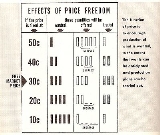
. Since resources of consumers are limited at any given time, consumers are relegated to satisfying wants in a descending hierarchy and bidding prices relative to the urgency of a variety of wants. This information on relative values is communicated, through price signal
s, to producers whose resources are also limited. In turn, relative prices for the productive services are established. The interchange of these two sets of prices establish market value, and serve to guide the rationing of resources, distributing income, and allocating resources.
Those goods which command the highest prices (when summed among all individuals) provide an incentive for businesses to provide these goods in a corresponding descending hierarchy of priority. However, the ordering of this hierarchy of wants is not constant. Consumer preferences change. When consumer preferences for a good change, then bidding pressure raises the price for a particular good as it moves to a higher position in the hierarchy. As a result of higher prices for this good, more productive forces are applied to satisfying the demand driven by the opportunity for higher profits in satisfying this new consumer preference. In other words, the high price sends a price signal to producers. This causes producers to increase supply, either by the same firms increasing production or new businesses coming in to the market, which eventually lowers the price and the profit incentive to increase supplies. Hence, the now lower price provides a price signal to producers to decrease production and, as a result, a surplus is prevented. Since resources are scarce (including labor and capital), supplies of other goods will be diminished as the productive resources are taken from other areas of production to be applied toward increasing output of the good who has risen in the hierarchy of consumer preferences. Also, as resources become more scarce the price increases, which signals to consumers to reduce consumption thereby ensuring that the quantity demanded does not exceed the quantity supplied. It is in this way that the free price system persuades consumers to ration dwindling resources. Hence, supply and demand affects price while at the same time, price affects supply and demand. If prices remain high because increases in supply cannot keep pace with demand, then this also signals other business to provide substitute goods in order to take advantage of profit opportunities.
Individual employments and incomes are also guided by the price system. Employment will move toward those goods and services that consumers value and away from those with declining importance to consumers as a result of changes in prices.
Supply and demand
Supply and demand is an economic model of price determination in a market. It concludes that in a competitive market, the unit price for a particular good will vary until it settles at a point where the quantity demanded by consumers will equal the quantity supplied by producers , resulting in an...
, with the resulting prices being understood as signal
Price signal
A price signal is a message sent to consumers and producers in the form of a price charged for a commodity; this is seen as indicating a signal for producers to increase supplies and/or consumers to reduce demand.- Free price system :...
s that are communicated between producers and consumers which serve to guide the production and distribution of resources. Through the free price system, supplies are rationed, income is distributed, and resources are allocated. A free price system contrasts with a controlled or fixed price system where prices are set by government, within a controlled market or planned economy
Planned economy
A planned economy is an economic system in which decisions regarding production and investment are embodied in a plan formulated by a central authority, usually by a government agency...
.
Mechanics of a free price system
Rather than prices being set by the state, as in a command economy with a fixed price system, prices are determined in a decentralized fashion by trades that occur as a result of sellers' asking prices matching buyers' bid prices as a result of subjective value judgementSubjective theory of value
The subjective theory of value is an economic theory of value that identifies worth as being based on the wants and needs of the members of a society, as opposed to value being inherent to an object....
in a market economy
Market economy
A market economy is an economy in which the prices of goods and services are determined in a free price system. This is often contrasted with a state-directed or planned economy. Market economies can range from hypothetically pure laissez-faire variants to an assortment of real-world mixed...
like ebay
EBay
eBay Inc. is an American internet consumer-to-consumer corporation that manages eBay.com, an online auction and shopping website in which people and businesses buy and sell a broad variety of goods and services worldwide...
. Since resources of consumers are limited at any given time, consumers are relegated to satisfying wants in a descending hierarchy and bidding prices relative to the urgency of a variety of wants. This information on relative values is communicated, through price signal
Price signal
A price signal is a message sent to consumers and producers in the form of a price charged for a commodity; this is seen as indicating a signal for producers to increase supplies and/or consumers to reduce demand.- Free price system :...
s, to producers whose resources are also limited. In turn, relative prices for the productive services are established. The interchange of these two sets of prices establish market value, and serve to guide the rationing of resources, distributing income, and allocating resources.
Those goods which command the highest prices (when summed among all individuals) provide an incentive for businesses to provide these goods in a corresponding descending hierarchy of priority. However, the ordering of this hierarchy of wants is not constant. Consumer preferences change. When consumer preferences for a good change, then bidding pressure raises the price for a particular good as it moves to a higher position in the hierarchy. As a result of higher prices for this good, more productive forces are applied to satisfying the demand driven by the opportunity for higher profits in satisfying this new consumer preference. In other words, the high price sends a price signal to producers. This causes producers to increase supply, either by the same firms increasing production or new businesses coming in to the market, which eventually lowers the price and the profit incentive to increase supplies. Hence, the now lower price provides a price signal to producers to decrease production and, as a result, a surplus is prevented. Since resources are scarce (including labor and capital), supplies of other goods will be diminished as the productive resources are taken from other areas of production to be applied toward increasing output of the good who has risen in the hierarchy of consumer preferences. Also, as resources become more scarce the price increases, which signals to consumers to reduce consumption thereby ensuring that the quantity demanded does not exceed the quantity supplied. It is in this way that the free price system persuades consumers to ration dwindling resources. Hence, supply and demand affects price while at the same time, price affects supply and demand. If prices remain high because increases in supply cannot keep pace with demand, then this also signals other business to provide substitute goods in order to take advantage of profit opportunities.
Individual employments and incomes are also guided by the price system. Employment will move toward those goods and services that consumers value and away from those with declining importance to consumers as a result of changes in prices.
See also
- Invisible handInvisible handIn economics, invisible hand or invisible hand of the market is the term economists use to describe the self-regulating nature of the marketplace. This is a metaphor first coined by the economist Adam Smith...
- Spontaneous orderSpontaneous orderSpontaneous order, also known as "self-organization", is the spontaneous emergence of order out of seeming chaos. It is a process found in physical, biological, and social networks, as well as economics, though the term "self-organization" is more often used for physical and biological processes,...
- Self organization
- Subjective theory of valueSubjective theory of valueThe subjective theory of value is an economic theory of value that identifies worth as being based on the wants and needs of the members of a society, as opposed to value being inherent to an object....
- Market economyMarket economyA market economy is an economy in which the prices of goods and services are determined in a free price system. This is often contrasted with a state-directed or planned economy. Market economies can range from hypothetically pure laissez-faire variants to an assortment of real-world mixed...
- CapitalismCapitalismCapitalism is an economic system that became dominant in the Western world following the demise of feudalism. There is no consensus on the precise definition nor on how the term should be used as a historical category...
- Free marketFree marketA free market is a competitive market where prices are determined by supply and demand. However, the term is also commonly used for markets in which economic intervention and regulation by the state is limited to tax collection, and enforcement of private ownership and contracts...