

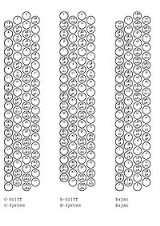
Free-bass system

Encyclopedia
A free-bass system is a system of bass button
s on an accordion
, arranged to give the performer greater access to playing melodies on the left-hand manual of the instrument and to forming one's own chords, by providing a buttonboard of single-note buttons with a range of three octaves or more, in contrast to the standard Stradella bass system
which only allows bass notes (range of a major seventh) and preset major, minor, dominant seventh, and diminished chords. The term "free-bass system" refers to various left-hand manual systems that provide this functionality:

had principally reached its current construction with 120 buttons over 6 rows. However, while that setup worked well for major and minor
music accompanied by many chords, the performer would only have access to about a single octave of notes while playing - two with a timely shift of registers. The problem was solved as early as 1910 by adding three rows of chromatically ordered single notes next to the standard bass
.
company decided to enlarge the market for accordionsMonichon wrote, "En 1912, la maison Hohner produira ses premières <> . . . . La 'Coopérative Stradella' mettra au point, en 1912, un instrument de 120 basses avec trois rangées de 'notes chromatique' . . ."—Pierre Monichon, Francesco Giannattasio and B. Bugiolacchi, Chronological Synthesis of the Evolution of the Accordion (1984). by turning the instrument from its traditional music
roots into an established instrument for orchestra
s. An orchestra was put together, touring Germany
to introduce the new concept. The company also supplied sheet music
for this new type of accordion. Although these were reportedly popular, it wasn't until later when the instrument became more widespread.
In North Europe, free-bass accordionist Mogens Ellegaard
helped popularize the instrument and achieve compositions for it.Ole Schmidt made the following comment: "I hated accordion until I met Mogens Ellegaard. He made me decide to write an accordion concerto for him." Ole Schmidt, cited in the CD booklet for Contemporary Danish Accordion Music, performed by Mogens Ellegaard with the Danish Radio Symphony Orchestra, conducted by Ole Schmidt (Solrod Strand, Denmark: Independent Music, 1987).
In an interview he describes how the free-bass accordion was still practically non-existent in his childhood (born 1935), but how composers in his native Denmark
began to write works for him since 1958. In 1968 he arranged the manufacture of accordions with nothing but free-bass layouts to accommodate newcomers, as free-bass accordions would otherwise always include standard bass.
In some Russian, Canadian and European music conservatories, free bass accordion is considered a serious instrument for study and there is now a large modern repertoire for it. In the United States, free bass instruments are much less well known despite attempts to popularize them by Palmer and Hughes and the Giulietti accordion company in the 1960s and 1970s. During this period several American
accordionists demonstrated the unique orchestral sound of the instrument through live performances as well as by composing original works which featured the instrument. Included among this group was John Serry, Sr.
whose Concerto For Free Bass Accordion
was completed during the 1960s. (See Accordion music genres
)
Button (control)
A push-button or simply button is a simple switch mechanism for controlling some aspect of a machine or a process. Buttons are typically made out of hard material, usually plastic or metal. The surface is usually flat or shaped to accommodate the human finger or hand, so as to be easily depressed...
s on an accordion
Accordion
The accordion is a box-shaped musical instrument of the bellows-driven free-reed aerophone family, sometimes referred to as a squeezebox. A person who plays the accordion is called an accordionist....
, arranged to give the performer greater access to playing melodies on the left-hand manual of the instrument and to forming one's own chords, by providing a buttonboard of single-note buttons with a range of three octaves or more, in contrast to the standard Stradella bass system
Stradella bass system
The Stradella Bass System is a buttonboard layout equipped on the bass side of many accordions, which uses columns of buttons arranged in a circle of fifths; this places the principal major chords of a key in three adjacent columns...
which only allows bass notes (range of a major seventh) and preset major, minor, dominant seventh, and diminished chords. The term "free-bass system" refers to various left-hand manual systems that provide this functionality:
- Two related layouts exist as mirror versions of the chromatic button accordionChromatic button accordionA chromatic button accordion is a type of button accordion where the melody-side keyboard consists of rows of buttons arranged chromatically. The bass-side keyboard is usually the Stradella system or one of the various free-bass systems. Included among chromatic button accordions are the Russian...
. - The "quintQuintQuint may refer to:In literature:* Quintinius Verginix, a character from The Edge Chronicles book series* Quint, a shipmaker in the series of novels Spider Riders*quint magazine, a Dubai based arts & culture magazine...
" or converter free-bass system invented by Bill PalmerBill PalmerBill Palmer invented a 'quint' system which was later patented by Titano as used in their line of converter bass accordions.He made many written contributions to magazines for the promotion of the Piano Accordion, including Accordion World...
- later patented by Titano. - Piano-like layout mirrors the right keyboard of a piano accordion, though buttons are not rectangular but round. This system is popular in Asian piano accordions, especially in AzeriAzerbaijanAzerbaijan , officially the Republic of Azerbaijan is the largest country in the Caucasus region of Eurasia. Located at the crossroads of Western Asia and Eastern Europe, it is bounded by the Caspian Sea to the east, Russia to the north, Georgia to the northwest, Armenia to the west, and Iran to...
qarmon. - Other less popular arrangements also exist.
History
By the year 1900, the Stradella bass systemStradella bass system
The Stradella Bass System is a buttonboard layout equipped on the bass side of many accordions, which uses columns of buttons arranged in a circle of fifths; this places the principal major chords of a key in three adjacent columns...
had principally reached its current construction with 120 buttons over 6 rows. However, while that setup worked well for major and minor
Major and minor
In Western music, the adjectives major and minor can describe a musical composition, movement, section, scale, key, chord, or interval.Major and minor are frequently referred to in the titles of classical compositions, especially in reference to the key of a piece.-Intervals and chords:With regard...
music accompanied by many chords, the performer would only have access to about a single octave of notes while playing - two with a timely shift of registers. The problem was solved as early as 1910 by adding three rows of chromatically ordered single notes next to the standard bass
Stradella bass system
The Stradella Bass System is a buttonboard layout equipped on the bass side of many accordions, which uses columns of buttons arranged in a circle of fifths; this places the principal major chords of a key in three adjacent columns...
.
Popularizing the free-bass accordion
The HohnerHohner
Hohner Musikinstrumente GmbH & Co. KG is a company specialising in the manufacture of musical instruments. Founded in 1857 by Matthias Hohner , Hohner is identified especially with harmonicas and accordions. The Hohner company has invented and produced many different styles, and most of the...
company decided to enlarge the market for accordionsMonichon wrote, "En 1912, la maison Hohner produira ses premières <
Traditional music
Traditional music is the term increasingly used for folk music that is not contemporary folk music. More on this is at the terminology section of the World music article...
roots into an established instrument for orchestra
Orchestra
An orchestra is a sizable instrumental ensemble that contains sections of string, brass, woodwind, and percussion instruments. The term orchestra derives from the Greek ορχήστρα, the name for the area in front of an ancient Greek stage reserved for the Greek chorus...
s. An orchestra was put together, touring Germany
Germany
Germany , officially the Federal Republic of Germany , is a federal parliamentary republic in Europe. The country consists of 16 states while the capital and largest city is Berlin. Germany covers an area of 357,021 km2 and has a largely temperate seasonal climate...
to introduce the new concept. The company also supplied sheet music
Sheet music
Sheet music is a hand-written or printed form of music notation that uses modern musical symbols; like its analogs—books, pamphlets, etc.—the medium of sheet music typically is paper , although the access to musical notation in recent years includes also presentation on computer screens...
for this new type of accordion. Although these were reportedly popular, it wasn't until later when the instrument became more widespread.
In North Europe, free-bass accordionist Mogens Ellegaard
Mogens Ellegaard
Mogens Ellegaard of Denmark is widely regarded as the "father of the avant-garde accordion."- Early life :Ellegaard was the son of a carpenter and began studying the instrument at the age of eight. - The free-bass accordion :...
helped popularize the instrument and achieve compositions for it.Ole Schmidt made the following comment: "I hated accordion until I met Mogens Ellegaard. He made me decide to write an accordion concerto for him." Ole Schmidt, cited in the CD booklet for Contemporary Danish Accordion Music, performed by Mogens Ellegaard with the Danish Radio Symphony Orchestra, conducted by Ole Schmidt (Solrod Strand, Denmark: Independent Music, 1987).
In an interview he describes how the free-bass accordion was still practically non-existent in his childhood (born 1935), but how composers in his native Denmark
Denmark
Denmark is a Scandinavian country in Northern Europe. The countries of Denmark and Greenland, as well as the Faroe Islands, constitute the Kingdom of Denmark . It is the southernmost of the Nordic countries, southwest of Sweden and south of Norway, and bordered to the south by Germany. Denmark...
began to write works for him since 1958. In 1968 he arranged the manufacture of accordions with nothing but free-bass layouts to accommodate newcomers, as free-bass accordions would otherwise always include standard bass.
In some Russian, Canadian and European music conservatories, free bass accordion is considered a serious instrument for study and there is now a large modern repertoire for it. In the United States, free bass instruments are much less well known despite attempts to popularize them by Palmer and Hughes and the Giulietti accordion company in the 1960s and 1970s. During this period several American
United States
The United States of America is a federal constitutional republic comprising fifty states and a federal district...
accordionists demonstrated the unique orchestral sound of the instrument through live performances as well as by composing original works which featured the instrument. Included among this group was John Serry, Sr.
John Serry, Sr.
John Serry, Sr. was an accomplished concert accordionist virtuoso, arranger, composer, organist and educator who performed on the CBS Radio and CBS Television networks...
whose Concerto For Free Bass Accordion
Concerto For Free Bass Accordion
Concerto for Free Bass Accordion was written for the solo Free-bass system accordion by John Serry, Sr. in 1964 and was revised in 1966. A transcription for solo piano was completed in 1995 and revised in 2002...
was completed during the 1960s. (See Accordion music genres
Accordion music genres
The accordion has traditionally been used to perform folk or ethnic music, popular music, and transcriptions from the operatic and light-classical music repertoire...
)