

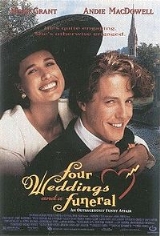
Four Weddings and a Funeral

Encyclopedia
Four Weddings and a Funeral is a 1994 British comedy film
directed by Mike Newell
. It was the first of several films by screenwriter Richard Curtis
to feature Hugh Grant
. The film was an unexpected success
, becoming the highest-grossing British film in cinema history at the time, with worldwide box office in excess of $245.7 million, and receiving an Academy Award nomination for Best Picture
.
), a debonair but faux pas-prone Englishman, who is smitten with Carrie, an attractive American (Andie MacDowell
), whom Charles repeatedly meets at weddings and at a funeral.
The first wedding is that of Angus and Laura (Timothy Walker
and Sara Crowe
), at which Charles is the best man. Charles and his collection of single friends wonder if they will ever get married. At this wedding, Charles meets Carrie for the first time and spends the night with her. Carrie teases him by pretending that now they have slept together, they will also have to get married, which Charles endeavours to respond to before realising she is joking. She then goes back home to America, observing that they may have missed an opportunity.
The second wedding is that of Bernard and Lydia (David Haig
and Sophie Thompson
), a couple who got together at the previous wedding. Rowan Atkinson makes his second appearance, this time as a fully fledged but gaffe-prone priest conducting his first wedding ceremony through his connection as a friend of the family. Charles is happy to discover that Carrie is attending the wedding until she introduces him to her fiancé, Sir Hamish Banks (Corin Redgrave
), a wealthy politician from Scotland. At the reception, Charles finds himself seated at a table with several ex-girlfriends who relate embarrassing stories about his inability to be discreet, and afterward, bumps into Henrietta (known among Charles' friends as "Duckface"), with whom he had a difficult relationship.
As the evening wears on, Charles finds himself in an empty hotel suite watching Carrie and Hamish leave in a taxicab, only to be trapped in the bath after the newlyweds suddenly stumble into the room to have sex. After Charles awkwardly exits the room, Henrietta confronts him about his habit of "serial monogamy", telling him that he is afraid of letting anyone get too close to him. Shortly after this encounter, Charles runs into Carrie (without her fiancé), and they end up spending another night together.
A few months later, Charles receives an invitation to Carrie's wedding in Scotland. While shopping for a present in London he accidentally bumps into Carrie in a shop and ends up helping her select her wedding dress. Carrie also astonishes him with a list of her more than thirty sexual partners (he learns he is #32). He later tries to confess his love to her and hints that he would like to have a relationship with her. However, he says it rather lamely, and the confession obviously comes too late.
The third wedding is that of Carrie and Hamish at a Scottish castle. Charles attends, depressed at the prospect of Carrie marrying Hamish. As the reception gets under way, Gareth (Simon Callow
) instructs his friends to go forth and seek potential mates; Fiona's brother, Tom (James Fleet
), stumbles through an attempt to connect with the minister's wife, while Charles' flatmate, Scarlett (Charlotte Coleman
), strikes up a conversation with a tall, attractive American named Chester. As Charles watches Carrie and Hamish dance as husband and wife, Charles' friend Fiona (Kristin Scott Thomas
) deduces his feelings about Carrie. When Charles asks why Fiona is not married, she confesses that she has always loved Charles since they first met years ago. Charles is surprised and empathetic, but does not requite her love.
At the wedding, Matthew's lover, Gareth, dies suddenly of a heart attack: Matthew (John Hannah
, in one of his first screen roles) is in another part of the room listening to the groom's toast when Gareth dies.
The funeral is that of Gareth. At the funeral, Matthew recites the poem Funeral Blues
("Stop all the clocks...") by W. H. Auden
, commemorating his relationship with Gareth. After the funeral, Charles and Tom have a discussion about whether finding that one true love is just a futile effort, and ponder that, while their clique
have always viewed themselves as proud-to-be-single, Gareth and Matthew had in fact been a "married" couple amongst them all the while.
The fourth wedding takes place ten months later, and is that of Charles, who has decided to marry Henrietta. However, moments before the ceremony, Carrie arrives at the church and reveals to Charles that she and Hamish are no longer together. Charles has a crisis of confidence, which he reveals to his deaf brother David (David Bower
). At the altar, when the vicar
asks if anyone knows a reason why the couple should not marry, David asks Charles to translate for him, and says in sign language
that he suspects the groom is having doubts and loves someone else. The vicar asks whether Charles does love someone else, and Charles replies, "I do." Henrietta punches Charles and the wedding is abruptly halted.
Finally, Carrie visits Charles, who is recovering from the debacle, to check that he is OK and apologise for attending. Charles confesses that, while standing at the altar, he realised that for the first time in his life he totally and utterly loved one person, "and it wasn't the person standing next to me in the veil." Charles makes a proposal of lifelong commitment without marriage to Carrie, saying, "Do you think not being married to me might maybe be something you could consider doing for the rest of your life?" Carrie responds by saying, "I do."
The song "Going To The Chapel" is then played as we see Henrietta marry a member of the guard, Scarlett marry Chester, David marry his girlfriend, Tom marry his distant cousin Deirdre (whom he met at Charles' wedding and instantly fell for), Matthew with a new partner (Duncan Kenworthy), Fiona marrying Prince Charles (a joke) and Charles and Carrie with their son, presumably not married.
, including Hampstead
, Greenwich Hospital, Betchworth
in Surrey, Amersham
in Buckinghamshire, St Bartholomew-the-Great
(wedding #4) and West Thurrock
in Essex. The scenes set in Scotland were filmed in Scotland (e.g. exterior shots of guests arriving for the funeral were filmed in South Queensferry
, Edinburgh
) and at stately homes in Bedfordshire
(Luton Hoo
for wedding two reception) and Hampshire
. Many of the extras were recruited by Amber Rudd
who is described in the credits as Aristocracy Co-ordinator: among those used were Lords Burlington and Woolton
.
Noted film critic Roger Ebert
gave the film three-and-a-half stars out of four, calling it "delightful and sly", and directed with "light-hearted enchantment" by Newell. He praised Grant's performance, describing it as a kind of "endearing awkwardness".
The film did have its detractors, though. Writing for the Chicago Reader, Jonathan Rosenbaum called the film "generic" and "standard issue", stating that the audience shouldn't "expect to remember it ten minutes later".
Time
magazine writer Richard Corliss was less scathing, but agreed that it was forgettable, saying that people would "forget all about [the movie] by the time they leave the multiplex," even joking at the end of his review that he had forgotten the film's name.
on 11 March 1994, Four Weddings and a Funeral opened with $138,486 in 5 theatres. But upon its wide release
on 15 April 1994, the film topped the box office with $4,162,489. The film would continue to gross $53,700,832 domestically with an additional $193 million internationally, earning $245,700,832 worldwide.
BAFTA Awards:
Australian Film Institute
:
British Comedy Awards
:
César Awards:
Chicago Film Critics
:
Evening Standard Awards
:
Golden Globe Awards:
London Film Awards:
Writers Guild of America (WGA):
Writers' Guild of Great Britain
:
At the BAFTAs, the film beat what many thought to be the front runner, Forrest Gump
by Robert Zemeckis
.
Nominations
Recognition
The film was voted the 27th greatest comedy film
of all time by readers of Total Film
in 2000. In 2004, the same magazine named it the 34th greatest British film of all time. It is number 96 on Bravo's "100 Funniest Movies".
was composed by British classical composer Richard Rodney Bennett
. The movie also featured a soundtrack of popular songs, including a cover version
of The Troggs
' "Love Is All Around" performed by Wet Wet Wet
that remained at number 1 in the British charts for fifteen weeks and was then the ninth (now twelfth) biggest selling single of all time in Britain. This song would later be adapted into "Christmas Is All Around" and sung by the character of Billy Mack in Richard Curtis' 2003 film Love Actually
, in which Grant also stars. The soundtrack also features Elton John
's "Crocodile Rock
", "But Not for Me
", and "Chapel of Love
", and Gloria Gaynor
's "I Will Survive
."
Comedy film
Comedy film is a genre of film in which the main emphasis is on humour. They are designed to elicit laughter from the audience. Comedies are mostly light-hearted dramas and are made to amuse and entertain the audiences...
directed by Mike Newell
Mike Newell (director)
Michael Cormac "Mike" Newell is an English director and producer of motion pictures for the screen and for television. After the release of Harry Potter and the Goblet of Fire in 2005, Newell became the third most commercially successful British director in recent years, behind Christopher Nolan...
. It was the first of several films by screenwriter Richard Curtis
Richard Curtis
Richard Whalley Anthony Curtis, CBE is a New Zealand-born British screenwriter, music producer, actor and film director, known primarily for romantic comedy films such as Four Weddings and a Funeral, Bridget Jones's Diary, Notting Hill, Love Actually and The Girl in the Café, as well as the hit...
to feature Hugh Grant
Hugh Grant
Hugh John Mungo Grant is an English actor and film producer. He has received a Golden Globe Award, a BAFTA, and an Honorary César. His films have earned more than $2.4 billion from 25 theatrical releases worldwide. Grant achieved international stardom after appearing in Richard Curtis's...
. The film was an unexpected success
Sleeper hit
A sleeper hit, a.k.a. surprise hit , refers to a film, book, single, album, TV show, or video game that gains unexpected success or recognition...
, becoming the highest-grossing British film in cinema history at the time, with worldwide box office in excess of $245.7 million, and receiving an Academy Award nomination for Best Picture
Academy Award for Best Picture
The Academy Award for Best Picture is one of the Academy Awards of Merit presented annually by the Academy of Motion Picture Arts and Sciences to artists working in the motion picture industry. The Best Picture category is the only category in which every member of the Academy is eligible not only...
.
Plot
The film follows the adventures of a group of friends through the eyes of Charles (Hugh GrantHugh Grant
Hugh John Mungo Grant is an English actor and film producer. He has received a Golden Globe Award, a BAFTA, and an Honorary César. His films have earned more than $2.4 billion from 25 theatrical releases worldwide. Grant achieved international stardom after appearing in Richard Curtis's...
), a debonair but faux pas-prone Englishman, who is smitten with Carrie, an attractive American (Andie MacDowell
Andie MacDowell
Rosalie Anderson "Andie" MacDowell is an American model and actress. She has received the Golden Camera and an Honorary César.-Early life:...
), whom Charles repeatedly meets at weddings and at a funeral.
The first wedding is that of Angus and Laura (Timothy Walker
Timothy Walker
Timothy Walker is a British film and television actor. His most famous role was perhaps as Angus the groom in the 1994 film Four Weddings and a Funeral, but he has also appeared in Nuremberg: Nazis on Trial, Looking for Victoria, Peak Practice, Monsignor Renard, Pie in the Sky and Doctor...
and Sara Crowe
Sara Crowe
Sara Crowe , also known as Sara K. Crowe, is a Scottish film and stage actress, who mainly plays comedy roles.-Career:...
), at which Charles is the best man. Charles and his collection of single friends wonder if they will ever get married. At this wedding, Charles meets Carrie for the first time and spends the night with her. Carrie teases him by pretending that now they have slept together, they will also have to get married, which Charles endeavours to respond to before realising she is joking. She then goes back home to America, observing that they may have missed an opportunity.
The second wedding is that of Bernard and Lydia (David Haig
David Haig
David Haig is an Olivier Award-winning English actor and FIPA Award-winning writer. He is known for his versatility, having played dramatic, serio-comic and comedic roles, playing characters of varied social classes...
and Sophie Thompson
Sophie Thompson
Sophie Thompson is an award-winning English actress, best known for playing Stella Crawford in EastEnders.-Early life:...
), a couple who got together at the previous wedding. Rowan Atkinson makes his second appearance, this time as a fully fledged but gaffe-prone priest conducting his first wedding ceremony through his connection as a friend of the family. Charles is happy to discover that Carrie is attending the wedding until she introduces him to her fiancé, Sir Hamish Banks (Corin Redgrave
Corin Redgrave
Corin William Redgrave was an English actor and political activist.-Early life:Redgrave was born in Marylebone, London, the only son and middle child of actors Michael Redgrave and Rachel Kempson...
), a wealthy politician from Scotland. At the reception, Charles finds himself seated at a table with several ex-girlfriends who relate embarrassing stories about his inability to be discreet, and afterward, bumps into Henrietta (known among Charles' friends as "Duckface"), with whom he had a difficult relationship.
As the evening wears on, Charles finds himself in an empty hotel suite watching Carrie and Hamish leave in a taxicab, only to be trapped in the bath after the newlyweds suddenly stumble into the room to have sex. After Charles awkwardly exits the room, Henrietta confronts him about his habit of "serial monogamy", telling him that he is afraid of letting anyone get too close to him. Shortly after this encounter, Charles runs into Carrie (without her fiancé), and they end up spending another night together.
A few months later, Charles receives an invitation to Carrie's wedding in Scotland. While shopping for a present in London he accidentally bumps into Carrie in a shop and ends up helping her select her wedding dress. Carrie also astonishes him with a list of her more than thirty sexual partners (he learns he is #32). He later tries to confess his love to her and hints that he would like to have a relationship with her. However, he says it rather lamely, and the confession obviously comes too late.
The third wedding is that of Carrie and Hamish at a Scottish castle. Charles attends, depressed at the prospect of Carrie marrying Hamish. As the reception gets under way, Gareth (Simon Callow
Simon Callow
Simon Phillip Hugh Callow, CBE is an English actor, writer and theatre director. He is also currently a judge on Popstar to Operastar.-Early years:...
) instructs his friends to go forth and seek potential mates; Fiona's brother, Tom (James Fleet
James Fleet
James Edward Fleet is an English actor. He is most famous for his roles as the bumbling and well-meaning Tom in the 1994 British romantic comedy film Four Weddings and a Funeral, and the dim-witted Hugo Horton in the BBC situation comedy television series The Vicar of Dibley.-Personal life:Fleet...
), stumbles through an attempt to connect with the minister's wife, while Charles' flatmate, Scarlett (Charlotte Coleman
Charlotte Coleman
Charlotte Ninon Coleman was an English actress best known for playing Scarlett in the film Four Weddings and a Funeral , Jess in the television drama Oranges Are Not the Only Fruit, and her childhood roles of Sue in Worzel Gummidge and the character Marmalade Atkins...
), strikes up a conversation with a tall, attractive American named Chester. As Charles watches Carrie and Hamish dance as husband and wife, Charles' friend Fiona (Kristin Scott Thomas
Kristin Scott Thomas
Kristin A. Scott Thomas, OBE is an English actress who has also acquired French nationality. She gained international recognition in the 1990s for her roles in Bitter Moon, Four Weddings and a Funeral and The English Patient....
) deduces his feelings about Carrie. When Charles asks why Fiona is not married, she confesses that she has always loved Charles since they first met years ago. Charles is surprised and empathetic, but does not requite her love.
At the wedding, Matthew's lover, Gareth, dies suddenly of a heart attack: Matthew (John Hannah
John Hannah (actor)
John David Hannah is a Scottish actor of film and television. He has appeared in Stephen Sommers' Mummy Series, Richard Curtis' Four Weddings and a Funeral and Sliding Doors with Gwyneth Paltrow...
, in one of his first screen roles) is in another part of the room listening to the groom's toast when Gareth dies.
The funeral is that of Gareth. At the funeral, Matthew recites the poem Funeral Blues
Funeral Blues
"Funeral Blues" or "Stop all the clocks" is a poem by W. H. Auden, first published in its final, familiar form in 1938, but based on an earlier version published in 1936.-Titles and versions:...
("Stop all the clocks...") by W. H. Auden
W. H. Auden
Wystan Hugh Auden , who published as W. H. Auden, was an Anglo-American poet,The first definition of "Anglo-American" in the OED is: "Of, belonging to, or involving both England and America." See also the definition "English in origin or birth, American by settlement or citizenship" in See also...
, commemorating his relationship with Gareth. After the funeral, Charles and Tom have a discussion about whether finding that one true love is just a futile effort, and ponder that, while their clique
Clique
A clique is an exclusive group of people who share common interests, views, purposes, patterns of behavior, or ethnicity. A clique as a reference group can be either normative or comparative. Membership in a clique is typically exclusive, and qualifications for membership may be social or...
have always viewed themselves as proud-to-be-single, Gareth and Matthew had in fact been a "married" couple amongst them all the while.
The fourth wedding takes place ten months later, and is that of Charles, who has decided to marry Henrietta. However, moments before the ceremony, Carrie arrives at the church and reveals to Charles that she and Hamish are no longer together. Charles has a crisis of confidence, which he reveals to his deaf brother David (David Bower
David Bower
David Bower is a Welsh actor, best known for his role as David in the hit romantic comedy Four Weddings and a Funeral. Born in Wrexham, North Wales, he is deaf and took his degree in the Theatre of the Deaf. After university he joined what became the Signdance Collective working as sign dancer...
). At the altar, when the vicar
Vicar
In the broadest sense, a vicar is a representative, deputy or substitute; anyone acting "in the person of" or agent for a superior . In this sense, the title is comparable to lieutenant...
asks if anyone knows a reason why the couple should not marry, David asks Charles to translate for him, and says in sign language
British Sign Language
British Sign Language is the sign language used in the United Kingdom , and is the first or preferred language of some deaf people in the UK; there are 125,000 deaf adults in the UK who use BSL plus an estimated 20,000 children. The language makes use of space and involves movement of the hands,...
that he suspects the groom is having doubts and loves someone else. The vicar asks whether Charles does love someone else, and Charles replies, "I do." Henrietta punches Charles and the wedding is abruptly halted.
Finally, Carrie visits Charles, who is recovering from the debacle, to check that he is OK and apologise for attending. Charles confesses that, while standing at the altar, he realised that for the first time in his life he totally and utterly loved one person, "and it wasn't the person standing next to me in the veil." Charles makes a proposal of lifelong commitment without marriage to Carrie, saying, "Do you think not being married to me might maybe be something you could consider doing for the rest of your life?" Carrie responds by saying, "I do."
The song "Going To The Chapel" is then played as we see Henrietta marry a member of the guard, Scarlett marry Chester, David marry his girlfriend, Tom marry his distant cousin Deirdre (whom he met at Charles' wedding and instantly fell for), Matthew with a new partner (Duncan Kenworthy), Fiona marrying Prince Charles (a joke) and Charles and Carrie with their son, presumably not married.
Cast
- Hugh GrantHugh GrantHugh John Mungo Grant is an English actor and film producer. He has received a Golden Globe Award, a BAFTA, and an Honorary César. His films have earned more than $2.4 billion from 25 theatrical releases worldwide. Grant achieved international stardom after appearing in Richard Curtis's...
as Charles - Andie MacDowellAndie MacDowellRosalie Anderson "Andie" MacDowell is an American model and actress. She has received the Golden Camera and an Honorary César.-Early life:...
as Carrie - James FleetJames FleetJames Edward Fleet is an English actor. He is most famous for his roles as the bumbling and well-meaning Tom in the 1994 British romantic comedy film Four Weddings and a Funeral, and the dim-witted Hugo Horton in the BBC situation comedy television series The Vicar of Dibley.-Personal life:Fleet...
as Tom - Simon CallowSimon CallowSimon Phillip Hugh Callow, CBE is an English actor, writer and theatre director. He is also currently a judge on Popstar to Operastar.-Early years:...
as Gareth - John HannahJohn Hannah (actor)John David Hannah is a Scottish actor of film and television. He has appeared in Stephen Sommers' Mummy Series, Richard Curtis' Four Weddings and a Funeral and Sliding Doors with Gwyneth Paltrow...
as Matthew - Kristin Scott ThomasKristin Scott ThomasKristin A. Scott Thomas, OBE is an English actress who has also acquired French nationality. She gained international recognition in the 1990s for her roles in Bitter Moon, Four Weddings and a Funeral and The English Patient....
as Fiona - David BowerDavid BowerDavid Bower is a Welsh actor, best known for his role as David in the hit romantic comedy Four Weddings and a Funeral. Born in Wrexham, North Wales, he is deaf and took his degree in the Theatre of the Deaf. After university he joined what became the Signdance Collective working as sign dancer...
as David - Charlotte ColemanCharlotte ColemanCharlotte Ninon Coleman was an English actress best known for playing Scarlett in the film Four Weddings and a Funeral , Jess in the television drama Oranges Are Not the Only Fruit, and her childhood roles of Sue in Worzel Gummidge and the character Marmalade Atkins...
as Scarlett - Timothy WalkerTimothy WalkerTimothy Walker is a British film and television actor. His most famous role was perhaps as Angus the groom in the 1994 film Four Weddings and a Funeral, but he has also appeared in Nuremberg: Nazis on Trial, Looking for Victoria, Peak Practice, Monsignor Renard, Pie in the Sky and Doctor...
as Angus - Sara CroweSara CroweSara Crowe , also known as Sara K. Crowe, is a Scottish film and stage actress, who mainly plays comedy roles.-Career:...
as Laura - Rowan AtkinsonRowan AtkinsonRowan Sebastian Atkinson is a British actor, comedian, and screenwriter. He is most famous for his work on the satirical sketch comedy show Not The Nine O'Clock News, and the sitcoms Blackadder, Mr. Bean and The Thin Blue Line...
as Father Gerald - David HaigDavid HaigDavid Haig is an Olivier Award-winning English actor and FIPA Award-winning writer. He is known for his versatility, having played dramatic, serio-comic and comedic roles, playing characters of varied social classes...
as Bernard - Sophie ThompsonSophie ThompsonSophie Thompson is an award-winning English actress, best known for playing Stella Crawford in EastEnders.-Early life:...
as Lydia - Corin RedgraveCorin RedgraveCorin William Redgrave was an English actor and political activist.-Early life:Redgrave was born in Marylebone, London, the only son and middle child of actors Michael Redgrave and Rachel Kempson...
as Sir Hamish Banks - Anna ChancellorAnna Chancellor-Family:Chancellor was born in Richmond, London, England, the daughter of the Hon. Mary Alice Jolliffe and John Paget Chancellor. Through her mother's mother, Lady Perdita Rose Mary Asquith, Chancellor is the great-granddaughter of The Hon. Raymond Aquith and the great-great-granddaughter of Prime...
as Henrietta ("Duckface") - Duncan KenworthyDuncan KenworthyDuncan H. Kenworthy, OBE is a British film and television producer, and co-founder of the production company DNA Films. He is currently a producer at Toledo Productions....
(uncredited) as Matthew's "gorgeous" new boyfriend
Production
The film was shot mainly in London and the Home CountiesHome Counties
The home counties is a term which refers to the counties of South East England and the East of England which border London, but do not include the capital city itself...
, including Hampstead
Hampstead
Hampstead is an area of London, England, north-west of Charing Cross. Part of the London Borough of Camden in Inner London, it is known for its intellectual, liberal, artistic, musical and literary associations and for Hampstead Heath, a large, hilly expanse of parkland...
, Greenwich Hospital, Betchworth
Betchworth
Betchworth is a village and civil parish in the Mole Valley district of Surrey, England. The village lies on the north bank of the River Mole, off the A25 road, about three miles east of Dorking and three miles west of Reigate. The village lay within the Reigate hundred.It was home to the now...
in Surrey, Amersham
Amersham
Amersham is a market town and civil parish within Chiltern district in Buckinghamshire, England, 27 miles north west of London, in the Chiltern Hills. It is part of the London commuter belt....
in Buckinghamshire, St Bartholomew-the-Great
St Bartholomew-the-Great
The Priory Church of St Bartholomew the Great is an Anglican church located at West Smithfield in the City of London, founded as an Augustinian priory in 1123 -History:...
(wedding #4) and West Thurrock
West Thurrock
West Thurrock is a traditional Church of England parish and town in Thurrock, Essex, England, located 17.5 miles east south-east of Charing Cross, London.-Location:...
in Essex. The scenes set in Scotland were filmed in Scotland (e.g. exterior shots of guests arriving for the funeral were filmed in South Queensferry
South Queensferry
South Queensferry , also called Queensferry, is a former Royal Burgh in West Lothian now part of the City of Edinburgh, Scotland. It is located some ten miles to the north west of the city centre, on the shore of the Firth of Forth between the Forth Bridge and the Forth Road Bridge, approximately 8...
, Edinburgh
Edinburgh
Edinburgh is the capital city of Scotland, the second largest city in Scotland, and the eighth most populous in the United Kingdom. The City of Edinburgh Council governs one of Scotland's 32 local government council areas. The council area includes urban Edinburgh and a rural area...
) and at stately homes in Bedfordshire
Bedfordshire
Bedfordshire is a ceremonial county of historic origin in England that forms part of the East of England region.It borders Cambridgeshire to the north-east, Northamptonshire to the north, Buckinghamshire to the west and Hertfordshire to the south-east....
(Luton Hoo
Luton Hoo
Luton Hoo straddles the Hertfordshire and Bedfordshire borders between the towns of Harpenden and Luton. The unusual name "Hoo" is a Saxon word meaning the spur of a hill, and is more commonly associated with East Anglia.- Early History :...
for wedding two reception) and Hampshire
Hampshire
Hampshire is a county on the southern coast of England in the United Kingdom. The county town of Hampshire is Winchester, a historic cathedral city that was once the capital of England. Hampshire is notable for housing the original birthplaces of the Royal Navy, British Army, and Royal Air Force...
. Many of the extras were recruited by Amber Rudd
Amber Rudd
Amber Rudd is a British Conservative Party politician who was elected as Member of Parliament for the East Sussex constituency of Hastings and Rye at the May 2010 general election, defeating the incumbent Labour MP Michael Foster.Rudd is an alumna of Edinburgh University...
who is described in the credits as Aristocracy Co-ordinator: among those used were Lords Burlington and Woolton
Simon Marquis, 3rd Earl of Woolton
Simon Frederick James Marquis, 3rd Earl of Woolton , is the son of the 2nd Earl of Woolton and his second wife Josephine Gordon-Cumming, now Countess Lloyd George of Dwyfor. In 1987 he married Hon. Sophie Birdwood, daughter of the 3rd Baron Birdwood, and had three daughters by her...
.
Critical response
The film was very well received with critics, currently holding a 96% "Certified Fresh" approval on reviews aggregator Rotten Tomatoes, with the site's consensus stating, "While frothy to a fault, Four Weddings and a Funeral features irresistibly breezy humor, and winsome performances from Hugh Grant and Andie MacDowell."Noted film critic Roger Ebert
Roger Ebert
Roger Joseph Ebert is an American film critic and screenwriter. He is the first film critic to win a Pulitzer Prize for Criticism.Ebert is known for his film review column and for the television programs Sneak Previews, At the Movies with Gene Siskel and Roger Ebert, and Siskel and Ebert and The...
gave the film three-and-a-half stars out of four, calling it "delightful and sly", and directed with "light-hearted enchantment" by Newell. He praised Grant's performance, describing it as a kind of "endearing awkwardness".
The film did have its detractors, though. Writing for the Chicago Reader, Jonathan Rosenbaum called the film "generic" and "standard issue", stating that the audience shouldn't "expect to remember it ten minutes later".
Time
Time (magazine)
Time is an American news magazine. A European edition is published from London. Time Europe covers the Middle East, Africa and, since 2003, Latin America. An Asian edition is based in Hong Kong...
magazine writer Richard Corliss was less scathing, but agreed that it was forgettable, saying that people would "forget all about [the movie] by the time they leave the multiplex," even joking at the end of his review that he had forgotten the film's name.
Box office
Upon its North American limited releaseLimited release
Limited release is a term in the American motion picture industry for a motion picture that is playing in a select few theaters across the country ....
on 11 March 1994, Four Weddings and a Funeral opened with $138,486 in 5 theatres. But upon its wide release
Wide release
Wide release is a term in the American motion picture industry for a motion picture that is playing nationally . Specifically, a movie is considered to be in wide release when it is on 600 screens or more in the United States and Canada.In the US, films holding an NC-17 rating almost never have a...
on 15 April 1994, the film topped the box office with $4,162,489. The film would continue to gross $53,700,832 domestically with an additional $193 million internationally, earning $245,700,832 worldwide.
Awards and recognition
WinsBAFTA Awards:
- BAFTA Award for Best FilmBAFTA Award for Best FilmThis page lists the winners and nominees for the BAFTA Award for Best Film, BAFTA Award for Best Film not in the English Language and Alexander Korda Award for Best British Film for each year, in addition to the retired earlier versions of those awards...
- BAFTA David Lean Award for Direction (Mike Newell)
- BAFTA Award for Best Actor (Hugh Grant)
- BAFTA Award for Best Supporting ActressBAFTA Award for Best Actress in a Supporting RoleBest Actress in a Supporting Role is a British Academy Film award presented annually by the British Academy of Film and Television Arts to recognize an actress who has delivered an outstanding supporting performance in a film...
(Kristin Scott Thomas)
Australian Film Institute
Australian Film Institute
The Australian Film Institute was founded in 1958 as a non-profit organisation devoted to developing an active film culture in Australia and fostering engagement between the general public and the Australian film industry...
:
- Best Foreign Film
British Comedy Awards
British Comedy Awards
The British Comedy Awards is an annual awards ceremony in the United Kingdom celebrating notable comedians and entertainment performances of the previous year.-History:...
:
- Best Comedy Film
César Awards:
- César Award for Best Foreign FilmCésar Award for Best Foreign FilmThis is the list of winners and nominees of the César Award for Best Foreign Film .-1970s:-1980s:-1990s:-2000s:-2010s:...
Chicago Film Critics
Chicago Film Critics Association Awards 1994
----Best Film: Hoop Dreams The 7th Chicago Film Critics Association Awards honored the finest achievements in 1994 filmmaking.-Winners:* Best Actor:** Tom Hanks - Forrest Gump* Best Actress:** Jennifer Jason Leigh - Mrs...
:
- Most Promising Actor (Hugh Grant)
Evening Standard Awards
Evening Standard British Film Awards
The Evening Standard British Film Awards were established in 1973 by the British London area evening newspaper Evening Standard. The Standard Awards is the only ceremony "dedicated to British and Irish talent," judged by a panel of "top UK critics." Each ceremony honours films from the previous...
:
- Best Actress (Kristin Scott Thomas)
- Best Screenplay (Richard Curtis)
Golden Globe Awards:
- Golden Globe Award for Best Actor - Motion Picture Musical or ComedyGolden Globe Award for Best Actor - Motion Picture Musical or ComedyThe Golden Globe Award for Best Actor - Motion Picture Musical or Comedy was first awarded by the Hollywood Foreign Press Association as a separate category in 1951...
(Hugh Grant)
London Film Awards:
- British Director of the Year (Mike Newell)
- British Film of the Year
- British Producer of the Year (Duncan Kenworthy)
- British Screenwriter of the Year (Richard Curtis)
Writers Guild of America (WGA):
- Best Screenplay – Original (Richard Curtis)
Writers' Guild of Great Britain
Writers' Guild of Great Britain
The Writers' Guild of Great Britain, established in 1959, is a trade union for professional writers. It is affiliated with both the Trades Union Congress and the International Affiliation of Writers Guilds .-Activities:...
:
- Film – Screenplay (Richard Curtis)
At the BAFTAs, the film beat what many thought to be the front runner, Forrest Gump
Forrest Gump
Forrest Gump is a 1994 American epic comedy-drama romance film based on the 1986 novel of the same name by Winston Groom. The film was directed by Robert Zemeckis, starring Tom Hanks, Robin Wright and Gary Sinise...
by Robert Zemeckis
Robert Zemeckis
Robert Lee Zemeckis is an American film director, producer and screenwriter. Zemeckis first came to public attention in the 1980s as the director of the comedic time-travel Back to the Future film series, as well as the Academy Award-winning live-action/animation epic Who Framed Roger Rabbit ,...
.
Nominations
- Academy Award for Best PictureAcademy Award for Best PictureThe Academy Award for Best Picture is one of the Academy Awards of Merit presented annually by the Academy of Motion Picture Arts and Sciences to artists working in the motion picture industry. The Best Picture category is the only category in which every member of the Academy is eligible not only...
(lost to Forrest GumpForrest GumpForrest Gump is a 1994 American epic comedy-drama romance film based on the 1986 novel of the same name by Winston Groom. The film was directed by Robert Zemeckis, starring Tom Hanks, Robin Wright and Gary Sinise...
) - Academy Award for Best Screenplay – Original – Richard Curtis (lost to Pulp FictionPulp fictionPulp fiction may refer to:* pulp magazines, short stories presented in a magazine format, printed on cheaply made wood-pulp paper* Pulp Fiction, a 1994 film directed by Quentin Tarantino...
) - BAFTA Award for Best Film MusicBAFTA Award for Best Film MusicThe Anthony Asquith Award for Film Music is an annual award given by British Academy of Film and Television Arts.-1960s:*1968 - The Lion in Winter - John Barry...
– Richard Rodney Bennett (lost to BackbeatBackbeat (film)Backbeat is a 1994 British-German drama film directed by Iain Softley. It chronicles the early days of The Beatles in Hamburg, Germany. The film focuses primarily on the relationship between Stuart Sutcliffe and John Lennon , and also with Sutcliffe's German girlfriend Astrid Kirchherr...
) - BAFTA Award for Best Screenplay – OriginalBAFTA Award for Best Original ScreenplayThe BAFTA Award for Best Original Screenplay is the British Academy Film Award for the best script not based upon previously published material. It has been awarded since 1984, when the original category was split into two awards, the other being the BAFTA Award for Best Adapted...
– Richard Curtis (lost to Pulp Fiction) - BAFTA Award for Best Supporting ActorBAFTA Award for Best Actor in a Supporting RoleBest Actor in a Supporting Role is a British Academy Film award presented annually by the British Academy of Film and Television Arts to recognize an actor who has delivered an outstanding supporting performance in a film...
– Simon Callow (lost to Samuel L. JacksonSamuel L. JacksonSamuel Leroy Jackson is an American film and television actor and film producer. After becoming involved with the Civil Rights Movement, he moved on to acting in theater at Morehouse College, and then films. He had several small roles such as in the film Goodfellas before meeting his mentor,...
for Pulp Fiction) - BAFTA Award for Best Supporting ActorBAFTA Award for Best Actor in a Supporting RoleBest Actor in a Supporting Role is a British Academy Film award presented annually by the British Academy of Film and Television Arts to recognize an actor who has delivered an outstanding supporting performance in a film...
– John Hannah - BAFTA Award for Best Supporting ActressBAFTA Award for Best Actress in a Supporting RoleBest Actress in a Supporting Role is a British Academy Film award presented annually by the British Academy of Film and Television Arts to recognize an actress who has delivered an outstanding supporting performance in a film...
– Charlotte Coleman (lost to Kristin Scott ThomasKristin Scott ThomasKristin A. Scott Thomas, OBE is an English actress who has also acquired French nationality. She gained international recognition in the 1990s for her roles in Bitter Moon, Four Weddings and a Funeral and The English Patient....
for this film) - Directors Guild of America Award for Outstanding Directorial Achievement in Motion Pictures – Mike Newell (lost to Quentin TarantinoQuentin TarantinoQuentin Jerome Tarantino is an American film director, screenwriter, producer, cinematographer and actor. In the early 1990s, he began his career as an independent filmmaker with films employing nonlinear storylines and the aestheticization of violence...
for Pulp Fiction) - Golden Globe Award for Best Motion Picture – Musical or Comedy (lost to The Lion KingThe Lion KingThe Lion King is a 1994 American animated film produced by Walt Disney Feature Animation and released by Walt Disney Pictures. It is the 32nd feature in the Walt Disney Animated Classics series...
) - Golden Globe Award for Best Actress – Motion Picture Musical or Comedy – Andie MacDowell (lost to Jamie Lee CurtisJamie Lee CurtisJamie Lee Curtis is an American actress and author. Although she was initially known as a "scream queen" because of her starring roles in several horror films early in her career, such as Halloween, The Fog, Prom Night and Terror Train, Curtis has since compiled a body of work that spans many...
in True LiesTrue LiesTrue Lies is a 1994 American action-comedy film directed by James Cameron and starring Arnold Schwarzenegger, Jamie Lee Curtis, Tom Arnold, Bill Paxton, Tia Carrere, Charlton Heston, and Art Malik. Eliza Dushku also appears in the film in one of her first major film roles...
) - Golden Globe Award for Best ScreenplayGolden Globe Award for Best ScreenplayThe Golden Globe Award for Best Screenplay - Motion Picture is one of the annual awards given by the Hollywood Foreign Press Association."†" indicates the winner of the Academy Award for Best Writing "‡" indicates the winner of the Academy Award for Best Writing "§" indicates a Golden Globe Award...
– Richard Curtis (lost to Quentin TarantinoQuentin TarantinoQuentin Jerome Tarantino is an American film director, screenwriter, producer, cinematographer and actor. In the early 1990s, he began his career as an independent filmmaker with films employing nonlinear storylines and the aestheticization of violence...
for Pulp Fiction)
Recognition
The film was voted the 27th greatest comedy film
Comedy film
Comedy film is a genre of film in which the main emphasis is on humour. They are designed to elicit laughter from the audience. Comedies are mostly light-hearted dramas and are made to amuse and entertain the audiences...
of all time by readers of Total Film
Total Film
Total Film is a British film magazine published 13 times a year by Future Publishing. The magazine was launched in 1997 and offers film, DVD and Blu-ray news, reviews and features...
in 2000. In 2004, the same magazine named it the 34th greatest British film of all time. It is number 96 on Bravo's "100 Funniest Movies".
Soundtrack
The original scoreFilm score
A film score is original music written specifically to accompany a film, forming part of the film's soundtrack, which also usually includes dialogue and sound effects...
was composed by British classical composer Richard Rodney Bennett
Richard Rodney Bennett
Sir Richard Rodney Bennett, CBE is an English composer renowned for his film scores and his jazz performance as much as for his challenging concert works...
. The movie also featured a soundtrack of popular songs, including a cover version
Cover version
In popular music, a cover version or cover song, or simply cover, is a new performance or recording of a contemporary or previously recorded, commercially released song or popular song...
of The Troggs
The Troggs
The Troggs are an English rock band from the 1960s that had a number of hits in UK and the US. Their most famous songs include, "Wild Thing", "With a Girl Like You", and "Love Is All Around"...
' "Love Is All Around" performed by Wet Wet Wet
Wet Wet Wet
Wet Wet Wet are a Scottish pop rock band that formed in the 1980s. They scored a number of hits in the British charts and around the world. The band is composed of Marti Pellow , Tommy Cunningham , Graeme Clark and Neil Mitchell...
that remained at number 1 in the British charts for fifteen weeks and was then the ninth (now twelfth) biggest selling single of all time in Britain. This song would later be adapted into "Christmas Is All Around" and sung by the character of Billy Mack in Richard Curtis' 2003 film Love Actually
Love Actually
Love Actually is a 2003 British romantic comedy film written and directed by Richard Curtis. The screenplay delves into different aspects of love as shown through ten separate stories involving a wide variety of individuals, many of whom are shown to be interlinked as their tales progress...
, in which Grant also stars. The soundtrack also features Elton John
Elton John
Sir Elton Hercules John, CBE, Hon DMus is an English rock singer-songwriter, composer, pianist and occasional actor...
's "Crocodile Rock
Crocodile Rock
"Crocodile Rock" is a song written by Elton John and Bernie Taupin, and recorded in June 1972 at the Strawberry Studios, Château d'Hérouville in France. It was released on 27 October 1972 in the UK and 20 November 1972 in the US, as a pre-release single from his forthcoming 1973 album Don't Shoot...
", "But Not for Me
But Not for Me (song)
"But Not for Me" is a popular song, composed by George Gershwin, with lyrics by Ira Gershwin.It was written for their musical Girl Crazy and introduced in the original production by Ginger Rogers. It is also in the 1992 musical based on Girl Crazy, Crazy for You...
", and "Chapel of Love
Chapel of Love
"Chapel of Love" is a song written by Jeff Barry, Ellie Greenwich and Phil Spector, and made famous by The Dixie Cups in 1964, spending three weeks at number one on the Billboard Hot 100. There have also been many other versions of this song...
", and Gloria Gaynor
Gloria Gaynor
Gloria Gaynor is an American singer, best known for the disco era hits; "I Will Survive" , "Never Can Say Goodbye" , "Let Me Know " and "I Am What I Am" .-Early career:Gaynor was a singer with the Soul...
's "I Will Survive
I Will Survive
"I Will Survive" is a song first performed by American singer Gloria Gaynor, released in October 1978. It was written by Freddie Perren and Dino Fekaris...
."
See also
- Notting HillNotting Hill (film)Notting Hill is a 1999 British romantic comedy film set in Notting Hill, London, released on 21 May 1999. The screenplay was by Richard Curtis, who had written Four Weddings and a Funeral. It was produced by Duncan Kenworthy and directed by Roger Michell...
(1999), also written by Curtis and starring Grant - Love ActuallyLove ActuallyLove Actually is a 2003 British romantic comedy film written and directed by Richard Curtis. The screenplay delves into different aspects of love as shown through ten separate stories involving a wide variety of individuals, many of whom are shown to be interlinked as their tales progress...
(2003), another film by Curtis starring Grant - Black Versace dress of Elizabeth HurleyBlack Versace dress of Elizabeth HurleyElizabeth Hurley wore a black Versace dress, often referred to as "That Dress", when she accompanied Hugh Grant to the premiere of Four Weddings and a Funeral in 1994. The dress was held together by several oversized gold safety pins...