
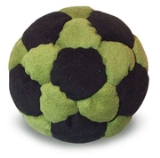
Footbag
A footbag is a small
bean bag or sand bag used as a
ball in a number of sports and
games. It is typically controlled by the
feet, but in some sports every part of the body except the hands and arms may be used. The term footbag is also the generic name for the sports which use the footbag. The main varieties are
Freestyle Footbag, footbag net, and circle kick. Both the footbag and the sports that use it are sometimes referred to as
Hacky Sack or hackey sack.
Encyclopedia
A
footbag is a small
bean bag or sand bag used as a
ball in a number of sports and
games. It is typically controlled by the
feet, but in some sports every part of the body except the hands and arms may be used. The term
footbag is also the generic name for the sports which use the footbag. The main varieties are
Freestyle Footbag, footbag net, and circle kick. Both the footbag and the sports that use it are sometimes referred to as
Hacky Sack or
hackey sack.
History of footbag
Footbag was invented in 1972 in
Oregon City, Oregon, when John Stalberger met Mike Marshall, who had been kicking around a hand-made bean bag. John had recently had knee surgery and was looking for a way to work on his flexibility. He instantly took to the game and became good friends with Marshall. They called the game "Hack the Sack." It gained much popularity in the 80s.
Stalberger and Marshall soon became enthralled with the game, which Marshall had been hoping to promote with the general public. The two designed a product, which they trademarked the "
Hacky Sack", and began putting together a plan to market the product and the sport. At the same time, they decided to create a "generic" term for the sport itself, as opposed to their product, and they named the sport "footbag".
Tragically, Mike Marshall died of a
heart attack in 1975, at only 28 years of age. Stalberger, determined to realize their vision of footbag as a sport, continued to promote the product and the game. He formed the National Hacky Sack Association along with the help of many others. He ultimately sold the rights for the Hacky Sack footbag to Kransco , which also manufactered the
frisbee flying disc.
In the years following the creation of the
Hacky Sack product, many footbag enthusiasts began sprouting up around the world, and a sport was born. Following the model of
volleyball and
tennis, players began volleying a footbag over a 5-foot-high net and "footbag net" became an attractive alternative sport. Freestyle footbag has become the most popular form of the game because of its cooperative nature. Advanced freestylers choreograph routines to music, much like
rhythmic gymnastics or
figure skating.
Footbag sports now have a rules body that governs the various aspects of competitive footbag play: the International Footbag Committee .
Equipment
Although some argue that certain types of shoes are necessary, the only piece of equipment that is really required in order to play footbag is a footbag. These come in many styles, colors, and varieties. Some footbags have simple cotton exteriors, while others are made of 2 to 120+ panels of suede. Generally the more panels a bag has the more spherical its shape and the more difficult it is to stall. Some are filled with sand; others, plastic pellets. Many footbags have designs on them, either geometric or pictorial . Some footbags are specialized for footbag net; these are generally not good for playing freestyle footbag.
Part of the appeal and popularity of footbag is due to this simplicity of equipment. A footbag can be bought for under $5, easily stored in a pocket, and later retrieved for a quick game of
freestyle. Most other sports, by comparison, are not nearly as portable or affordable.
Of course, advanced equipment is available for those who want or need it. 32-panel footbags usually contain a mixed filler. Most professional stitchers use some form of a combination of Plastic Poly Pellets, BB's, steel shot, or lead shot. 32 panel bags are a little more difficult to stall, but are often truer when set for more complex tricks; these usually range from 25-35 USD. Professional footbags are usually made of a fabric called ultrasuede light, or facile. Facile is thinner than standard footbag material so the bag is softer and easier to control. Facile footbags are typically more expensive than standard footbags as the material to produce them can cost as much as $50/yd.
Additionally, many Open-level players wear
Adidas Rod Laver tennis shoes, Adidas Clima Cool 1s, or
Reebok G-Unit G6 I , and many varieties of skateboarding shoes while playing.
The Quantum shoe made by Planetfootbag is a newly introduced shoe, designed specifically for freestyle footbag.
Footbag freestyle
Main article: Freestyle footbagFreestyle Footbag is a footbag sport where players demonstrate their abilities by performing sequences of difficult moves. The objective is to perform a series of tricks linked together. The ending position of the bag on one trick becomes the starting position of the bag on the next trick. Tricks are created by combining different components between contacts . Components can be spins, dexterities , or ducks . Contacts are usually on the inside of the foot behind the opposite support leg or on the toe, however many inventive possibilities remain and are used to create an endless list of tricks. There is an annual footbag world championships held each year. The current freestyle world champion is Vasek Klouda, of the Czech Republic.
Footbag net
Main article: Footbag netIn
footbag net, players move a footbag back and forth across a five-foot-high net. This game combines elements of
tennis,
badminton, and
volleyball. Specifically, the court dimensions and layout are similar to those of badminton; the scoring is similar to old scoring system in volleyball ; and serves must be diagonal, as in tennis. Footbag net games can be played to eleven or fifteen points, although the winners must win by at least two points.
Circle kick
Circle kick is the most common game played with a footbag, and it is the game people usually refer to when they talk about "hacking." Players stand in a circle and keep it moving around the circle, without having it touch the ground or hitting it with their hands. A "hack" is achieved when every person in the circle contributes a kick. Circle kick is generally accompanied by an unwritten set of etiquette guidelines designed to keep the game fun, friendly, and open to everyone including new players, and these rules vary from circle to circle. The most basic rule is to respect all other players. Some other general guidelines include picking up the footbag after you drop it or kick it away, rather than having someone else retrieve it, not serving the footbag to yourself, and not hogging the footbag but making sure to pass it to players who have not gotten it recently. Most circles are very open to new players and will not ostracise anyone for being less coordinated or well practiced than the rest. One shouldn't apologize for this when playing but this can be hard to avoid when first starting.
See also
External links