
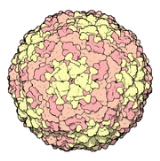
Foot-and-mouth disease or
hoof-and-mouth disease (
Aphtae epizooticae) is an
infectiousInfectious diseases, also known as communicable diseases, contagious diseases or transmissible diseases comprise clinically evident illness resulting from the infection, presence and growth of pathogenic biological agents in an individual host organism...
and sometimes fatal viral
diseaseA disease is an abnormal condition affecting the body of an organism. It is often construed to be a medical condition associated with specific symptoms and signs. It may be caused by external factors, such as infectious disease, or it may be caused by internal dysfunctions, such as autoimmune...
that affects cloven-hoofed animals, including domestic and wild bovids. The virus causes a high fever for two or three days, followed by blisters inside the mouth and on the feet that may rupture and cause lameness.
Foot-and-mouth disease is a severe plague for animal farming, since it is highly infectious and can be spread by infected animals through
aerosolTechnically, an aerosol is a suspension of fine solid particles or liquid droplets in a gas. Examples are clouds, and air pollution such as smog and smoke. In general conversation, aerosol usually refers to an aerosol spray can or the output of such a can...
s, through contact with contaminated farming equipment, vehicles, clothing or feed, and by domestic and wild predators. Its containment demands considerable efforts in
vaccinationA vaccine is a biological preparation that improves immunity to a particular disease. A vaccine typically contains an agent that resembles a disease-causing microorganism, and is often made from weakened or killed forms of the microbe or its toxins...
, strict monitoring,
trade restrictionA trade restriction is an artificial restriction on the trade of goods between two countries. It is the result of protectionism. However, the term is not uncontroversial since what one part may see as a trade restriction another may see as a way to protect consumers from inferior, harmful or...
s and
quarantineQuarantine is compulsory isolation, typically to contain the spread of something considered dangerous, often but not always disease. The word comes from the Italian quarantena, meaning forty-day period....
s, and occasionally the elimination of millions of animals.
Susceptible animals include
cattleCattle are the most common type of large domesticated ungulates. They are a prominent modern member of the subfamily Bovinae, are the most widespread species of the genus Bos, and are most commonly classified collectively as Bos primigenius...
, water buffalo,
sheepSheep are quadrupedal, ruminant mammals typically kept as livestock. Like all ruminants, sheep are members of the order Artiodactyla, the even-toed ungulates. Although the name "sheep" applies to many species in the genus Ovis, in everyday usage it almost always refers to Ovis aries...
,
goatThe domestic goat is a subspecies of goat domesticated from the wild goat of southwest Asia and Eastern Europe. The goat is a member of the Bovidae family and is closely related to the sheep as both are in the goat-antelope subfamily Caprinae. There are over three hundred distinct breeds of...
s,
pigA pig is any of the animals in the genus Sus, within the Suidae family of even-toed ungulates. Pigs include the domestic pig, its ancestor the wild boar, and several other wild relatives...
s,
antelopeAntelope is a term referring to many even-toed ungulate species indigenous to various regions in Africa and Eurasia. Antelopes comprise a miscellaneous group within the family Bovidae, encompassing those old-world species that are neither cattle, sheep, buffalo, bison, nor goats...
,
deerDeer are the ruminant mammals forming the family Cervidae. Species in the Cervidae family include white-tailed deer, elk, moose, red deer, reindeer, fallow deer, roe deer and chital. Male deer of all species and female reindeer grow and shed new antlers each year...
, and
bisonMembers of the genus Bison are large, even-toed ungulates within the subfamily Bovinae. Two extant and four extinct species are recognized...
. It has also been known to infect
hedgehogA hedgehog is any of the spiny mammals of the subfamily Erinaceinae and the order Erinaceomorpha. There are 17 species of hedgehog in five genera, found through parts of Europe, Asia, Africa, and New Zealand . There are no hedgehogs native to Australia, and no living species native to the Americas...
s,
elephantElephants are large land mammals in two extant genera of the family Elephantidae: Elephas and Loxodonta, with the third genus Mammuthus extinct...
s,
llamaThe llama is a South American camelid, widely used as a meat and pack animal by Andean cultures since pre-Hispanic times....
, and
alpacaAn alpaca is a domesticated species of South American camelid. It resembles a small llama in appearance.Alpacas are kept in herds that graze on the level heights of the Andes of southern Peru, northern Bolivia, Ecuador, and northern Chile at an altitude of to above sea level, throughout the year...
may develop mild symptoms, but are resistant to the disease and do not pass it on to others of the same species. In laboratory experiments,
mice-Fiction:*Mice , alien species in The Hitchhiker's Guide to the Galaxy*The Mice -Acronyms:* "Meetings, Incentives, Conferencing, Exhibitions", facilities terminology for events...
and
ratsRATS may refer to:* RATS , Regression Analysis of Time Series, a statistical package* Rough Auditing Tool for Security, a computer program...
and
chickenThe chicken is a domesticated fowl, a subspecies of the Red Junglefowl. As one of the most common and widespread domestic animals, and with a population of more than 24 billion in 2003, there are more chickens in the world than any other species of bird...
s have been successfully infected by artificial means, but it is not believed that they would contract the disease under natural conditions. Humans are very rarely affected.
The
virus responsible for the diseaseThe foot-and-mouth disease virus is the pathogen that causes foot-and-mouth disease. It is a picornavirus, the prototypical member of the Aphthovirus genus...
is a
picornavirusA picornavirus is a virus belonging to the family Picornaviridae. Picornaviruses are non-enveloped, positive-stranded RNA viruses with an icosahedral capsid. The genome RNA is unusual because it has a protein on the 5' end that is used as a primer for transcription by RNA polymerase...
, the prototypic member of the genus
AphthovirusAphthovirus is a viral genus of the family Picornaviridae. Aphthoviruses infect vertebrates, and include the causative agent of foot-and-mouth disease. Foot-and-mouth disease virus is the prototypic member of the genus Aphthovirus...
. Infection occurs when the virus particle is taken into a
cellThe cell is the basic structural and functional unit of all known living organisms. It is the smallest unit of life that is classified as a living thing, and is often called the building block of life. The Alberts text discusses how the "cellular building blocks" move to shape developing embryos....
of the host. The cell is then forced to manufacture thousands of copies of the virus, and eventually bursts, releasing the new particles in the blood. The virus is highly variable, which limits the effectiveness of vaccination.
History
The cause of FMD was first shown to be viral in 1897 by Friedrich Loeffler. He passed the
bloodBlood is a specialized bodily fluid in animals that delivers necessary substances such as nutrients and oxygen to the cells and transports metabolic waste products away from those same cells....
of an infected animal through a
Chamberland filterA Chamberland filter, also known as a Pasteur-Chamberland filter, is a porcelain water filter invented by Charles Chamberland in 1884. It is similar to the Berkefeld filter in principle.-Design:...
and found that the fluid that was collected could still cause the disease in healthy animals.
FMD occurs throughout much of the world, and whilst some countries have been free of FMD for some time, its wide host range and rapid spread represent cause for international concern. After
World War IIWorld War II, or the Second World War , was a global conflict lasting from 1939 to 1945, involving most of the world's nations—including all of the great powers—eventually forming two opposing military alliances: the Allies and the Axis...
, the disease was widely distributed throughout the world. In 1996, endemic areas included
AsiaAsia is the world's largest and most populous continent, located primarily in the eastern and northern hemispheres. It covers 8.7% of the Earth's total surface area and with approximately 3.879 billion people, it hosts 60% of the world's current human population...
,
AfricaAfrica is the world's second largest and second most populous continent, after Asia. At about 30.2 million km² including adjacent islands, it covers 6% of the Earth's total surface area and 20.4% of the total land area...
, and parts of
South AmericaSouth America is a continent situated in the Western Hemisphere, mostly in the Southern Hemisphere, with a relatively small portion in the Northern Hemisphere. The continent is also considered a subcontinent of the Americas. It is bordered on the west by the Pacific Ocean and on the north and east...
; as of August 2007,
ChileChile ,officially the Republic of Chile , is a country in South America occupying a long, narrow coastal strip between the Andes mountains to the east and the Pacific Ocean to the west. It borders Peru to the north, Bolivia to the northeast, Argentina to the east, and the Drake Passage in the far...
is disease free, and
UruguayUruguay ,officially the Oriental Republic of Uruguay,sometimes the Eastern Republic of Uruguay; ) is a country in the southeastern part of South America. It is home to some 3.5 million people, of whom 1.8 million live in the capital Montevideo and its metropolitan area...
and
ArgentinaArgentina , officially the Argentine Republic , is the second largest country in South America by land area, after Brazil. It is constituted as a federation of 23 provinces and an autonomous city, Buenos Aires...
have not had an outbreak since 2001.
North AmericaNorth America is a continent wholly within the Northern Hemisphere and almost wholly within the Western Hemisphere. It is also considered a northern subcontinent of the Americas...
and
AustraliaAustralia , officially the Commonwealth of Australia, is a country in the Southern Hemisphere comprising the mainland of the Australian continent, the island of Tasmania, and numerous smaller islands in the Indian and Pacific Oceans. It is the world's sixth-largest country by total area...
have been free of FMD for many years.
New ZealandNew Zealand is an island country in the south-western Pacific Ocean comprising two main landmasses and numerous smaller islands. The country is situated some east of Australia across the Tasman Sea, and roughly south of the Pacific island nations of New Caledonia, Fiji, and Tonga...
has never had a case of foot-and-mouth disease. Most
EuropeEurope is, by convention, one of the world's seven continents. Comprising the westernmost peninsula of Eurasia, Europe is generally 'divided' from Asia to its east by the watershed divides of the Ural and Caucasus Mountains, the Ural River, the Caspian and Black Seas, and the waterways connecting...
an countries have been recognized as disease free, and countries belonging to the
European UnionThe European Union is an economic and political union of 27 independent member states which are located primarily in Europe. The EU traces its origins from the European Coal and Steel Community and the European Economic Community , formed by six countries in 1958...
have stopped FMD
vaccinationVaccination is the administration of antigenic material to stimulate the immune system of an individual to develop adaptive immunity to a disease. Vaccines can prevent or ameliorate the effects of infection by many pathogens...
.
However, in 2001, a serious outbreak of FMD in
BritainGreat Britain or Britain is an island situated to the northwest of Continental Europe. It is the ninth largest island in the world, and the largest European island, as well as the largest of the British Isles...
resulted in the slaughter of many animals, the postponing of the
general electionThe United Kingdom general election, 2001 was held on Thursday 7 June 2001 to elect 659 members to the British House of Commons. It was dubbed "the quiet landslide" by the media, as the Labour Party was re-elected with another landslide result and only suffered a net loss of 6 seats...
for a month, and the cancellation of many sporting events and leisure activities such as the
Isle of Man TTThe International Isle of Man TT Race is a motorcycle racing event held on the Isle of Man and was for many years the most prestigious motorcycle race in the world...
. Due to strict government policies on sale of livestock, disinfection of all persons leaving and entering farms and the cancellation of large events likely to be attended by farmers, a potentially economically disastrous
epizooticIn epizoology, an epizootic is a disease that appears as new cases in a given animal population, during a given period, at a rate that substantially exceeds what is "expected" based on recent experience . Epidemic is the analogous term applied to human populations...
was avoided in the
Republic of IrelandIreland , described as the Republic of Ireland , is a sovereign state in Europe occupying approximately five-sixths of the island of the same name. Its capital is Dublin. Ireland, which had a population of 4.58 million in 2011, is a constitutional republic governed as a parliamentary democracy,...
, with just one case recorded in Proleek, Co. Louth. In August 2007, FMD was found at two farms in
SurreySurrey is a county in the South East of England and is one of the Home Counties. The county borders Greater London, Kent, East Sussex, West Sussex, Hampshire and Berkshire. The historic county town is Guildford. Surrey County Council sits at Kingston upon Thames, although this has been part of...
, England. All livestock were culled and a quarantine erected over the area. There have since been two other suspected outbreaks, although these seem now not to be related to FMD. The only reported cases in 2010 were a false alarm from GIS Alex Baker, as proven false by the Florida Farm and Agricultural Department, and confirmed quarantine/slaughter of cows and pigs has been reported from Miyazaki prefecture in Japan in the month of June after three cows tested positive. A total of some 270,000 cattle have been ordered slaughtered following the disease's outbreak.
Clinical signs
The incubation period for foot-and-mouth disease virus has a range between 2 and 12 days. The disease is characterized by high
feverFever is a common medical sign characterized by an elevation of temperature above the normal range of due to an increase in the body temperature regulatory set-point. This increase in set-point triggers increased muscle tone and shivering.As a person's temperature increases, there is, in...
that declines rapidly after two or three days; blisters inside the mouth that lead to excessive secretion of stringy or foamy saliva and to drooling; and blisters on the feet that may rupture and cause lameness. Adult animals may suffer weight loss from which they do not recover for several months as well as swelling in the testicles of mature males, and in cows,
milkMilk is a white liquid produced by the mammary glands of mammals. It is the primary source of nutrition for young mammals before they are able to digest other types of food. Early-lactation milk contains colostrum, which carries the mother's antibodies to the baby and can reduce the risk of many...
production can decline significantly. Though most animals eventually recover from FMD, the disease can lead to
myocarditisMyocarditis is inflammation of heart muscle . It resembles a heart attack but coronary arteries are not blocked.Myocarditis is most often due to infection by common viruses, such as parvovirus B19, less commonly non-viral pathogens such as Borrelia burgdorferi or Trypanosoma cruzi, or as a...
(inflammation of the heart muscle) and death, especially in newborn animals. Some infected animals remain
asymptomaticIn medicine, a disease is considered asymptomatic if a patient is a carrier for a disease or infection but experiences no symptoms. A condition might be asymptomatic if it fails to show the noticeable symptoms with which it is usually associated. Asymptomatic infections are also called subclinical...
, but they nonetheless
carryAn asymptomatic carrier is a person or other organism that has contracted an infectious disease, but who displays no symptoms. Although unaffected by the disease themselves, carriers can transmit it to others...
FMD and can transmit it to others.
Evolution
Of the seven serotypes of this virus, A, C, O, Asia 1 and SAT3 appear to be distinct lineages; SAT 1 and SAT 2 are unresolved clades. The mutation rate of the protein-encoding sequences of strains isolated between 1932 and 2007 has been estimated to be 1.46 × 10(-3) substitutions/site/year, a rate similar to that of other RNA viruses. The most recent common ancestor appears to have evolved ~481 years ago (early 16th century). Skyline plot anaylsis shows a population expansion in the early 20th century, which was then followed by a rapid decline in population size in the late 20th century.
There are at least 7 genotypes of serotype Asia 1.
Transmission
The foot-and-mouth disease virus can be transmitted in a number of ways, including close contact animal-to-animal spread, long-distance aerosol spread and fomites or inanimate objects, typically fodder and motor vehicles. The clothes and skin of animal handlers, such as farmers, standing water, and uncooked food scraps and feed supplements containing infected animal products can harbor the virus as well. Cows can also catch FMD from the semen of infected bulls. Control measures include quarantine and destruction of infected livestock, and export bans for meat and other animal products to countries not infected with the disease.
Just as humans may spread the disease by carrying the virus on their clothes and bodies, animals that are not susceptible to the disease may still aid in spreading it. This was the case in Canada in 1952, when an outbreak flared up again after
dogThe domestic dog is a domesticated form of the gray wolf, a member of the Canidae family of the order Carnivora. The term is used for both feral and pet varieties. The dog may have been the first animal to be domesticated, and has been the most widely kept working, hunting, and companion animal in...
s had carried off bones from dead animals. Wolves are thought to play a similar role in the former
Soviet UnionThe Soviet Union , officially the Union of Soviet Socialist Republics , was a constitutionally socialist state that existed in Eurasia between 1922 and 1991....
.
Foot-and-mouth disease infecting humans
Humans can be infected with foot-and-mouth disease through contact with infected animals, but this is extremely rare. Some cases were caused by laboratory accidents. Because the virus that causes FMD is sensitive to stomach acid, it cannot spread to humans via consumption of infected meat, except in the mouth before the meat is swallowed. In the UK, the last confirmed human case occurred in 1966, and only a few other cases have been recorded in countries of
continental EuropeContinental Europe, also referred to as mainland Europe or simply the Continent, is the continent of Europe, explicitly excluding European islands....
, Africa, and South America. Symptoms of FMD in humans include malaise, fever, vomiting, red ulcerative lesions (surface-eroding damaged spots) of the oral tissues, and sometimes vesicular lesions (small blisters) of the skin. According to a newspaper report, FMD killed two children in England in 1884, supposedly due to infected milk.
Another viral disease with similar symptoms,
hand, foot and mouth diseaseHand, foot and mouth disease is a human syndrome caused by intestinal viruses of the Picornaviridae family. The most common strains causing HFMD are Coxsackie A virus and Enterovirus 71 ....
, occurs more frequently in humans, especially in young children; the cause, Coxsackie A virus, is different from FMDV. Coxsackie viruses belong to the
EnterovirusEnteroviruses are a genus of ssRNA viruses associated with several human and mammalian diseases. Serologic studies have distinguished 66 human enterovirus serotypes on the basis of antibody neutralization tests. Additional antigenic variants have been defined within several of the serotypes on the...
es within the Picornaviridae.
Because FMD rarely infects humans, but spreads rapidly among animals, it is a much greater threat to the agriculture industry than to human health. Farmers around the world can lose huge amounts of money during a foot-and-mouth
epizooticIn epizoology, an epizootic is a disease that appears as new cases in a given animal population, during a given period, at a rate that substantially exceeds what is "expected" based on recent experience . Epidemic is the analogous term applied to human populations...
, when large numbers of animals are destroyed and revenues from milk and meat production go down.
Vaccination
Like other viruses, the FMD virus continually evolves and mutates, thus one of the difficulties in vaccinating against it is the huge variation between and even within
serotypeSerotype or serovar refers to distinct variations within a subspecies of bacteria or viruses. These microorganisms, viruses, or cells are classified together based on their cell surface antigens...
s. There is no cross-protection between serotypes (meaning that a vaccine for one serotype will not protect against any others) and in addition, two
strainsIn biology, a strain is a low-level taxonomic rank used in three related ways.-Microbiology and virology:A strain is a genetic variant or subtype of a micro-organism . For example, a "flu strain" is a certain biological form of the influenza or "flu" virus...
within a given serotype may have
nucleotideDeoxyribonucleic acid is a nucleic acid that contains the genetic instructions used in the development and functioning of all known living organisms . The DNA segments that carry this genetic information are called genes, but other DNA sequences have structural purposes, or are involved in...
sequences that differ by as much as 30% for a given gene. This means FMD
vaccineA vaccine is a biological preparation that improves immunity to a particular disease. A vaccine typically contains an agent that resembles a disease-causing microorganism, and is often made from weakened or killed forms of the microbe or its toxins...
s must be highly specific to the strain involved. Vaccination only provides temporary
immunityAn immune system is a system of biological structures and processes within an organism that protects against disease by identifying and killing pathogens and tumor cells. It detects a wide variety of agents, from viruses to parasitic worms, and needs to distinguish them from the organism's own...
that lasts from months to years.
Currently, the World Organisation for Animal Health recognizes countries to be in one of three disease states with regards to FMD: FMD present with or without vaccination, FMD-free with vaccination, and FMD-free without vaccination. Countries designated FMD-free without vaccination have the greatest access to export markets, and therefore many developed nations, including Canada, the United States, and the UK, work hard to maintain their current status.
Reasons cited for restricting export from countries using FMD vaccines include, probably most importantly, routine blood tests relying on antibodies cannot distinguish between an infected and a vaccinated animal, which severely hampers screening of animals used in export products, risking a spread of FMD to importing countries. A widespread preventive vaccination would also conceal the existence of the virus in a country. From there, it could potentially spread to countries without vaccine programs. Lastly, an animal infected shortly after being vaccinated can harbor and spread FMD without showing symptoms itself, hindering containment and culling of sick animals as a remedy.
Many early
vaccineA vaccine is a biological preparation that improves immunity to a particular disease. A vaccine typically contains an agent that resembles a disease-causing microorganism, and is often made from weakened or killed forms of the microbe or its toxins...
s used dead samples of FMDV to inoculate animals, but those early vaccines sometimes caused real outbreaks. In the 1970s, scientists discovered that a vaccine could be made using only a single key
proteinProteins are biochemical compounds consisting of one or more polypeptides typically folded into a globular or fibrous form, facilitating a biological function. A polypeptide is a single linear polymer chain of amino acids bonded together by peptide bonds between the carboxyl and amino groups of...
from the virus. The task was to produce enough quantities of the protein to be used in the vaccination. On June 18, 1981, the U.S. government announced the creation of a vaccine targeted against FMD, the world's first
genetically engineeredGenetic engineering, also called genetic modification, is the direct human manipulation of an organism's genome using modern DNA technology. It involves the introduction of foreign DNA or synthetic genes into the organism of interest...
vaccine.
The North American FMD Vaccine Bank is housed at the
United States Department of AgricultureThe United States Department of Agriculture is the United States federal executive department responsible for developing and executing U.S. federal government policy on farming, agriculture, and food...
's (USDA) Foreign Animal Disease Diagnostic Laboratory (FADDL) at
Plum Island Animal Disease CenterPlum Island Animal Disease Center is a United States federal research facility dedicated to the study of animal diseases. It is part of the DHS Directorate for Science and Technology....
. The Center, located 1.5 miles (2.4 km) off the coast of Long Island, NY, is the only place in the United States where scientists can conduct research and diagnostic work on highly contagious animal diseases such as FMD. Because of this limitation, US companies working on FMD usually use facilities in other countries where such diseases are endemic.
United States 1914-1929
The US has had nine FMD outbreaks since 1870; the most devastating one happened in 1914. It originated from
MichiganMichigan is a U.S. state located in the Great Lakes Region of the United States of America. The name Michigan is the French form of the Ojibwa word mishigamaa, meaning "large water" or "large lake"....
, but its entry into the stockyards in Chicago turned it into an
epizooticIn epizoology, an epizootic is a disease that appears as new cases in a given animal population, during a given period, at a rate that substantially exceeds what is "expected" based on recent experience . Epidemic is the analogous term applied to human populations...
. About 3,500 livestock herds were infected across the US, totaling over 170,000 cattle, sheep and swine. The eradication came at a cost of US$4.5 million. A 1924 outbreak in California resulted not only in the slaughter of 109,000 farm animals, but also 22,000
deerDeer are the ruminant mammals forming the family Cervidae. Species in the Cervidae family include white-tailed deer, elk, moose, red deer, reindeer, fallow deer, roe deer and chital. Male deer of all species and female reindeer grow and shed new antlers each year...
.
The US saw its latest FMD outbreak in
Montebello, CaliforniaMontebello is a city in Los Angeles County, California, United States, in the southwestern part of the San Gabriel Valley. It is located on of land just east of downtown Los Angeles. It is considered part of the Gateway Cities, and the city is a member of the Gateway Cities Council of...
in 1929. This outbreak originated in hogs that had eaten infected meat scraps from a tourist steamship that had stocked meat in
ArgentinaArgentina , officially the Argentine Republic , is the second largest country in South America by land area, after Brazil. It is constituted as a federation of 23 provinces and an autonomous city, Buenos Aires...
. Over 3,600 animals were slaughtered and the disease was contained in less than a month.
United Kingdom 1967
In October 1967, a farmer in
ShropshireShropshire is a county in the West Midlands region of England. For Eurostat purposes, the county is a NUTS 3 region and is one of four counties or unitary districts that comprise the "Shropshire and Staffordshire" NUTS 2 region. It borders Wales to the west...
reported a lame sow, which was later diagnosed with FMD. The source was believed to be remains of legally-imported infected lamb from Argentina and Chile. The virus spread and, in total, 442,000 animals were slaughtered and the outbreak had an estimated cost of £370 million.
Taiwan 1997
Taiwan had previous epidemics of FMD in 1913-14 and 1924–29, but had since been spared epidemics, and considered itself free of FMD as late as in the 1990s. On the 19th of March 1997, a sow at a farm in
HsinchuHsinchu City is a city in northern Taiwan. Hsinchu is popularly nicknamed "The Windy City" for its windy climate.Hsinchu City is administered as a special municipality within Taiwan . The city is bordered by Hsinchu County to the north and east, Miaoli County to the south, and the Taiwan Strait...
prefecture,
TaiwanTaiwan , also known, especially in the past, as Formosa , is the largest island of the same-named island group of East Asia in the western Pacific Ocean and located off the southeastern coast of mainland China. The island forms over 99% of the current territory of the Republic of China following...
was diagnosed with a strain of FMD which only infects swine. Mortality was high, nearing 100% in the infected herd. The cause of the epidemic was not determined, but the farm was near a port city known for its pig-smuggling industry and illegal slaughterhouses. Smuggled swine or contaminated meat are thus likely sources of the disease.
The disease spread fast among swine herds in Taiwan, with 200-300 new farms being infected daily. Causes for this include the high swine density in the area, with up to 6,500 hogs per square mile, feeding of pigs with untreated garbage, and the farm's proximity to slaughterhouses. Other systemic issues, such as lack of laboratory facilities, slow response and initial lack of a vaccination program, contributed. The farmers allegedly intentionally introduced FMD to their flocks, because the payment offered to farmers for culled swine was at the time higher than the market value of the swine.
A complicating factor is the endemic spread of
swine vesicular diseaseSwine vesicular disease is an acute, contagious viral disease of swine caused by the swine vesicular disease virus, an enterovirus. It is characterized by fever and vesicles with subsequent ulcers in the mouth and on the snout, feet, and teats...
(SVD) in Taiwan. The symptoms are indistinguishable from FMD, which may have led to previous misdiagnosing of FMD as SVD. Laboratory analysis was seldom used for diagnosis, and FMD may thus have gone unnoticed for some time.
The swine depopulation was a massive undertaking, with the military contributing substantial manpower. At peak capacity, 200,000 hogs per day were disposed of, mainly by
electrocutionElectric Shock of a body with any source of electricity that causes a sufficient current through the skin, muscles or hair. Typically, the expression is used to denote an unwanted exposure to electricity, hence the effects are considered undesirable....
. Carcasses were disposed of by burning and burial, but burning was avoided in water resource protection areas. In April, industrial incinerators were running around the clock to dispose of the carcasses.
Initially, 40,000 combined vaccines for the strains O-1, A-24 and Asia-1 were available and administered to zoo animals and valuable breeding hogs. At the end of March, half a million new doses of vaccines for O-1 and Asia-1 were made available. On the May 3rd, 13 million doses of O-1 vaccine arrived, and both the March and May shipments were distributed free of charge. There was a danger of vaccination crews spreading the disease; therefore, trained farmers were allowed to administer the vaccine under veterinary supervision.
Taiwan had previously been the major exporter of pork to Japan, and among the top 15 pork producers in the world in 1996. During the outbreak, over 3.8 million swine were destroyed at a cost of US$6.9 billion. The Taiwanese pig industry was devastated as a result, and the export market was in ruins.
In 2007, Taiwan was considered free of FMD, but was still conducting a vaccination program, which restricts the export of meat from Taiwan.
United Kingdom 2001
The epidemic of foot-and-mouth disease in the
United KingdomThe United Kingdom of Great Britain and Northern IrelandIn the United Kingdom and Dependencies, other languages have been officially recognised as legitimate autochthonous languages under the European Charter for Regional or Minority Languages...
in the spring and summer of 2001 was caused by the "Type O pan Asia" strain of the disease. This episode resulted in more than 2,000 cases of the disease in farms throughout the British countryside. Around seven million sheep and cattle were killed in an eventually successful attempt to halt the disease. The county of
CumbriaCumbria , is a non-metropolitan county in North West England. The county and Cumbria County Council, its local authority, came into existence in 1974 after the passage of the Local Government Act 1972. Cumbria's largest settlement and county town is Carlisle. It consists of six districts, and in...
was the worst affected area of the country, with 843 cases. By the time the disease was halted in October 2001, the crisis was estimated to have cost Britain £8 billion ($16 billion) in costs to the agricultural and support industries, and to the outdoor industry. What made this outbreak so serious was the amount of time between infection being present at the first outbreak loci, and the time when countermeasures were put into operation against the disease, such as transport bans and detergent washing of both vehicles and personnel entering livestock areas. However, the extreme overkill of many disease-free animals (80% of culled livestock were clean) was a result of inappropriate poor mathematical modelling that did not reflect the epidemiology of the epidemic. The epidemic was probably caused by pigs which had been fed infected garbage that had not been properly heat-sterilized. It is further believed that the garbage contained remains of infected meat which had been illegally imported to Britain.
China 2005
In April 2005, an Asia-1 strain of FMD appeared in the eastern provinces of
Shandong' is a Province located on the eastern coast of the People's Republic of China. Shandong has played a major role in Chinese history from the beginning of Chinese civilization along the lower reaches of the Yellow River and served as a pivotal cultural and religious site for Taoism, Chinese...
and
Jiangsu' is a province of the People's Republic of China, located along the east coast of the country. The name comes from jiang, short for the city of Jiangning , and su, for the city of Suzhou. The abbreviation for this province is "苏" , the second character of its name...
. During April and May, it spread to suburban Beijing, the northern province of
Hebei' is a province of the People's Republic of China in the North China region. Its one-character abbreviation is "" , named after Ji Province, a Han Dynasty province that included what is now southern Hebei...
, and the
XinjiangXinjiang is an autonomous region of the People's Republic of China. It is the largest Chinese administrative division and spans over 1.6 million km2...
autonomous regionAn autonomous region is a first-level administrative subdivision of People's Republic of China. Like Chinese provinces, an autonomous region has its own local government, but an autonomous region theoretically has more legislative rights. An Autonomous Region is a minority entity which has a...
in northwest China. On 13 May, China reported the FMD outbreak to the
World Health OrganizationThe World Health Organization is a specialized agency of the United Nations that acts as a coordinating authority on international public health. Established on 7 April 1948, with headquarters in Geneva, Switzerland, the agency inherited the mandate and resources of its predecessor, the Health...
and the OIE. This was the first time China has publicly admitted to having FMD. China is still reporting FMD outbreaks. In 2007, reports filed with the OIE documented new or ongoing outbreaks in the provinces of
Gansu' is a province located in the northwest of the People's Republic of China.It lies between the Tibetan and Huangtu plateaus, and borders Mongolia, Inner Mongolia, and Ningxia to the north, Xinjiang and Qinghai to the west, Sichuan to the south, and Shaanxi to the east...
,
QinghaiQinghai ; Oirat Mongolian: ; ; Salar:) is a province of the People's Republic of China, named after Qinghai Lake...
and
XinjiangXinjiang is an autonomous region of the People's Republic of China. It is the largest Chinese administrative division and spans over 1.6 million km2...
. This included reports of domestic
yakThe yak, Bos grunniens or Bos mutus, is a long-haired bovine found throughout the Himalayan region of south Central Asia, the Tibetan Plateau and as far north as Mongolia and Russia. In addition to a large domestic population, there is a small, vulnerable wild yak population...
showing signs of infection. FMD is endemic in pastoral regions of China from Heilongjiang Province in the northeast to Sichuan Province and the Tibetan Autonomous region in the southwest. Chinese domestic media reports often use a euphemism "Disease Number Five" (五号病) rather than FMD in reports because of the sensitivity of the FMD issue. In March 2010, Southern Rural News (Nanfang Nongcunbao), in an article "Breaking the Hoof and Mouth Disease Taboo", noted that FMD has long been covered up in China by referring to it that way. FMD is also called canker (口疮) or hoof jaundice (蹄癀) in China, so information on FMD in China can be found online using those words as search terms. One can find online many provincial orders and regulations on FMD control predating China's acknowledgment that the disease existed in China, for example Guangxi Zhuang Autonomous Region 1991 regulation on preventing the spread of Disease No.5.
United Kingdom 2007
An infection of foot-and-mouth disease in the
United KingdomThe United Kingdom of Great Britain and Northern IrelandIn the United Kingdom and Dependencies, other languages have been officially recognised as legitimate autochthonous languages under the European Charter for Regional or Minority Languages...
was confirmed by the
Department for Environment, Food and Rural AffairsThe Department for Environment, Food and Rural Affairs is the government department responsible for environmental protection, food production and standards, agriculture, fisheries and rural communities in the United Kingdom...
, on 3 August 2007, on farmland located in
NormandyNormandy is both the name of a civil parish in the borough of Guildford in Surrey, England and the name of the largest village in that parish. It lies close to the western edge of the county of Surrey close to the border with Hampshire and just north of the chalk hill known as the Hog's Back...
,
SurreySurrey is a county in the South East of England and is one of the Home Counties. The county borders Greater London, Kent, East Sussex, West Sussex, Hampshire and Berkshire. The historic county town is Guildford. Surrey County Council sits at Kingston upon Thames, although this has been part of...
. All livestock in the vicinity were culled on 4 August. A nationwide ban on the movement of cattle and pigs was imposed, with a 3 km (1.9 mi) protection zone placed around the outbreak sites and the nearby virus research and vaccine production establishments, together with a 10 km (6.2 mi) increased surveillance zone.
On 4 August, the strain of the virus was identified as an "01 BFS67-like" virus, one linked to vaccines and not normally found in animals, and isolated in the 1967 outbreak. The same strain was used at the nearby
Institute for Animal HealthThe Institute for Animal Health is a research institute in the United Kingdom dedicated to the study of infectious diseases of farm animals. It forms part of the UK government's Biotechnology and Biological Sciences Research Council . The institute employs many scientists and vets, along with a...
and
Merial Animal Health LtdMerial is a multinational animal health company. It was formed as a joint venture between Merck & Co. and Sanofi-Aventis in 1997. Merial is now the animal health subsidiary of Sanofi-Aventis. Merial is a company leader in innovation, and provides an ample range with products to improve the...
at
PirbrightPirbright is a village in Surrey, England. Neighbouring villages include Worplesdon, Deepcut, Brookwood and Normandy. Pirbright parish has an area of some falling into two distinct communities with the military area to the north of the railway and the village to the south...
, 2.5 miles (4 km) away which is an American/French owned research facility, and was identified as a possible source of infection.
On 12 September, a new outbreak of the disease was confirmed in
EghamEgham is a wealthy suburb in the Runnymede borough of Surrey, in the south-east of England. It is part of the London commuter belt and Greater London Urban Area, and about south-west of central London on the River Thames and near junction 13 of the M25 motorway.-Demographics:Egham town has a...
,
SurreySurrey is a county in the South East of England and is one of the Home Counties. The county borders Greater London, Kent, East Sussex, West Sussex, Hampshire and Berkshire. The historic county town is Guildford. Surrey County Council sits at Kingston upon Thames, although this has been part of...
, 19 km (11.8 mi) from the original outbreak, with a second case being confirmed on a nearby farm on 14 September.
These outbreaks caused a cull of all at-risk animals in the area surrounding Egham, including two farms near to the famous four-star Hotel Great Fosters. These outbreaks also caused the closure of Windsor Great Park due to the park containing deer; the park remained closed for three months. On 19 September 2007, there was a suspected case of FMD in
SolihullSolihull is a town in the West Midlands of England with a population of 94,753. It is a part of the West Midlands conurbation and is located 9 miles southeast of Birmingham city centre...
, where a temporary control zone was set up by Defra.
Japan and Korea 2010–2011
In April 2010, a report of three incursions of FMD in
JapanJapan is an island nation in East Asia. Located in the Pacific Ocean, it lies to the east of the Sea of Japan, China, North Korea, South Korea and Russia, stretching from the Sea of Okhotsk in the north to the East China Sea and Taiwan in the south...
and
South KoreaThe Republic of Korea , , is a sovereign state in East Asia, located on the southern portion of the Korean Peninsula. It is neighbored by the People's Republic of China to the west, Japan to the east, North Korea to the north, and the East China Sea and Republic of China to the south...
led the United Nations Food and Agriculture Organization (FAO) to issue a call for increased global surveillance. Japan veterinary authorities confirmed an outbreak of type O FMD virus, currently more common in Asian countries where FMD is endemic.
South Korea was hit by the rarer type A FMD in January, and then suffered type O infection in April. The most serious case of foot-and-mouth outbreak in South Korea's history started in November 2010 in pig farms in
AndongAndong is a city in Gyeongsangbuk-do Province, South Korea. It is the largest city in the northern part of the province with a population of 167,821 in October 2010. The Nakdong River flows through the city...
city of
Gyeongsangbuk-doGyeongsangbuk-do or shortly Gyeongbuk is a province in eastern South Korea. The province was formed in 1896 from the northern half of the former Gyeongsang province, remained a province of Korea until the country's division in 1945, then became part of South Korea.The Gyeongsangbuk-do Office is...
, and has since spread in the country rapidly. More than 100 cases of the disease have been confirmed in the country so far, and in January 2011,
South KoreaThe Republic of Korea , , is a sovereign state in East Asia, located on the southern portion of the Korean Peninsula. It is neighbored by the People's Republic of China to the west, Japan to the east, North Korea to the north, and the East China Sea and Republic of China to the south...
n officials started a mass cull of approximately 12 percent, or around 3 million in total, of the entire domestic pig population and 107,000 of three million cattle of the country to halt the outbreak.
On 10 Feb 2011,
North KoreaThe Democratic People’s Republic of Korea , , is a country in East Asia, occupying the northern half of the Korean Peninsula. Its capital and largest city is Pyongyang. The Korean Demilitarized Zone serves as the buffer zone between North Korea and South Korea...
reported an outbreak affecting pigs in the region around
PyongyangPyongyang is the capital of the Democratic People's Republic of Korea, commonly known as North Korea, and the largest city in the country. Pyongyang is located on the Taedong River and, according to preliminary results from the 2008 population census, has a population of 3,255,388. The city was...
, by then ongoing since at least December 2010. Efforts to control the outbreak have been hampered by illicit sales of infected meat.
Bulgaria 2011
The outbreak was recognised when a wild boar was shot, which had crossed the
BulgariaBulgaria , officially the Republic of Bulgaria , is a parliamentary democracy within a unitary constitutional republic in Southeast Europe. The country borders Romania to the north, Serbia and Macedonia to the west, Greece and Turkey to the south, as well as the Black Sea to the east...
n-
TurkishTurkey , known officially as the Republic of Turkey , is a Eurasian country located in Western Asia and in East Thrace in Southeastern Europe...
border near the village of Kosti,
Burgas Province-Municipalities:The Burgas province contains 13 municipalities . The following table shows the names of each municipality in English and Cyrillic, the main town or village , and the population of each as of 2009.-Demography:The Burgas province had a population of 423,608 -Municipalities:The Burgas...
in the Strandzha Mountains. The autopsy discovered foot-and mouth disease. After this, 37 infected animals were discovered in the village of Kosti, and all susceptible animals there were culled.
Burgas Province-Municipalities:The Burgas province contains 13 municipalities . The following table shows the names of each municipality in English and Cyrillic, the main town or village , and the population of each as of 2009.-Demography:The Burgas province had a population of 423,608 -Municipalities:The Burgas...
and seven other neighboring provinces declared a
quarantineQuarantine is compulsory isolation, typically to contain the spread of something considered dangerous, often but not always disease. The word comes from the Italian quarantena, meaning forty-day period....
.
On 14 January, a further outbreak was discovered in the neighboring village of
RezovoRezovo is a village and seaside resort in southeastern Bulgaria, part of Tsarevo municipality, Burgas Province, in the coastal Strandzha geographical region. Lying at the mouth of the Rezovo River in the Black Sea, Rezovo is the southernmost point of the Bulgarian Black Sea Coast and the...
. It is thought to have been carried by a Turkish
cattleCattle are the most common type of large domesticated ungulates. They are a prominent modern member of the subfamily Bovinae, are the most widespread species of the genus Bos, and are most commonly classified collectively as Bos primigenius...
herd. On 17 January, the presence of the disease was confirmed. The Bulgarian authorities ordered culling of all susceptible livestock in Rezovo. Compensation for the losses in the two villages has been promised.
On 31 January, a third focus of infection was discovered in the southeastern Bulgarian village of
GramatikovoGramatikovo is a village in the municipality of Malko Tarnovo, in Burgas Province, in southeastern Bulgaria.On 31 January a foot-and-mouth disease outbreak was discovered in the village of Gramatikovo.-References:...
. On 25 March, two new outbreaks were discovered in the villages of
GranicharGranichar, Burgas Province is a village in the municipality of Sredets, in Burgas Province, in southeastern Bulgaria....
and Kirovo.
Economic and ethical issues
Epidemics of FMD have resulted in the slaughter of millions of animals, despite this being a frequently nonfatal disease for adult animals (2-5% mortality), though young animals can have a high mortality. The Taiwan outbreak that only affected pigs also showed a high mortality for adults. The destruction of animals is primarily to halt further spread, as growth and milk production may be permanently affected, even in animals that have recovered. Due to international efforts to eradicate the disease, infection would also lead to trade bans being imposed on affected countries. Critics of current policies to cull infected herds argue that the financial imperative needs to be balanced against the killing of many animals, especially when a significant proportion of infected animals, most notably those producing milk, would recover from infection and live normal lives, albeit with reduced milk production. On the ethical side, one must also consider that FMD is a painful disease for the affected animals. The vesicles/blisters are painful in themselves, and restrict both eating and movement. Through ruptured blisters, the animal is at risk from secondary bacterial infections and, in some cases, permanent disability.
See also
- Animal virology
The study of animal viruses is important from a veterinary viewpoint and many of these viruses cause diseases that are economically devastating. Many animal viruses are also important from a human medical perspective...
Animal viruses
- Hand, foot and mouth disease
Hand, foot and mouth disease is a human syndrome caused by intestinal viruses of the Picornaviridae family. The most common strains causing HFMD are Coxsackie A virus and Enterovirus 71 ....
(HFMD)
- Swine vesicular disease
Swine vesicular disease is an acute, contagious viral disease of swine caused by the swine vesicular disease virus, an enterovirus. It is characterized by fever and vesicles with subsequent ulcers in the mouth and on the snout, feet, and teats...
(SVD)
External links
- 2007 Outbreak Foot and Mouth Disease Timeline
- A Manufactured Plague: The history of Foot-and-mouth Disease in Britain. Foot and Mouth - the Management of a Pseudo-crisis (2004, ISBN 1-84407-080-8) by Abigail Wood, a veterinary researcher at the University of Manchester
The University of Manchester is a public research university located in Manchester, United Kingdom. It is a "red brick" university and a member of the Russell Group of research-intensive British universities and the N8 Group...
.
- Animal viruses
- Current status of Foot and Mouth worldwide at International des Epizooties. WAHID Interface - OIE World Animal Health Information Database
- Foot-and-mouth disease in man
- Foot and Mouth Livestock Symptoms Guide and Images
- In the 1884 outbreak in Britain
- Intervet International has a site devoted to FMD detailing information about Control, Vaccination, Legal Issues, and Preparation
- Levy, Jay A., Heinz Fraenkel-Conrat, and Robert A. Owens. "Picornaviridae" Chap. 2, section 2.2 in Virology. Englewood Cliffs, NJ: Prentice Hall, 1994.
- News updates on the 2007 UK Foot-and-mouth disease outbreak
- Foot and Mouth Disease Iowa State University Department of Veterinary Pathology, Center for Food Security and Public Health
- United States Animal Health Association FOOT-AND-MOUTH DISEASE
- USDA Foot-and-Mouth Research Laboratory Records
- The Lab-On-Site Project has more information in Foot and Mouth Disease Virus.