
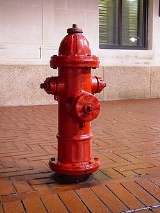
A
fire hydrant is an
active fire protectionActive fire protection is an integral part of fire protection. AFP is characterised by items and/or systems, which require a certain amount of motion and response in order to work, contrary to passive fire protection.-Fire suppression:...
measure, and a source of water provided in most urban, suburban and rural areas with municipal water service to enable
firefighterFirefighters are rescuers extensively trained primarily to put out hazardous fires that threaten civilian populations and property, to rescue people from car incidents, collapsed and burning buildings and other such situations...
s to tap into the municipal water supply to assist in extinguishing a fire. Buildings near a hydrant may qualify for an
insuranceIn law and economics, insurance is a form of risk management primarily used to hedge against the risk of a contingent, uncertain loss. Insurance is defined as the equitable transfer of the risk of a loss, from one entity to another, in exchange for payment. An insurer is a company selling the...
discount since firefighters should be able to more rapidly extinguish a fire on the insured property.
The concept of
fire plugs dates to at least the 17th century. This was a time when firefighters responding to a call would dig down to the wooden water mains and hastily bore a hole to secure water to fight fires. The water would fill the hole creating a temporary well, and be transported from the well to the fire via
bucket brigadeA bucket brigade or human chain is a method for transporting items where items are passed from one stationary person to the next.The method was important in firefighting before the advent of hand pumped fire engines, whereby firefighters would pass buckets to each other to extinguish a blaze. A...
s or, later, via
hand pumped fire enginesA fire apparatus, fire engine, fire truck, or fire appliance is a vehicle designed to assist in fighting fires by transporting firefighters to the scene and providing them with access to the fire, along with water or other equipment...
. The holes were then plugged with stoppers, normally redwood, which over time came to be known as
fire plugs. The location of the plug would often be recorded or marked so that it could be reused in future fires. This is the source of the colloquial term
fire plug still used for fire hydrants today. After the
Great Fire of LondonThe Great Fire of London was a major conflagration that swept through the central parts of the English city of London, from Sunday, 2 September to Wednesday, 5 September 1666. The fire gutted the medieval City of London inside the old Roman City Wall...
in 1666, the city installed water mains with holes drilled at intervals, equipped with risers, allowing an access point to the wooden fire plugs from street level.
The invention of a post or pillar type fire hydrant is generally credited to Frederick Graff Sr., Chief Engineer of the Philadelphia Water Works around the year 1801. It had a combination hose/faucet outlet and was of "wet barrel" design with the valve in the top. It is said that Graff held the first patent for a fire hydrant, but this cannot be verified due to the fact that the patent office in Washington D.C. caught on fire in 1836 where many patent records from that period were destroyed in the process. In 1863,
Birdsill HollyBirdsill Holly was an inventor. Holly was born in Auburn, New York. He spent his early years in Seneca Falls, New York, a major center of water powered industries. His first patented invention was a rotary water pump.-Life:...
invented the modern version of the fire hydrant. While Holly was only one of many involved in the development of the fire hydrant, innovations he introduced are largely responsible for the fire hydrant taken for granted today. In 1869, Holly was issued U.S. patent #94749, for an "improved fire hydrant".
Operation
A
hoseA fire hose is a high-pressure hose used to carry water or other fire retardant to a fire to extinguish it. Outdoors, it is attached either to a fire engine or a fire hydrant. Indoors, it can be permanently attached to a building's standpipe or plumbing system...
is attached to the fire hydrant, then the
valveA valve is a device that regulates, directs or controls the flow of a fluid by opening, closing, or partially obstructing various passageways. Valves are technically pipe fittings, but are usually discussed as a separate category...
is opened to provide a powerful flow of water, on the order of 350
kPaThe pascal is the SI derived unit of pressure, internal pressure, stress, Young's modulus and tensile strength, named after the French mathematician, physicist, inventor, writer, and philosopher Blaise Pascal. It is a measure of force per unit area, defined as one newton per square metre...
(50 lbf/in²) (this pressure varies according to region and depends on various factors including the size and location of the attached water main). This hose can be further attached to a
fire engineA fire apparatus, fire engine, fire truck, or fire appliance is a vehicle designed to assist in fighting fires by transporting firefighters to the scene and providing them with access to the fire, along with water or other equipment...
, which can then use a powerful
pumpA pump is a device used to move fluids, such as liquids, gases or slurries.A pump displaces a volume by physical or mechanical action. Pumps fall into three major groups: direct lift, displacement, and gravity pumps...
to boost the water pressure and possibly split it into multiple streams. The hose may be connected with a
threadedA threaded pipe is a pipe with screw-threaded ends for assembly.- Tapered threads :The threaded pipes used in some plumbing installations for the delivery of gases or fluids under pressure have a threaded section that is slightly conical . This is called a "tapered thread"...
connection or a
StorzFor the beer, see Storz Brewing Company.Storz is a type of hose coupling invented by Carl August Guido Storz in 1882 that connects using interlocking hooks and flanges. It is sometimes referred to as a sexless coupling, because rather than having a male and a female end connected by screw threads,...
connector. Care should be taken not to open or close a fire hydrant too quickly, as this can create a
water hammerWater hammer is a pressure surge or wave resulting when a fluid in motion is forced to stop or change direction suddenly . Water hammer commonly occurs when a valve is closed suddenly at an end of a pipeline system, and a pressure wave propagates in the pipe...
which can damage nearby pipes and equipment. The water inside a charged hoseline causes it to be very heavy and high water pressure causes it to be stiff and unable to make a tight turn while pressurized. When a fire hydrant is unobstructed, this is not a problem, as there is enough room to adequately position the hose.
Most fire hydrant valves are not designed to throttle the water flow; they are designed to be operated full-on or full-off. The valving arrangement of most dry-barrel hydrants is for the drain valve to be open at anything other than full operation. Usage at partial-opening can consequently result in considerable flow directly into the soil surrounding the hydrant, which, over time, can cause severe scouring. A hose with a closed nozzle valve, or fire truck connection, or closed
gate valveThe gate valve, also known as a sluice valve, is a valve that opens by lifting a round or rectangular gate/wedge out of the path of the fluid. The distinct feature of a gate valve is the sealing surfaces between the gate and seats are planar, so gate valves are often used when a straight-line flow...
is always attached to the hydrant prior to opening the hydrant's main valve.
When a
firefighterFirefighters are rescuers extensively trained primarily to put out hazardous fires that threaten civilian populations and property, to rescue people from car incidents, collapsed and burning buildings and other such situations...
is operating a hydrant, appropriate
personal protective equipmentPersonal protective equipment refers to protective clothing, helmets, goggles, or other garment or equipment designed to protect the wearer's body from injury by blunt impacts, electrical hazards, heat, chemicals, and infection, for job-related occupational safety and health purposes, and in...
, such as
gloveA glove is a garment covering the hand. Gloves have separate sheaths or openings for each finger and the thumb; if there is an opening but no covering sheath for each finger they are called "fingerless gloves". Fingerless gloves with one large opening rather than individual openings for each...
s and a
helmetA helmet is a form of protective gear worn on the head to protect it from injuries.Ceremonial or symbolic helmets without protective function are sometimes used. The oldest known use of helmets was by Assyrian soldiers in 900BC, who wore thick leather or bronze helmets to protect the head from...
with face shield, are typically worn. High pressure water coursing through a potentially aging and corroding hydrant could cause a failure, injuring the firefighter operating the hydrant or bystanders.
In most jurisdictions it is illegal to park a car within a certain distance of a fire hydrant. In North America the distances are commonly 3 to 5 m or 10 to 15 ft, often indicated by yellow or red paint on the curb. In the UK, yellow lines are used to keep cars from parking over underground hydrants. Parking restrictions are sometimes ignored (especially in cities where available street parking is scarce), however these laws are usually enforced. The rationale is that hydrants need to be visible and accessible in an emergency.
Other uses
To prevent casual use or misuse, the hydrant requires special tools to be opened, usually a large wrench with a pentagon-shaped socket. Vandals sometimes cause monetary loss by wasting water when they open hydrants. Such vandalism can also reduce municipal water pressure and impair firefighters' efforts to extinguish fires. Sometimes those simply seeking to play in the water remove the caps and open the valve, providing residents a place to play and cool off in summer. However, this is usually discouraged as residents have been struck by passing automobiles while playing in the street in the water spray. In spite of this, some US communities provide low flow
sprinklerIrrigation sprinklers are sprinklers used on farms, golf courses, and yards, to provide water to vegetation and plants in the event of drought. They may also be used for recreation, as a cooling system, or to keep down the amount of airborne dust....
heads to enable residents to use the hydrants to cool off during hot weather, while gaining some control on water usage. Most fire hydrants in
AustraliaAustralia , officially the Commonwealth of Australia, is a country in the Southern Hemisphere comprising the mainland of the Australian continent, the island of Tasmania, and numerous smaller islands in the Indian and Pacific Oceans. It is the world's sixth-largest country by total area...
are protected by a silver-coloured cover with a red top, secured to the ground with bolts to protect the hydrant from vandalism and unauthorised use. The cover must be removed before use.
In most US areas, contractors who need temporary water may purchase permits to use hydrants. The permit will generally require a
hydrant meterA water meter is a device used to measure the volume of water usage. This article provides an overview of technical aspects of water meters. The worldwide prevalence of metering as well as its economic benefits and costs are covered in the separate article on water metering.In many developed...
, a gate valve and sometimes a
clapper valveA check valve, clack valve, non-return valve or one-way valve is a mechanical device, a valve, which normally allows fluid to flow through it in only one direction....
(if not designed into the hydrant already) to prevent back-flow into the hydrant. Additionally, residents who wish to use the hydrant to fill their in-ground
swimming poolA swimming pool, swimming bath, wading pool, or simply a pool, is a container filled with water intended for swimming or water-based recreation. There are many standard sizes; the largest is the Olympic-size swimming pool...
are commonly permitted to do so provided they pay for the water and agree to allow firefighters to
draftThe term drafting water refers to the use of suction to move a liquid such as water from a vessel or body of water below the intake of a suction pump. A rural fire department or farmer might draft water from a pond as the first step in moving the water elsewhere...
from their pool in the case of an emergency.
Municipal services, such as
street sweeperA street sweeper or street cleaner can refer to a person's occupation or a machine that cleans streets, usually in an urban area.-History of street sweeping in the United States:...
s and tank trucks, may also be allowed to use hydrants to fill their water tanks. Often
sewerA sanitary sewer is a separate underground carriage system specifically for transporting sewage from houses and commercial buildings to treatment or disposal. Sanitary sewers serving industrial areas also carry industrial wastewater...
maintenance trucks need water to flush out
sewerageSewerage refers to the infrastructure that conveys sewage. It encompasses receiving drains, manholes, pumping stations, storm overflows, screening chambers, etc. of the sanitary sewer...
lines, and fill their tanks on site from a hydrant. If necessary, the municipal workers will record the amount of water they used, or use a meter.
Since fire hydrants are one of the most accessible parts of a water distribution system, they are often used for attaching pressure gauges or loggers or monitor system water pressure. Automatic flushing devices are often attached to hydrants to maintain chlorination levels in areas of low usage. Hydrants are also used as an easy above ground access point by leak detection devices to detect locate leak from the sound they make.
Construction
In areas subject to freezing temperatures, only a portion of the hydrant is above ground. The valve is located below the
frost lineThe frost line—also known as frost depth or freezing depth—is most commonly the depth to which the groundwater in soil is expected to freeze. The frost depth depends on the climatic conditions of an area, the heat transfer properties of the soil and adjacent materials, and on nearby heat sources...
and connected via a
riserRiser may refer to:* Riser , a reservoir in a manufacturing mold* Stair riser, the vertical elements in a set of stairs* Drilling riser, a device used on a ship or offshore drilling rig...
to the above-ground portion. A valve rod extends from the valve itself up through a seal at the top of the hydrant, where it can be operated with the proper
wrenchA wrench or spanner is a tool used to provide grip and mechanical advantage in applying torque to turn objects—usually rotary fasteners, such as nuts and bolts—or keep them from turning....
. This design is known as a "dry barrel" hydrant, in that the barrel, or vertical body of the hydrant, is normally dry. A drain valve underground opens when the water valve is completely closed; this allows all water to drain from the hydrant body to prevent the hydrant from freezing.
In warm areas, hydrants are used with one or more valves in the above-ground portion. Unlike cold-weather hydrants, it is possible to turn the water supply on and off to each port. This style is known as a "wet barrel" hydrant.
Both wet- and dry- barrel hydrants typically have multiple outlets. Wet barrel hydrant outlets are typically individually controlled, while a single stem operates all the outlets of a dry barrel hydrant simultaneously. Thus, wet barrel hydrants allow single outlets to be opened, requiring somewhat more effort but simultaneously allowing more flexibility.
A typical U.S. dry-barrel hydrant has two smaller outlets and one larger outlet. The larger outlet is often a Storz connection if the local fire department has standardized on hose using Storz fittings for large diameter supply line. The larger outlet is known as a "steamer" connection (because they were once used to supply steam powered water pumps), and a hydrant with such an outlet may be referred to as a "steamer hydrant" although this usage is becoming archaic. Likewise, an older hydrant without a steamer connection may be referred to as a "village hydrant."
Appearance
Hydrant coloring may be due either to purely practical criteria or more artistic. In the United States, the AWWA and NFPA recommend hydrants be colored chrome yellow for rapid identification apart from the bonnet and nozzle caps which should be coded according to their available flow. Class AA hydrants (>1500 gpm) should have their nozzle caps and bonnet colored light blue, Class A hydrants (1000–1499 gpm), green, Class B hydrants (500–999 gpm), orange, and Class C hydrants (0–499 gpm), red. This aids arriving firefighters in determining how much water is available and whether to call for additional resources, or locate another hydrant. Other codings can be and frequently are used, some of greater complexity, incorporating pressure information, others more simplistic. In
OttawaOttawa is the capital of Canada, the second largest city in the Province of Ontario, and the fourth largest city in the country. The city is located on the south bank of the Ottawa River in the eastern portion of Southern Ontario...
, hydrant colors communicate different messages to firefighters; for example, if the inside of the hydrant is corroded so much that the interior diameter is too narrow for good pressure, it will be painted in a specific scheme to indicate to firefighters to move on to the next one. In many localities, a white or purple top indicates that the hydrant provides non-potable water. Where artistic and/or aesthetic considerations are paramount, hydrants can be extremely varied, or more subdued. In both instances this is usually at the cost of reduced practicality.
In Germany, most hydrants are located below ground (
Unterflurhydrant) and are accessed by a
Standrohr which provides the connections for the hoses.
Signage
In the UK and
IrelandIreland , described as the Republic of Ireland , is a sovereign state in Europe occupying approximately five-sixths of the island of the same name. Its capital is Dublin. Ireland, which had a population of 4.58 million in 2011, is a constitutional republic governed as a parliamentary democracy,...
, hydrants are located in the ground. Yellow "H" hydrant signs indicate the location of the hydrants, and are similar to the blue signs in
FinlandFinland , officially the Republic of Finland, is a Nordic country situated in the Fennoscandian region of Northern Europe. It is bordered by Sweden in the west, Norway in the north and Russia in the east, while Estonia lies to its south across the Gulf of Finland.Around 5.4 million people reside...
. Mounted on a small post or nearby wall etc., the two numbers indicate the size of the water main (top number) and the distance from the sign (lower number). Modern signs show these measurements in millimetres and metres, whereas older signs use inches and feet. Because the orders of magnitude are so different (6 inches versus 150 mm) there is no ambiguity whichever measuring system is used.
In areas of the United States without winter snow cover, blue reflectors embedded in the street are used to allow rapid identification of hydrants at night. In areas with snow cover, tall signs or flags are used so that hydrants can be located even if covered with snow. In
ruralRural areas or the country or countryside are areas that are not urbanized, though when large areas are described, country towns and smaller cities will be included. They have a low population density, and typically much of the land is devoted to agriculture...
areas tall narrow posts painted with visible colours such as red are attached to the hydrants to allow them to be located during heavy snowfall periods.
In
AustraliaAustralia , officially the Commonwealth of Australia, is a country in the Southern Hemisphere comprising the mainland of the Australian continent, the island of Tasmania, and numerous smaller islands in the Indian and Pacific Oceans. It is the world's sixth-largest country by total area...
, Hydrant signage varies, with several types displayed across the country. Most Australian hydrants are underground, being of a ballcock system, and a standpipe with a central plunger is used to open the valve. Due to this, hydrant signage is essential, due to their concealed nature.
- Painted markers — Usually a white or yellow (sometimes reflective paint) triangle or arrow painted on the road, pointing towards the side of the road the hydrant will be found on. These are most common in old areas, or on new roads where more advanced signs have not been installed. These are almost always coupled with a secondary form of signage.
- Hydrant Marker Plates — Found on power poles, fences, or street-signs, these are a comprehensive and effective system of identification. The plate consists of several codes; H (Potable water Hydrant), RH (Recycled/Non Potable), P (Pathway, where the hydrant cover can be found), R (Roadway). The plate is vertically oriented, around 8 cm wide, and 15 cm high. Found on this plate, from top to bottom, are the following features:
- The codes listed above, Potable/Non-potable at the top, Path/Roadway on the bottom of the plate.
- Below this, a number giving the distance to the hydrant (in meters), then a second number below that giving the size (in millimeters) of the water main.
- A black line across the center of the plate indicated the hydrant is found on the opposite side of the road to which the plate is affixed.
- Plates for recycled water have a purple background, as well as the RH code, normal potable hydrants are white, with the H code.
- Road reflectors or Cats eyes – Almost exclusively blue, these are placed on the center line of the road, usually with little indication on which side of the road the hydrant lies. They are visible for several hundred meters at night in heavy rain, further in clear conditions.
Inspection and maintenance
In most areas fire hydrants require annual inspections and maintenance — they normally only have a one year warranty, but some have 5 or even 10 year warranties, although the longer warranty does not remove the need for periodic inspections or maintenance. These inspections are generally performed by the local municipalities but they often do not inspect hydrants that are identified as private. Private hydrants are usually located on larger properties to adequately protect large buildings in case of a fire and in order to comply with the fire code. Such hydrants have met the requirements of insurance underwriters and are often referred to as UL/FM hydrants. Some companies are contracted out to inspect private fire hydrants unless the municipality has undertaken that task.
Some fire hydrant manufacturers recommend lubricating the head mechanism and restoring the head gaskets and O-rings annually in order that the fire hydrant perform the service expected of them, while others have incorporated proprietary features to provide long-term lubrication of the hydrant's operating mechanism. In any case, periodic inspection of lubricates is recommended. Lubrication is generally done with a food grade non-petroleum lubricant to avoid contamination of the distribution system.
Occasionally a stone or foreign object will mar the seat gasket. In this case, most hydrants have a special seat wrench that allows removal of the seat to replace the gasket or other broken parts without removing the hydrant from the ground. Hydrant extensions are also available for raising a hydrant if the grade around the hydrant changes. Without extending the height, the wrenches to remove caps would not clear and the break flanges for traffic models would not be located correctly in case they were hit. Hydrant repair kits are also available to repair sacrificial parts designed to break when hit by a vehicle.
Many departments use the hydrants for flushing out water line sediments. When doing so, they often use a hydrant diffuser, a device that diffuses the water so that it doesn't damage property and is less dangerous to bystanders than a solid stream. Some diffusers also dechlorinate the water to avoid ground contamination. Hydrants are also sometimes used as entry or exit points for
pipe cleaning pigsPigging in the context of pipelines refers to the practice of using pipeline inspection gauges or 'pigs' to perform various maintenance operations on a pipeline. This is done without stopping the flow of the product in the pipeline....
.
Historical inventions and innovations
Before the modern fire hydrant, a primitive fire suppression system was to bury a wooden water pipe (often no more than a hollowed out log) along the streets.
In the event of a fire, teams would dig down to the buried wooden water main and auger a hole in the pipe. And out would come the water to fill buckets with the water, and start a bucket brigade to extinguish the fire. When they were finished, they would need to hammer a wooden plug into the log to stop the flow of water. Hence the origin of the term “fire plug.”
The version of fire hydrants used today were invented by
Birdsill HollyBirdsill Holly was an inventor. Holly was born in Auburn, New York. He spent his early years in Seneca Falls, New York, a major center of water powered industries. His first patented invention was a rotary water pump.-Life:...
of Lockport, New York for his prodigious contributions to the field of hydraulic engineering in the 19th Century. While Holly was only one of many involved in the development of the fire hydrant, innovations he introduced are largely responsible for the fire hydrant taken for granted today. At Holly Manufacturing, he designed machinery for the Lockport water works that allowed water to be pumped under pressure into city mains without a reservoir. Shortly thereafter, Holly came up with his first design for a fire hydrant. Holly's Fire Protection and Water System, an integrated system designed to deliver water under a steady pressure for public safety, brought him worldwide fame in 1863. The system was widely adapted throughout the
United StatesThe United States of America is a federal constitutional republic comprising fifty states and a federal district...
and
CanadaCanada is a North American country consisting of ten provinces and three territories. Located in the northern part of the continent, it extends from the Atlantic Ocean in the east to the Pacific Ocean in the west, and northward into the Arctic Ocean...
, and established the standard upon which all current, water distribution systems are based upon. In 1869, Holly was issued U.S. patent #94749, for an "improved fire hydrant".
Non-pressurized (dry) hydrants
In rural areas where municipal water systems are not available, dry hydrants are used to supply water for fighting fires. A dry hydrant is analogous to a standpipe. A dry hydrant is usually an unpressurized, permanently installed pipe that has one end below the water level of a lake or pond. This end usually has a strainer to prevent debris from entering the pipe. The other end is above ground and has a hard sleeve connector. When needed, a pumper fire engine will pump from the lake or pond by drafting water. This is done by vacuuming the air out of the dry hydrant, hard sleeve, and the fire engine pump with a primer. Because lower pressure exists at the pump intake, atmospheric pressure on the pond or lake forces water into part of the dry hydrant above water, into the hard sleeve, and finally into the pump. This water can then be pumped by the engine's centrifugal pump.
Other types
- Water wells are also sometimes classified as fire hydrants if they can supply enough water volume and pressure.
- Standpipes are connections for firehoses within a building and serve the same purpose as fire hydrants in larger structures. Standpipes may be "dry" or "wet" (permanently filled with water).
See also
- Arson
Arson is the crime of intentionally or maliciously setting fire to structures or wildland areas. It may be distinguished from other causes such as spontaneous combustion and natural wildfires...
- Active fire protection
Active fire protection is an integral part of fire protection. AFP is characterised by items and/or systems, which require a certain amount of motion and response in order to work, contrary to passive fire protection.-Fire suppression:...
- Fire extinguisher
A fire extinguisher or extinguisher, flame entinguisher is an active fire protection device used to extinguish or control small fires, often in emergency situations...
- Fire protection
Fire protection is the study and practice of mitigating the unwanted effects of fires. It involves the study of the behaviour, compartmentalisation, suppression and investigation of fire and its related emergencies, as well as the research and development, production, testing and application of...
- Fire sprinkler
A fire sprinkler system is an active fire protection measure, consisting of a water supply system, providing adequate pressure and flowrate to a water distribution piping system, onto which fire sprinklers are connected...
- Flushing hydrant
A Flushing hydrant is a hydrant that is used for flushing a water line of silt, rust, debris, or stagnant water. Many water utilities use standard fire hydrants for flushing their lines. Specialized flushing hydrants are often smaller and less expensive than a fire hydrant to reduce cost where fire...
- Hydrant wrench
A hydrant wrench is a tool used to remove fire hydrant caps and open the valve of the hydrant. They are usually adjustable so as to fit different sized hydrant nuts.-In France:...
- Portable water tank
A portable water tank is a collapsible temporary tank designed for the reserve storage of water in firefighting, emergency relief, and military applications. These tanks can be either supported or unsupported. The supported tanks have a steel or aluminum frame and range in size from 600 to 5000 US...
Further reading
— Issued to John Jorden on September 8, 1838 for "...a new and useful improvement in Fire-Plugs and Hydrants...". This is an early wooden bodied hydrant, the earliest hydrant patent extant; the
patent officeA patent office is a governmental or intergovernmental organization which controls the issue of patents. In other words, "patent offices are government bodies that may grant a patent or reject the patent application based on whether or not the application fulfils the requirements for...
itself burned to the ground in 1836, taking with it all prior hydrant patents. — Issued to Richard Stileman on January 20, 1863. An early iron hydrant, believed the first patented hydrant with the larger size
steamer port to supply steam fire engines. Manufactured and marketed as the Stileman hydrant. See also
Stileman page at FireHydrant.org. — Issued to Zebulon Erastus Coffin on July 21, 1868. This is a cast iron hydrant very similar to modern fire hydrants, it was produced by Boston Machine Co. See also
Boston Machine page at FireHydrant.org. — Issued to Birdsill Holly on September 14, 1869. Birdsill Holly himself makes no claim in his patent text that he invented the fire hydrant. What is more, his improvements are relatively minor, and today, obsolete. See also
Holly page at FireHydrant.org.
External links