


Figure skate

Encyclopedia

Ice skate
Ice skates are boots with blades attached to the bottom, used to propel the bearer across a sheet of ice. They are worn as footwear in many sports, including ice hockey, bandy and figure skating. The first ice skates were made from leg bones of horse, ox or deer, and were attached to feet with...
used by figure skaters
Figure skating
Figure skating is an Olympic sport in which individuals, pairs, or groups perform spins, jumps, footwork and other intricate and challenging moves on ice skates. Figure skaters compete at various levels from beginner up to the Olympic level , and at local, national, and international competitions...
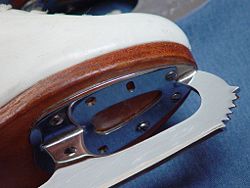
. The skates consist of a boot and a blade that is attached with screws to the sole of the boot. Inexpensive sets for recreational skaters are available, but most figure skaters purchase boots and blades separately and have the blades mounted by a professional skate technician.
History
Ice skates have a history dating back thousands of years, originating in Scandinavia among other cold North European regions in 3000 BC. Amongst the several inventions up until today, the first development of ice skates were made out of bone. 'Bone skates' were typically gathered using bones found from animals such as horses and cows, but more commonly in horses. Depending on the size of the skater's feet, different types of bones were used to match the length of their shoes. In order for the bone to attach to the skater's shoe, leather straps were strung through holes that were pierced horizontally into the bone and fastened to the skater's feet.During the thirteenth and fourteenth century, the first wooden skates with metal blades were made. This has effectively evolved from bone skates, as wood was easy to work with and metal lasted longer. Within the 15th to 18th century, the skates were used with the same material but were much lighter with longer blades which allowed for controlled balance. During the 19th century, ice skates have modernized to allow for even more control and safer travelling. Figure skates are now manufactured with extreme precision, as they are now used in competitive sports. Blades are specifically designed to include various types of toe picks that allow for skaters to reach new heights for jumps and spins, depending on the skater’s level.
Specific figure skates were created in response to the rise of figure skating's popularity in the 19th century, coinciding with the beginnings of formalized competitions such as the World Figure Skating Championships
World Figure Skating Championships
The World Figure Skating Championships is an annual figure skating competition sanctioned by the International Skating Union in which elite figure skaters compete for the title of World Champion...
. The name "figure" skating arises from the compulsory portion
Compulsory figures
Compulsory figures or school figures were formerly an aspect of the sport of figure skating, from which the sport derives its name. Carving specific patterns or figures into the ice was the original focus of the sport. The patterns of compulsory figures all derive from the basic figure eight...
of the competition, dropped in the 1990s, requiring skaters to trace out precise figures on the ice, including perfect figure 8 circles.
Boots
Figure skating boots are traditionally made by hand from many layers of leatherLeather
Leather is a durable and flexible material created via the tanning of putrescible animal rawhide and skin, primarily cattlehide. It can be produced through different manufacturing processes, ranging from cottage industry to heavy industry.-Forms:...
. The design of figure skating boots changed significantly during the 20th century. Old photographs of skaters such as Sonja Henie
Sonja Henie
Sonja Henie was a Norwegian figure skater and film star. She was a three-time Olympic Champion in Ladies Singles, a ten-time World Champion and a six-time European Champion . Henie won more Olympic and World titles than any other ladies figure skater...
from the 1920s and 1930s show them wearing thin, supple boots reaching to mid-calf. Modern skating boots, on the other hand, are extremely rigid to support the foot and ankle in jumps, and are cut much lower—just over ankle height—to allow the foot to flex. Because the stiffness of the boots makes good fit essential, many skaters either order custom boots or have their boots "bumped out" over pressure points by a skate technician.
In recent years, boots made of synthetic materials with heat-moldable linings have become popular with many skaters because they combine strength with lighter weight than leather boots, and are easier to "break in." The latest development in boot technology is a boot that is hinged at the ankle to provide lateral support while allowing more flexibility. Boots used in ice dance are usually slightly lower in the back to allow for greater bend in the ankle. Some boots also come with a flexible elastic back.
The typical colors for boots are black for men and white for women, although other colors are available.
Blades
Ice hockey equipment
In ice hockey, players use specialized equipment both to facilitate the play of the game and for protection as this is a sport where injuries are common, therefore, all players are encouraged to protect their bodies from bruises and severe fractures...
skates in having a set of large, jagged teeth called toe picks on the front of the blade. The toe picks are used primarily in jumping and footwork, and should not be used for stroking or spins
Figure skating spins
Spins are an element in figure skating where the skater rotates, centered on a single point on the ice, while holding one or more body positions. The skater rotates on the part of the blade just behind the toe pick, with the weight on the ball of the foot...
. Toe pick designs have become quite elaborate and sometimes include teeth on the sides of the blade.
The skate blades are typically made of tempered carbon steel
Steel
Steel is an alloy that consists mostly of iron and has a carbon content between 0.2% and 2.1% by weight, depending on the grade. Carbon is the most common alloying material for iron, but various other alloying elements are used, such as manganese, chromium, vanadium, and tungsten...
, coated with a high-quality chrome
Chrome plating
Chrome plating, often referred to simply as chrome, is a technique of electroplating a thin layer of chromium onto a metal object. The chromed layer can be decorative, provide corrosion resistance, ease cleaning procedures, or increase surface hardness.-Process:A component to be chrome plated will...
. Lightweight aluminum and stainless steel blades are becoming more popular with skaters. Blades are about 3/16 inch thick and may have a slightly tapered cross-section. There are different blades for different levels of skaters which often correspond to a skater's age, size and skill level. Blades for advanced skaters often have larger toepicks and different curves than blades for beginner, intermediate and recreational levels.
When viewed from the side, the blade of a figure skate is not flat, but curved slightly, forming an arc of a circle with a radius
Radius
In classical geometry, a radius of a circle or sphere is any line segment from its center to its perimeter. By extension, the radius of a circle or sphere is the length of any such segment, which is half the diameter. If the object does not have an obvious center, the term may refer to its...
of . This curvature is referred to as the rocker of the blade. The sweet spot of the blade is below the ball of the foot. This spot is usually located near the stanchion
Stanchion
A stanchion is an upright bar or post, often providing support for some other object.* An architectural term applied to the upright iron bars in windows that pass through the eyes of the saddle bars or horizontal irons to steady the leadlight. A stanchion is an upright bar or post, often...
of the blade, and is the part of the blade where all spins are spun on.
The blade is also hollow ground; a groove on the bottom of the blade creates two distinct edges, inside and outside. The inside edge of the blade is on the side closest to the skater; the outside edge of the blade is on the side farthest from the skater. In figure skating it is always desirable to skate on only one edge of the blade, never on both at the same time (which is referred to as a flat). The apparently effortless power and glide across the ice exhibited by elite figure skaters fundamentally derives from efficient use of the edges to generate speed.
Ice dancers
Ice dancing
Ice dancing is a form of figure skating which draws from the world of ballroom dancing. It was first competed at the World Figure Skating Championships in 1952, but did not become a Winter Olympic Games medal sport until 1976....
' and synchronized skaters
Synchronized skating
Synchronized skating or synchronised skating, a large and fast-growing discipline, consists of 8—20 athletes skating on ice at one time moving as one flowing unit at high speeds...
' blades are about an inch shorter in the rear than those used by skaters in other disciplines, to accommodate the intricate footwork and close partnering in dance. They also possess a smaller pick near the bottom to allow for better edge-work and less focus on jumping.
Blade types
Various specialty blade types exist, including:- Tapered figure skating blades have a design which causes them to be thicker at the front near the toepicks and thinner at the tail of the blade; therefore, the edges are not parallel.
- Side honed figure skating blades have a concave design which causes them to be thicker at the stanchions and the edge stripe and thinner in between. They are easily recognizable because they cause reflections to be inverted.
- Parabolic figure skating blades were first introduced by HD Sports in order to employ new scientific developments in the creation of figure skating blades. The middle section of parabolic blades is thinner than that of normal blades, while both ends are typically wider than those of regular blades. This translates into less steel and a lighter blade overall. Their design is meant to improve skaters' blade stability, footwork, and edges.