

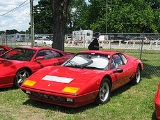
Ferrari Berlinetta Boxer

Overview
Automobile
An automobile, autocar, motor car or car is a wheeled motor vehicle used for transporting passengers, which also carries its own engine or motor...
produced by Ferrari
Ferrari
Ferrari S.p.A. is an Italian sports car manufacturer based in Maranello, Italy. Founded by Enzo Ferrari in 1929, as Scuderia Ferrari, the company sponsored drivers and manufactured race cars before moving into production of street-legal vehicles as Ferrari S.p.A. in 1947...
in Italy
Italy
Italy , officially the Italian Republic languages]] under the European Charter for Regional or Minority Languages. In each of these, Italy's official name is as follows:;;;;;;;;), is a unitary parliamentary republic in South-Central Europe. To the north it borders France, Switzerland, Austria and...
between 1973 and 1984. They used a mid-mounted flat-12
Flat-12
A flat-12 is an internal combustion engine in a flat configuration, having 12 cylinders.The flat-12 is wider than a V12...
(180° V12, not actually a true boxer
Flat engine
A flat engine is an internal combustion engine with multiple pistons that move in a horizontal plane. Typically, the layout has cylinders arranged in two banks on either side of a single crankshaft and is sometimes known as the boxer, or horizontally opposed engine. The concept was patented in 1896...
) engine, replacing the FR layout Daytona
Ferrari Daytona
The Ferrari 365 GTB/4, better known by the unofficial name Ferrari Daytona, is a Gran Turismo automobile produced from 1968 to 1973. It was first introduced to the public at the Paris Auto Salon in 1968 and replaced the 275 GTB/4...
, and were succeeded in the Ferrari stable by the Testarossa
Ferrari Testarossa
The Ferrari Testarossa is a 12-cylinder mid-engine sports car manufactured by Ferrari, which went into production in 1984 as the successor to the Ferrari Berlinetta Boxer...
. It was designed by Leonardo Fioravanti.
Production of the BB was a major step for Enzo Ferrari
Enzo Ferrari
Enzo Anselmo Ferrari Cavaliere di Gran Croce OMRI was an Italian race car driver and entrepreneur, the founder of the Scuderia Ferrari Grand Prix motor racing team, and subsequently of the Ferrari car manufacturer...
. He felt that a mid-engined road car would be too difficult for his buyers to handle, and it took many years for his engineers to convince him to adopt the layout.
