
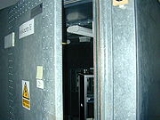
A
Faraday cage or
Faraday shield is an enclosure formed by
conducting materialIn science and engineering, an electrical conductor is a material which contains movable electric charges. In metallic conductors, such as copper or aluminum, the movable charged particles are electrons...
, or by a mesh of such material. Such an enclosure blocks out external static electrical fields.
Faraday cages are named after the English scientist
Michael FaradayMichael Faraday, FRS was an English chemist and physicist who contributed to the fields of electromagnetism and electrochemistry....
, who invented them in 1836.
A Faraday cage's operation depends on the fact that an external static electrical field will cause the electrical charges within the cage's conducting material to redistribute themselves so as to cancel the field's effects in the cage's interior. This phenomenon is used, for example, to protect electronic equipment from
lightningLightning is an atmospheric discharge of electricity accompanied by thunder, which typically occurs during thunderstorms, and sometimes during volcanic eruptions or dust storms...
strikes and other
electrostatic dischargeElectrostatic discharge is the sudden and momentary electric current that flows between two objects at different electrical potentials caused by direct contact or induced by an electrostatic field...
s.
To a large degree, Faraday cages also shield the interior from external
electromagnetic radiationElectromagnetic radiation is a ubiquitous phenomenon that takes the form of self-propagating waves in a vacuum or in matter. It consists of electric and magnetic field components which oscillate in phase perpendicular to each other and perpendicular to the direction of energy propagation...
if the conductor is thick enough and any holes are significantly smaller than the radiation's
wavelengthIn physics, the wavelength of a sinusoidal wave is the spatial period of the wave – the distance over which the wave's shape repeats.It is usually determined by considering the distance between consecutive corresponding points of the same phase, such as crests, troughs, or zero crossings, and is a...
. For example, certain
computer forensicComputer forensics is a branch of forensic science pertaining to legal evidence found in computers and digital storage media. Computer forensics is also known as digital forensics....
test procedures of electronic components or systems that require an environment devoid of electromagnetic interference may be conducted within a
screen room. These screen rooms are essentially work areas that are completely enclosed by one or more layers of fine metal mesh or perforated sheet metal. The metal layers are grounded to dissipate any electric currents generated from the external electromagnetic fields, and thus block a large amount of the electromagnetic interference. See also
electromagnetic shieldingElectromagnetic shielding is the process of limiting the penetration of electromagnetic fields into a space, by blocking them with a barrier made of conductive material. Typically it is applied to enclosures, separating electrical devices from the 'outside world', and to cables, separating wires...
.
Note that the reception of external radio signals, a form of
electromagnetic radiationElectromagnetic radiation is a ubiquitous phenomenon that takes the form of self-propagating waves in a vacuum or in matter. It consists of electric and magnetic field components which oscillate in phase perpendicular to each other and perpendicular to the direction of energy propagation...
, through an antenna within a cage can be severely reduced or even totally blocked by the cage itself.
History
In 1836 Michael Faraday observed that the charge on a charged conductor resided only on its exterior and had no influence on anything enclosed within it. To demonstrate this fact he built a room coated with metal foil and allowed high-voltage discharges from an electrostatic generator to strike the outside of the room. He used an
electroscopeAn electroscope is an early scientific instrument that is used to detect the presence and magnitude of electric charge on a body. It was the first electrical measuring instrument. The first electroscope, a pivoted needle called the versorium, was invented by British physician William Gilbert...
to show that there was no electric charge present on the inside of the room's walls.
The same effect was predicted earlier by
Francesco BeccariaGiovanni Battista Beccaria , Italian physicist, was born at Mondovì, and entered the religious order of the Pious Schools in 1732....
(1716–1781) at the University of
TurinTurin is a major city as well as a business and cultural centre in northern Italy, capital of the Piedmont region, located mainly on the left bank of the Po River surrounded by the Alpine arch...
, a student of
Benjamin FranklinBenjamin Franklin was one of the Founding Fathers of the United States of America. A noted polymath, Franklin was a leading author and printer, satirist, political theorist, politician, scientist, inventor, civic activist, statesman, soldier, and diplomat...
, who stated that "all electricity goes up to the free surface of the bodies without diffusing in their interior substance." Later, the
BelgianThe Kingdom of Belgium is a country in northwest Europe. It is a founding member of the European Union and hosts its headquarters, as well as those of other major international organizations, including NATO...
physicist
Louis MelsensLouis Melsens was a Belgian physicist and chemist. In 1846, he became professor of chemistry in the Veterinary School in Kureghem. Melsens applied the principle of the Faraday cage to lightning conductors and invented iodine tincture for disinfection...
(1814–1886) applied the principle to lightning conductors. A closely related concept is that of the
Gaussian surfaceA Gaussian surface is a closed three-dimensional surface through which a flux of an electric field is to be calculated. It is thus not an arbitrary closed surface...
, discovered by
Carl Friedrich GaussJohann Carl Friedrich Gauss was a German mathematician and scientist who contributed significantly to many fields, including number theory, statistics, analysis, differential geometry, geodesy, geophysics, electrostatics, astronomy and optics...
.
Although this cage effect has been attributed to Michael Faraday, it was Benjamin Franklin on 1755 that observed the effect by lowering an uncharged cork ball suspended on a silk thread through an opening. In his words "
the cork was not attracted to the inside of the can as it would have been to the outside, and though it touched the bottom, yet, when drawn out it was not found to be electrified (charged) by that touch, as it would have been by touching the outside. The fact is singular." Franklin has discovered the behavior of what we now refer as a Faraday cage or shield (based on one of Faraday's famous ice pail experiments which duplicated Franklin's cork and can) [from ].
Operation
A Faraday cage is best understood as an approximation to an ideal hollow conductor. Externally applied electric fields produce forces on the
charge carrierIn physics, a charge carrier denotes a free particle carrying an electric charge. Examples are electrons and ions.In ionic solutions, the charge carriers are the dissolved cations and anions. Similarly, cations and anions of the dissociated liquid serve as charge carriers in liquids and melted...
s (usually electrons) within the conductor, generating a current that rearranges the charges. Once the charges have rearranged so as to cancel the applied field inside, the current stops.
If a charge is placed inside an ungrounded Faraday cage the internal face of the cage will be charged (in the same manner described for an external charge) to prevent the existence of a field inside the body of the cage.
However, this charging of the inner face would re-distribute the charges in the body of the cage. This charges the outer face of the cage with a charge equal in sign and magnitude to the one placed inside the cage. Since the internal charge and the inner face cancel each other out, the spread of charges on the outer face is not affected by the position of the internal charge inside the cage.
So for all intents and purposes the cage will generate the same electric field it would generate if it was simply charged by the charge placed inside.
If the cage is grounded the excess charges will go to the ground instead of the outer face, so the inner face and the inner charge will cancel each other out and the rest of the cage would remain neutral.
The effectiveness of a Faraday cage or shield is dependent upon the wavelength of the electric or electromagnetic fields it is intended to shield. Effectiveness of shielding also depends upon the types of metals used in the cages as well as their thicknesses.
Examples
- The shield of a screened cable
A shielded or screened cable is an electrical cable of one or more insulated conductors enclosed by a common conductive layer. The shield may be composed of braided strands of copper , a non-braided spiral winding of copper tape, or a layer of conducting polymer. Usually, this shield is covered...
, such as the coax used for cable television, protects the internal conductors from electrical noise.
- A shopping bag lined with aluminum foil acts as a Faraday cage. It is often used by shoplifters to steal RFID tagged items.
See also
- Frieder Kempe
Frieder Kempe is a German scientist who designed a special metallic fabric called Farabloc that shields the human body from immediate shifts in the earth's electromagnetic field. Published studies show Farabloc relief pain...
- Anechoic chamber
An anechoic chamber is a shielded room designed to attenuate sound or electromagnetic energy. Anechoic chambers were originally used in the context of acoustic to trap the reflections of a room, but more recently, anechoic chambers have also been used to provide a shielded environment for radio...
- Conductive textile
Conductive fibers or yarns are a cross between the world of electric wires and the world of textiles, with attributes of each. Conductive yarns or fibers can be woven, knit, embroidered, braided, sewn etc., thus becoming conductive textiles...
- Electromagnetic field
The electromagnetic field is a physical field produced by electrically charged objects. It affects the behavior of charged objects in the vicinity of the field. Light is the electromagnetic field in a certain frequency range...
- Electromagnetic interference
Electromagnetic interference is a disturbance that affects an electrical circuit due to either electromagnetic conduction or electromagnetic radiation emitted from an external source. The disturbance may interrupt, obstruct, or otherwise degrade or limit the effective performance of the circuit...
- Hoffman box
A Hoffman Box is an enclosure used to secure electrical and/or network equipment, and is used in such things as a protected distribution system....
External links