
|
|
|
|
FV101 Scorpion
|
| |
|
| |
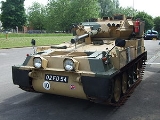
The FV101 Scorpion is a British light tank, part of the Combat Vehicle Reconnaissance (Tracked) or, CVR(T) family. The full design name is Combat Vehicle Reconnaissance (Tracked) Fire Support (Scorpion). Manufactured by Alvis Vickers it was introduced into service with the British Army in 1973 and served until 1994.
More than 3,000 were produced. It is also one of the fastest tanks in the world, along with pre-WWII BT series.
nded to be a fast and air-transportable reconnaissance vehicle, the Scorpion is built from mainly aluminium armour and mounts an L23A1 76 mm gun firing high-explosive, HESH, smoke, and canister rounds.

Discussion
Ask a question about 'FV101 Scorpion'
Start a new discussion about 'FV101 Scorpion'
Answer questions from other users
|
Encyclopedia
The FV101 Scorpion is a British light tank, part of the Combat Vehicle Reconnaissance (Tracked) or, CVR(T) family. The full design name is Combat Vehicle Reconnaissance (Tracked) Fire Support (Scorpion). Manufactured by Alvis Vickers it was introduced into service with the British Army in 1973 and served until 1994.
More than 3,000 were produced. It is also one of the fastest tanks in the world, along with pre-WWII BT series.
History
Intended to be a fast and air-transportable reconnaissance vehicle, the Scorpion is built from mainly aluminium armour and mounts an L23A1 76 mm gun firing high-explosive, HESH, smoke, and canister rounds. Original models had a Jaguar 4.2 litre petrol engine. This engine was chosen because of its high power to weight ratio. Some customers specified diesel engines. The Perkins Diesel engine was chosen, which has shown longer in-service life, and has a reduced risk of fire. All models are capable of 80 km/h.
Two troops from B Sqn of the Blues and Royals each comprising two Scorpion and two of the similar Scimitar saw active service in the Falklands War of 1982, (along with one Samson armoured recovery vehicle) and provided the only armoured assets of the British landing force. With a 'footprint' much lighter than that of a main battle tank, it was one of the few vehicles capable of operating in the extremely boggy conditions of East Falkland, and did so very well, due to possessing a ground pressure of approximately four pounds per square inch (actually less than that of a walking infantryman). At least one Scimitar was seriously damaged by an Argentine landmine, but the crew were unscathed, and the vehicle was salvaged by Chinook HC.1 helicopterand soon brought back into service by the attached REME section. Both tactical and strategic commanders have stated that a larger number of CVR(T) would have aided and shortened the campaign greatly, with possibly reduced casualties . Its cross country ability was demonstrated in a recorded incident where a commander jumped from his vehicle and sank into the boggy ground (wheeled vehicles being almost no use away from established roads).
The Scorpion has been withdrawn from British Army service and the refurbished hulls have been mated with surplus turrets from the FV 721 Fox CVR(W) wheeled reconnaissance vehicle to form a composite vehicle, to create the 30mm RARDEN cannon armed Sabre, which is very similar in appearance to the Scimitar. The chief reason for this was that the obsolescent 76mm gun was not found to be as effective or efficient in engaging enemy light armour/miscellaneous targets as the flat-trajectory 30mm cannon. Some small armies such as the Botswana Defense Force and the Irish Army, and notably the larger Philippine Army, continue to use Scorpion units, in some cases up-armed retroactively with 90mm Cockerill guns (see below). A small number are in use at BATUS in Canada as part of OPFOR representing 125mm gun armed T-80-type vehicles, with the main armament barrel replaced with plastic drainpipe, and known as "Salamanders".
Users
- Belgian Army - (701 Scorpions and variants, all withdrawn)
- Botswana Defence Force
- Royal Brunei Land Forces
- Chilean Navy (Infanterķa de Marina - Chilean Marines)
- Honduras Army
- Indian Army
- Indonesian Army - 100 Scorpion 90
- Iranian Army (ex. Imperial Iranian Army) 80 in service
- Irish Army (14 In Service One Of Which Is Being Upgraded For Trials)
- Royal Jordanian Land Force
- Malaysian Army - 26 Scorpion 90
- New Zealand Army
- Military of Nigeria - 140 in service
- Royal Army of Oman
- Philippine Army - 42 Scorpions
- Spanish Marines(all 17 transferred to Chile)
- Royal Thai Army- 154+
- Army of Venezuela - (90 Scorpions 78 FV101-C.90 +6 FV104 +2 FV105 +4 FV106)
- Turret only - mounted on M113AS1 to form Medium Reconnaissance Vehicle (MRV)
Variants
Scorpion 90 - This export version is armed with the long-barreled Cockerill M.k3 M-A1 90mm gun, fitted with a prominent muzzle brake. It was purchased by the Indonesian, Malaysian and Venezuelan armed forces.
Scorpion Turret used in Australian MRV
The Scorpion turret was also mounted on the M113AS1 (the Australian version of the M113), the resulting vehicle being known as the Medium Reconnaissance Vehicle (MRV). MRVs were issued to Royal Australian Armoured Corps reconnaissance regiments.
The MRV also featured the water heater/cooker from the Scorpion.
Like the Saladin turret Fire Support Vehicle (FSV) before it, the MRV was colloquially known as a "Beast" or "the Beast".
Related vehicles using the same (or similar) hull include:
These vehicles are collectively known as the CVR(T) - Combat Vehicle Reconnaissance (Tracked) - family.
Production
- A total of approximately 4,000 vehicles of the CVR(T) family had been manufactured in the UK and Belgium by the time production ceased in the mid-1990's.
See also
- AVGP Canadian wheeled armoured vehicle using the Scorpion turret.
External links
|
| |
|
|