

FIM-43 Redeye

Encyclopedia
The General Dynamics
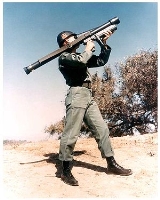
FIM-43 Redeye was a man-portable surface-to-air missile
system. It used infrared homing to track its target. Production was terminated in September 1969 after about 85,000 rounds had been built - in anticipation of the Redeye II, which later became the FIM-92 Stinger
. The Redeye was withdrawn gradually between 1982 and 1995 as the Stinger was deployed.
began seeking new infantry air-defense weapons, as machine guns were ineffective against new fast jets. Several gun/rocket systems were investigated but none were promising. In the mid 1950s Convair
began studies of a man portable infrared guided missile. In November 1956 the results of these studies were shown to the US Army and USMC
. In 1957 official requirements were formulated, and in 1958 Convair was awarded a contract to start development of the system.
In July 1959 the development project began, in March 1960, the first test rounds were fired. Launches from a launch tube followed in May 1961, with a shoulder launch occurring in 1961. Technical problems prevented the missile entering full production: the missile did not live up to its specifications - being slower, less maneuverable and less accurate. During the testing, substantial use was made of the Atlantic Research MQR-16 Gunrunner
expendable target missile.
Limited production began as XM41 Redeye Block I. The missile was designated XMIM-43A in June 1963. Block I systems were then evaluated between 1965 and 1966.
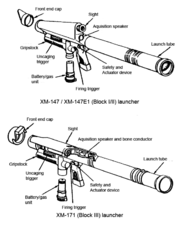 Block II systems designated XM41E1 began development in 1964, the missile being designated XMIM-43B. The missiles were delivered in April 1966, and included a new gas-cooled detector cell, a slightly redesigned launcher and an improved warhead.
In 1965 to 1966 General Dynamics developed the final Redeye Block III configuration, designated at first XM41E2 with XFIM-43C missiles. The missiles retained the seeker from the Block II missile, but included a new rocket motor, warhead and fuze. The launcher now had an XM-62 open sight and upgraded electronics. The new missile could turn at up to 3g. The missile achieved a kill probability against F9F tactical drones travelling at 430 knots at an altitude of 100 meters of 0.51. From this it was calculated that the kill probability versus a Mikoyan-Gurevich MiG-21
at similar altitude would be 0.403, and 0.53 against helicopters (specifically the Mi-6
and US H-13 and H-21). Kill probability against larger propeller driven aircraft like the AN-12 was estimated at 0.43. Production of the Block III systems began in May 1967. In 1968 Block III was declared operational.
in 1984, where they were used to shoot down a number of aircraft including several Su-25 jets as well as Mi-24 and Mi-8
helicopters. By November 1985 it had largely been replaced by the dramatically more successful FIM-92 Stinger missiles.
The Redeye was known as Hamlet in Danish
service and as RBS 69 in Swedish service.
, the operator then begins visually tracking the target - using the sight unit on the launcher. Once the target is locked onto by the missile a buzzer in the launcher hand grip begins vibrating, alerting the operator. The operator then presses the trigger, which fires the initial booster stage and launches the missile out of the tube at a speed of around 80 feet per second (25 m/s). As the missile leaves the tube spring-loaded fins pop out, 4 stabilizing tail fins at the back of the missile, and two control surfaces at the front of the missile. Once the missile has traveled six meters, the sustainer motor ignites. The sustainer motor takes the missile to its peak velocity of Mach 1.7 in 5.8 seconds. 1.25 seconds after the sustainer is ignited, the warhead is armed.
The missile's seeker is only capable of tracking the hot exhausts of aircraft, which limits the engagements to tail-chase only. The missile's blast fragmentation warhead is triggered by an impact fuze
requiring a direct hit. As a first generation missile it is susceptible to a variety of countermeasure
s including flares
and hot brick jammers. In addition, its inability to turn at a rate greater than 3 G means that it can be outmaneuvered if detected.
no longer in service replaced by FIM-92 Stinger
and older Strela-2 from the NVA
: 1973-1990 by the Israel Defense Forces
; no longer in active service, replaced by FIM-92 Stinger
.: 1977-1979 by the National Guard
, unknown number being provided by Israel
; no longer in active service. Sweden
: No longer in active service. Thailand
: Former user: Mostly in reserve of Armed Forces, Turkish Forces in Northern Cyprus uses an unknown number.: No longer in service, replaced by FIM-92 Stinger
.
and the Bosnian mujahideen
General Dynamics
General Dynamics Corporation is a U.S. defense conglomerate formed by mergers and divestitures, and as of 2008 it is the fifth largest defense contractor in the world. Its headquarters are in West Falls Church , unincorporated Fairfax County, Virginia, in the Falls Church area.The company has...
FIM-43 Redeye was a man-portable surface-to-air missile
Surface-to-air missile
A surface-to-air missile or ground-to-air missile is a missile designed to be launched from the ground to destroy aircraft or other missiles...
system. It used infrared homing to track its target. Production was terminated in September 1969 after about 85,000 rounds had been built - in anticipation of the Redeye II, which later became the FIM-92 Stinger
FIM-92 Stinger
The FIM-92 Stinger is a personal portable infrared homing surface-to-air missile , which can be adapted to fire from ground vehicles and helicopters , developed in the United States and entered into service in 1981. Used by the militaries of the U.S...
. The Redeye was withdrawn gradually between 1982 and 1995 as the Stinger was deployed.
Development
In 1948 the United States ArmyUnited States Army
The United States Army is the main branch of the United States Armed Forces responsible for land-based military operations. It is the largest and oldest established branch of the U.S. military, and is one of seven U.S. uniformed services...
began seeking new infantry air-defense weapons, as machine guns were ineffective against new fast jets. Several gun/rocket systems were investigated but none were promising. In the mid 1950s Convair
Convair
Convair was an American aircraft manufacturing company which later expanded into rockets and spacecraft. The company was formed in 1943 by the merger of Vultee Aircraft and Consolidated Aircraft, and went on to produce a number of pioneering aircraft, such as the Convair B-36 bomber, and the F-102...
began studies of a man portable infrared guided missile. In November 1956 the results of these studies were shown to the US Army and USMC
United States Marine Corps
The United States Marine Corps is a branch of the United States Armed Forces responsible for providing power projection from the sea, using the mobility of the United States Navy to deliver combined-arms task forces rapidly. It is one of seven uniformed services of the United States...
. In 1957 official requirements were formulated, and in 1958 Convair was awarded a contract to start development of the system.
In July 1959 the development project began, in March 1960, the first test rounds were fired. Launches from a launch tube followed in May 1961, with a shoulder launch occurring in 1961. Technical problems prevented the missile entering full production: the missile did not live up to its specifications - being slower, less maneuverable and less accurate. During the testing, substantial use was made of the Atlantic Research MQR-16 Gunrunner
MQR-16 Gunrunner
The MQR-16A Gunrunner was an unguided rocket developed by Atlantic Research during the 1960s. Designed with low cost as a priority, the MQR-16A was intended to act as a target drone for use in the development of man-portable surface-to-air missiles, and as a training target for the missile operators...
expendable target missile.
Limited production began as XM41 Redeye Block I. The missile was designated XMIM-43A in June 1963. Block I systems were then evaluated between 1965 and 1966.
In 1965 to 1966 General Dynamics developed the final Redeye Block III configuration, designated at first XM41E2 with XFIM-43C missiles. The missiles retained the seeker from the Block II missile, but included a new rocket motor, warhead and fuze. The launcher now had an XM-62 open sight and upgraded electronics. The new missile could turn at up to 3g. The missile achieved a kill probability against F9F tactical drones travelling at 430 knots at an altitude of 100 meters of 0.51. From this it was calculated that the kill probability versus a Mikoyan-Gurevich MiG-21
Mikoyan-Gurevich MiG-21
The Mikoyan-Gurevich MiG-21 is a supersonic jet fighter aircraft, designed by the Mikoyan-Gurevich Design Bureau in the Soviet Union. It was popularly nicknamed "balalaika", from the aircraft's planform-view resemblance to the Russian stringed musical instrument or ołówek by Polish pilots due to...
at similar altitude would be 0.403, and 0.53 against helicopters (specifically the Mi-6
Mil Mi-6
|-Facts:*Test pilot N.B. Leshin has set the world record of speed. This event was awarded by the American Helicopter Society.*Small numbers are still in service, most in Siberia plus a small number with the People's Republic of China...
and US H-13 and H-21). Kill probability against larger propeller driven aircraft like the AN-12 was estimated at 0.43. Production of the Block III systems began in May 1967. In 1968 Block III was declared operational.
History
50 Redeye systems were delivered to the Mujahideen by the US during the Soviet war in AfghanistanSoviet war in Afghanistan
The Soviet war in Afghanistan was a nine-year conflict involving the Soviet Union, supporting the Marxist-Leninist government of the Democratic Republic of Afghanistan against the Afghan Mujahideen and foreign "Arab–Afghan" volunteers...
in 1984, where they were used to shoot down a number of aircraft including several Su-25 jets as well as Mi-24 and Mi-8
Mil Mi-8
The Mil Mi-8 is a medium twin-turbine transport helicopter that can also act as a gunship. The Mi-8 is the world's most-produced helicopter, and is used by over 50 countries. Russia is the largest operator of the Mi-8/Mi-17 helicopter....
helicopters. By November 1985 it had largely been replaced by the dramatically more successful FIM-92 Stinger missiles.
The Redeye was known as Hamlet in Danish
Denmark
Denmark is a Scandinavian country in Northern Europe. The countries of Denmark and Greenland, as well as the Faroe Islands, constitute the Kingdom of Denmark . It is the southernmost of the Nordic countries, southwest of Sweden and south of Norway, and bordered to the south by Germany. Denmark...
service and as RBS 69 in Swedish service.
Description
The missile is fired from the M171 missile launcher. First the seeker is cooled to operating temperatureOperating temperature
An operating temperature is the temperature at which an electrical or mechanical device operates. The device will operate effectively within a specified temperature range which varies based on the device function and application context, and ranges from the minimum operating temperature to the...
, the operator then begins visually tracking the target - using the sight unit on the launcher. Once the target is locked onto by the missile a buzzer in the launcher hand grip begins vibrating, alerting the operator. The operator then presses the trigger, which fires the initial booster stage and launches the missile out of the tube at a speed of around 80 feet per second (25 m/s). As the missile leaves the tube spring-loaded fins pop out, 4 stabilizing tail fins at the back of the missile, and two control surfaces at the front of the missile. Once the missile has traveled six meters, the sustainer motor ignites. The sustainer motor takes the missile to its peak velocity of Mach 1.7 in 5.8 seconds. 1.25 seconds after the sustainer is ignited, the warhead is armed.
The missile's seeker is only capable of tracking the hot exhausts of aircraft, which limits the engagements to tail-chase only. The missile's blast fragmentation warhead is triggered by an impact fuze
Fuse (explosives)
In an explosive, pyrotechnic device or military munition, a fuse is the part of the device that initiates function. In common usage, the word fuse is used indiscriminately...
requiring a direct hit. As a first generation missile it is susceptible to a variety of countermeasure
Countermeasure
A countermeasure is a measure or action taken to counter or offset another one. As a general concept it implies precision, and is any technological or tactical solution or system designed to prevent an undesirable outcome in the process...
s including flares
Flare (pyrotechnic)
A flare, also sometimes called a fusee, is a type of pyrotechnic that produces a brilliant light or intense heat without an explosion. Flares are used for signalling, illumination, or defensive countermeasures in civilian and military applications...
and hot brick jammers. In addition, its inability to turn at a rate greater than 3 G means that it can be outmaneuvered if detected.
Variants
- Block I FIM-43/XFIM-43A/XMIM-43A -
- Block II FIM-43B/XFIM-43B/XMIM-43B - Fitted with a gas cooled seeker and improved warhead and fuse and modified launcher.
- XFEM-43B Experimental test missile, with data logging capability
- Block III FIM-43C/XFIM-43C Production version - Improved warhead and fuse section, and a new launcher.
- XFEM-43C Experimental test missile, with data logging capability
- FIM-43D Upgraded missile, with unknown capabilities.
Comparison chart
| System | 9K32M Strela-2M Strela 2 The 9K32 “Strela-2” is a man-portable, shoulder-fired, low-altitude surface-to-air missile system with a high explosive warhead and passive infrared homing guidance... (missile: 9M32M) |
9K34 Strela-3 9K34 Strela-3 The 9K34 Strela-3 man-portable air defence missile system was developed in the Soviet Union as a response to the poor performance of the earlier 9K32 Strela 2 system. "9K34" is its GRAU designation and its NATO reporting name is SA-14 Gremlin. The missile was largely based on the earlier Strela... (missile: 9M36) |
FIM-43C Redeye |
|---|---|---|---|
| Service entry | 1968 | 1974 | 1968 |
| Weight of system ready to shoot |
15 kg | 16 kg | 13.3 kg |
| Missile weight | 9.8 kg | 10.3 kg | 8.3 kg |
| Length | 1.44 m | 1.47 m | 1.40 m |
| Warhead weight | 1.17 kg | 1.17 kg | 1.06 kg |
| Warhead type | Directed-energy blast fragmentation |
Directed-energy blast fragmentation |
Blast fragmentation (M222) |
| Warhead explosive content | 0.37 kg HMX HMX HMX, also called octogen, is a powerful and relatively insensitive nitroamine high explosive, chemically related to RDX. Like RDX, the name has been variously listed as High Melting eXplosive, Her Majesty's eXplosive, High-velocity Military eXplosive, or High-Molecular-weight rdX.The molecular... |
0.37 kg HMX HMX HMX, also called octogen, is a powerful and relatively insensitive nitroamine high explosive, chemically related to RDX. Like RDX, the name has been variously listed as High Melting eXplosive, Her Majesty's eXplosive, High-velocity Military eXplosive, or High-Molecular-weight rdX.The molecular... and 20g secondary charge |
0.36 kg HTA-3 HMX HMX, also called octogen, is a powerful and relatively insensitive nitroamine high explosive, chemically related to RDX. Like RDX, the name has been variously listed as High Melting eXplosive, Her Majesty's eXplosive, High-velocity Military eXplosive, or High-Molecular-weight rdX.The molecular... |
| Missile engagement aspect | Tail-chase Tail-chase engagement A tail-chase engagement is one where a surface-to-air missile system or jet aircraft engages another aircraft while the target aircraft is flying away from the attacker... only |
Limited forward hemisphere (all-aspect All-aspect An all-aspect missile is one which is able to track a target no matter which way the target faces relative to the missile. In other words, an all-aspect missile can be launched against a target in a tail-chase engagement, in a head-on engagement, in a side-on engagement, from above, from below,... ) capability |
Tail-chase / limited forward-hemisphere (depending on conditions and version) |
| Seeker type | Uncooled PbS detector element (1–2.8 µm sensitivity range). |
Nitrogen-cooled PbS detector element (2–4.3 µm sensitivity range). |
Gas-cooled (FIM-43A: Peltier cooled) PbS detector element |
| Seeker modulation | AM-modulated (spin scan) | FM-modulated (conical scan) | AM-modulated |
| Maximum range | 4,200 m | 4,100 m | 4,500 m |
| Missile speed | 500 m/s | 450 m/s | 580 m/s |
| Maximum speed target speed | 260 m/s (receding) | 310 m/s (receding) | 225 m/s |
| Engagement altitude | 0.05-2.3 km | 0.03-2.3 ... 3.0 km | 0.05-2.7 km |
Users
: 1970s - 1980s by 111 Bty (or affectionately "Eleventy One Battery"), 16th Air Defence Regiment, Royal Australian Artillery. Replaced by RBS-70 SAM. Bosnia and HerzegovinaBosnia and Herzegovina
Bosnia and Herzegovina , sometimes called Bosnia-Herzegovina or simply Bosnia, is a country in Southern Europe, on the Balkan Peninsula. Bordered by Croatia to the north, west and south, Serbia to the east, and Montenegro to the southeast, Bosnia and Herzegovina is almost landlocked, except for the...
no longer in service replaced by FIM-92 Stinger
FIM-92 Stinger
The FIM-92 Stinger is a personal portable infrared homing surface-to-air missile , which can be adapted to fire from ground vehicles and helicopters , developed in the United States and entered into service in 1981. Used by the militaries of the U.S...
and older Strela-2 from the NVA
National People's Army
The National People’s Army were the armed forces of the German Democratic Republic .The NVA was established in 1956 and disestablished in 1990. There were frequent reports of East German advisors with Communist African countries during the Cold War...
: 1973-1990 by the Israel Defense Forces
Israel Defense Forces
The Israel Defense Forces , commonly known in Israel by the Hebrew acronym Tzahal , are the military forces of the State of Israel. They consist of the ground forces, air force and navy. It is the sole military wing of the Israeli security forces, and has no civilian jurisdiction within Israel...
; no longer in active service, replaced by FIM-92 Stinger
FIM-92 Stinger
The FIM-92 Stinger is a personal portable infrared homing surface-to-air missile , which can be adapted to fire from ground vehicles and helicopters , developed in the United States and entered into service in 1981. Used by the militaries of the U.S...
.: 1977-1979 by the National Guard
National Guard (Nicaragua)
In Nicaragua, the National Guard was a militia and a gendarmerie created during the occupation of that country by the United States from 1909 to 1933. It became notorious for human rights abuses and corruption under the regime of the Somoza family.-Creation:...
, unknown number being provided by Israel
Israel
The State of Israel is a parliamentary republic located in the Middle East, along the eastern shore of the Mediterranean Sea...
; no longer in active service. Sweden
Sweden
Sweden , officially the Kingdom of Sweden , is a Nordic country on the Scandinavian Peninsula in Northern Europe. Sweden borders with Norway and Finland and is connected to Denmark by a bridge-tunnel across the Öresund....
: No longer in active service. Thailand
Thailand
Thailand , officially the Kingdom of Thailand , formerly known as Siam , is a country located at the centre of the Indochina peninsula and Southeast Asia. It is bordered to the north by Burma and Laos, to the east by Laos and Cambodia, to the south by the Gulf of Thailand and Malaysia, and to the...
: Former user: Mostly in reserve of Armed Forces, Turkish Forces in Northern Cyprus uses an unknown number.: No longer in service, replaced by FIM-92 Stinger
FIM-92 Stinger
The FIM-92 Stinger is a personal portable infrared homing surface-to-air missile , which can be adapted to fire from ground vehicles and helicopters , developed in the United States and entered into service in 1981. Used by the militaries of the U.S...
.
Non-state actors
Bosniak armyArmy of the Republic of Bosnia and Herzegovina
The Army of the Republic of Bosnia and Herzegovina was the military force of the Republic of Bosnia and Herzegovina established by the government of Bosnia and Herzegovina in 1992 following the outbreak of the Bosnian War...
and the Bosnian mujahideen
Bosnian mujahideen
Bosnian mujahideen were foreign Muslim volunteers who fought on the side of Bosnian Muslims during the 1992–1995 Bosnian war. They arrived in Bosnia with the aim of fighting for Islam and on behalf of Muslims who were at the time brutally attacked by Serbs and Croats in different parts of the...
 Afghan Mujahideen
- Hezbollah
- UNITA
 UNITAThe National Union for the Total Independence of Angola is the second-largest political party in Angola. Founded in 1966, UNITA fought with the Popular Movement for the Liberation of Angola in the Angolan War for Independence and then against the MPLA in the ensuing civil war .The war was one...