

Explosion protection

Encyclopedia
Explosion protection is used to protect all sorts of buildings and civil engineering infrastructure against internal and external explosion
s or deflagration
s. It was widely believed until recently that a building subject to an explosive attack had a chance to remain standing only if it possessed some extraordinary resistive capacity. This belief rested on the assumption that the specific impulse or the time integral of pressure, which is a dominant characteristic of the blast load, is fully beyond our control.
gas (f. i. CO2 or N2), or, by means of keeping the concentration of flammable content of an atmosphere consistently below or above the explosive limit, or, by means of consistent elimination of ignition sources.
failures or subject to changing release pressures with changes in temperature, as “rupture membrane” type are; capable of leak tight service; service temperatures of up to 2,000°F; and can be more cost effective in small quantities. Rupture membrane type vents can provide a leak tight seal more readily in most cases; have a relatively broad tolerance on their release pressure and are more readily incorporated into systems with discharge ducts.
 There are several fundamental considerations in the review of a system handling potentially explosive dusts, gases or a mixture of the two. Dependent upon the design basis being used, often National Fire Protection Association Guideline 68, the definition of these may vary somewhat. To facilitate providing the reader with an appreciation of the issues rather than a design primer, the following have been limited to the major ones only.
Explosion
An explosion is a rapid increase in volume and release of energy in an extreme manner, usually with the generation of high temperatures and the release of gases. An explosion creates a shock wave. If the shock wave is a supersonic detonation, then the source of the blast is called a "high explosive"...
s or deflagration
Deflagration
Deflagration is a term describing subsonic combustion that usually propagates through thermal conductivity; hot burning material heats the next layer of cold material and ignites it. Most "fire" found in daily life, from flames to explosions, is deflagration...
s. It was widely believed until recently that a building subject to an explosive attack had a chance to remain standing only if it possessed some extraordinary resistive capacity. This belief rested on the assumption that the specific impulse or the time integral of pressure, which is a dominant characteristic of the blast load, is fully beyond our control.
Avoidance
Avoidance will make it impossible for an explosion or deflagration to occur, for instance by means of consistent displacement of the O2 necessary for an explosion or deflagration to take place, by means of paddingPadding
Padding is thin cushioned material sometimes added to clothes. It is often done in an attempt to soften impacts on certain zones of the body or enhance appearance by 'improving' a physical feature, often a sexually significant one...
gas (f. i. CO2 or N2), or, by means of keeping the concentration of flammable content of an atmosphere consistently below or above the explosive limit, or, by means of consistent elimination of ignition sources.
Constructional explosion protection
Constructional explosion protection aims at pre-defined, limited or zero damage that results from applied protective techniques in combination with reinforcement of the equipment or structures that must be expected to become subject to internal explosion pressure and flying debris or external violent impact.Explosion protection method selection
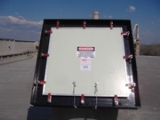
The technology of protection can range in price dramatically but where the type of device is rational to use, would typically be from least to most expensive solutions: explosion doors and vents (dependent on quantities and common denominators, either may end up the wise price choice); inerting: explosion suppression; isolation – or combinations of same. To focus on the most cost effective, doors typically have lower release pressure capabilities; are not susceptible to fatigueFatigue (material)
'In materials science, fatigue is the progressive and localized structural damage that occurs when a material is subjected to cyclic loading. The nominal maximum stress values are less than the ultimate tensile stress limit, and may be below the yield stress limit of the material.Fatigue occurs...
failures or subject to changing release pressures with changes in temperature, as “rupture membrane” type are; capable of leak tight service; service temperatures of up to 2,000°F; and can be more cost effective in small quantities. Rupture membrane type vents can provide a leak tight seal more readily in most cases; have a relatively broad tolerance on their release pressure and are more readily incorporated into systems with discharge ducts.
See also
- Explosion pressure
- Pressure relief valve
- Explosives safetyExplosives safetyExplosives safety originated as a formal program in the US in the aftermath of World War I when several ammunition storage areas were destroyed in a series of mishaps. The most serious occurred at Lake Denmark Naval Ammunition Storage Depot, New Jersey, in July, 1926 when an electrical storm led to...
- Explosion ventExplosion ventAn explosion vent is a safety device to protect equipment or buildings against excessive internal, explosion-incurred pressures, by means of pressure relief. An explosion vent will relieve pressure from the instant its opening pressure pstat has been exceeded.Several explosion vent panels can be...
- Prestressed structurePrestressed structurePrestressed structure is the one whose overall integrity, stability and security depend, primarily, on a prestressing. Prestressing means the intentional creation of permanent stresses in a structure for the purpose of improving its performance under various service conditions.There are the...
- Inert gasInert gasAn inert gas is a non-reactive gas used during chemical synthesis, chemical analysis, or preservation of reactive materials. Inert gases are selected for specific settings for which they are functionally inert since the cost of the gas and the cost of purifying the gas are usually a consideration...
- Explosion prevention standards for electrical equipmentElectrical Equipment in Hazardous AreasIn electrical engineering, a hazardous location is defined as a place where concentrations of flammable gases, vapors, or dusts occur. Electrical equipment that must be installed in such locations is especially designed and tested to ensure it does not initiate an explosion, due to arcing contacts...