
All Topics  
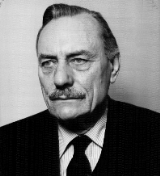
Enoch Powell

 
Enoch Powell

   Email Print
   Bookmark   Link


Enoch Powell


Brigadier
Brigadier

Brigadier is a military Military rank, the meaning of which has a considerable variation....
 John Enoch Powell, MBE
Order of the British Empire

The Most Excellent Order of the British Empire is a United Kingdom order of chivalry established on 4 June 1917 by George V of the United Kingdom....
 (16 June 1912 – 8 February 1998) was a British
United Kingdom

The United Kingdom of Great Britain and Northern Ireland, commonly known as the United Kingdom , the UK or Britain,is a sovereign state located off the northwestern coast of continental Europe....
 politician
Politician

A politician is an individual who is involved in influencing public decision making through the influence of politics or a person who influences the way a society is governed....
, linguist, writer
Author

An author is defined both as "the person who originates or gives existence to anything" and that authorship determines responsibility for what is created....
, academic, soldier
Soldier

A soldier is a general English term that refers to a land component of national armed forces.In most societies of the world, "soldier" is also a general term for any member of the land forces including Commissioned officer and non-commissioned officers....
 and poet
Poet

A poet is a person who writes poetry....
.

He was a Conservative Party
Conservative Party (UK)

The Conservative and Unionist Party, more commonly known as the Conservative Party, is a conservative political party in the United Kingdom....
 Member of Parliament
Member of Parliament

A Member of Parliament, or MP, is a representative of the voters to a parliament. In many countries the term applies specifically to members of the lower house, as upper houses often have a unique title, such as senate, and thus also have unique titles for its members, such as senators....
 (MP) between 1950 and February 1974, and an Ulster Unionist MP between October 1974 and 1987. He was controversial through most of his career, and his tenure in senior office was brief. He held strong and distinctive views on matters such as immigration, national identity, monetary policy, and the United Kingdom
United Kingdom

The United Kingdom of Great Britain and Northern Ireland, commonly known as the United Kingdom , the UK or Britain,is a sovereign state located off the northwestern coast of continental Europe....
's entry into the European Economic Community
European Economic Community

The European Economic Community was an international organisation created in 1957 to bring about economic integration between Belgium, France, Germany, Italy, Luxembourg and the Netherlands....
, which later became the European Union
European Union

The European Union is an economic and political union of 27 European Union member state, located primarily in Europe. It was established by the Treaty of Maastricht on 1 November 1993 upon the foundations of the pre-existing European Economic Community....
.


Discussion
Ask a question about 'Enoch Powell'
Start a new discussion about 'Enoch Powell'
Answer questions from other users
Full Discussion Forum


Quotations


In the end, the Labour party could cease to represent labour. Stranger historic ironies have happened than that.

The Sunday Telegraph (18 October, 1964).

Yes, I am a virus. I am the virus that kills socialists.

Replying to Harold Wilson's conference speech where he attacked "the virus of Powellism" (1 October, 1968).

Independence, the freedom of a self-governing nation, is in my estimation the highest political good, for which any disadvantage, if need be, and any sacrifice are a cheap price.

Speech at Stockport (8 June, 1973).

Judas was paid! Judas was paid! I am making a sacrifice!

Powell reacting to a heckler's cry of "Judas!" in a speech in Shipley where he told the audience to vote Labour (25 February, 1974).

All political lives, unless they are cut off in midstream at a happy juncture, end in failure, because that is the nature of politics and of human affairs.

Enoch Powell, Joseph Chamberlain (Thames and Hudson, 1977), p. 151.

We must be mad, literally mad, as a nation to be permitting the annual inflow of some 50,000 dependants, who are for the most part the material of the future growth of the immigrant-descended population. It is like watching a nation busily engaged in heaping up its own funeral pyre.


Encyclopedia


Brigadier
Brigadier

Brigadier is a military Military rank, the meaning of which has a considerable variation....
 John Enoch Powell, MBE
Order of the British Empire

The Most Excellent Order of the British Empire is a United Kingdom order of chivalry established on 4 June 1917 by George V of the United Kingdom....
 (16 June 1912 – 8 February 1998) was a British
United Kingdom

The United Kingdom of Great Britain and Northern Ireland, commonly known as the United Kingdom , the UK or Britain,is a sovereign state located off the northwestern coast of continental Europe....
 politician
Politician

A politician is an individual who is involved in influencing public decision making through the influence of politics or a person who influences the way a society is governed....
, linguist, writer
Author

An author is defined both as "the person who originates or gives existence to anything" and that authorship determines responsibility for what is created....
, academic, soldier
Soldier

A soldier is a general English term that refers to a land component of national armed forces.In most societies of the world, "soldier" is also a general term for any member of the land forces including Commissioned officer and non-commissioned officers....
 and poet
Poet

A poet is a person who writes poetry....
.

He was a Conservative Party
Conservative Party (UK)

The Conservative and Unionist Party, more commonly known as the Conservative Party, is a conservative political party in the United Kingdom....
 Member of Parliament
Member of Parliament

A Member of Parliament, or MP, is a representative of the voters to a parliament. In many countries the term applies specifically to members of the lower house, as upper houses often have a unique title, such as senate, and thus also have unique titles for its members, such as senators....
 (MP) between 1950 and February 1974, and an Ulster Unionist MP between October 1974 and 1987. He was controversial through most of his career, and his tenure in senior office was brief. He held strong and distinctive views on matters such as immigration, national identity, monetary policy, and the United Kingdom
United Kingdom

The United Kingdom of Great Britain and Northern Ireland, commonly known as the United Kingdom , the UK or Britain,is a sovereign state located off the northwestern coast of continental Europe....
's entry into the European Economic Community
European Economic Community

The European Economic Community was an international organisation created in 1957 to bring about economic integration between Belgium, France, Germany, Italy, Luxembourg and the Netherlands....
, which later became the European Union
European Union

The European Union is an economic and political union of 27 European Union member state, located primarily in Europe. It was established by the Treaty of Maastricht on 1 November 1993 upon the foundations of the pre-existing European Economic Community....
. He is remembered for his controversial 1968 "Rivers of Blood" speech
Rivers of Blood speech

The Rivers of Blood speech was a speech about immigration and anti-discrimination legislation in the United Kingdom made on April 20, 1968 by Enoch Powell, the Conservative Party Member of Parliament for Wolverhampton South West....
 in opposition to mass Commonwealth
Commonwealth of Nations

The Commonwealth of Nations, also known as the Commonwealth or the British Commonwealth, is an intergovernmental organization of fifty-three independent member states....
 immigration to Britain; this resulted in him being sacked from the Shadow Cabinet
Shadow Cabinet

The Shadow Cabinet is a senior group of opposition spokespeople in the Westminster system of government who together under the leadership of the Official opposition form an alternative cabinet to the government's, whose members shadow or mark each individual member of the government....
.

Life


Early years

Enoch Powell was born in Stechford, Birmingham
Birmingham

Birmingham is a city status in the United Kingdom and metropolitan borough in the West Midlands of England. Birmingham is the most populous of England's English Core Cities Group, and is the List of United Kingdom cities by population British city after London, with a population of 1,010,200 ....
, England
England

native_name =|conventional_long_name = England|common_name = England|image_flag = Flag of England.svg|image_coat = England COA.svg|symbol_type = Royal Coat of Arms...
. He lived there for the first six years of his life before moving, in 1918, to Kings Norton
Kings Norton

Kings Norton is an area of Birmingham, England. It is also a Birmingham City Council ward within the Government of Birmingham, England#Districts of Northfield, Birmingham....
, where he lived until 1930. He was the only child of Albert Enoch Powell (1872–1956), primary school headmaster, and his wife, Ellen Mary (1886–1953). Ellen was the daughter of Henry Breese, a Liverpool
Liverpool

Liverpool [] is a city and metropolitan borough of Merseyside, England, along the eastern side of the Mersey Estuary. It was founded as a History of borough status in England and Wales in 1207 and was granted City status in the United Kingdom in 1880....
 policeman, and his wife Eliza), who had given up her own teaching career after marrying. The Powells were of Welsh
Welsh people

The Welsh people are an ethnic group and nation associated with Wales and the Welsh language. John Davies argues that the origin of the "Welsh nation" can be traced to the late 4th and early 5th centuries, following the Roman withdrawal from Britain, although Celtic languages seem to have been spoken in Wales far longer....
 descent, having moved to the developing Black Country
Black Country

The Black Country is a loosely defined area of the English West Midlands conurbation, to the north and west of Birmingham, and to the south and east of Wolverhampton, around the South Staffordshire coalfield....
 in the early 19th century. His great-grandfather was a miner
Coal mining

Coal mining is the extraction or removal of coal from the earth by mining. When coal is used for fuel in power generation it is referred to as steaming or thermal coal....
 in the coalfield
Coalfield

A coalfield is an area of certain uniform characteristics where coal is mined. The criteria for determining the approximate boundary of a coalfield are geographical and cultural, in addition to geological....
s, and his grandfather had been employed in the iron trade.

Powell was a pupil at King Edward's School, Birmingham
King Edward's School, Birmingham

King Edward's School is an independent school secondary school in Birmingham, England, founded by Edward VI of England in 1552. It is part of the Foundation of the Schools of King Edward VI, and is widely regarded as one of the most academically successful schools in the country, according to various league tables....
, where he studied classics, specifically Latin and Greek (which would later influence his 'Rivers of Blood' speech
Rivers of Blood speech

The Rivers of Blood speech was a speech about immigration and anti-discrimination legislation in the United Kingdom made on April 20, 1968 by Enoch Powell, the Conservative Party Member of Parliament for Wolverhampton South West....
), and was one of the few pupils in the school's history to attain 100% in an end-of-year English examination. He studied at Trinity College, Cambridge
Trinity College, Cambridge

Trinity College is one of the 31 Colleges of the University of Cambridge of the University of Cambridge. Trinity has more members than any other college in Cambridge or University of Oxford, with around 700 undergraduates, 430 graduate students, and over 160 Fellows; however, counting only the student body it has somewhat fewer than Homert...
, from 1930 to 1933. During his time at Cambridge he fell under the influence both of the poet A. E. Housman
A. E. Housman

Alfred Edward Housman , usually known as A. E. Housman, was an England classics and poet, best known for his cycle of poems A Shropshire Lad....
, then Professor of Latin at the university, and of the writings of the German philosopher Friedrich Nietzsche
Friedrich Nietzsche

Friedrich Wilhelm Nietzsche was a 19th century philosophy Germans philosophy and classical philology. He wrote critical texts on religion, morality, contemporary culture, philosophy, and science, using a distinctive German language style and displaying a fondness for metaphor and aphorism....
. He took no part in politics at university.

It was while at Cambridge
Cambridge

The city status in the United Kingdom of Cambridge is a College town and the administrative centre of the county of Cambridgeshire, England. It lies about 50 miles north of London....
 that Powell is recorded as having enjoyed one of his first close relationships. Indeed, according to John Evans, Chaplain of Trinity
Trinity College, Cambridge

Trinity College is one of the 31 Colleges of the University of Cambridge of the University of Cambridge. Trinity has more members than any other college in Cambridge or University of Oxford, with around 700 undergraduates, 430 graduate students, and over 160 Fellows; however, counting only the student body it has somewhat fewer than Homert...
 and Extra Preacher to the Queen, instructions were left with him to reveal after Powell's death that at least one of the romantic affairs of his life had been homosexual. Powell had particularly drawn the Chaplain's attention to lines in his First Poems (published 1937). Biographers such as Simon Heffer
Simon Heffer

Simon James Heffer is a United Kingdom journalist, columnist and writer, noted for his right-wing political views. He was educated at King Edward VI Grammar School in Chelmsford and Corpus Christi College, Cambridge, University of Cambridge....
 dispute this however, and have argued that this did not mean that he was homosexual; merely that he had not yet met any girls.

After achieving a double starred first
British undergraduate degree classification

The British undergraduate degree classification system is a grade scheme for undergraduate degrees in the United Kingdom. The system has been applied in other countries, such as India, the Republic of Ireland, Kenya, South Africa, Singapore, Malaysia, Hong Kong, Australia, New Zealand, Nigeria, Malta and Canada....
 in Latin and Greek, he stayed on at Trinity College as a Fellow, spending much of his time studying ancient manuscripts in Rome and producing academic works in Greek and Welsh.

In 1937 he was appointed Professor of Greek at Sydney University aged 25 (failing in his aim of beating Nietzsche's record of becoming a professor at 24). Amongst his pupils was the future Prime Minister of Australia
Prime Minister of Australia

The Prime Minister of Australia is the head of government of the Australia, holding office on commission from the Governor-General of Australia....
 Gough Whitlam
Gough Whitlam

'Edward Gough Whitlam', Order of Australia, Queens Counsel , known as 'Gough Whitlam' , is an Australian former politician and 21st Prime Minister of Australia....
. He revised Stuart-Jones's edition of Thucydides
Thucydides

Thucydides was a Greeks history and author of the History of the Peloponnesian War, which recounts the 5th century B.C. war between Sparta and Athens to the year 411 B.C....
' Historiae
History of the Peloponnesian War

The History of the Peloponnesian War is an account of the Peloponnesian War in Ancient Greece, fought between the Peloponnesian League and the Delian League ....
 for the Oxford University Press
Oxford University Press

Oxford University Press is a publisher and a department of the University of Oxford in England. It is the largest university press in the world, being larger than all the American university presses combined with Cambridge University Press....
 in 1938. His most lasting contribution to classical scholarship was his Lexicon to Herodotus (1938).

As well as his education at Cambridge
University of Cambridge

The University of Cambridge , located in Cambridge, England, is the List of oldest universities in continuous operation university in the Anglosphere....
, Powell took a course in Urdu
Urdu

Urdu is a Central_Indo-Aryan_languages#Central_Zone_.28Madhya_or_Hindi.29 Indo-Aryan languages of the Indo-Iranian languages, belonging to the Indo-European languages family of languages....
 at the School of Oriental Studies, now the School of Oriental and African Studies
School of Oriental and African Studies

The School of Oriental and African Studies is a constituent college of the University of London, specialising in the laws, politics, economics, languages and humanities concerning Asia, Africa and the Near East and Middle East....
, University of London
University of London

Based primarily in London, England, United Kingdom, the University of London is a federal mega university made up of 31 affiliates: 19 separate university institutions, and 12 research institutes....
, because he felt that his long-cherished ambition of becoming Viceroy of India
Governor-General of India

The Governor-General of India was the head of the British Raj in India, and later, after Indian Independence Act 1947, the representative of the List of Indian monarchs#Kings of India and Pakistan....
 would be unattainable without knowledge of an Indian language.

Soon after arrival in Sydney, Australia he was appointed Curator of the Nicholson Museum
Nicholson Museum

The Nicholson Museum houses the University of Sydney collection of antiquities, one of the largest in the Southern Hemisphere. It is located at the southern entrance to the Quadrangle of the Main Campus of the University of Sydney....
 at Sydney University. He stunned the vice-chancellor by informing him that war would soon break out in Europe, and that when it did he would be heading home to enlist in the army. By the time Powell left King Edward's School in 1930 he had confirmed his instinctive belief that the Armistice was merely temporary and that Britain would be at war with Germany again. During his time there as a professor, he grew increasingly angry at the appeasement
Appeasement

Appeasement is "the policy of settling international quarrels by admitting and satisfying grievances through rational negotiation and compromise, thereby avoiding the resort to an armed conflict which would be expensive, bloody, and possibly dangerous." The term is most often applied to the foreign policy of United Kingdom Prime Minister of t...
 of Nazi Germany
Nazi Germany

Nazi Germany and the Third Reich are the colloquial English names for Germany under the regime of Adolf Hitler and the Nazi Party , which established a Totalitarianism dictatorship that existed from 1933 to 1945....
 and what he saw as a betrayal of British national interests. After Neville Chamberlain
Neville Chamberlain

Arthur Neville Chamberlain was a British Conservative Party politician and Prime Minister of the United Kingdom from 1937 to 1940. Chamberlain is best known for appeasement foreign policy, in particular regarding his signing of the Munich Agreement in 1938, conceding the Sudetenland region of Czechoslovakia to Germany, and for his "containm...
's first visit to Adolf Hitler
Adolf Hitler

Adolf Hitler was an Austrian-born Germany politician and the leader of the National Socialist German Workers Party , popularly known as the Nazi Party....
 at Berchtesgaden
Berchtesgaden

Berchtesgaden is a Municipalities of Germany in the Germany Bavarian Alps. It is located in the south district of Berchtesgadener Land in Bavaria, near the border with Austria, some 30 km south of Salzburg and 180 km southeast of Munich....
 Powell was bitter in a letter to his parents of 18 September 1938:

"I do here in the most solemn and bitter manner curse the Prime Minister of England for having cumulated all his other betrayals of the national interest and honour, by his last terrible exhibition of dishonour, weakness and gullibility. The depths of infamy to which our accurst "love of peace" can lower us are unfathomable".


In another letter to his parents in June 1939, before the outbreak of war, Powell wrote:

"It is the English
English people

The English are a nation and ethnic group native to England who speak English language in England. The English identity as a people is of early medieval origin, when they were known in Old English as the Anglecynn....
, not their Government; for if they were not blind cowards, they would lynch Chamberlain and Halifax and all the other smarmy traitors".


Immediately upon the outbreak of war, Powell returned to England
England

native_name =|conventional_long_name = England|common_name = England|image_flag = Flag of England.svg|image_coat = England COA.svg|symbol_type = Royal Coat of Arms...
, although not before buying a Russian
Russian language

Russian is the most geographically widespread language of Eurasia, the most widely spoken of the Slavic languages, and the largest native language in Europe....
 dictionary, since he thought "Russia would hold the key to our survival and victory, as it had in 1812 and 1916".

War years

In October 1939 Powell enlisted in the Royal Warwickshire Regiment, almost a month after returning home. Powell enlisted in the ranks as an Australian. In later years he recorded his promotion from private to lance-corporal in his Who's Who
Who's Who

Who's Who or Who is Who is the name of a number of reference publications, generally containing concise biography information on a particular group of people....
 entry, on other occasions describing it as a greater promotion than entering the Cabinet. He was trained for a commission after, whilst working in a kitchen, answering the question of an inspecting officer with a Greek proverb. He was commissioned on the General List in 1940, but almost immediately transferred to the Intelligence Corps
Intelligence Corps

The Intelligence Corps is one of the corps of the British Army. It is responsible for gathering, analysing and disseminating military intelligence and also for counter-intelligence and security....
. In October 1941, as a Lieutenant, Powell was posted to Cairo
Cairo

Cairo , which means "the triumphant", is the Cairo and largest city of Egypt.It is the most populous metropolitan area in Egypt and is also one of the most populous in the world....
 and transferred back to the Royal Warwickshire Regiment. He was soon promoted to the rank of Major
Major

In many European languages, the term Major refers to a military rank, denoting seniority at one of usually various levels of rank, for example: "Sergeant-Major" denoting the most senior ranking sergeant of a large military unit; "Captain-Major", denoting a mid-level command status Officer ...
. He helped mastermind the attack on Rommel
Rommel

Rommel is the family name of*Erwin Rommel, German Field Marshal*Eddie Rommel, American baseball pitcher and umpire*Juliusz R?mmel, Polish general...
's supply lines, as well as the Battle of El Alamein
Battle of El Alamein

There were two battles of El Alamein in the Second World War, both fought in 1942. The Battles occurred in Egypt in and around an area named after a railway stop called El Alamein at ....
. Powell was promoted Lieutenant-Colonel in August 1942. Twelve months later, in August 1943 he was posted to Delhi
Delhi

Delhi , sometimes referred to as Dilli , is the List of most populous cities in India metropolis in India and, with over 11 million residents, the List of metropolitan areas by population....
. Though he served in Africa
Africa

Africa is the world's second-largest and second most-populous continent, after Asia. At about 30.2 million km? including adjacent islands, it covers 6% of the Earth's total surface area and 20.4% of the total land area....
 with the Desert Rats, Powell himself never actually saw combat, serving for most of his military career as a staff officer. It was in Algiers
Algiers

Algiers Nicknamed El-Bahdja or Alger la Blanche for the glistening white of its buildings as seen rising up from the sea, Algiers is situated on the west side of a bay of the Mediterranean Sea....
 that the seed of Powell's dislike of the United States
United States

The United States of America is a Federal government constitutional republic comprising U.S. state and a federal district. The country is situated mostly in central North America, where its Contiguous United States and Washington, D.C., the Capital districts and territories, lie between the Pacific Ocean and Atlantic Oceans, Borders of the U...
 was planted. After talking with some senior American officials, he became convinced that one of America's main war aims was to destroy the British Empire
British Empire

The British Empire comprised the dominions, Crown colony, protectorates, League of Nations mandate, and other Dependent territory ruled or administered by the United Kingdom , that had originated with the overseas colonies and trading posts established by England in the late 16th and early 17th centuries....
. Writing home on 16 February 1943, Powell said: "I see growing on the horizon the greater peril than Germany or Japan
Japan

Japan is an island country in East Asia. Located in the Pacific Ocean, it lies to the east of the Sea of Japan, People's Republic of China, North Korea, South Korea and Russia, stretching from the Sea of Okhotsk in the north to the East China Sea and Taiwan in the south....
 ever were... our terrible enemy, America
United States

The United States of America is a Federal government constitutional republic comprising U.S. state and a federal district. The country is situated mostly in central North America, where its Contiguous United States and Washington, D.C., the Capital districts and territories, lie between the Pacific Ocean and Atlantic Oceans, Borders of the U...
...."

Powell's conviction of the anti-British attitude of the Americans continued during the war. Powell cut out and retained all his life an article from the New Statesman
New Statesman

The New Statesman is a United Kingdom left-wing politics magazine published weekly in London. The current editor is Jason Cowley, whose appointment was announced on 16 May 2008....
 newspaper of 13 November 1943, in which the American Clare Boothe Luce
Clare Boothe Luce

Clare Boothe Luce was an United States playwright, editor, journalist, ambassador, socialite and one of the first women ever in the United States House of Representatives, representing the state of Connecticut....
 said in a speech that India
India

India, officially the Republic of India , is a country in South Asia. It is the List of countries and outlying territories by total area country by geographical area, the List of countries by population country, and the most populous liberal democracy in the world....
n independence would mean that the "USA will really have won the greatest war in the world for democracy".

He desperately wanted to go to the Far East
Far East

The Far East is a term current in English language to refer to the countries of East Asia. The term is often expanded to also include Southeast Asia and South Asia, for economic and cultural reasons, for example because Buddhism is common to East Asia, Southeast Asia and South Asia....
 to help the fight against Japan
Japan

Japan is an island country in East Asia. Located in the Pacific Ocean, it lies to the east of the Sea of Japan, People's Republic of China, North Korea, South Korea and Russia, stretching from the Sea of Okhotsk in the north to the East China Sea and Taiwan in the south....
 because "the war in Europe
Europe

Europe is, conventionally, one of the world's seven continents. Comprising the westernmost peninsula of Eurasia, Europe is generally divided from Asia to its east by the water divide of the Ural Mountains, the Ural , the Caspian Sea, and by the Caucasus Mountains to the southeast....
 is won now, and I want to see the Union Flag
Union Flag

The Union Flag, also known as the Union Jack, is the national Flag of the United Kingdom. Historically, the flag was used throughout the former British Empire....
 back in Singapore
Singapore

Singapore , officially the Republic of Singapore, is an island country microstate located at the southern tip of the Malay Peninsula. It lies 137 kilometres north of the equator, south of the Malaysian state of Johor and north of Indonesia's Riau Islands....
" before, Powell thought, the Americans beat Britain to it.

Powell attempted to join the Chindits
Chindits

The Chindits were a British India "Special Force" that served in Burma and India from 1942 until 1945 during the Burma Campaign in World War II....
 and jumped into a taxi to bring the matter up with Orde Wingate but his duties and rank precluded the assignment.

Powell began the war as the youngest professor in the Commonwealth; he ended it as the youngest Brigadier
Brigadier

Brigadier is a military Military rank, the meaning of which has a considerable variation....
 in the British army
British Army

The British Army is the Army branch of the British Armed Forces. It came into being with the unification of the Kingdoms of Kingdom of England and Kingdom of Scotland into the Kingdom of Great Britain in 1707....
, one of the very few men in the entire war to rise from Private to Brigadier (another being Fitzroy Maclean
Fitzroy Maclean

Major-General Sir Fitzroy Hew Royle MacLean of Dunconnel, 1st Baronet Order of the Thistle Order of the British Empire was a Scottish diplomat, soldier, adventurer, writer and politician....
). Powell felt guilty for having survived when many of those he had met during his journey through the ranks had not. When once asked how he would like to be remembered, he at first answered "Others will remember me as they will remember me", but when pressed he replied "I should like to have been killed in the war."

Joining the Conservative Party

Though he voted for the Labour Party
Labour Party (UK)

The Labour Party is a political party in the United Kingdom. Founded at the start of the 20th century, it has been since the 1920s the principal party of the Left-wing politics in England, Scotland and Wales, but not Northern Ireland, where it has only recently organised again....
 in their 1945 landslide victory
United Kingdom general election, 1945

The United Kingdom General Election of 1945 was a United Kingdom general election held on 5 July 1945, with delayed polls taking place on 12 July and in Nelson and Colne on 19 July....
, because he wanted to punish the Conservative Party for the Munich agreement
Munich Agreement

The Munich Agreement was an agreement regarding the Sudetenland, which were areas along borders of Czechoslovakia, mainly inhabited by Czech Germans....
, after the war he joined the Conservatives and worked for the Conservative Research Department
Conservative Research Department

The Conservative Research Department is an integral part of the central organisation of the Conservative Party of the United Kingdom. It operates alongside the other departments of Conservative Campaign Headquarters at 30 Millbank, London SW1....
 under R. A. Butler, where his colleagues included Iain Macleod
Iain Macleod

Iain Norman Macleod was a United Kingdom Conservative Party politician and government minister....
 and Reginald Maudling
Reginald Maudling

Reginald Maudling was a United Kingdom politician known for his intellectual brilliance, political pragmatism, and easygoing nature but slightly dogged by a reputation for laziness....
. After unsuccessfully contesting the Labour Party's ultra-safe seat
Safe seat

A safe seat is a seat in a legislature which is regarded as fully secured, either by a certain political party, the incumbent representative personally or a combination of both....
 of Normanton
Normanton (UK Parliament constituency)

Normanton is a county constituency represented in the British House of Commons of the Parliament of the United Kingdom. It elects one Member of Parliament by the first past the post system of election....
 at a by-election in 1947
Normanton by-election, 1947

The Normanton by-election, 1947 was a by-election held for the British House of Commons United Kingdom constituencies of Normanton on 11 February 1947....
 (when the Labour majority was 62%), he was elected as Member of Parliament
Member of Parliament

A Member of Parliament, or MP, is a representative of the voters to a parliament. In many countries the term applies specifically to members of the lower house, as upper houses often have a unique title, such as senate, and thus also have unique titles for its members, such as senators....
 (MP) for Wolverhampton South West in the 1950 general election
United Kingdom general election, 1950

The 1950 United Kingdom general election was the first general election ever after a full term of a Labour party government. Despite polling over one and a half million votes more than the Conservative party , the election, held on 23 February 1950 resulted in Labour receiving a slim majority of just five seats over all other parties, and th...
.

Powell's ambition to be Governor-General of India
Governor-General of India

The Governor-General of India was the head of the British Raj in India, and later, after Indian Independence Act 1947, the representative of the List of Indian monarchs#Kings of India and Pakistan....
 crumbled in February 1947, when Prime Minister Clement Attlee
Clement Attlee

Clement Richard Attlee, 1st Earl Attlee, Order of the Garter, Order of Merit, Order of the Companions of Honour, Her Majesty's Most Honourable Privy Council, Fellow of the Royal Society was a British people politician, who served as Prime Minister of the United Kingdom from 1945 to 1951, and leader of the Labour Party from 1935 to 1955....
 announced that Indian independence
Indian independence movement

The term Indian independence movement incorporates various national and regional campaigns, agitations and efforts of both Nonviolent and Revolutionary movement for Indian independence philosophy....
 was imminent. Powell was so shocked by the change of policy that he spent the whole night after it was announced walking the streets of London, trying to take it in. He came to terms with it by becoming fiercely anti-imperialist, believing that once India had gone the whole empire should follow it. This logical absolutism explained his later indifference to the Suez crisis
Suez Crisis

The Suez Crisis, also referred to as the Tripartite Aggression, was a military attack on Egypt by United Kingdom, France, and Israel beginning on 29 October 1956....
, his contempt for the Commonwealth, and his urging that Britain should scrap any remaining pretence that she was a world power.

On 2 January 1952 the 39-year-old Powell married 26-year-old Margaret Pamela Wilson, a former colleague from Conservative Central Office, who provided him with the settled and happy family life that was essential to his political career. They had two daughters, born in January 1954 and October 1956.

On 3 March 1953 Powell spoke against the Royal Titles Bill in the House of Commons. He said he found three major changes to the style of the United Kingdom, "all of which seem to me to be evil". The first one was "that in this title, for the first time, will be recognised a principle hitherto never admitted in this country, namely, the divisibility of the crown". Powell said that the unity of the realm had evolved over centuries and included the British Empire: "It was a unit because it had one Sovereign. There was one Sovereign: one realm". He feared that by "recognising the division of the realm into separate realms, are we not opening the way for that other remaining unity – the last unity of all – that of the person, to go the way of the rest?"

The second change he objected to was "the suppression of the word 'British', both from before the words 'Realms and Territories' where it is replaced by the words 'her other' and from before the word 'Commonwealth', which, in the Statute of Westminster, is described as the 'British Commonwealth of Nations'":

"To say that he is Monarch of a certain territory and his other realms and territories is as good as to say that he is king of his kingdom. We have perpetrated a solecism in the title we are proposing to attach to our Sovereign and we have done so out of what might almost be called an abject desire to eliminate the expression 'British'. The same desire has been felt... to eliminate this word before the term 'Commonwealth'.... Why is it, then, that we are so anxious, in the description of our own Monarch, in a title for use in this country, to eliminate any reference to the seat, the focus and the origin of this vast aggregate of territories? Why is it that this 'teeming womb of royal Kings', as Shakespeare called it, wishes now to be anonymous?"


Powell went on to claim the answer was that because the British Nationality Act 1948
British Nationality Act 1948

The British Nationality Act 1948 was an Act of the Parliament of the United Kingdom which established the status of Citizen of the United Kingdom and Colonies , the national citizenship of the United Kingdom and those places that were still British colonies on 1 January 1949, when the 1948 Act came into force....
 had removed allegiance to the crown as the basis of citizenship and replaced that with nine separate citizenships combined together by statute. Therefore if any of these nine countries became republics nothing in law would change, as happened with India when it became a republic. Furthermore, Powell went on, the essence of unity was "that all the parts recognise they would sacrifice themselves to the interests of the whole". He denied that there was in India that "recognition of belonging to a greater whole which involves the ultimate consequence in certain circumstances of self-sacrifice in the interests of the whole". Therefore the title 'Head of the Commonwealth', the third major change, was "essentially a sham. They are essentially something which we have invented to blind ourselves to the reality of the position".

These changes were "greatly repugnant" to Powell but:
"... if they are changes which were demanded by those who in many wars had fought with this country, by nations who maintained an allegiance to the Crown, and who signified a desire to be in the future as were in the past; if it were our friends who had come to us and said: 'We want this,' I would say: 'Let it go. Let us admit the divisibility of the Crown. Let us sink into anonymity and cancel the word 'British' from our titles. If they like the conundrum 'Head of the Commonwealth' in the Royal style, let it be there'. However, the underlying evil of this is that we are doing it for the sake not of our friends but of those who are not our friends. We are doing this for the sake of those to whom the very names 'Britain' and 'British' are repugnant.... We are doing this for the sake of those who have deliberately cast off their allegiance to our common Monarchy."
For the rest of his life Powell regarded this speech as the finest he ever delivered.

Powell was a member of the Suez Group of MPs who were against the removal of British troops from the Suez Canal
Suez Canal

The Suez Canal is a canal in Egypt. Opened in November 1869, it allows water transportation between Europe and Asia without navigating around Africa or carrying goods overland between the Mediterranean and the Red Sea....
 because such a move would demonstrate, Powell argued, that Britain could no longer maintain a position there and that any claim to the Suez Canal would therefore be illogical. However, after the troops had left in 1954 and the Egyptians nationalised the Canal in 1956, Powell opposed the British attempts to retake the Canal in the Suez War because he thought the British no longer had the resources to be a world power.

Periods as a Minister

In December 1955 he was made a junior Housing Minister and later became Financial Secretary to the Treasury
Financial Secretary to the Treasury

Financial Secretary to the Treasury is a junior Ministerial post in the HM Treasury. It is the 4th most significant Ministerial role within the Treasury after the Chancellor of the Exchequer, the Chief Secretary to the Treasury, and the Paymaster General....
, but in January 1958 he resigned, along with the Chancellor of the Exchequer Peter Thorneycroft
Peter Thorneycroft

George Edward Peter Thorneycroft, Baron Thorneycroft Order of the Companions of Honour Privy Council of the United Kingdom , was a United Kingdom Conservative Party politician....
 and his Treasury colleague Nigel Birch
Nigel Birch, Baron Rhyl

Evelyn Nigel Chetwode Birch, Baron Rhyl, Privy Council of the United Kingdom, Order of the British Empire was a British Conservative Party politician....
, in protest at government plans for increased expenditure; he was a staunch deflationist, or in modern terms a monetarist, and a believer in market forces. (Powell was also a member of the Mont Pelerin Society
Mont Pelerin Society

The Mont Pelerin Society is an international organization composed of economics, intellectuals, business leaders, and others who favour classical liberalism; the society advocates free market economic policies and the political values of an open society....
.) The by-product of this expenditure was the printing of extra money to pay for it all, which Powell believed to be a major cause of inflation, and in effect a form of taxation, as the holders of money find their money is worth less. Inflation rose to 2.5% - a high figure for the era, especially in peacetime.

In the late 1950s Powell backed deflation and in the 1960s was an advocate of free market
Free market

A free market is a market that is free of government intervention and regulation, besides the minimal function of maintaining the legal system and protecting property rights, and is also free of private force and fraud....
 policies which at the time were seen as extreme and unworkable, as well as unpopular. In many respects, Powell can be seen as a Thatcherite avant la lettre: he was calling for the privatisation of the Post Office and the telephone network as early as 1964, over 20 years before these changes actually took place; and, like Mrs Thatcher later, he both scorned the idea of "consensus politics" and wanted the Conservative Party to become a modern businesslike party, freed from its old aristocratic and "old boy network" associations. Perhaps most notably of all, in his 1958 resignation over public spending and what he saw as an inflationary economic policy, he anticipated almost exactly the views that in the 1980s came to be described as "monetarism".

On 27 July 1959 Powell gave his speech on Hola Camp
Hola massacre

The Hola Massacre is an event that took place shortly after the end of the Mau Mau Uprising against British colonial rule in Hola, Kenya, Kenya....
 of Kenya, where eleven Mau Mau were killed after refusing work in the camp. Powell noted that some MPs had described the eleven as "sub-human" but Powell responded by saying: "In general, I would say that it is a fearful doctrine, which must recoil upon the heads of those who pronounce it, to stand in judgment on a fellow human being and to say, 'Because he was such-and-such, therefore the consequences which would otherwise flow from his death shall not flow'." Powell also disagreed with the notion that because it was in Africa then different methods were acceptable:

"Nor can we ourselves pick and choose where and in what parts of the world we shall use this or that kind of standard. We cannot say, 'We will have African standards in Africa, Asian standards in Asia and perhaps British standards here at home'. We have not that choice to make. We must be consistent with ourselves everywhere. All Government, all influence of man upon man, rests upon opinion. What we can do in Africa, where we still govern and where we no longer govern, depends upon the opinion which is entertained of the way in which this country acts and the way in which Englishmen act. We cannot, we dare not, in Africa of all places, fall below our own highest standards in the acceptance of responsibility".


Denis Healey
Denis Healey

Denis Winston Healey, Baron Healey, Order of the Companions of Honour, Order of the British Empire, Privy Council of the United Kingdom is a British life peer and Labour Party politician....
, MP from 1952 to 1992, later said this speech was "the greatest parliamentary speech I ever heard... it had all the moral passion and rhetorical force of Demosthenes
Demosthenes

Demosthenes was a prominent Greeks statesman and orator of History of Athens. His oratorys constitute a significant expression of contemporary Athenian intellectual prowess and provide an insight into the politics and culture of ancient Greece during the 4th century BC....
". The Daily Telegraph
The Daily Telegraph

The Daily Telegraph is a British broadsheet newspaper, founded in 1855. Excepting the Financial Times and The Herald , it is the only remaining national daily newspaper printed on traditional newsprint in the broadsheet format in the United Kingdom, as most other broadsheet publications have converted to the smaller tabloid/Compa...
 report of the speech said that "as Mr Powell sat down, he put his hand across his eyes. His emotion was justified, for he had made a great and sincere speech".

Powell returned to the government in July 1960, when he was appointed Health Minister
Secretary of State for Health

Secretary of State for Health is a UK cabinet position responsible for the British Department of Health. The current Secretary of State for Health is Alan Johnson, appointed on 28 June 2007 as part of Gordon Brown's first cabinet....
, albeit outside the Cabinet, but this changed in 1962. In this post he was responsible for promoting an ambitious ten-year programme of general hospital building and for beginning the run-down of the huge psychiatric institutions
Institutionalisation

The term institutionalization is widely used in social theory to denote the process of making something become embedded within an organization, social system, or society as an established custom or norm within that system....
. In his famous 1961 "Water Tower" speech, he said:

"There they stand, isolated, majestic, imperious, brooded over by the gigantic water-tower and chimney combined, rising unmistakable and daunting out of the countryside - the asylums which our forefathers built with such immense solidity to express the notions of their day. Do not for a moment underestimate their powers of resistance to our assault. Let me describe some of the defences which we have to storm".


The speech catalysed a debate that was one of several strands leading to the Care in the Community
Care in the Community

Although this policy has been attributed to the Margaret Thatcher government in the 1980s, community care was not a new idea. As a policy it had been around since the early 1950s....
 initiative of the 1980s. In 1993 however Powell claimed that his policy could have worked but had not. He claimed the criminally insane should have never been released and that the problem was one of funding. He said the new way of caring for the mentally ill would cost more, not less, than the old way because community care was decentralised and intimate as well as being "more human". His successors had not, Powell claimed, provided the money for local authorities to spend on mental health care and therefore institutional care had been run-down whilst at the same time there was no investment in community care.

Later, he oversaw the employment of a large number of Commonwealth immigrants by the understaffed National Health Service
National Health Service

The National Health Service is the name commonly used to refer to the four publicly funded healthcare systems of the United Kingdom, collectively or individually, although only the health service in England uses the name 'National Health Service' without further qualification....
. Prior to this, many non-white immigrants who held full rights of citizenship in Britain were obliged to take the jobs that no one else wanted (e.g. street cleaning, night-shift assembly production lines), often paid considerably less than their white counterparts.

Along with Iain Macleod, Powell refused to serve in the Cabinet following the appointment of Alec Douglas-Home
Alec Douglas-Home

Alexander Frederick Douglas-Home, Baron Home of the Hirsel, Order of the Thistle, Imperial Privy Council , 14th Earl of Home from 1951 to 1963, was a British Conservative Party politician, and served as Prime Minister of the United Kingdom for a year from October 1963 to October 1964 ....
 as Prime Minister. This refusal was not based on antipathy to Home personally but was in protest against what Macleod and Powell saw as Macmillan's underhand manipulation of colleagues during the process of choosing a new leader. Following the Conservatives' defeat in the 1964 general election
United Kingdom general election, 1964

The United Kingdom general election of 1964 was held on 15 October 1964, more than five years after its predecessor, and thirteen years after the Conservative Party had first taken power....
, he agreed to return to the front bench as Transport spokesman. In 1965 he stood in the first-ever party leadership election, but came a distant third to Edward Heath
Edward Heath

Sir Edward Richard George Heath, Order of the Garter, Order of the British Empire , often known as Ted Heath, was Prime Minister of the United Kingdom from 1970 to 1974 and leader of the Conservative Party from 1965 to 1975....
, who appointed him Shadow Secretary of State for Defence.

Shadow Defence Secretary


In his first speech to the Conservative Party conference as Shadow secretary of State for Defence on 14 October 1965, Powell outlined a fresh defence policy, jettisoning what he saw as outdated global military commitments left-over from Britain's imperial past and stressing that Britain was a European power and therefore an alliance with Western European states from possible attack from the East was central to Britain's safety. He defended Britain's nuclear weapons (he did not yet advocate unilateral nuclear disarmament) and argued that it was "the merest casuistry to argue that if the weapon and the means of using it are purchased in part, or even altogether, from another nation, therefore the independent right to use it has no reality. With a weapon so catastrophic, it is possession and the right to use which count". Also, Powell called into question Western military commitments East of Suez
East of Suez

The phrase East of Suez is used in United Kingdom military and political discussions in reference to imperial interests beyond the European theatre ....
:

"However much we may do to safeguard and reassure the new independent countries in Asia and Africa, the eventual limits of Russian and Chinese advance in those directions will be fixed by a balance of forces which will itself be Asiatic and African. The two Communist empires are already in a state of mutual antagonism; but every advance or threat of advance by one or the other calls into existence countervailing forces, sometimes nationalist in character, sometimes expansionist, which will ultimately check it. We have to reckon with the harsh fact that the attainment of this eventual equilibrium of forces may at some point be delayed rather than hastened by Western military presence".


The Daily Telegraph journalist David Howell
David Howell, Baron Howell of Guildford

David Howell, Baron Howell of Guildford is a British Conservative Party politician, journalist, and economic consultant. His daughter Frances is married to the Conservative MP George Osborne....
 remarked to Andrew Alexander that Powell had "just withdrawn us from East of Suez, and received an enormous ovation because no-one understood what he was talking about". However the Americans were worried by Powell's speech as they wanted British military commitments in South-East Asia as they were still fighting in Vietnam. A transcript of the speech was sent to Washington and the American embassy requested to talk to Heath about the "Powell doctrine". The New York Times said Powell's speech was "a potential declaration of independence from American policy". During the election campaign of 1966
United Kingdom general election, 1966

The 1966 UK general election on 31 March 1966 was called by sitting Labour Prime Minister Harold Wilson. Wilson's decision to call an election turned on the fact that his government, elected only two years previously in United Kingdom general election, 1964 had an unworkable small majority of only 4 MPs....
 Powell claimed that the British government had contingency plans to send at least a token British force to Vietnam and that, under Labour, Britain "has behaved perfectly clearly and perfectly recognisably as an American satellite". President Johnson
Lyndon B. Johnson

Lyndon Baines Johnson , often referred to as LBJ, was the List of Presidents of the United States President of the United States and List of Vice Presidents of the United States Vice President of the United States ....
 had indeed asked Wilson for some British forces for Vietnam, and when it was later suggested to Powell that the view in Washington—that the public reaction to Powell's allegations had made Wilson realise he would not have public opinion on his side and so could not go through with it—Powell responded: "The greatest service I have performed for my country, if that is so". Labour was returned with a large majority, and Powell was retained by Heath as Shadow Defence Secretary as he believed Powell "was too dangerous to leave out".

In a controversial speech on 26 May 1967, Powell criticised Britain's post-war world role:
"In our imagination the vanishing last vestiges... of Britain's once vast Indian Empire
British Raj

British Raj primarily refers to the British rule in the Indian subcontinent between 1858 and 1947; it can also refer to the period of dominion, and even the region under the rule....
 have transformed themselves into a peacekeeping role on which the sun never sets. Under God's good providence and in partnership with the United States, we keep the peace of the world and rush hither and thither containing Communism
Communism

Communism is a socioeconomic structure and political ideology that promotes the establishment of an egalitarianism, classlessness, stateless society based on common ownership and control of the means of production and property in general....
, putting out brush fires and coping with subversion. It is difficult to describe, without using terms derived from psychiatry, a notion having so few points of contact with reality".


In 1967, Powell spoke openly of his opposition to the influx Kenyan
Kenya

The Republic of Kenya is a country in East Africa. It is bordered by Ethiopia to the north, Somalia to the northeast, Tanzania to the south, Uganda to the west, and Sudan to the northwest, with the Indian Ocean running along the southeast border....
 Asians
Asia

Asia is the world's largest and most populous continent. It covers 8.6% of the Earth's total surface area and, with over 4 billion people, it contains more than 60% of the world's current human population....
 to the United Kingdom after the African
Africa

Africa is the world's second-largest and second most-populous continent, after Asia. At about 30.2 million km? including adjacent islands, it covers 6% of the Earth's total surface area and 20.4% of the total land area....
 country's leader Jomo Kenyatta
Jomo Kenyatta

Jomo Kenyatta served as the first Prime Minister and President of Kenya. He is considered the Father of the Nation of the Kenyan nation....
 expelled its entire Asian population.

"Rivers of Blood" speech

Powell was noted for his oratorical skills, and for being a maverick. On Saturday 20 April 1968 he made a controversial speech in Birmingham, in which he warned his audience of what he believed would be the consequences of continued unchecked immigration from the Commonwealth to Britain. It was an allusion to Virgil
Virgil

Publius Vergilius Maro was a classical Roman poet, best known for three major works?the Bucolics , the Georgics and the Aeneid?although several Appendix Vergiliana are also attributed to him....
 towards the end of the speech which has been remembered and gave the speech its common title:

As I look ahead, I am filled with foreboding. Like the Roman, I seem to see 'the River Tiber
Tiber

The Tiber is the third-longest river in Italy, rising in the Apennine mountains in Emilia-Romagna and flowing 406 kilometres through Umbria and Lazio to the Tyrrhenian Sea....
 foaming with much blood'. That tragic and intractable phenomenon which we watch with horror on the other side of the Atlantic but which there is interwoven with the history and existence of the States itself, is coming upon us here by our own volition and our own neglect. Indeed, it has all but come. In numerical terms, it will be of American proportions long before the end of the century. Only resolute and urgent action will avert it even now.


The central political issue addressed by the speech was not immigration as such, however. It was the introduction by the Labour Government of the Race Relations Act 1968
Race Relations Act 1968

The Race Relations Act 1968 was a British Act of Parliament making it illegal to refuse housing, employment, or public services to a person on the grounds of colour, race, ethnic or national origins....
, which Powell found offensive and immoral. The Act would prohibit discrimination on the grounds of race in certain areas of British life, particularly housing, where many local authorities had been refusing to provide houses for immigrant families until they had lived in the country for a certain number of years.

One feature of his speech was the extensive quotation of a letter he had received detailing the experiences of one of his constituents in Wolverhampton. The writer described the fate of an elderly woman who was supposedly the last white person living in her street. She had repeatedly refused applications from non-whites requiring rooms-to-let, which resulted in her being called a racist outside her home and receiving excrement through her letterbox.

Heath sacked Powell from his Shadow Cabinet
Shadow Cabinet

The Shadow Cabinet is a senior group of opposition spokespeople in the Westminster system of government who together under the leadership of the Official opposition form an alternative cabinet to the government's, whose members shadow or mark each individual member of the government....
 the day after the speech, and he never held another senior political post. Powell received almost 120,000 (predominantly positive) letters and a Gallup poll at the end of April showed that 74% of those asked agreed with his speech. After The Sunday Times
The Sunday Times

The Sunday Times is a British Sunday newspaper.The Sunday Times may also refer to:*The Sunday Times *The Sunday Times *The Sunday Times ...
 branded his speeches "racialist", Powell sued it for libel, but withdrew when he was required to provide the letters he had quoted from.

Powell had issued an advance copy of his speech to the media and their appearance at the speech may have been due to the fact that they realised the content was explosive.

In July 1965 he had come third in the Conservative Party leadership contest, obtaining only 15 votes, just below the result Hugh Fraser
Hugh Fraser (politician)

Major Sir Hugh Charles Patrick Joseph Fraser Order of the British Empire was a British Conservative Party politician and first husband of the author Lady Antonia Fraser....
 gained. After the 'Rivers of Blood' speech, however, Powell was transformed into a national public figure and won huge support across Britain. Three days after the speech, on 23 April, as the Race Relations Bill was being debated in the House of Commons
British House of Commons

The House of Commons is the lower house of the Parliament of the United Kingdom, which also comprises the British monarchy and the House of Lords ....
, 1,000 dockers marched on Westminster protesting against Powell's "victimisation", and the next day 400 meat porters from Smithfield market handed in a 92-page petition in support of Powell.

"Morecambe Budget"

Powell made a speech in Morecambe
Morecambe

Morecambe is a seaside resort within the City of Lancaster district of Lancashire, England. As of 2003 it has a resident population of about 45,000....
 on 11 October 1968 on the economy, setting out alternative, radical free-market policies which would later be called the 'Morecambe Budget'. Powell used the financial year of 1968-9 to show how income tax could be halved from 8s 3d to 4s 3d in the pound (basic rate cut from 41% to 21%) and how capital gains tax and selective employment tax could be abolished without reducing expenditure on defence or the social services. These tax cuts required a saving of £2,855 million, and this would be funded by eradicating losses in the nationalised industries and denationalising the profit-making state concerns; ending all housing subsidies except for those who could not afford their own housing; ending all foreign aid; ending all grants and subsidies in agriculture; ending all assistance to development areas; ending all investment grants; abolishing the National Economic Development Council
National Economic Development Council

The National Economic Development Council was a corporatist economic planning forum set up in the 1962 in the United Kingdom to bring together management, trades unions and government in an attempt to address Britain's relative economic decline....
 and abolishing the Prices and Incomes Board. Also the cuts in taxation would allow the state to borrow from the public to spend on capital projects such as hospitals and roads and also to spend on the firm and humane treatment of criminals.

House of Lords reform

The summer of 1968 saw the publication of The House of Lords in the Middle Ages after 20 years' work. At the press conference for its publication, Powell said if the government introduced a Bill to reform the Lords he would be its "resolute enemy". Later in 1968, when the government published its Bills for the new session, Powell was angry at Heath's acceptance of the plan drawn up by the Conservative MP Iain Macleod and Labour's Richard Crossman
Richard Crossman

Richard Howard Stafford Crossman, known as Dick Crossman, was a United Kingdom Labour Party politician, author and editing of the New Statesman....
 to reform the Lords, titled the Parliament (No. 2) Bill. Crossman, opening the debate on 19 November, said the government would reform the Lords in five ways: removing the voting rights of hereditary peers; making sure no party had a permanent majority; in normal circumstances the government of the day would have a working majority; to weaken the Lords' powers to delay laws; and to abolish their power to refuse to consent to subordinate legislation if it had been voted for by the Commons.

Powell spoke in the debate, opposing these plans. He said the reforms were "unnecessary and undesirable" and that there was no weight in the claim that the Lords could "check or frustrate the firm intentions" of the Commons. He claimed that only election or nomination could replace the hereditary nature of the Lords. If they were elected it would pose the dilemma of which House was truly representative of the electorate. He also had another objection: "How can the same electorate be represented in two ways so that the two sets of representatives can conflict and disagree with one another?" Those nominated would be bound to the Chief Whip of their party through a sort of oath and Powell asked "what sort of men and women are they to be who would submit to be nominated to another chamber upon condition that they will be mere dummies, automatic parts of a voting machine?" The inclusion of 30 cross-benchers was "a grand absurdity" because they would have been chosen "upon the very basis that they have no strong views of principle on the way in which the country ought to be governed". Powell claimed the Lords derived their authority not from a strict hereditary system but from its prescriptive nature: "It has long been so, and it works". He then added that there was no widespread desire for reform: he pointed to a recent survey of working-class voters which showed only a third of them wanted to reform or abolish the Lords, with another third believing the Lords were an "intrinsic part of the national traditions of Britain". Powell deduced from this that "As so often the ordinary rank and file of the electorate have seen a truth, an important fact, which has escaped so many more clever people – the underlying value of that which is traditional, that which is prescriptive".

After more speeches against the Bill in early 1969, and with left-wing Labour MPs against Lords reform as well (they wanted abolition), Harold Wilson announced on 17 April that the Bill was being dropped. Wilson's statement was short, with Powell intervening: "Don't eat them too quickly", which provoked much laughter in the House. Later that day Powell said in a speech to the Primrose League
Primrose League

The Primrose League was an organisation for spreading Conservative Party principles in Great Britain. It was founded in 1883 and active until the mid 1990s....
:

"There was an instinct, inarticulate but deep and sound, that the traditional, prescriptive House of Lords posed no threat and injured no interests, but might yet, for all its illogicalities and anomalies, make itself felt on occasion to useful purpose. The same sound instinct was repelled by the idea of a new-fashioned second chamber, artificially constructed by power, party and patronage, to function in a particular way. Not for the first time, the common people of this country proved the surest defenders of their traditional institutions.


Powell's biographer Simon Heffer has described the defeat of Lords reform as "perhaps the greatest triumph of Powell's political career".

In 1969, when it was first suggested that the United Kingdom would join the European Economic Community
European Economic Community

The European Economic Community was an international organisation created in 1957 to bring about economic integration between Belgium, France, Germany, Italy, Luxembourg and the Netherlands....
, Powell spoke openly of his opposition to the country joining this common market.

Departure from the Conservative Party

Powell's popularity appeared to contribute to the Conservatives' surprise victory in the 1970 General Election
United Kingdom general election, 1970

The United Kingdom general election of 1970 was held on 18 June 1970, and resulted in a surprise victory for the Conservative Party under leader Edward Heath, who defeated the Labour Party under Harold Wilson....
, which showed a late surge in Conservative support in the West Midlands
West Midlands (county)

The West Midlands is a metropolitan county in West Midlands England with a population of 2,591,300. It came into existence as a metropolitan county in 1974 after the passage of the Local Government Act 1972....
, near Powell's constituency. In "exhaustive research" on the election, the American pollster Douglas Schoen and University of Oxford
University of Oxford

The University of Oxford , located in the city of Oxford, Oxfordshire, England, is the List of oldest universities in continuous operation in the English-speaking world....
 academic R.W. Johnson believed it "beyond dispute" that Enoch Powell had attracted 2.5 million votes to the Conservatives. Johnson later wrote that "It became clear that Powell had won the 1970 election for the Tories... of all those who had switched their vote from one party to another in the election, 50 per cent were working class Powellites. Not only had 18 per cent of Labour Powellites switched to the Tories but so had 24 per cent of Liberal Powellites". Johnson further believed that the votes Powell brought to the Conservatives were "quite possibly four or five million". A Daily Express
Daily Express

The Daily Express is a conservative, United Kingdom tabloid newspaper, in its heyday a middle-market title but nowadays very much downmarket....
 poll in 1972 showed Powell being the most popular politician in the country.

In a defence debate in March 1970 he claimed that "the whole theory of the tactical nuclear weapon, or the tactical use of nuclear weapons, is an unmitigated absurdity" and that it was "remotely improbable" that any group of nations engaged in war would "decide upon general and mutual suicide" and called for enlargement of Britain's continental army. However when fellow Conservative Julian Amery later in the debate criticised Powell for his anti-nuclear pronouncements, Powell responded: "I have always regarded the possession of the nuclear capability as a protection against nuclear blackmail. It is a protection against being threatened with nuclear weapons. What it is not a protection against is war". However, Powell would later criticise this theory of nuclear deterrence.

Powell had voted against the Schuman plan
Schuman Declaration

File:Schuman Declaration.oggThe Schuman Declaration is a governmental proposal by then-Foreign Minister of France Robert Schuman to place the coal and steel industries of France and West Germany under a common High Authority of the European Coal and Steel Community....
 in 1950 and had supported entry only because he believed that the Common Market was simply a means to secure free trade. In March 1969 he turned forcefully against Britain's joining the European Economic Community
European Economic Community

The European Economic Community was an international organisation created in 1957 to bring about economic integration between Belgium, France, Germany, Italy, Luxembourg and the Netherlands....
. Opposition to entry had hitherto been confined largely to the Labour Party but now, he said, it was clear to him that the sovereignty of Parliament was in question, as was Britain's very survival as a nation. This nationalist analysis attracted millions of grass-roots Conservatives and others, and as much as anything else made Powell the implacable enemy of Heath, a fervent pro-European, but there was already a deep enmity between the two.

The Conservatives had promised at the 1970 election that in relation to the Common Market "Our sole commitment is to negotiate; no more, no less". When Powell saw Heath sign an accession treaty before Parliament had even debated the issue, when the second reading of the Bill to put the Treaty into law passed by just eight votes on second reading, and when it became clear that the British people would have no further say in the matter, he declared open war on his party's line. He voted against the government on every one of the 104 divisions in the course of the European Communities Bill. When finally he lost this battle, he decided he could no longer sit in a parliament that he believed was no longer sovereign. In the summer of 1972 he prepared to resign, and changed his mind only because of fears of a renewed wave of immigration from Uganda
Uganda

The Republic of Uganda is a landlocked country in East Africa. It is bordered on the east by Kenya, on the north by Sudan, on the west by the Democratic Republic of the Congo, on the southwest by Rwanda, and on the south by Tanzania....
 following the rise of Idi Amin
Idi Amin

Idi Amin Dada , commonly known as Idi Amin, was a Ugandan Military dictatorship and the President of Uganda of Uganda from 1971 to 1979. Amin joined the British colony regiment, the King's African Rifles, in 1946, and advanced to the rank of Major General and Commander of the Ugandan Army....
, who had expelled Uganda's Asian residents.

In 1972, the same year that he publicly spoke of his opposition to the immigration of Ugandan Asians, Powell was also defeated in his fight against the European Communities Bill, which paved the way for the United Kingdom to join the common market that he had spent three years campaigning to prevent from happening.

However, in February 1974 Powell left the Conservative Party, mainly because it had taken the UK into the EEC and because it abandoned its manifesto commitments and he therefore could not stand in support of it at the election. The monetarist economist Milton Friedman
Milton Friedman

Milton Friedman was an United States economist, statistician and public intellectual, and a recipient of the Nobel Memorial Prize in Economic Sciences....
 sent Powell a letter praising his stance as principled. Powell had his friend Andrew Alexander talk with Labour Party leader Harold Wilson's press secretary, Joe Haines
Joe Haines

Joseph Thomas William Haines is a United Kingdom journalist and former press secretary to UK Labour Party leader and Prime Minister Harold Wilson ....
, on Powell's timing of his speeches against Heath. Powell had been talking with Wilson irregularly since June 1973 during chance meetings in the gentlemen's toilets of the aye lobby in the House of Commons. Wilson and Haines had ensured that Powell would dominate the newspapers of the Sunday and Monday before election day by having no Labour front bencher give a major speech on 23 February, the day of Powell's speech. Powell gave this speech at the Mecca Dance Hall in the Bull Ring, Birmingham to an audience of 1,500, with some press reports estimating that 7,000 had to be turned away. Powell said the issue of British membership of the EEC was one where "if there be a conflict between the call of country and that of party, the call of country must come first":

"Curiously, it so happens that the question 'Who governs Britain?' which at the moment is being frivolously posed, might be taken, in real earnest, as the title of what I have to say. This is the first and last election at which the British people will be given the opportunity to decide whether their country is to remain a democratic nation, governed by the will of its own electorate expressed in its own Parliament, or whether it will become one province in a new European superstate under institutions which know nothing of the political rights and liberties that we have so long taken for granted".


Powell went on to criticise the Conservative Party for obtaining British membership despite promising at the general election that they would "negotiate: no more, no less" and that Britain needed "the full-hearted consent of Parliament and people" if Britain were to join. He also denounced Heath for accusing his political opponents of lacking respect for Parliament whilst being "the first Prime Minister in three hundred years who entertained, let alone executed, the intention of depriving Parliament of its sole right to make the laws and impose the taxes of this country". He then advocated a vote for the Labour Party:

"The question is: can they now be prevented from taking back into their own hands the decision about their identity and their form of government which truly was theirs all along? I do not believe they can be prevented: for they are now, at a general election, provided with a clear, definite and practicable alternative, namely, a fundamental renegotiation directed to regain free access to world food markets and recover or retain the powers of Parliament, a renegotiation to be followed in any event by a specific submission of the outcome to the electorate, a renegotiation protected by an immediate moratorium or stop on all further integration of the UK into the Community. This alternative is offered, as such an alternative must be in our parliamentary democracy, by a political party capable of securing a majority in the House of Commons and sustaining a Government".


This call to vote Labour shocked some of Powell's supporters who were more concerned with beating socialism than the loss of national independence. On 25 February he made another speech at Shipley
Shipley

Shipley is the name of several places in England:*Shipley, Derbyshire*Shipley, Northumberland*Shipley, Shropshire*Shipley, West Sussex*Shipley, West Yorkshire...
 urging a vote for Labour and saying he did not believe the claim that Wilson would U-turn on his commitment to renegotiation, which to Powell was ironic considering Heath's premiership: "In acrobatics Harold Wilson, for all his nimbleness and skill, is simply no match for the breathtaking, thoroughgoing efficiency of the present Prime Minister". At this moment a heckler shouted out "Judas!" Powell responded: "Judas was paid! Judas was paid! I am making a sacrifice!" Later in the speech Powell said: "I was born a Tory, am a Tory and shall die a Tory. It is part of me... it is something I cannot alter". In 1987 Powell said there was no contradiction between urging people to vote Labour whilst proclaiming to be a Tory: "Many Labour members are quite good Tories".

Powell, in an interview on 26 February, said he would be voting for Helen Middleweek, the Labour candidate, rather than the Conservative Nicholas Budgen
Nicholas Budgen

Nicholas William Budgen , often called Nick Budgen, was a United Kingdom Conservative Party politician.Named after St. Nicholas Church in Newport, Shropshire of which his grandfather was priest....
. When on 1 March Powell saw The Times headline "Mr Heath's general election gamble fails" he reacted by singing Te Deum
Te Deum

The Te Deum is an Early Christian hymn of praise. The hymn remains in regular use in the Roman Catholic Church in the Office of Readings found in the Liturgy of the Hours, and in thanksgiving to God for a special blessing either after Mass or Divine Office or as a separate religious ceremony....
. The election result was a hung parliament
Hung parliament

In parliamentary systems, a hung parliament is one in which no one political party has an outright majority, and means it is most commonly equally balanced....
 with Labour five seats ahead of the Conservatives. The national swing to Labour was 1 per cent; 4 per cent in Powell's heartland, the West Midlands conurbation
West Midlands conurbation

The West Midlands conurbation is the name given to the large conurbation that includes the cities of Birmingham and Wolverhampton and the large towns of Dudley, Walsall, West Bromwich, Solihull, Stourbridge, Halesowen and Sutton Coldfield in the England West Midlands ....
; and 16 per cent in his old constituency (although Budgen won the seat). Both Powell and Heath believed that Powell was responsible for the Conservatives losing the election.

Ulster Unionist Party

In a sudden general election in October 1974, Powell returned to Parliament as Ulster Unionist
Ulster Unionist Party

The Ulster Unionist Party is the more moderate of the two main Unionist political parties in Northern Ireland. Prior to the split in Unionism in the late 1960s, when the former Protestant Unionist Party began to attract more hard line support away from the UUP, it governed Northern Ireland between 1921 and 1972 as the sole Unionist party....
 MP for South Down
South Down (UK Parliament constituency)

South Down is a Parliamentary Constituency in the United Kingdom House of Commons....
, having rejected an offer to stand as a candidate for the National Front
British National Front

The British National Front is a far-right and white people-only United Kingdom List of political parties in the United Kingdom whose major political activities were during the 1970s and 1980s....
. He repeated his call to vote Labour due to their policy on the EEC.

Since 1968 Powell had been an increasingly frequent visitor to Northern Ireland
Northern Ireland

conventional_long_name = Northern Ireland|native_name= Tuaisceart ?ireannNorlin Airlann|motto =|image_map = Europe location N-IRL2.png...
, and in keeping with his general British nationalist viewpoint he sided strongly with the Ulster Unionists in their desire to remain a constituent part of the United Kingdom. From early 1971 he opposed, with increasing vehemence, Heath's approach to Northern Ireland, the greatest breach with his party coming over the imposition of direct rule in 1972. He was a strong believer in the United Kingdom, and he believed that it would survive only if the Unionists strove to integrate fully with the United Kingdom by abandoning the devolved rule that Northern Ireland had until recently enjoyed. He refused point-blank to join the Orange Institution
Orange Institution

The Orange Institution, more commonly known as the Orange Order or the Orange Lodge, is a Protestant fraternal organisation based predominantly in Northern Ireland and Scotland with lodges throughout the Commonwealth of Nations and the United States....
 – the first Ulster Unionist MP at Westminster
Westminster

Westminster is an area of Central London, within the City of Westminster. It lies on the north bank of the River Thames, southwest of the City of London and southwest of Charing Cross....
 never to be a member (and to date only one of three, the others being Ken Maginnis and Lady Hermon
Sylvia Hermon

Sylvia, Lady Hermon is a Ulster Unionist Party politician and Member of Parliament for the Northern Ireland constituency of North Down . She was married to the late Jack Hermon, former Chief Constable of the Royal Ulster Constabulary....
), and he was an outspoken opponent of the more extremist Unionism espoused by the Reverend Ian Paisley
Ian Paisley

Ian Richard Kyle Paisley , styled The Rt Hon. The Revd Ian Paisley and also known as Dr Ian Paisley, is a veteran politician and church minister in Northern Ireland....
 and his supporters.

In the aftermath of the 21 November 1974 Birmingham pub bombings
Birmingham pub bombings

The Birmingham pub bombings were bombings by the Provisional Irish Republican Army in Birmingham, England on November 21, 1974 which killed 21 people and injured 182....
 by the Provisional Irish Republican Army
Provisional Irish Republican Army

The Provisional Irish Republican Army , is an Irish republican paramilitary organisation that considers itself a direct continuation of the Irish Republican Army that fought in the Irish War of Independence....
 (PIRA), the government passed the Prevention of Terrorism Act. During its second reading Powell warned of passing legislation "in haste and under the immediate pressure of indignation on matters which touch the fundamental liberties of the subject; for both haste and anger are ill counsellors, especially when one is legislating for the rights of the subject". He said terrorism was a form of warfare which could not be prevented by laws and punishments but by the aggressor's certainty that the war was impossible to win.

When Heath called a leadership election
Conservative Party (UK) leadership election, 1975

Edward Heath, leader of the Conservative Party and Prime Minister of the United Kingdom had called and unexpectedly lost the United Kingdom general election, February 1974....
 at the end of 1974, Powell claimed they would have to find someone who was not a member of the Cabinet "which, without a single resignation or public dissent, not merely swallowed but advocated every single reversal of election pledge or party principle".

During the 1975 referendum on British membership of the EEC, Powell campaigned unsuccessfully for a 'No' vote. On 23 March 1977, in a vote of confidence against the minority Labour government, Powell, along with a few other Ulster Unionists, abstained. The government won by 322 votes to 298, and remained in power for another two years.

During 1983 his local agent was Jeffrey Donaldson
Jeffrey Donaldson

Jeffrey Mark Donaldson, Member of Parliament, Member of the Northern Ireland Assembly is a Northern Ireland politician and Member of Parliament for Lagan Valley....
, later an Ulster Unionist MP before defecting to the DUP.

Powell claimed that the only way to stop the PIRA was for Northern Ireland
Northern Ireland

conventional_long_name = Northern Ireland|native_name= Tuaisceart ?ireannNorlin Airlann|motto =|image_map = Europe location N-IRL2.png...
 to be an integral part of the United Kingdom, treated no differently from any other of its constituent parts. He claimed the ambiguous nature of the province's status, with its own parliament and prime minister
Prime Minister of Northern Ireland

The Prime Minister of Northern Ireland was the de facto head of the Government of Northern Ireland. No such office was provided for in the Government of Ireland Act 1920....
, gave hope to the PIRA that it could be detached from the rest of the UK:

"Every word or act which holds out the prospect that their unity with the rest of the United Kingdom might be negotiable is itself, consciously or unconsciously, a contributory cause to the continuation of violence in Northern Ireland".


In Powell's later career as an Ulster Unionist MP he continued to criticise the United States, and claimed that the Americans were trying to persuade the British to push Northern Ireland into an all-Ireland state because the condition for Irish membership of NATO, Powell claimed, was Northern Ireland. The Americans wanted to close the 'yawning gap' in NATO defence that was the southern Irish coast to northern Spain. Powell had a copy of from 15 August 1950 in which the American government said that the 'agitation' caused by partition in Ireland "lessens the usefulness of Ireland in international organisations and complicates strategic planning for Europe". "It is desirable", the document continued, "that Ireland should be integrated into the defense planning of the North Atlantic area, for its strategic position and present lack of defensive capacity are matters of significance.

Relations with Thatcher

In February 1975, after winning the leadership election, Margaret Thatcher
Margaret Thatcher

Margaret Hilda Thatcher, Baroness Thatcher Order of the Garter, Order of Merit, Her Majesty's Most Honourable Privy Council, Fellow of the Royal Society was Prime Minister of the United Kingdom from 1979 to 1990 and Leader of the Conservative Party of the Conservative Party from 1975 to 1990....
 refused to offer Powell a Shadow Cabinet place because "he turned his back on his own people" by leaving the Conservative Party exactly 12 months earlier and telling the electorate to vote Labour. Powell replied she was correct to do that: "In the first place I am not a member of the Conservative Party and secondly, until the Conservative Party has worked its passage a very long way it will not be rejoining me".. Powell also attributed Thatcher's success to luck, saying that she was faced with "supremely unattractive opponents at the time".

Though he voted with the Conservatives in a vote of confidence that brought down the Labour government on 28 March, Powell did not welcome the victory of Margaret Thatcher in the May 1979 election. "Grim" was Powell's response when he was asked what he thought of Thatcher's victory. During the election campaign, Thatcher again said that there would be no place for Powell in her cabinet if the Conservatives won the General Election. Powell later came to appreciate and praise Thatcher's patience and tenacity in getting her own way, and although he was on supposedly good terms with Thatcher (she claimed her own monetarist policies stemmed from Powell's, to which he remarked drily, "A pity she did not understand them!"), he remained at odds with Thatcher over her pro-American foreign policy and her support for nuclear weapons. She also dismissed his claims over Airey Neave's and Lord Mounbatten's murders.

Powell came into conflict with Thatcher in November 1985 because of her support for the Anglo-Irish Agreement
Anglo-Irish Agreement

The Anglo-Irish Agreement was an agreement between the United Kingdom and Republic of Ireland which aimed to bring an end to the Troubles in Northern Ireland....
, resigning his seat in protest and then regaining it at the ensuing by-election
Northern Ireland by-elections, 1986

The 1986 Northern Ireland by-elections were fifteen by-elections held on 23 January, 1986, to fill vacancies in the Parliament of the United Kingdom caused by the resignation in December 1985 of all sitting Unionist Members of Parliament ....
.

However, he had backed Mrs Thatcher for declaring war
Falklands War

The Falklands War , also called the Falklands Conflict/Crisis, was fought in 1982 between Argentina and the United Kingdom over the disputed Falkland Islands and South Georgia and the South Sandwich Islands....
 on Argentina
Argentina

Argentina, officially the Argentine Republic , is a country in South America, constituted as a federation of 23 provinces and an autonomous city....
 in April 1982 following their invasion of the Falkland Islands
Falkland Islands

The Falkland Islands are an archipelago in the South Atlantic Ocean, located from the coast of Argentina, west of the Shag Rocks , and north of the British Antarctic Territory ....
 - a conflict with the United Kingdom won just over two months later.

After Mrs Thatcher's Bruges Speech in September 1988 and her increasing hostility to the abolition of the pound sterling in the last years of her premiership, Powell made many speeches publicly supporting her attitude to Europe. In early September 1989 a collection of Powell's speeches on Europe was published titled Enoch Powell on 1992 (1992 being the year set for the European Single Market). In a speech at Chatham House for the launch of the book on 6 September, he advised Thatcher to fight the next general election on a nationalist theme as many Eastern European nations previously under Russian rule were gaining their freedom. At the Conservative Party conference in October he told a fringe meeting: "I find myself today less on the fringe of that party than I have done for 20 years". On 5 January 1990, addressing Conservatives in Liverpool, Powell claimed that if the Conservatives played the "British card" at the next general election they could win; that the new mood in Britain for "self-determination" had given the newly independent nations of Eastern Europe a "beacon", adding that Britain should stand alone, if necessary, for European freedom. Five days after this speech, in an interview for The Daily Telegraph, Thatcher praised Powell: "I have always read Enoch Powell's speeches and articles very carefully... I always think it was a tragedy that he left. He is a very, very able politician. I say that even though he has sometimes said vitriolic things against me".

When Thatcher was challenged by Michael Heseltine
Michael Heseltine

Michael Ray Dibdin Heseltine, Baron Heseltine, Order of the Companions of Honour, Privy Council of the United Kingdom is a British people businessman, Conservative Party politician and patron of the Tory Reform Group....
 for the leadership of the Conservative Party
Conservative Party (UK) leadership election, 1990

The 1990 Conservative Party leadership election in the United Kingdom took place in November 1990 following the decision of former Secretary of State for Defence and Secretary of State for the Environment Michael Heseltine to stand against the incumbent Conservative leader and Prime Minister of the United Kingdom, Margaret Thatcher....
 in November 1990, Powell said he would rejoin the party – which he had left in 1974 over the issue of Europe – if Thatcher won, and would urge the public to support both her and, in Powell's view, national independence. As it turned out she resigned, and Powell never rejoined the Conservative party. Powell also had a detached and philosophical view about Thatcher's downfall.

Parliamentary career during the 1980s


In the 1980s Powell began espousing the policy of unilateral nuclear disarmament. In a debate on the nuclear deterrent on 3 March 1981 Powell claimed that the debate was now more political than military; that Britain did not possess an independent deterrent and that through NATO Britain was tied to the nuclear deterrence theory of the United States. In the debate on the address shortly after the general election of 1983, Powell picked up on Thatcher's willingness, when asked, to use nuclear weapons in the "last resort". Powell gave a scenario of what he though the last resort would be, namely that the Soviet Union would be ready to invade Britain and had used a nuclear weapon on somewhere such as Rockall
Rockall

Rockall is a small, uninhabited, rocky islet in the north Atlantic Ocean, and one of the sea areas named in the Shipping Forecast broadcast on BBC Radio 4....
 to demonstrate their willingness to use it:

"What would the United Kingdom do? Would it discharge Polaris, Trident or whatever against the main centres of population of the Continent of Europe or in European Russia? If so, what would be the consequence? The consequence would not be that we should survive, that we should repel our antagonist – nor would it be that we should escape defeat. The consequence would be that we would make certain, as far as is humanly possible, the virtual destruction and elimination of the hope of the future in these islands.... I would much sooner that the power to use it was not in the hands of any individual in this country at all".


Powell went on to say that if the Soviet invasion had already begun and Britain deployed a retaliatory strike the results would be the same: "We should be condemning, not merely to death, but as near as may be the non-existence of our population". To Powell an invasion would take place with or without Britain's nuclear weapons and therefore there was no point in retaining it. He said that after years of consideration he had come to the conclusion that there was no "rational grounds on which the deformation of our defence preparations in the United Kingdom by our determination to maintain a current independent nuclear deterrent can be justified".

In 1984, Powell also claimed that the Central Intelligence Agency
Central Intelligence Agency

The Central Intelligence Agency is a civilian intelligence agency of the Federal government of the United States. It is the successor of the Office of Strategic Services formed during World War II to coordinate espionage activities between the branches of the US military services....
 had murdered Earl Mountbatten of Burma
Louis Mountbatten, 1st Earl Mountbatten of Burma

Admiral of the Fleet Louis Francis Albert Victor Nicholas Mountbatten, 1st Earl Mountbatten of Burma, Order of the Garter, Order of the Bath, Order of Merit, Order of the Star of India, Order of the Indian Empire, Royal Victorian Order, Distinguished Service Order, Her Majesty's Most Honourable Privy Council was a United Kingdom a...
 and that the deaths of the MPs Airey Neave
Airey Neave

Airey Middleton Sheffield Neave, Distinguished Service Order, Order of the British Empire, Military Cross, was a British soldier, barrister and politician....
 and Robert Bradford
Robert Bradford (NI politician)

The Reverend Robert Bradford MP was a Vanguard Unionist Progressive Party and Ulster Unionist Member of Parliament for the Belfast South constituency in Northern Ireland until he was killed by the Provisional Irish Republican Army on 14 November 1981....
 were carried out by the USA in order to stop Neave's policy of integration for Northern Ireland. Then in 1986 he again argued that Irish National Liberation Army
Irish National Liberation Army

The Irish National Liberation Army is an Irish republican, left-wing paramilitary organisation which was formed on 8 December, 1974.Sharing a common Marxist ideology with the Irish Republican Socialist Movement, it enjoyed its peak of influence in the late 1970s and early 1980s and is now one of a number of small armed republican groups in...
 (INLA) had not killed Airey Neave but that "MI6 and their friends" were responsible instead, claiming to have been told so by RUC officers.

Enoch Powell lost his seat in the 1987 general election
United Kingdom general election, 1987

The United Kingdom general election of 1987 was held on 11 June 1987 and was the third consecutive victory for the Conservative Party under the leadership of Margaret Thatcher....
 to the Social Democratic Labour Party
Social Democratic Labour Party

Social Democratic Labour Party may refer to one of the following.*Russian Social Democratic Labour Party*Social Democratic Workers' Party *Social Democratic Labour Party of Trinidad and Tobago, see List of political parties in Trinidad and Tobago...
's Eddie McGrady
Eddie McGrady

Edward Kevin McGrady MP, known as Eddie McGrady, is an Irish nationalist politician and a member of the United Kingdom Parliament.One of eleven children, McGrady was educated at St....
, mainly due to demographic and boundary changes which resulted in there being many more Catholics in the constituency than before. Ironically, the boundary changes had arisen due to his own campaign for the number of MPs representing Northern Ireland to be increased to the equivalent proportion for the rest of the United Kingdom, as part of the steps towards greater integration. He was offered a life peerage, which was regarded as his right as a former cabinet minister, but declined it. He argued that, as he had opposed the Life Peerages Act 1958
Life Peerages Act 1958

The Life Peerages Act 1958 established the modern standards for the creation of life peers by the British monarchy of the United Kingdom. Life peers are barons and are members of the House of Lords for life, but their titles and membership in the Lords are not inherited by their children....
, it would be hypocritical for him to take one.

Post-parliamentary life


He was critical of the Special Air Service
Special Air Service

The Special Air Service is a special forces regiment within the British Army which has served as a model for the special forces of other countries....
 (SAS) shootings
Operation Flavius

Operation Flavius was the name given to an operation by a Special Air Service team in Gibraltar on 6 March 1988 tasked with preventing a Provisional Irish Republican Army bomb plot....
 of three unarmed IRA members in Gibraltar
Gibraltar

Gibraltar is a British overseas territory located near the southernmost tip of the Iberian Peninsula overlooking the Strait of Gibraltar. The territory shares a border with Spain to the north....
 in March 1988.

Powell claimed in an article for The Guardian on 7 December 1988 that the new Western-friendly foreign policy of Russia under Mikhail Gorbachev
Mikhail Gorbachev

Mikhail Sergeyevich Gorbachev is a Russian politician. He was the last General Secretary of the Communist Party of the Soviet Union, serving from 1985 until 1991, and also the last head of state of the USSR, serving from 1988 until its collapse in 1991....
 heralded "the death and burial of the American empire". In spring 1989 he made a programme for the BBC (broadcast in July) on his visit to Russia and his impressions on that country. This included going to the graves of 600,000 people who died during the siege of Leningrad
Siege of Leningrad

The Siege of Leningrad, also known as The Leningrad Blockade...
 and saying that he could not believe a people who had suffered so much would willingly start another war. He also went to a veterans' parade (wearing his own medals) and talked with Russian soldiers with the aid of an interpreter. However the programme was criticised by those who believed that Powell had dismissed the Soviet Union's threat to the West since 1945, so impressed had he been with Russia's sense of national identity.

When German reunification
German reunification

German reunification took place twice after 1945: first in 1957, the Saarland was permitted to join the Federal Republic of Germany, and again on 3 October 1990, when the five re-established states of the German Democratic Republic joined the Germany , and Berlin was united into a single city-state....
 was on the agenda in 1990, Powell claimed that Britain urgently needed to create an alliance with the Soviet Union
Soviet Union

The Union of Soviet Socialist Republics was a Constitution of the Soviet Union socialist state that existed in Eurasia from 1922 to 1991.The name is a translation of the , romanization of Russian Soyuz Sovetskikh Sotsialisticheskikh Respublik, abbreviated ????, SSSR....
 in view of Germany
Germany

Germany , officially the Federal Republic of Germany , is a country in Central Europe. It is bordered to the north by the North Sea, Denmark, and the Baltic Sea; to the east by Poland and the Czech Republic; to the south by Austria and Switzerland; and to the west by France, Luxembourg, Belgium, and the Netherlands....
's effect on the balance of power in Europe.

After Iraq
Iraq

Iraq , officially the Republic of Iraq , is a country in Western Asia spanning most of the northwestern end of the Zagros Mountains, the eastern part of the Syrian Desert and the northern part of the Arabian Desert....
 invaded Kuwait
Kuwait

The State of Kuwait is a sovereign Arab emirate on the coast of the Persian Gulf, enclosed by Saudi Arabia to the south and Iraq to the north and west....
 on 2 August 1990, Powell claimed that, because Britain was not an ally of Kuwait in the "formal sense" and because the balance of power
Balance of power in international relations

In international relations, a balance of power exists when there is parity or stability between competing forces. As a term in international law for a 'just equilibrium' between the members of the family of nations, it expresses the doctrine intended to prevent any one nation from becoming sufficiently strong so as to enable it to enforce it...
 in the Middle East
Middle East

File:GreaterMiddleEast1.pngThe Middle East is a region that spans southwestern Asia, western Asia, and northeastern Africa. It has no clear boundaries, often used as a synonym to Near East, in opposition to Far East....
 had ceased to be a British concern after the end of the British Empire, Britain should not go to war. Powell claimed that "Saddam Hussein
Saddam Hussein

Saddam Hussein Abd al-Majid al-Tikriti was the President of Iraq of Iraq from 16 July 1979 until 9 April 2003.A leading member of the revolutionary Ba'ath Party, which espoused secular pan-Arabism, economic modernization, and Arab socialism, Saddam played a key role in the 1968 coup that brought the party to long-term power....
 has a long way to go yet before his troops come storming up the beaches of Kent
Kent

Kent is a Counties of England in southeast England, and is one of the home counties. It borders East Sussex, Surrey and Greater London and has a defined boundary with Essex in the middle of the River Thames estuary....
 or Sussex
Sussex

Sussex , from the Old English Su?seaxe , is a Historic counties of England in South East England England corresponding roughly in area to the ancient Kingdom of Sussex....
"; after Britain claimed to be defending small nations from attack, Powell said "I sometimes wonder if, when we shed our power, we omitted to shed our arrogance".

Last years

In the autumn of 1992, at the age of 80, Powell was diagnosed as suffering from Parkinson's Disease. 1994 was marked by the publication of The Evolution of the Gospel, A New Translation of the First Gospel with Commentary and Introductory Essay. During the final years of his life he managed occasional pieces of journalism and co-operated in a BBC documentary about his life in 1995. When Labour won the 1997 General Election
United Kingdom general election, 1997

The UK general election, 1997 was held on 1 May 1997. The Labour Party won the general election in a landslide victory with 418 seats, the most seats the party has ever held....
, Powell told his wife that the electorate had voted to break up the United Kingdom. By this time Powell had been hospitalised several times as a result of a succession of falls. Powell began, but did not complete, work on a study of the Gospel of John
Gospel of John

The Gospel of John is the fourth gospel in the Biblical canon of the New Testament, traditionally ascribed to John the Evangelist. Like the three synoptic gospels, it contains an account of some of the actions and sayings of Jesus of Nazareth, but differs from them in ethos and theological emphases....
. It was unfinished at the time of his death, aged 85, at 4:30 a.m. on 8 February 1998 at the King Edward VII Hospital
King Edward VII Hospital

There are several hospitals in the world named King Edward VII Hospital:...
 for Officers in the City of Westminster
City of Westminster

The City of Westminster is a London borough of London with City status in the United Kingdom. It is located west of the City of London and north of the River Thames, and forms part of Inner London and the bulk of London's central area....
, London.

Dressed in his brigadier's uniform, Enoch Powell was buried in his regiment's plot in Warwick Cemetery, Warwickshire
Warwickshire

Warwickshire is a landlocked non-metropolitan county in the West Midlands of England. The county town is Warwick, although the largest town is Nuneaton in the far north of the county....
, ten days later, after a family funeral service at Westminster Abbey
Westminster Abbey

The Collegiate Church of St Peter at Westminster, which is almost always referred to popularly and informally as Westminster Abbey, is a large, mainly Gothic architecture Church , in Westminster, London, just to the west of the Palace of Westminster....
 and a public service at St. Margaret's, Westminster
St. Margaret's, Westminster

The Anglicanism church of St. Margaret, Westminster is situated in the grounds of Westminster Abbey on Parliament Square, and is the parish church of the United Kingdom Palace of Westminster in London....
. He was survived by his wife and two daughters.

Personality

Despite his earlier militant atheism
Atheism

Atheism is the absence or rejection of belief in deity, or the explicit view that Existence of God.Many list of atheists are Skepticism of all supernatural beings and cite a lack of empiricism evidence for the existence of deities....
 Powell became a devout Anglican
Church of England

The Church of England is the State religion Christianity Ecclesia in England, the Mother Church of the worldwide Anglican Communion and the oldest among the communion's thirty-eight independent national and regional churches....
, having thought in 1949 "that he heard the bells of St Peter's Wolverhampton calling him" (Heffer p. 130) while walking to his flat in his (then future) constituency. Subsequently, he became a churchwarden of St Margaret's, Westminster
St. Margaret's, Westminster

The Anglicanism church of St. Margaret, Westminster is situated in the grounds of Westminster Abbey on Parliament Square, and is the parish church of the United Kingdom Palace of Westminster in London....
. He spent much of his later life trying to prove, with close textual reading, that Christ had not been crucified but stoned to death.

Powell was reading Greek
Ancient Greek

Ancient Greek is the historical stage in the development of the Greek language spanning across the Archaic Greece , Classical Greece , and Hellenistic civilization periods of ancient Greece and the classical antiquity....
 by the age of five, learning it from his mother. At age 70 he began learning his 12th and final language, Hebrew.

In August 2002 Powell appeared in the List of 100 Greatest Britons
100 Greatest Britons

100 Greatest Britons was broadcast in 2002 by the BBC. The programme was the result of a vote conducted to determine whom the United Kingdom public considers the greatest British people have been in history....
 of all time (voted for by the public in a BBC nationwide poll).

Powell had remarked that "all political lives end in failure" and did not hesitate to agree that this maxim applied to his own. Like Tony Benn
Tony Benn

Anthony "Tony" Neil Wedgwood Benn , formerly 2nd Viscount Stansgate, is a United Kingdom socialist politician and the current President of the Stop the War Coalition....
 (a personal friend from a different political background, whom Powell had helped to renounce his peerage
Peerage

The Peerage is a system of titles of nobility in the United Kingdom, part of the British honours system. The term is used both collectively to refer to the entire body of titles, and individually to refer to a specific title....
 and so remain an elected Member of Parliament), he was seen by supporters as putting conscience and duty to his constituents before loyalty to his party or the sake of his career.

Powell's rhetorical gifts were also employed, with success, beyond politics. He was a poet of some accomplishment, with four published collections to his name: First Poems; Casting Off; Dancer's End; and The Wedding Gift. His Collected Poems appeared in 1990. He translated Herodotus
Herodotus

Herodotus of Halicarnassus was a Greeks historian who lived in the 5th century BC and is regarded as the "Father of History" in Western culture....
 (The History of Herodotus) and published many other works of classical scholarship. He published a biography of Joseph Chamberlain
Joseph Chamberlain

Joseph Chamberlain was an influential British businessman, politician, and statesman.In his early years Chamberlain was a radically minded Liberal Party member, a campaigner for educational reform, and President of the Board of Trade....
, which treated the split with Gladstone over Irish Home Rule in 1886 as the pivotal point of his career, rather than the adoption of Tariff Reform, and which contained the famous line that "all political careers, unless they are cut off at some happy juncture, end in failure". Powell published many books on political matters too, which were often annotated collections of his speeches. His political publications were often as critical of his own party as they were of Labour, often making fun of what he saw as logical fallacies in reasoning or action. His book Freedom & Reality contained many quotes from Labour party manifestos or by Harold Wilson
Harold Wilson

James Harold Wilson, Baron Wilson of Rievaulx, Order of the Garter, Order of the British Empire, Fellow of the Royal Society, Her Majesty's Most Honourable Privy Council was one of the most prominent British politicians of the later half of the 20th century....
 which he regarded as nonsensical.

Criticism

Powell said "I have and always will set my face like flint against making any difference between one citizen of this country and another on grounds of his origins." In The Trial of Enoch Powell, a Channel 4
Channel 4

Channel 4 is a UK Public service broadcasting in the United Kingdom television broadcaster which began transmissions on 2 November 1982. Although commercially self-funded, it is ultimately publicly owned; originally a subsidiary of the Independent Broadcasting Authority , the station is now owned and operated by the #Channel Four Television...
 television broadcast in April 1998, on the thirtieth anniversary of his Birmingham speech (and two months after his death), 64% of the studio audience voted that Powell was not a racist. However, some in the Church took a different view: upon his death the Bishop of Croydon
Wilfred Wood (bishop)

Wilfred Denniston Wood, KA was Bishop of Croydon from 1985 to 2003, the first black bishop in the Church of England. He came second in the 100 Great Black Britons list....
 stated "Enoch Powell gave a certificate of respectability to white racist views which otherwise decent people were ashamed to acknowledge."

The conservative commentator Bruce Anderson has noted that the "Rivers of Blood" speech would have come as a complete surprise to anyone who had studied his record: he had been a West Midlands MP for 18 years but had said hardly anything about immigration. On this view, the speech was merely part of a badly miscalculated strategy to become party leader if Ted Heath should fall. Anderson adds that the speech had no effect on immigration, except to make it more difficult for the subject to be discussed rationally in polite society.

Powell's detractors often assert that he was 'far-right', 'proto-fascist' or 'racist'. The first two charges clash with his voting record on most social issues, such as homosexual
Homosexuality

Homosexuality refers to human sexual behavior or same-sex attraction between people of the same sex or to homosexual orientation. As a sexual orientation, homosexuality refers to "having sexual and romantic attraction primarily or exclusively to members of one?s own sex"; "it also refers to an individual?s sense of personal and social identi...
 law reform - he was actually co-sponsor of a Bill on this issue in May 1965 - and the abolition of the death penalty
Capital punishment in the United Kingdom

Capital punishment was used in the United Kingdom and its predecessor states of England and Scotland from the earliest times until the punishment was abolished in the 20th century....
, both liberal reforms which had limited support in the Conservative Party at the time, although he did little to call public attention to his stance on these non-party "issues of conscience".

He voted against the return of the death penalty in 1969, 1973, 1974, 1975, 1983 and 1987. Although substantial sections of the public supported Powell on the issues for which he was better known, most of the "liberal intelligentsia" tended to denounce him as a racist. For some, this charge seems unconvincing in the light of Powell's pre-political actions, and it was not until the late 1960s that he made speeches on immigration and nationality. On this view, he is perhaps better classified as a romantic British nationalist than any sort of fascist: like Michael Foot
Michael Foot

Michael Mackintosh Foot is an England politician and writer. He was leader of the Labour Party from 1980 to 1983....
 from the other end of the political spectrum (with whom he joined forces on constitutional issues such as defeating House of Lords reform and opposing Britain's entry to the European Community), he was an ardent constitutionalist, worshipping Parliament as the cradle of democracy, whereas most actual fascists want to abolish the democratic institutions.

Powell's speeches and TV interviews throughout his political life displayed a suspicion towards "The Establishment" in general, and by the 1980s there was a regular expectation that he would make some sort of speech or act in a way designed to upset the government and ensure he would not be offered a Life Peer
Life peer

In the United Kingdom, life peers are appointed members of the Peerage whose titles may not be inherited. Nowadays life peerages, always of baronial rank, are created under the Life Peerages Act 1958 and entitle the holders to seats in the House of Lords, presuming they meet qualifications such as age and citizenship....
age (and thus be transferred to the House of Lords
House of Lords

The House of Lords is the second house of the Parliament of the United Kingdom and is also commonly referred to as "the Lords". The Parliament comprises the British monarchy, the British House of Commons , and the Lords....
), which he had no intention of accepting so long as Edward Heath sat in the Commons. (Heath remained in the Commons until after Powell's death.) He had opposed the 1958 Life Peerages Act and felt it would be hypocritical to accept a life peerage himself, while no Prime Minister was ever willing to offer him a hereditary peer
Hereditary peer

Hereditary peers form part of the Peerage in the United Kingdom. There are over seven hundred peers who hold titles that may be inheritance. Formerly, most of them were entitled to a seat in House of Lords, but since the House of Lords Act 1999 only ninety-two are permitted to sit, although this reduction has been challenged in the European C...
age.

Powell in popular culture


The South Africa
South Africa

The Republic of South Africa, also known by Official names of South Africa, is a country located at the southern tip of the continent of Africa....
n-born British musician Manfred Mann
Manfred Mann (musician)

Manfred Mann is a professional keyboard instrument player, best known as the founding member of Manfred Mann and Manfred Mann's Earth Band....
 released an instrumental track entitled "Konekuf" ("Fuk Enok" backwards) in the 1970s, indicating his opinion of Powell. John Cale
John Cale

John Davies Cale , better known as John Cale, is a Welsh people musician, composer, singer-songwriter and record producer who was a founding member of the rock & roll band The Velvet Underground....
's "Graham Greene
Graham Greene

Henry Graham Greene Order of Merit, Order of the Companions of Honour was an English writer best known as a novelist, but who also produced short stories, plays, screenplays, travel writing and criticism....
" also mentions Powell, although the context is more obscure, and in 1970 ska
Ska

Ska is a music genre that originated in Jamaica in the late 1950s, and was the precursor to rocksteady and reggae. Ska combined elements of Caribbean mento and Calypso music with United States jazz and rhythm and blues....
 and reggae
Reggae

Reggae is a music genre first developed in Jamaica in the late 1960s.While sometimes used in a broader sense to refer to most types of Music of Jamaica, the term reggae more properly denotes a particular music style that originated following on the development of ska and rocksteady....
 singer Millie
Millie

Millie may refer to:* A diminutive of the female given names "Emily", "Millicent", "Mildred" or sometimes "Amelia "*...
 sang "Enoch Power" against Powell. The song began with the German national anthem. The Beatles
The Beatles

The Beatles were a rock music and pop music band from Liverpool, England that formed in 1960. During their career, the group primarily consisted of John Lennon , Paul McCartney , George Harrison and Ringo Starr ....
' song "Get Back
Get Back

"Get Back" is a song by The Beatles, written primarily by Paul McCartney and credited to Lennon/McCartney. The song was originally released as a single on 11 April 1969 and credited to "The Beatles with Billy Preston." It later became the closing track of Let It Be , which was The Beatles' last album released before the group formally sp...
" was originally conceived as a critical and satirical commentary of Powell's "Rivers of Blood" speech. Earlier versions of the song, titled "Commonwealth" and "No Pakistan
Pakistan

Pakistan , officially the Islamic Republic of Pakistan, is a country located in South Asia and borders Central Asia and the Middle East. It has a 1,046 kilometre coastline along the Arabian Sea and Gulf of Oman in the south, and is bordered by Afghanistan and Iran in the west, India in the east and People's Republic of China in th...
is," the latter of which very closely resembles the finished product, are circulated with bootlegs of the Let It Be
Let It Be (album)

Let It Be is the twelfth U.K album, the nineteenth U.S. album, and the final original album released by The Beatles. It was released on 8 May 1970 by the band's Apple Records label shortly after the group's announced breakup....
 sessions. The Beatles ultimately decided against releasing the song in this earlier form, fearing that the ironic intent might go over some people's heads and that the song might lead listeners to mistakenly believe that the group were actually endorsing Powell's views rather than criticising them.

Arthur Wise's 1970 novel Who Killed Enoch Powell? examines what the consequences might be for the United Kingdom if Powell were to be the victim of a political assassination. The novel was a runner-up for the MWA's
Mystery Writers of America

Mystery Writers of America is an organization for mystery writers, based in New York.The organization was founded in 1945 by Clayton Rawson, Anthony Boucher, Lawrence Treat, and Brett Halliday....
 Edgar award
Edgar Award

The Edgar Allan Poe Awards , named after Edgar Allan Poe, are presented every year by the Mystery Writers of America. They honor the best in mystery fiction, non-fiction, television, film and theatre published or produced in the past year....
 in the category of Best Mystery Novel.

Michael Moorcock
Michael Moorcock

Michael John Moorcock is an English writer primarily of science fiction and fantasy fiction who has also published a number of literary novels....
's 1971 novel Warlord of the Air
Warlord of the Air

The Warlord of the Air is a 1971 British alternate history science fiction novel written by Michael Moorcock. It concerns the adventures of Oswald Bastable, an Edwardian-era soldier stationed in India, and his adventures in an Parallel universe wherein the First World War never happened....
 is set in an alternate universe where Enoch Powell is a Major in command of a military airship.

Powell's name was mentioned in some of the more daring BBC comedies of the 1960s and 1970s, e.g. in several Monty Python's Flying Circus
Monty Python's Flying Circus

Monty Python?s Flying Circus is a BBC sketch comedy programme from the Monty Python comedy team, and the group's initial claim to fame. The show was noted for its surreality, Wiktionary:risqu? or innuendo-laden humour, sight gags, and sketches without punchlines....
 skits, including "Travel Agent" and "Election Special". In a Christmas episode of Steptoe and Son
Steptoe and Son

Steptoe and Son is a British sitcom written by Galton and Simpson about two rag and bone man living in Oil Drum Lane, a fictional street in Shepherd's Bush, London....
, the elder Steptoe sings "Enoch's Dreaming of a White Christmas," (after the fashion of the Bing Crosby
Bing Crosby

Harry Lillis "Bing" Crosby was an United States popular singer and actor whose career lasted from 1926 until his death.One of the first multimedia stars, from 1934 to 1954 Bing Crosby held a nearly unrivaled command of record sales, radio ratings and motion picture grosses....
 song "White Christmas
White Christmas

A white Christmas, to most people in the Northern Hemisphere, refers to a Christmas Day with snow on the ground. This phenomenon is far more common in some countries than in others....
") as he prepares Christmas decorations at the table. Powell is also referred to approvingly by Alf Garnett
Alf Garnett

Alf Garnett is a fictional character in the United Kingdom Situation comedy Till Death Us Do Part , Till Death... and In Sickness and in Health, and chat show The Thoughts of Chairman Alf....
 a number of times in episodes of Till Death Us Do Part (British TV series), as for example in an episode about a power cut, when he says "It's a pity old Enoch ain't in charge. He'd sort them out. He'd put the coons down the pits, he would," as a black technician comes into the room behind him to fix the family's broken television. In the Scatty Safari
Scatty Safari

Scatty Safari is an episode of the United Kingdom comedy television series The Goodies .This episode is also known as "The Existence of Rolf Harris"....
 episode The Goodies
The Goodies

:For information about the television series, see The Goodies The Goodies are a trio of United Kingdom comedians , who created, wrote, and starred in a surrealism British television comedy series called The Goodies during the 1970s and early 1980s combining sketch comedy and situation comedy....
 Bill, Tim and Graeme inadvertently unleash a rapidly multiplying plague of Rolf Harris
Rolf Harris

Rolf Harris Order of the British Empire, Order of Australia , is an Australian musician, singer, composer, Painting, and Presenter....
es. Graeme estimates that there will be 25 million Rolf Harris
Rolf Harris

Rolf Harris Order of the British Empire, Order of Australia , is an Australian musician, singer, composer, Painting, and Presenter....
es by Christmas. Tim is reading the paper and says that it is "exactly what Enoch says" and then comments that he (Enoch) is moving to Jamaica
Jamaica

Jamaica is an island nation of the Greater Antilles, in length and as much as in width situated in the Caribbean Sea. It is about south of Cuba, and west of the island of Hispaniola, on which Haiti and the Dominican Republic are situated....
. In the Vicar of Dibley episode "Election" David Horton comments that he is "going to suffer the worst political defeat since Enoch Powell stood in Brixton
Brixton

Brixton is an area of the London Borough of Lambeth, in inner London-South London. It is bordered by Stockwell, Clapham Common, Streatham, Camberwell, Tulse Hill and Herne Hill....
 on the whites only ticket".

The main character in Moses Ascending, a novel about immigrants in London by Sam Selvon, writes Powell a letter. The scene is highly ironic.

He is also mentioned in White Teeth
White Teeth

White Teeth is a 2000 novel by the United Kingdom author Zadie Smith. It focuses on the later lives of two wartime friends - the Bangladeshi Samad Iqbal and the Englishman Archie Jones, and their families in London....
 (written by Zadie Smith
Zadie Smith

Zadie Smith is an England novelist. To date she has written three novels. In 2003, she was included on Granta list of 20 best young authors....
), in The Rotters' Club
The Rotters' Club

The Rotters' Club may refer to:*The Rotters' Club by the Canterbury scene band Hatfield and the North.*The Rotters' Club by Jonathan Coe....
 (written by Jonathan Coe
Jonathan Coe

Jonathan Coe, born 19 August 1961 in Bromsgrove, Worcestershire, is a United Kingdom novelist and writer. His work usually has an underlying preoccupation with political issues, although this serious engagement is often expressed comically in the form of satire....
), in the film East is East
East is East (film)

East Is East is a BAFTA award-winning British cinema comedy-drama film released in 1999 in film.It is set in a mixed-race household with a Pakistani father and a United Kingdom mother in Salford, Manchester, in 1971....
, the novel The Buddha of Suburbia
The Buddha of Suburbia

The Buddha of Suburbia may refer to:* The Buddha of Suburbia , a 1990 novel by Hanif Kureishi* The Buddha of Suburbia , a 1993 BBC television series based on the book...
, and in many other films and novels associated with Britain's ethnic minorities.

In the musical version of "Acorn Antiques
Acorn Antiques

Acorn Antiques is a parody soap opera written by Victoria Wood as a regular feature in the two seasons of Victoria Wood As Seen On TV, which ran from 1985 to 1987....
" John The Director's ill-fated operetta of "Acorn Antiques" is rehearsed in the "Enoch Powell Performing Arts Centre and Leisure Complex".

He is mentioned (and displayed in the video) in the Christy Moore
Christy Moore

Christopher Andrew 'Christy' Moore is a popular Irish folk singer, songwriter, and guitarist. He is well known as one of the founding members of Planxty....
 song "Don't Forget Your Shovel".

He is mentioned in the John Moore
John Moore

John Moore may refer to:...
 song "Little England
Little England

The phrase Little England has at least two distinct meanings:* historically, a non-imperial England as advocated by Little Englanders;* the area called Little England beyond Wales in southwest Wales....
".

He is mentioned in the Luke Haines
Luke Haines

Luke Haines is an England musician, songwriter and author, who has recorded music under various names and with various bands, including The Auteurs and Black Box Recorder ....
 song "All The English Devils".

He is also mentioned in the David Eldridge
David Eldridge

David Eldridge is the earliest known person of European descent to die in the Western Reserve, and the first person to be buried in the newly-created city of Cleveland....
 play Serving It Up.

Powell was portrayed by Martin Oldfield in the 2002 BBC production of Ian Curteis
Ian Curteis

Ian Bayley Curteis is a British television dramatist and former television director.In a career as a television dramatist from the late 1960s onwards Curteis wrote for many of the most fondly remembered series of the day including The Onedin Line and Crown Court ....
's controversial The Falklands Play
The Falklands Play

The Falklands Play is a dramatic account of the political events leading up to, and including, the 1982 Falklands War. The play was written by Ian Curteis, an experienced writer who had started his television career in drama, but had increasingly come to specialise in dramatic reconstructions of history....
.

He is mentioned in numerous episodes of the BBC series "Life on Mars" - eg Series 2 Episode 3 the gov explains the likelihood of an event occurring "Maybe Enoch Powell is throwing one at Shirley Bassey"

Portrait bust of Enoch Powell


Enoch Powell sat for sculptor Alan Thornhill
Alan Thornhill

Alan Thornhill is a United Kingdom sculptor....
 for a portrait in clay. The correspondence file relating to the Powell portrait bust is held as part of the Thornhill Papers (2006:56) in the archive of the Henry Moore Foundation
Henry Moore Foundation

The Henry Moore Foundation is a registered charity in England, established for education and promotion of the fine arts — in particular, to advance understanding of the works of Henry Moore....
's Henry Moore Institute in Leeds
Leeds

Leeds is located on the River Aire in West Yorkshire, England. It is the urban core and administrative centre of the wider metropolitan borough of the City of Leeds....
 and the terracotta remains in the collection of the artist.

Bibliography

  • Obituary of Enoch Powell, Daily Telegraph, London, 9 February 1998.
  • Paul Foot
    Paul Foot

    Paul Mackintosh Foot was a United Kingdom investigative journalist, political campaigner, author, and long-time member of the Socialist Workers Party ....
    , The Rise of Enoch Powell, London, 1969.
  • Simon Heffer
    Simon Heffer

    Simon James Heffer is a United Kingdom journalist, columnist and writer, noted for his right-wing political views. He was educated at King Edward VI Grammar School in Chelmsford and Corpus Christi College, Cambridge, University of Cambridge....
    , Like the Roman: The Life of Enoch Powell, London, 1998. ISBN 0-297-84286-2
  • Andrew Roth
    Andrew Roth

    Andrew Roth is a biographer and journalist notable for compiling the definitive Parliamentary Profiles of British Member of Parliament. He has been a well known figure amongst the politicians and journalists in Westminster for 50 years and is also known for his appearances on UK television....
    , Enoch Powell: Tory Tribune, London, 1970. SBN 356 03150 0
  • Robert Shepherd, Enoch Powell, London, 1998. ISBN 0-09-179208-8
  • Tom Stacey, Immigration and Enoch Powell, London, 1970.


Powell's writings


  • Enoch Powell (1936) The Rendel Harris Papyri
  • Enoch Powell (1937) First Poems
  • Enoch Powell (1938) A Lexicon to Herodotus
  • Enoch Powell (1939) The History of Herodotus
  • Enoch Powell (1939) Casting-off, and other poems
  • Enoch Powell (1939) Herodotus, Book VIII
  • Enoch Powell (1942) Llyfr Blegywryd
  • Enoch Powell (1942) Thucydidis Historia
  • Enoch Powell (1949) (translation) Herodotus
  • Enoch Powell (1950) (jointly) One Nation
  • Enoch Powell (1951) (poems) Dancer's End and The Wedding Gift
  • Enoch Powell (1952) The Social Services, Needs and Means
  • Enoch Powell (1954) Change is our Ally
  • Enoch Powell (1955, second edition 1970) (with Angus Maude
    Angus Maude

    Angus Edmund Upton Maude, Baron Maude of Stratford-upon-Avon , was a Conservative Party politician and Cabinet of the United Kingdom member from 1979 until 1981....
    ) Biography of a Nation, London, ISBN 0212983733
  • Enoch Powell (1960) Great Parliamentary Occasions
  • Enoch Powell (1960) Saving in a Free Society
  • Enoch Powell (1965) A Nation not Afraid
  • Enoch Powell (1966, revised edition 1976) Medicine and Politics
  • Enoch Powell (1968) (with Keith Wallis) The House of Lords in the Middle Ages
  • Enoch Powell (1969 [1999]) Freedom and Reality, Kingswood, ISBN 0-7160-0541-7 (this volume includes the text of the Rivers of Blood speech.)
  • Enoch Powell (1971) Common Market: The Case Against
  • Enoch Powell (1972) Still to Decide, Kingswood, ISBN 0716005662
  • Enoch Powell (1973) Common Market: Renegotiate or Come Out
  • Enoch Powell (1973) No Easy Answers, London, ISBN 0859690016
  • Enoch Powell (1977) Wrestling With the Angel, London, ISBN 0-85969-127-6
  • Enoch Powell (1977) Joseph Chamberlain, London, ISBN 0-500-01185-0
  • Enoch Powell (1978) (editor Richard Ritchie) A Nation or No Nation, London, ISBN 0713415428
  • Enoch Powell (1989) (editor Richard Ritchie) Enoch Powell on 1992, London, ISBN 1-85470-008-1
  • Enoch Powell (1991) (editor Rex Collings) Reflections of a Statesman, London, ISBN 0947792880
  • Enoch Powell (1990) Collected Poems
  • Enoch Powell (1994) The Evolution of the Gospel


See also

  • Powellism
    Powellism

    Powellism is the name given to the political views of Conservative Party and Ulster Unionist Party politician Enoch Powell, which derive from his High Tory and libertarianism outlook....
     - The political beliefs of Enoch Powell
  • Radio Enoch
    Radio Enoch

    Radio Enoch was a pirate radio station in the United Kingdom, operating out of the West Midlands , homeland of its namesake, Enoch Powell. Radio Enoch professed a socially right-wing viewpoint, and also extolled the virtues of Capitalism ownership and means of production arguments....
     - Anti-socialist pirate radio station that took its name from Powell
  • Rivers of Blood
  • Nigel Hastilow
    Nigel Hastilow

    Nigel Hastilow was a prospective parliamentary candidate for the British Conservative Party who tendered his resignation as PPC in November 2007 after sparking a controversy with a newspaper column about immigration....


External links

  • are held at Churchill Archives Centre
    Churchill Archives Centre

    The Churchill Archives Centre is one of the largest repositories in the United Kingdom for the preservation and study of modern personal papers....
     in Cambridge and are accessible to the public.
  • Powell interviewed shortly after his controversial "Rivers of Blood" speech. (Audio clip, 3:31 mins, Requires to listen)


Offices held