

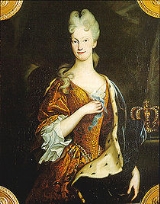
Elisabeth of Parma

Encyclopedia
Elisabeth Farnese the daughter of Odoardo Farnese and Dorothea Sophie of Neuburg, was Queen consort of Spain who exerted great influence over Spain's foreign policy.
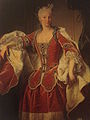 Elisabeth was born at the Palazzo della Pilotta
in Parma
, the capital of a duchy which had been ruled by her family for over two centuries. Elisabeth would later become the heiress of her father's dominions after her uncle Francesco Farnese, Duke of Parma
and his younger brother, both of whom remained childless. Victor Amadeus, Prince of Piedmont
and Francesco d'Este, Hereditary Prince of Modena had asked for her hand but negotiations failed.
The Duchy of Parma
would later be inherited by her first son Infante Carlos
, and after his accession to the Spanish throne the title passed on to her third son Infante Felipe
. It was he who founded the modern day House of Bourbon-Parma
.
Her mother educated her in strict seclusion, but even this measure failed to tame her imperious and ambitious temper. At the age of twenty-one (24 December 1714) she was married by proxy at Parma
to Philip V of Spain
. The marriage was arranged by Cardinal Alberoni
, with the concurrence of the Princesse des Ursins
, the Camarera mayor de Palacio
of the King of Spain.
and Sicily
. So vigorously did she enter into this policy that, when the French forces advanced to the Pyrenees
, she placed herself at the head of one division of the Spanish army.
But Elizabeth's ambition was grievously disappointed. The Triple Alliance
thwarted her plans with British troops raiding Vigo
, and at length in 1720 the allies made the banishment of Alberoni a condition of peace. Sicily also had to be evacuated and finally all her entreaties failed to prevent the abdication of Philip, who in 1724 gave up the throne in favour of his firstborn heir (from his first marriage), and retired to the palace of La Granja
. (Also in 1724, she acquired the San Ildefonso Group
for him from the Odescalchi family.)
Seven months later, however, the death of the young king recalled Philip to the throne. During his later years, when he was nearly senile, she directed the whole policy of Spain so as to secure thrones in Italy for her sons. In 1731 she had the satisfaction of seeing her favorite scheme realized with the recognition by the powers in the Treaty of Vienna
of her son Don Carlos (afterwards Charles III of Spain
) as the Duke of Parma, and after the Treaty of Vienna (1738)
his accession to the throne of the Two Sicilies. Her second son, Philip
, became Duke of Parma in 1748.
In Elisabeth's time, Spain was a leading power in the world with a large empire stretching from its hub in Europe to much of the Americas.
and Barbara of Portugal
, whom she hated; and the accession to the throne of Parma of her beloved second son, Philip
. In 1752 she built Riofrio Palace
as her dowager residence. One year before her death she had the satisfaction of seeing the marriage between her grandson, Charles
, Prince of Asturias (future Charles IV), and her granddaugther Maria Luisa of Parma
.
She later spent much of her time at the palaces of La Granja
and Aranjuez. It was there that she died in 1766 at the age of 73. She was buried next to her husband in the Colegiata of San Ildefonso.
{| class="toccolours collapsible collapsed" width=100% align="center"
|-
! style="background:#ccccff;"|Family of Elisabeth in 1723
|-
|
{| class="toccolours collapsible collapsed" width=100% align="center"
|-
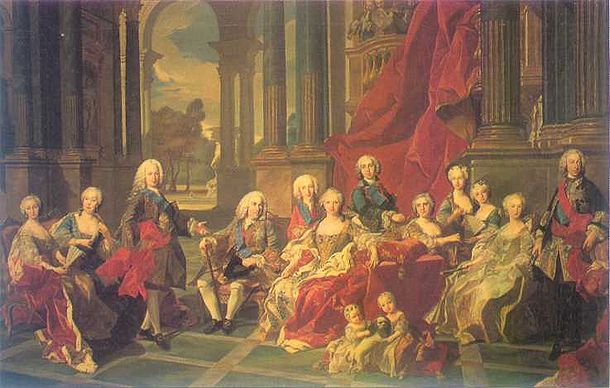
! style="background:#ccccff;"|Family of Elisabeth of Parma in 1743
|-
|
! width=20% | Name !! width=100px | Portrait !! Lifespan !! Notes !!
|-
| Charles
Duke of Parma
King of Naples and Sicily
King of Spain
||
||20 January 1716 –
14 December 1788
|| was the King of Spain and the Spanish Indes from 1759 to his death in 1788. In 1738 he married the cultured Princess Maria Amalia of Saxony
with whom he had 13 children;
|-
| Infante Francisco
||
|| 21 March 1717 –
21 April 1717
|| died in infancy
|-
| Infanta Mariana Victoria
Queen of Portugal
||
|| 31 March 1718 –
15 January 1781
|| ; was Queen Consort
of Portugal and the Algarves due to her marriage to Joseph I. She also acted as Queen Regent of Portugal.
|-
| Philip
Duke of Parma
||
|| 20 March 1720 –
18 July 1765
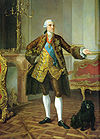
|| Duke of Parma, Plasencia and Guastalla (15 March 1720 – 18 July 1765) was duke of Parma from 1748 to 1765. He founded the house of Bourbon-Parma (a.k.a the Bourbons of Parma); married Princess Louise Élisabeth of France
and had issue.
|-
| Infanta Maria Teresa Antonia Rafaela
Dauphine of France
||
|| 11 June 1726 –
22 July 1746
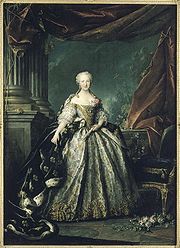
|| was Dauphine of France as spouse of Louis, Dauphin of France. In France, she was known simply as Madame la Dauphine.
|-
| Infante Luis Antonio Jaime
Count of Chinchón
||
|| 25 July 1727 –
7 August 1785
|| known as the Cardinal-Infante. Was Archbishop of Toledo, Primate of Spain and Cardinal
since 1735. In 1754 renounced his ecclesiastical titles and became Count of Chinchón. In 1776, he married morganatically Doña María Teresa de Vallabriga y Rozas and had issue, but without royal titles.
|-
| Infanta Maria Antonia Ferdinanda
Queen of Sardinia
||
|| 17 November 1729 –
19 September 1785
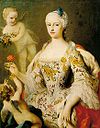
|| was Queen of Sardinia as the wife of King Victor Amadeus III of Sardinia
. She was a mother of 3 rulers of Sardinia.
|}
Parma
Palazzo della Pilotta
The Palazzo della Pilotta is a complex of edifices in the historical centre of Parma, in northern Italy. Its name derives from the game of pelota.-History:...
in Parma
Parma
Parma is a city in the Italian region of Emilia-Romagna famous for its ham, its cheese, its architecture and the fine countryside around it. This is the home of the University of Parma, one of the oldest universities in the world....
, the capital of a duchy which had been ruled by her family for over two centuries. Elisabeth would later become the heiress of her father's dominions after her uncle Francesco Farnese, Duke of Parma
Francesco Farnese, Duke of Parma
Francesco Farnese reigned as the seventh and penultimate Farnese Duke of Parma and Piacenza from 1694 until his death...
and his younger brother, both of whom remained childless. Victor Amadeus, Prince of Piedmont
Victor Amadeus, Prince of Piedmont
Victor Amadeus of Savoy was the eldest son of Victor Amadeus II, Duke of Savoy and his French wife Anne Marie d'Orléans. He was the Heir apparent of Savoy from his birth and as such was styled as the Prince of Piedmont. He acted as Regent of Savoy from September 1713 till September 1714 in the...
and Francesco d'Este, Hereditary Prince of Modena had asked for her hand but negotiations failed.
The Duchy of Parma
Duchy of Parma
The Duchy of Parma was created in 1545 from that part of the Duchy of Milan south of the Po River, as a fief for Pope Paul III's illegitimate son, Pier Luigi Farnese, centered on the city of Parma....
would later be inherited by her first son Infante Carlos
Charles III of Spain
Charles III was the King of Spain and the Spanish Indies from 1759 to 1788. He was the eldest son of Philip V of Spain and his second wife, the Princess Elisabeth Farnese...
, and after his accession to the Spanish throne the title passed on to her third son Infante Felipe
Philip, Duke of Parma
Philip of Spain was Duke of Parma from 1748 to 1765. He founded the House of Bourbon-Parma , a cadet line of the Spanish branch of the dynasty...
. It was he who founded the modern day House of Bourbon-Parma
House of Bourbon-Parma
The House of Bourbon-Parma is an Italian cadet branch of the House of Bourbon. It is thus descended from the Capetian dynasty in male line. The name of Bourbon-Parma comes from the main name and the other from the title of Duke of Parma....
.
Her mother educated her in strict seclusion, but even this measure failed to tame her imperious and ambitious temper. At the age of twenty-one (24 December 1714) she was married by proxy at Parma
Parma
Parma is a city in the Italian region of Emilia-Romagna famous for its ham, its cheese, its architecture and the fine countryside around it. This is the home of the University of Parma, one of the oldest universities in the world....
to Philip V of Spain
Philip V of Spain
Philip V was King of Spain from 15 November 1700 to 15 January 1724, when he abdicated in favor of his son Louis, and from 6 September 1724, when he assumed the throne again upon his son's death, to his death.Before his reign, Philip occupied an exalted place in the royal family of France as a...
. The marriage was arranged by Cardinal Alberoni
Giulio Alberoni
Giulio Alberoni was an Italian cardinal andstatesman in the service of Philip V of Spain.-Early years:He was born near Piacenza, probably at the village of Fiorenzuola d'Arda in the Duchy of Parma....
, with the concurrence of the Princesse des Ursins
Marie-Anne de la Trémoille, princesse des Ursins
Marie Anne de La Trémoille, princesse des Ursins , lady of the Spanish court, was the daughter of the duc de Noirmoutier and his wife Renée Julie Aubri...
, the Camarera mayor de Palacio
Camarera mayor de Palacio
The Camarera mayor de Palacio was the Official of the Royal Household and Heritage of the Crown of Spain, who was in charge of the person and the rooms of the Queen of Spain....
of the King of Spain.
Spain
On arriving at the Spanish border, Elizabeth was met by the Princesse des Ursins, but received her sternly, and, perhaps in accordance with a plan previously concerted with the king, at once ordered her removal from her presence and from Spain. Elizabeth quickly obtained complete influence over Philip V, who was considered by all means a weak king. This influence was exerted altogether in support of Alberoni's policy, one chief aim of which was to recover the ancient Italian possessions of Spain, and which actually resulted in the seizure of SardiniaSardinia
Sardinia is the second-largest island in the Mediterranean Sea . It is an autonomous region of Italy, and the nearest land masses are the French island of Corsica, the Italian Peninsula, Sicily, Tunisia and the Spanish Balearic Islands.The name Sardinia is from the pre-Roman noun *sard[],...
and Sicily
Sicily
Sicily is a region of Italy, and is the largest island in the Mediterranean Sea. Along with the surrounding minor islands, it constitutes an autonomous region of Italy, the Regione Autonoma Siciliana Sicily has a rich and unique culture, especially with regard to the arts, music, literature,...
. So vigorously did she enter into this policy that, when the French forces advanced to the Pyrenees
Pyrenees
The Pyrenees is a range of mountains in southwest Europe that forms a natural border between France and Spain...
, she placed herself at the head of one division of the Spanish army.
But Elizabeth's ambition was grievously disappointed. The Triple Alliance
Triple Alliance (1717)
The Triple Alliance was a treaty between the Dutch Republic, France and Great Britain, against Spain, attempting to maintain the agreement of the 1713 Treaty of Utrecht. The three states were concerned about Spain becoming a superpower in Europe. As a result of this militarisation took place,...
thwarted her plans with British troops raiding Vigo
Capture of Vigo
The Capture of Vigo occurred in 1719 during the War of the Quadruple Alliance when a British expedition landed on the Spanish coast and seized the settlement of Vigo which they occupied for ten days before withdrawing...
, and at length in 1720 the allies made the banishment of Alberoni a condition of peace. Sicily also had to be evacuated and finally all her entreaties failed to prevent the abdication of Philip, who in 1724 gave up the throne in favour of his firstborn heir (from his first marriage), and retired to the palace of La Granja
La Granja
La Granja may refer to:*Royal Palace of La Granja de San Ildefonso in Spain*La Granja de San Ildefonso, the town connected to it*La Granja, Chile*La Granja , a Chilean reality television show...
. (Also in 1724, she acquired the San Ildefonso Group
Castor and Pollux (Prado)
The Castor and Pollux group is an ancient Roman sculptural group of the 1st century AD, now in the Museo del Prado, Madrid.Drawing on 5th- and 4th-century BC Greek sculptures in the Praxitelean tradition, such as the Apollo...
for him from the Odescalchi family.)
Seven months later, however, the death of the young king recalled Philip to the throne. During his later years, when he was nearly senile, she directed the whole policy of Spain so as to secure thrones in Italy for her sons. In 1731 she had the satisfaction of seeing her favorite scheme realized with the recognition by the powers in the Treaty of Vienna
Treaty of Vienna (1731)
The Treaty of Vienna was first signed on 16 March 1731 by Count Finzendorf and the Earl of Chesterfield. This treaty marked the collapse of the Anglo-French Alliance , the beginning of the Anglo-Austrian Alliance and the birth of the legend of the natural enmity between the Kingdom of France and...
of her son Don Carlos (afterwards Charles III of Spain
Charles III of Spain
Charles III was the King of Spain and the Spanish Indies from 1759 to 1788. He was the eldest son of Philip V of Spain and his second wife, the Princess Elisabeth Farnese...
) as the Duke of Parma, and after the Treaty of Vienna (1738)
Treaty of Vienna (1738)
The Treaty of Vienna or Peace of Vienna was signed on November 18, 1738. It ended the War of the Polish Succession. By the terms of the treaty, Stanisław Leszczyński renounced his claim on the Polish throne and recognized Augustus III, Duke of Saxony. As compensation he received instead the...
his accession to the throne of the Two Sicilies. Her second son, Philip
Philip, Duke of Parma
Philip of Spain was Duke of Parma from 1748 to 1765. He founded the House of Bourbon-Parma , a cadet line of the Spanish branch of the dynasty...
, became Duke of Parma in 1748.
In Elisabeth's time, Spain was a leading power in the world with a large empire stretching from its hub in Europe to much of the Americas.
Widowhood
Elizabeth survived her husband by twenty years. In the time between his death in 1746 and her own in 1766, she witnessed many events: the accession to the Spanish throne of her stepson, Ferdinand VIFerdinand VI of Spain
Ferdinand VI , called the Learnt, was King of Spain from 9 July 1746 until his death. He was the fourth son of the previous monarch Philip V and his first wife Maria Luisa of Savoy...
and Barbara of Portugal
Barbara of Portugal
Barbara of Portugal was an Infanta of Portugal and later Queen of Spain as wife of Ferdinand VI of Spain.-Life in Portugal:...
, whom she hated; and the accession to the throne of Parma of her beloved second son, Philip
Philip, Duke of Parma
Philip of Spain was Duke of Parma from 1748 to 1765. He founded the House of Bourbon-Parma , a cadet line of the Spanish branch of the dynasty...
. In 1752 she built Riofrio Palace
Palacio Real de Riofrío
The Royal Palace of Riofrío is one of the residences of the Spanish Royal Family and under the management of the Patrimonio Nacional, a government initiative dedicated to the care and maintenance of properties owned by the Spanish state which are used by the royals...
as her dowager residence. One year before her death she had the satisfaction of seeing the marriage between her grandson, Charles
Charles IV of Spain
Charles IV was King of Spain from 14 December 1788 until his abdication on 19 March 1808.-Early life:...
, Prince of Asturias (future Charles IV), and her granddaugther Maria Luisa of Parma
Maria Luisa of Parma
Maria Luisa of Parma was Queen consort of Spain from 1788 to 1808 as the wife of King Charles IV of Spain. She was the youngest daughter of Duke Philip of Parma and his wife, Louise-Élisabeth of France, the eldest daughter of King Louis XV.She was christened Luisa Maria Teresa Ana, but was known...
.
She later spent much of her time at the palaces of La Granja
La Granja (palace)
The Royal Palace of La Granja de San Ildefonso is an 18th century palace in the small town of San Ildefonso in the hills near Segovia, 80 km north of Madrid, central Spain, formerly the summer residence of the Kings of Spain since the reign of Philip V...
and Aranjuez. It was there that she died in 1766 at the age of 73. She was buried next to her husband in the Colegiata of San Ildefonso.
{| class="toccolours collapsible collapsed" width=100% align="center"
|-
! style="background:#ccccff;"|Family of Elisabeth in 1723
|-
|
{| class="toccolours collapsible collapsed" width=100% align="center"
|-
! style="background:#ccccff;"|Family of Elisabeth of Parma in 1743
|-
|
Issue
{| style="text-align:center; width:100%" class="wikitable"! width=20% | Name !! width=100px | Portrait !! Lifespan !! Notes !!
|-
| Charles
Charles III of Spain
Charles III was the King of Spain and the Spanish Indies from 1759 to 1788. He was the eldest son of Philip V of Spain and his second wife, the Princess Elisabeth Farnese...
Duke of Parma
King of Naples and Sicily
King of Spain
||
||20 January 1716 –
14 December 1788
|| was the King of Spain and the Spanish Indes from 1759 to his death in 1788. In 1738 he married the cultured Princess Maria Amalia of Saxony
Maria Amalia of Saxony
Maria Amalia of Saxony was a German princess from the House of Wettin and was the wife of Charles III of Spain; she was the Queen consort of Naples and Sicily from 1738 till 1759 and then Queen consort of Spain from 1759 until her death in 1760...
with whom he had 13 children;
|-
| Infante Francisco
||
|| 21 March 1717 –
21 April 1717
|| died in infancy
|-
| Infanta Mariana Victoria
Mariana Victoria of Spain
Mariana Victoria of Spain was an Infanta of Spain and Queen consort of Portugal as wife of King Joseph I. The mother of Queen Maria I of Portugal, she also acted as Regent of Portugal during the last months of her husband's life and advisor to her daughter during her reign.-Background:Mariana...
Queen of Portugal
||
|| 31 March 1718 –
15 January 1781
|| ; was Queen Consort
Queen consort
A queen consort is the wife of a reigning king. A queen consort usually shares her husband's rank and holds the feminine equivalent of the king's monarchical titles. Historically, queens consort do not share the king regnant's political and military powers. Most queens in history were queens consort...
of Portugal and the Algarves due to her marriage to Joseph I. She also acted as Queen Regent of Portugal.
|-
| Philip
Philip, Duke of Parma
Philip of Spain was Duke of Parma from 1748 to 1765. He founded the House of Bourbon-Parma , a cadet line of the Spanish branch of the dynasty...
Duke of Parma
Parma
Parma is a city in the Italian region of Emilia-Romagna famous for its ham, its cheese, its architecture and the fine countryside around it. This is the home of the University of Parma, one of the oldest universities in the world....
||
|| 20 March 1720 –
18 July 1765
|| Duke of Parma, Plasencia and Guastalla (15 March 1720 – 18 July 1765) was duke of Parma from 1748 to 1765. He founded the house of Bourbon-Parma (a.k.a the Bourbons of Parma); married Princess Louise Élisabeth of France
Princess Louise Élisabeth of France
Louise Élisabeth de France was the eldest daughter of King Louis XV of France and his Queen consort, Maria Leszczyńska, and the elder twin sister of Anne Henriette de France. As the daughter of the king, she was a Daughter of France...
and had issue.
|-
| Infanta Maria Teresa Antonia Rafaela
Dauphine of France
||
|| 11 June 1726 –
22 July 1746
|| was Dauphine of France as spouse of Louis, Dauphin of France. In France, she was known simply as Madame la Dauphine.
|-
| Infante Luis Antonio Jaime
Luis de Borbón y Farnesio, 13th Count of Chinchón
Luis Antonio Jaime of Spain , Infante of Spain, Cardinal Deacon of the titular church of Santa Maria della Scala in Rome, Archbishop of Toledo and Primate of Spain and 13th Conde de Chinchón, Grandee of Spain First Class, known as the Cardinal-Infante, was a son of Philip V, King of Spain and his...
Count of Chinchón
Count of Chinchón
The Spanish noble title Count of Chinchón was initially created by Charles I of Spain on 9 May 1520, granting the title to Fernando de Cabrera y Bobadilla...
||
|| 25 July 1727 –
7 August 1785
|| known as the Cardinal-Infante. Was Archbishop of Toledo, Primate of Spain and Cardinal
Cardinal (Catholicism)
A cardinal is a senior ecclesiastical official, usually an ordained bishop, and ecclesiastical prince of the Catholic Church. They are collectively known as the College of Cardinals, which as a body elects a new pope. The duties of the cardinals include attending the meetings of the College and...
since 1735. In 1754 renounced his ecclesiastical titles and became Count of Chinchón. In 1776, he married morganatically Doña María Teresa de Vallabriga y Rozas and had issue, but without royal titles.
|-
| Infanta Maria Antonia Ferdinanda
Queen of Sardinia
||
|| 17 November 1729 –
19 September 1785
|| was Queen of Sardinia as the wife of King Victor Amadeus III of Sardinia
Victor Amadeus III of Sardinia
Victor Amadeus III was King of Sardinia from 1773 until his death. Although he was politically conservative, he carried out numerous administrative reforms until declaring war on revolutionary France in 1792...
. She was a mother of 3 rulers of Sardinia.
|}
Ancestry
Sources
- Petrie, Charles: King Charles III of Spain New York, John Day Company, 1971
- Harcourt-Smith, Simon: Cardinal of Spain: the Life and Strange Career of Giulio AlberoniGiulio AlberoniGiulio Alberoni was an Italian cardinal andstatesman in the service of Philip V of Spain.-Early years:He was born near Piacenza, probably at the village of Fiorenzuola d'Arda in the Duchy of Parma....
New York, Knopf, 1955 - Mémoires pour servir à l'histoire d'Espagne sous le régne de Philippe V by the Marquis de St Philippe, translated by Maudave (Paris, 1756)
- Memoirs of Elizabeth Farnese (London, 1746)
- Armstrong, E: Elizabeth Farnese, the TermagantTermagantIn Medieval Europe, Termagant was the name given to a god that the Europeans believed Muslims worshipped.-Origin of the concept:European literature from the Middle Ages often referred to Muslims as pagans, with sobriquets such as the paynim foe...
of Spain, 1892 - The Spanish original of the Comentarios del marqués de San Felipe was published in the Biblioteca de Autores Españoles.