

Ee ja nai ka

Encyclopedia
Japan
Japan is an island nation in East Asia. Located in the Pacific Ocean, it lies to the east of the Sea of Japan, China, North Korea, South Korea and Russia, stretching from the Sea of Okhotsk in the north to the East China Sea and Taiwan in the south...
from June 1867 to May 1868, at the end of the Edo period
Edo period
The , or , is a division of Japanese history which was ruled by the shoguns of the Tokugawa family, running from 1603 to 1868. The political entity of this period was the Tokugawa shogunate....
and the start of the Meiji restoration
Meiji Restoration
The , also known as the Meiji Ishin, Revolution, Reform or Renewal, was a chain of events that restored imperial rule to Japan in 1868...
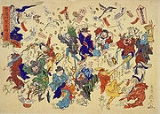
. In West Japan, it appeared at first in the form of dancing festival
Festival
A festival or gala is an event, usually and ordinarily staged by a local community, which centers on and celebrates some unique aspect of that community and the Festival....
s, often related to public works, rain magic, or dances for the dead. When sacred amulets were said to have fallen from heaven
Heaven
Heaven, the Heavens or Seven Heavens, is a common religious cosmological or metaphysical term for the physical or transcendent place from which heavenly beings originate, are enthroned or inhabit...
, thanksgiving celebrations for these amulets were added that could last for several days and effectively took whole rural and urban communities away from everyday life. Gifts were exchanged, youth groups organized mass dancing including crossdressing or wearing costumes. To express their gratitude towards the gods or buddhas who had given them the amulet
Amulet
An amulet, similar to a talisman , is any object intended to bring good luck or protection to its owner.Potential amulets include gems, especially engraved gems, statues, coins, drawings, pendants, rings, plants and animals; even words said in certain occasions—for example: vade retro satana—, to...
s, many people went on pilgrimages to local or regional sanctuaries. The term ee ja nai ka ("Isn't it great?") was a refrain in popular songs performed during these activities and was therefore later chosen as their title.
The great diversity and rivalry of religious practice in premodern Japan was the main driving force behind these events. It has been suggested that religious activists, such as priest
Priest
A priest is a person authorized to perform the sacred rites of a religion, especially as a mediatory agent between humans and deities. They also have the authority or power to administer religious rites; in particular, rites of sacrifice to, and propitiation of, a deity or deities...
s and itinerant preacher
Preacher
Preacher is a term for someone who preaches sermons or gives homilies. A preacher is distinct from a theologian by focusing on the communication rather than the development of doctrine. Others see preaching and theology as being intertwined...
s, played a major role in fabricating the "amulet showers," and some suspects were even caught in action by alert officers. Youth interested in celebrating parties, or in becoming spiritual leaders, were also suspected and in some cases convicted.
Ee ja nai ka was not linked to any political agenda; it must not be confused with popular protest or riots. It was not uncommon, however, to express deep concern for the ongoing process of political destabilization that shook Japan at the same time and ultimately led to the downfall of the Tokugawa shogunate
Tokugawa shogunate
The Tokugawa shogunate, also known as the and the , was a feudal regime of Japan established by Tokugawa Ieyasu and ruled by the shoguns of the Tokugawa family. This period is known as the Edo period and gets its name from the capital city, Edo, which is now called Tokyo, after the name was...
. Disgust at Western and Christian
Christian
A Christian is a person who adheres to Christianity, an Abrahamic, monotheistic religion based on the life and teachings of Jesus of Nazareth as recorded in the Canonical gospels and the letters of the New Testament...
foreigners, disappointment regarding the lack of political leadership and other signs of awakening national consciousness were frequently displayed. There is, however, no evidence for any political setup or staging of Ee ja nai ka, although this was also rumoured. Political authorities, whether they supported or opposed the ruling Tokugawa shogunate
Tokugawa shogunate
The Tokugawa shogunate, also known as the and the , was a feudal regime of Japan established by Tokugawa Ieyasu and ruled by the shoguns of the Tokugawa family. This period is known as the Edo period and gets its name from the capital city, Edo, which is now called Tokyo, after the name was...
, tried various strategies to contain the movement and to restore everyday order, but they never regarded it as a political threat.
In 1981, Japanese director Shohei Imamura
Shohei Imamura
was a Japanese film director. Imamura was the first Japanese director to win two Palme d'Or awards.His eldest son Daisuke Tengan is also a script writer and film director, and worked on the screenplays to Imamura's filmsThe Eel , Dr...
produced his film
Eijanaika
Eijanaika (film)
is a 1981 Japanese film by director Shohei Imamura. It was screened in the Un Certain Regard section at the 1981 Cannes Film Festival.-Cast:* Kaori Momoi - Ine* Shigeru Izumiya - Genji* Ken Ogata - Furukawa* Shigeru Tsuyuguchi - Kinzo* Masao Kusakari - Itoman...
which gives a deliberately historically incorrect interpretation of the events but nevertheless catches the unstable and tense atmosphere of the age.
Imamura had previously helped write the 1957 Yuzo Kawashima
Yuzo Kawashima
was a notable Japanese filmmaker, most famous for making tragi-comic films and satires.-Career:Kawashima was born in Mutsu, Aomori in the Shimokita Peninsula. From his youth, he suffered from a paralysis that affected his right leg and arm. He was educated at Meiji University, where he was a member...
film on the period, . This era was also depicted in the 1969 Kihachi Okamoto
Kihachi Okamoto
was a Japanese film director who has worked in several different genres, including jidaigeki.-Career:Born in Yonago, Okamoto attended Meiji University, but was drafted in 1943 and entered World War II during its most difficult hours, an experience that had a profound effect on his later film work,...
-directed Toshirō Mifune
Toshiro Mifune
Toshirō Mifune was a Japanese actor who appeared in almost 170 feature films. He is best known for his 16-film collaboration with filmmaker Akira Kurosawa, from 1948 to 1965, in works such as Rashomon, Seven Samurai, Throne of Blood, and Yojimbo...
film, .