

Dunnite

Encyclopedia
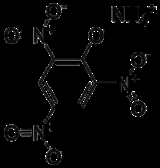
Dunnite, also known as Explosive D or systematically as ammonium picrate, is an explosive developed by Major Dunn in 1906. Ammonium picrate is a salt formed by reacting picric acid
and ammonia
.
It may be noted as the first explosive used in an aerial bombing operation in military history, performed by Italian pilots in Libya
in 1911.,La Stampa
, November 2, 1911.
It was used extensively by the United States Navy
during World War I
.
Though Dunnite was generally considered an insensitive substance, by 1911 the United States Army
had abandoned its use in favor of other alternatives. The Navy
, however, used it in armor-piercing artillery shells
and projectiles, and in coastal defense.
Dunnite typically did not detonate on striking heavy armor. Rather, the shell encasing it would penetrate the armor, after which the charge would be triggered by a fuse .
In 2008 caches of discarded Dunnite in remote locations were mistaken for rusty rocks at Cape Porcupine, Newfoundland and Labrador
, Canada.
Picric acid
Picric acid is the chemical compound formally called 2,4,6-trinitrophenol . This yellow crystalline solid is one of the most acidic phenols. Like other highly nitrated compounds such as TNT, picric acid is an explosive...
and ammonia
Ammonia
Ammonia is a compound of nitrogen and hydrogen with the formula . It is a colourless gas with a characteristic pungent odour. Ammonia contributes significantly to the nutritional needs of terrestrial organisms by serving as a precursor to food and fertilizers. Ammonia, either directly or...
.
It may be noted as the first explosive used in an aerial bombing operation in military history, performed by Italian pilots in Libya
Libya
Libya is an African country in the Maghreb region of North Africa bordered by the Mediterranean Sea to the north, Egypt to the east, Sudan to the southeast, Chad and Niger to the south, and Algeria and Tunisia to the west....
in 1911.,La Stampa
La Stampa
La Stampa is one of the best-known, most influential and most widely sold Italian daily newspapers. Published in Turin, it is distributed in Italy and other European nations. The current owner is the Fiat Group.-History:...
, November 2, 1911.
It was used extensively by the United States Navy
United States Navy
The United States Navy is the naval warfare service branch of the United States Armed Forces and one of the seven uniformed services of the United States. The U.S. Navy is the largest in the world; its battle fleet tonnage is greater than that of the next 13 largest navies combined. The U.S...
during World War I
World War I
World War I , which was predominantly called the World War or the Great War from its occurrence until 1939, and the First World War or World War I thereafter, was a major war centred in Europe that began on 28 July 1914 and lasted until 11 November 1918...
.
Though Dunnite was generally considered an insensitive substance, by 1911 the United States Army
United States Army
The United States Army is the main branch of the United States Armed Forces responsible for land-based military operations. It is the largest and oldest established branch of the U.S. military, and is one of seven U.S. uniformed services...
had abandoned its use in favor of other alternatives. The Navy
United States Navy
The United States Navy is the naval warfare service branch of the United States Armed Forces and one of the seven uniformed services of the United States. The U.S. Navy is the largest in the world; its battle fleet tonnage is greater than that of the next 13 largest navies combined. The U.S...
, however, used it in armor-piercing artillery shells
Armor-piercing shot and shell
An armor-piercing shell is a type of ammunition designed to penetrate armor. From the 1860s to 1950s, a major application of armor-piercing projectiles was to defeat the thick armor carried on many warships. From the 1920s onwards, armor-piercing weapons were required for anti-tank missions...
and projectiles, and in coastal defense.
Dunnite typically did not detonate on striking heavy armor. Rather, the shell encasing it would penetrate the armor, after which the charge would be triggered by a fuse .
In 2008 caches of discarded Dunnite in remote locations were mistaken for rusty rocks at Cape Porcupine, Newfoundland and Labrador
Newfoundland and Labrador
Newfoundland and Labrador is the easternmost province of Canada. Situated in the country's Atlantic region, it incorporates the island of Newfoundland and mainland Labrador with a combined area of . As of April 2011, the province's estimated population is 508,400...
, Canada.