


Disting

Encyclopedia
Uppsala
- Economy :Today Uppsala is well established in medical research and recognized for its leading position in biotechnology.*Abbott Medical Optics *GE Healthcare*Pfizer *Phadia, an offshoot of Pharmacia*Fresenius*Q-Med...
, Sweden
Sweden
Sweden , officially the Kingdom of Sweden , is a Nordic country on the Scandinavian Peninsula in Northern Europe. Sweden borders with Norway and Finland and is connected to Denmark by a bridge-tunnel across the Öresund....
, since pre-historic times. The name (Old Swedish
Old Swedish
Old Swedish is the name for two separate stages of the Swedish language that were spoken in the Middle Ages: Early Old Swedish , spoken from around 1225 until 1375, and Late Old Swedish , spoken from 1375 until 1526.Old Swedish developed from Old East Norse, the eastern dialect of Old Norse...
: Disæþing or Disaþing) originally referred to the great assembly called the Thing of all Swedes
Thing of all Swedes
The Thing of all Swedes was the governing assembly held from pre-historic times to the Middle Ages at Gamla Uppsala, Sweden, occurring at the end of February or early March in conjunction with a great fair and a pagan celebration called Dísablót...
, and it is derived from the fact that both the market and the thing
Thing (assembly)
A thing was the governing assembly in Germanic and introduced into some Celtic societies, made up of the free people of the community and presided by lawspeakers, meeting in a place called a thingstead...
were held in conjunction with the Dísablót
Dísablót
The Dísablót was the blót which was held in honour of the female spirits or deities called dísir , from pre-historic times until Christianization in Scandinavia. Its purpose was to enhance the coming harvest. It is mentioned in Hervarar saga, Víga-Glúms saga, Egils saga and the Heimskringla...
, the great blót
Blót
The blót was Norse pagan sacrifice to the Norse gods and the spirits of the land. The sacrifice often took the form of a sacramental meal or feast. Related religious practices were performed by other Germanic peoples, such as the pagan Anglo-Saxons...
s (sacrifices) for female powers called dís
Dis
- Academic institutions :* DIS – Danish Institute for Study Abroad, an English language study abroad program located in Copenhagen, Denmark* Dili International School, DIS an International School in Dili, Timor Leste - Companies :...
ir (they include the Norns and the Valkyrie
Valkyrie
In Norse mythology, a valkyrie is one of a host of female figures who decides who dies in battle. Selecting among half of those who die in battle , the valkyries bring their chosen to the afterlife hall of the slain, Valhalla, ruled over by the god Odin...
s) at the Temple at Uppsala
Temple at Uppsala
The Temple at Uppsala was a religious center in Norse paganism once located at what is now Gamla Uppsala , Sweden attested in Adam of Bremen's 11th century work Gesta Hammaburgensis ecclesiae pontificum and in Heimskringla, written by Snorri Sturluson in the 13th century...
. They were all originally held at the end of February or in early March.
The Iceland
Iceland
Iceland , described as the Republic of Iceland, is a Nordic and European island country in the North Atlantic Ocean, on the Mid-Atlantic Ridge. Iceland also refers to the main island of the country, which contains almost all the population and almost all the land area. The country has a population...
ic historian Snorri Sturluson
Snorri Sturluson
Snorri Sturluson was an Icelandic historian, poet, and politician. He was twice elected lawspeaker at the Icelandic parliament, the Althing...
, who was well-informed of Swedish matters and visited the country in 1219, explained in the Heimskringla
Heimskringla
Heimskringla is the best known of the Old Norse kings' sagas. It was written in Old Norse in Iceland by the poet and historian Snorri Sturluson ca. 1230...
(1225):
In Svithjod it was the old custom, as long as heathenism prevailed, that the chief sacrifice took place in Goe month at UpsalaGamla UppsalaGamla Uppsala is a parish and a village outside Uppsala in Sweden. It had 16,231 inhabitants in 1991.As early as the 3rd century AD and the 4th century AD and onwards, it was an important religious, economic and political centre...
. Then sacrifice was offered for peace, and victory to the king; and thither came people from all parts of Svithjod. All the Things of the Swedes, also, were held there, and markets, and meetings for buying, which continued for a week: and after Christianity was introduced into Svithjod, the Things and fairs were held there as before. After Christianity had taken root in Svithjod, and the kings would no longer dwell in Upsala, the market-time was moved to Candlemas, and it has since continued so, and it lasts only three days.
In 1611, the first play in the Swedish language named Disa
Disa
Disa is the heroine of a Swedish legendary saga, which was documented by Olaus Magnus, in 1555. It is believed to be from the Middle Ages, but includes Old Norse themes....
by Johannes Messenius
Johannes Messenius
Johannes Messenius was a Swedish historian, dramatist and university professor. He was born in the village of Freberga, in Stenby parish in Östergötland, and died in Oulu, in modern-day Finland.-Childhood:...
was enacted at the Disting showing a late medieval legend explaining the origins of the Disting, as the pagan origins had been forgotten. Instead of being held in honour of female powers, it was held in honour of a heroic girl who had prevailed on the king and the assembly to stop a great massacre of the weak and elderly to hinder overpopulation.
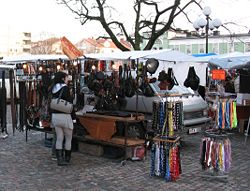
The market was officially abolished in 1895, but continued informally, and it still held in early February. It is one of the most traditional Swedish markets.