


Dissenting Gothic

Encyclopedia
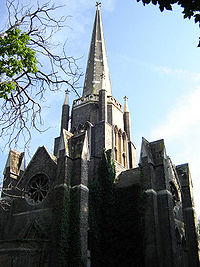
The style
In contrast to the pure copying of English mediaeval Gothic that was being advocated and promoted by some influential ecclesiologists during the early Gothic Revival period in Britain, most particularly by Augustus Welby Pugin and to an extent in the pages of the Camden Society'sCambridge Camden Society
The Cambridge Camden Society, later known as the Ecclesiological Society from 1845 when it moved to London, was a learned architectural society founded in 1839 by undergraduates at Cambridge University to promote "the study of Gothic Architecture, and of Ecclesiastical Antiques." Its activities...
quarterly journal (The Ecclesiologist, 1841-68), Dissenting Gothic provided a less Anglo-centric interpretation of the Gothic style, and purposefully introduced modernising elements to meet clients' needs.
In Dissenting Gothic the interests of good design could over-ride historical purity; the role of the architect was seen as originating a design solution, rather than promoting specific Gothic forms as a cause celebre in pursuit of an idealised high-church and mediaeval belief system.
Departing from the narrow confines of the approach adopted by some of the leading British ecclesiologists' during the early Gothic Revival period, architects who were willing to respond to the demand for Dissenting Gothic enlarged their portfolio, drawing on mainland European Gothic architecture as well as English forms . Moreover they could be more creative about relationship between form and function, seeking novel but appriopriate ways to introduce elements not found in mediaeval Gothic churches, so as to create interiors that met the particular congregational needs of the independent or nonconformist chapel-builders of the nineteenth century ; accommodate Sunday Schools and meeting rooms, with sometimes distorting effects on the physiognomy of the building; use confined city plots in efficient ways by varying from strict gothic floorplans and orientations; and experiment with a wide range of materials, and polychromatic designs, not found in mediaeval buildings.
The Early Gothic Revival Period
Although the earliest examples of Dissenting Gothic were commissioned by trustees of independent churches and chapels at about the same time as the beginnings of the purist AngloCatholic-dominated Gothic Revival movement - namely during the second quarter of the nineteenth century - the latter so profoundly dominated and led this early period of 'Gothic Revival' that there were relatively few examples in Britain or elsewhere of Dissenting Gothic before the third quarter of the nineteenth century.This limited use of Dissenting Gothic in the early Gothic Revival period of the second quarter of the nineteenth century, reflected a marked reluctance by trustees and sponsors of independently funded and managed churches or chapels (in Britain, commonly referred to as 'nonconformist' churches or chapels) to commission neo-Gothic whilst the ecclesiologists were portraying it as ‘high church’ architecture. Equally, there was a refusal by some 'Gothic Revival' architects to accept commissions for ‘low church’ buildings - nonconformist chapels and the like. For philosophical reasons, some architects in the early 'Gothic Revival' period considered that the style should remain the exclusive preserve of the ‘high church’.
The Later Gothic Revival Period
By the mid-nineteenth century these early controversies had weakened. In England, the case for commissioning neo-Gothic designs for nonconformist chapels was persuasively argued by the trained architect and Wesleyan Methodist minister, Frederick James JobsonFrederick James Jobson
Rev. Frederick James Jobson D.D. - commonly styled F. J. Jobson - painter, architect and Wesleyan Methodist minister, became President of the Methodist Conference in the late 1860s, and Treasurer of the "Wesleyan Methodist Foreign Mission Society" 1869–1882...
(commonly styled, F. J. Jobson), in his book Chapel and School Architecture (1850); and in America by the Rev. George Bowler's publication setting out examples of elevations and floorplans for nonconformist churches in the Gothic revival style .
By now it was becoming fashionable to adopt neo-Gothic for artistic reasons and intrinsic appeal alone, superseding its early associations with ‘high church’ buildings and their clients. Also, for more prosaic reasons, ‘'Dissenting Gothic'’ began to become commonplace from the mid-nineteenth century onwards; by this date the trustees of independent chapels could more easily afford the high building costs associated with the neo-Gothic style. For example, in Britain the 1851 census recorded, for the first time, a greater number of people attending independent chapels than Anglican churches; the higher level of philanthropic donations and membership fees this provided, could now become reflected in more costly building designs.
By the time the Gothic Revival had matured into a commonly accepted building style for all manner of building types (referred to as the "High Victorian Gothic" period (1855–85) in Britain), the influence of the ecclesiologists with their vision of neo-Gothic as befitting only high church buildings and favouring only pure 'English Gothic' forms with historically correct mediaeval detail, had passed by. This later 'Gothic Revival' period saw a willingness to innovate by many influential architects, reflecting the success of the less narrow approach of Dissenting Gothic. The architect James Cubitt
James Cubitt
James Cubitt was a Victorian church architect specialising in building non-conformist chapels. He was the son of a Baptist minister, from Norfolk who taught at Spurgeon's Pastor's College in South Norwood Hill — then on the outskirts of London.Cubitt was articled to the firm of Isaac Charles...
embodied such forward-looking principles in his book, Church Design for Congregations (1870), in which he noted the unsuitability of the conventional Gothic plan for nonconformist chapels, adding "there is every reason why our churches should be fitted for their destined use. It is not enough that they can be used...." His book gave further encouragement to looking at models besides traditional 'English Gothic', referring for example, to designs from Santa Sophia, Torcello, Gerona and Cologne.
Amongst these, northern European Brick Gothic
Brick Gothic
Brick Gothic is a specific style of Gothic architecture common in Northern Europe, especially in Northern Germany and the regions around the Baltic Sea that do not have natural rock resources. The buildings are essentially built from bricks...
was perhaps the best known alternative to English styles at that time; partly on account of its lower cost than stone blocks, but also its appeal to a section of nonconformist though to whom highly extravagant and ornamented building styles and monuments were either too vulgar, or associated with mediaeval superstition - Spurgeon
Charles Spurgeon
Charles Haddon Spurgeon was a large British Particular Baptist preacher who remains highly influential among Christians of different denominations, among whom he is still known as the "Prince of Preachers"...
cautioned against the Gothic fashion leading to "hobgoblins and monsters on the outside of their preaching houses".
In Australia Dissenting Gothic became known as "Victorian Free Gothic" and whilst the established Protestant Church followed its English counterpart in favouring "Academic Gothic", the independent or nonconformist denominations often chose Victorian Free Gothic. They more freely experimented with picturesque silhouettes and polychromatic surfaces; taking more from Ruskin's interest in 'impure' Gothic styles and the artistic merits of Gothic, than from Pugin's High Church and mediaevalist approach .
As the nineteenth century wore on, Dissenting Gothic became widespread not only as old chapels were rebuilt, but also amongst the new city suburbs that were being established in England and elsewhere. for example, as notes: "'Dissenting Gothic' was the style in Bowden, 'Manchester's most relaxed suburb'". Nonetheless its appeal amongst independents or nonconformists was not universal. The Baptists, quite unlike the Wesleyan Methodists and most notably the Unitarians, did not come to a generally accepted accommodation of the neo-Gothic style and indeed Spurgeon
Charles Spurgeon
Charles Haddon Spurgeon was a large British Particular Baptist preacher who remains highly influential among Christians of different denominations, among whom he is still known as the "Prince of Preachers"...
advanced the idea that the Grecan style
Neoclassical architecture
Neoclassical architecture was an architectural style produced by the neoclassical movement that began in the mid-18th century, manifested both in its details as a reaction against the Rococo style of naturalistic ornament, and in its architectural formulas as an outgrowth of some classicizing...
was most appropriate for church buildings because the New Testament was written in Greek. His London Metropolitan Tabernacle
Metropolitan Tabernacle
The Metropolitan Tabernacle is a large Reformed Baptist church in the Elephant and Castle in London. It was the largest non-conformist church edifice of its day in 1861. The Tabernacle Fellowship have been worshipping together since 1650, soon after the sailing of the Pilgrim Fathers...
of 1861 dramatically illustrated this alternative view .
Buildings of note
Fine examples of Dissenting Gothic include:- The Union ChapelUnion Chapel, IslingtonThe Union Chapel is a Grade II* listed church and music venue in Islington, North London, England, located on Compton Terrace.An example of Victorian gothic architecture, it was designed by James Cubitt, and constructed between 1874 and 1877, with further additions 1877-90, providing an ambitious...
, Highbury, London - by architect 'James Cubitt' (1877-9) - The Abney Park ChapelAbney Park ChapelAbney Park Chapel, is a Grade II Listed chapel, designed by William Hosking and built by John Jay that is situated in Europe's first wholly nondenominational cemetery, Abney Park Cemetery, London....
, Stoke Newington, London - by the architect William Hosking FSAWilliam HoskingWilliam Hosking FSA was a writer, lecturer, and architect who had an important influence on the growth and development of London in Victorian times...
and his client George CollisonGeorge CollisonGeorge Collison was an English Congregationalist and educator associated with Hackney Academy or Hackney College, which became part of New College London - itself part of the University of London.-Early life:...
(1838–40) - St.Paul's Presbyterian Church, St.James' Street, London - by the architect William Thomas (1854)
- The Unitarian Chapel/Welsh Baptist Chapel/Islamic AcademyUpper Brook Street Chapel, ManchesterThe Upper Brook Street Chapel, also known as the Islamic Academy, the Unitarian Chapel and the Welsh Baptist Chapel, is a former chapel with an attached Sunday School on the east side of Upper Brook Street, Chorlton-on-Medlock, Manchester, England. It is said to be the first neogothic Nonconformist...
, Upper Brook street, Manchester - by the architect Charles BarryCharles BarrySir Charles Barry FRS was an English architect, best known for his role in the rebuilding of the Palace of Westminster in London during the mid-19th century, but also responsible for numerous other buildings and gardens.- Background and training :Born on 23 May 1795 in Bridge Street, Westminster...
(1837-9) - Mill Hill Chapel, Leeds - by architects Bowman & Crowther (1847-8)
- The Unitarian Chapel, Gee Cross, Hyde, Cheshire - by architects 'Bowman & Crowther' (1846-8) - a commission refused by Pugin
- Cavendish Street Congregational Church, Manchester,by architect 'Edward Walters' (1847-8)
- Friar Lane Congregational Chapel, Nottingham (1828)
- St.Matthew's United ChurchSt. Matthew's United Church (Halifax)St. Matthew's United Church is a United Church of Canada church in downtown Halifax, Nova Scotia. The church was founded at the same time as the original colony in 1749 as a home for the various groups of dissenting Protestants who did not follow the Church of England. It originally met Sunday...
, Halifax, Nova Scotia (1857)
Further reading
- Cherry, Bridget [Ed](2007), Dissent and the Gothic Revival, Reading:The Chapels Society
- Jobson, F.J. (1850; reprinted 1991) Chapel and School Architecture, Peterborough:WHMS (Methodist Publishing House)
- Powell, Ken (1980) The Fall of Zion: Northern chapel architecture and its future, London:SAVE