
Diffusion of Innovations is a theory that seeks to explain how, why, and at what rate new
ideaIn the most narrow sense, an idea is just whatever is before the mind when one thinks. Very often, ideas are construed as representational images; i.e. images of some object. In other contexts, ideas are taken to be concepts, although abstract concepts do not necessarily appear as images...
s and
technologyTechnology is the making, usage, and knowledge of tools, machines, techniques, crafts, systems or methods of organization in order to solve a problem or perform a specific function. It can also refer to the collection of such tools, machinery, and procedures. The word technology comes ;...
spread through
cultureCulture is a term that has many different inter-related meanings. For example, in 1952, Alfred Kroeber and Clyde Kluckhohn compiled a list of 164 definitions of "culture" in Culture: A Critical Review of Concepts and Definitions...
s.
Everett RogersEverett M. Rogers was a communication scholar, sociologist, writer, and teacher. He is best known for originating the diffusion of innovations theory and for introducing the term early adopter....
, a professor of rural sociology, popularized the theory in his 1962 book
Diffusion of InnovationsDiffusion of Innovations is a theory that seeks to explain how, why, and at what rate new ideas and technology spread through cultures. Everett Rogers, a professor of rural sociology, popularized the theory in his 1962 book Diffusion of Innovations...
. He said diffusion is the process by which an innovation is communicated through certain channels over time among the members of a social system. The origins of the diffusion of innovations theory are varied and span multiple disciplines.
History
The concept was first studied by the French sociologist
Gabriel TardeJean-Gabriel De Tarde or Gabriel Tarde in short French sociologist, criminologist and social psychologist who conceived sociology as based on small psychological interactions among individuals , the fundamental forces being imitation and innovation.- Theory :Among the concepts...
(1890) and by German and Austrian anthropologists such as
Friedrich RatzelFriedrich Ratzel was a German geographer and ethnographer, notable for first using the term Lebensraum in the sense that the National Socialists later would.-Life:...
and
Leo FrobeniusLeo Viktor Frobenius was an ethnologist and archaeologist and a major figure in German ethnography.-Life:He was born in Berlin as the son of a Prussian officer and died in Biganzolo, Lago Maggiore, Piedmont, Italy...
. Its basic epidemiological or internal-influence form was formulated by H. Earl Pemberton, who provided examples of institutional diffusion such as postage stamps and compulsory school laws.
In 1962
Everett RogersEverett M. Rogers was a communication scholar, sociologist, writer, and teacher. He is best known for originating the diffusion of innovations theory and for introducing the term early adopter....
, a professor of rural sociology published
Diffusion of InnovationsDiffusion of Innovations is a theory that seeks to explain how, why, and at what rate new ideas and technology spread through cultures. Everett Rogers, a professor of rural sociology, popularized the theory in his 1962 book Diffusion of Innovations...
. In the book, Rogers synthesized research from over 508 diffusion studies and produced a theory for the adoption of innovations among individuals and organizations.
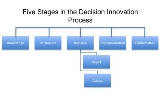
The book proposed 4 main elements that influence the spread of a new idea: the innovation, communication channels, time, and a social system. That is, diffusion is the process by which an innovation is communicated through certain channels over time among the members of a social system. Individuals progress through 5 stages: knowledge, persuasion, decision, implementation, and confirmation. If the innovation is adopted, it spreads via various communication channels. During communication, the idea is rarely evaluated from a scientific standpoint; rather, subjective perceptions of the innovation influence diffusion. The process occurs over time. Finally, social systems determine diffusion, norms on diffusion, roles of opinion leaders and change agents, types of innovation decisions, and innovation consequences. To use Rogers’ model in health requires us to assume that the innovation in classical diffusion theory is equivalent to scientific research findings in the context of practice, an assumption that has not been rigorously tested.
The origins of the diffusion of innovations theory are varied and span across multiple disciplines. Rogers identifies six main traditions that impacted diffusion research:
anthropologyAnthropology is the study of humanity. It has origins in the humanities, the natural sciences, and the social sciences. The term "anthropology" is from the Greek anthrōpos , "man", understood to mean mankind or humanity, and -logia , "discourse" or "study", and was first used in 1501 by German...
, early sociology,
rural sociologyRural sociology is a field of sociology associated with the study of social life in non-metropolitan areas. It is the scientific study of social arrangements and behaviour amongst people distanced from points of concentrated population or economic activity...
,
educationEducation in its broadest, general sense is the means through which the aims and habits of a group of people lives on from one generation to the next. Generally, it occurs through any experience that has a formative effect on the way one thinks, feels, or acts...
, industrial, and
medical sociologyMedical sociology is the sociological analysis of medical organizations and institutions; the production of knowledges and selection of methods, the actions and interactions of healthcare professionals, and the social or cultural effects of medical practice...
. The diffusion of innovation theory has been largely influenced by the work of rural sociologists.
Elements
The key elements in diffusion research are:
| Element |
Definition |
| Innovation |
Rogers defines an innovation as "an idea, practice, or object that is perceived as new by an individual or other unit of adoption". |
| Communication channels |
A communication channel is "the means by which messages get from one individual to another". |
| Time |
"The innovation-decision period is the length of time required to pass through the innovation-decision process". "Rate of adoption is the relative speed with which an innovation is adopted by members of a social system". |
| Social system |
"A social system is defined as a set of interrelated units that are engaged in joint problem solving to accomplish a common goal". |
Decisions
Two factors determine what type a particular decision is :
- Whether the decision is made freely and implemented voluntarily,
- Who makes the decision.
Based on these considerations, three types of innovation-decisions have been identified within diffusion of innovations.
| Type |
Definition |
| Optional Innovation-Decision |
This decision is made by an individual who is in some way distinguished from others in a social system. |
| Collective Innovation-Decision |
This decision is made collectively by all individuals of a social system. |
| Authority Innovation-Decision |
This decision is made for the entire social system by few individuals in positions of influence or power. |
Mechanism
Diffusion of an innovation occurs through a five–step process. This process is a type of decision-making. It occurs through a series of communication channels over a period of time among the members of a similar social system. Ryan and Gross first indicated the identification of adoption as a process in 1943 . Rogers categorizes the five stages (steps) as: awareness, interest, evaluation, trial, and adoption. An individual might reject an innovation at any time during or after the adoption process. In later editions of the Diffusion of Innovations Rogers changes the terminology of the five stages to: knowledge, persuasion, decision, implementation, and confirmation. However the descriptions of the categories have remained similar throughout the editions.

Five stages of the adoption process
| Stage |
Definition |
| Knowledge |
In this stage the individual is first exposed to an innovation but lacks information about the innovation. During this stage of the process the individual has not been inspired to find more information about the innovation. |
| Persuasion |
In this stage the individual is interested in the innovation and actively seeks information/detail about the innovation. |
| Decision |
In this stage the individual takes the concept of the change and weighs the advantages/disadvantages of using the innovation and decides whether to adopt or reject the innovation. Due to the individualistic nature of this stage Rogers notes that it is the most difficult stage to acquire empirical evidence . |
| Implementation |
In this stage the individual employs the innovation to a varying degree depending on the situation. During this stage the individual determines the usefulness of the innovation and may search for further information about it. |
| Confirmation |
Although the name of this stage may be misleading, in this stage the individual finalizes his/her decision to continue using the innovation and may use the innovation to its fullest potential. |
Rates of adoption
The rate of adoption is defined as the relative speed with which members of a social system adopt an innovation. It is usually measured by the length of time required for a certain percentage of the members of a social system to adopt an innovation . The rates of adoption for innovations are determined by an individual’s adopter category. In general, individuals who first adopt an innovation require a shorter adoption period (adoption process) than late adopters.
Within the rate of adoption there is a point at which an innovation reaches
critical massCritical mass is a sociodynamic term to describe the existence of sufficient momentum in a social system such that the momentum becomes self-sustaining and creates further growth....
. This is a point in time within the adoption curve that enough individuals have adopted an innovation in order that the continued adoption of the innovation is self-sustaining. In describing how an innovation reaches critical mass, Rogers outlines several strategies in order to help an innovation reach this stage. These strategies are: have an innovation adopted by a highly respected individual within a social network, creating an instinctive desire for a specific innovation. Inject an innovation into a group of individuals who would readily use an innovation, and provide positive reactions and benefits for early adopters of an innovation.
Rogers' 5 Factors
Rogers defines several intrinsic characteristics of innovations that influence an individual’s decision to adopt or reject an innovation.
| Factor |
Definition |
| Relative Advantage |
How improved an innovation is over the previous generation. |
| Compatibility |
The level of compatibility that an innovation has to be assimilated into an individual’s life. |
ComplexityIn general usage, complexity tends to be used to characterize something with many parts in intricate arrangement. The study of these complex linkages is the main goal of complex systems theory. In science there are at this time a number of approaches to characterizing complexity, many of which are... or SimplicitySimplicity is the state or quality of being simple. It usually relates to the burden which a thing puts on someone trying to explain or understand it. Something which is easy to understand or explain is simple, in contrast to something complicated...
|
If the innovation is too difficult to use an individual will not likely adopt it. |
| Trialability |
How easily an innovation may be experimented with as it is being adopted. If a user has a hard time using and trying an innovation this individual will be less likely to adopt it. |
| Observability |
The extent that an innovation is visible to others. An innovation that is more visible will drive communication among the individual’s peers and personal networks and will in turn create more positive or negative reactions. |
Adopter categories
Rogers defines an adopter category as a classification of individuals within a social system on the basis of innovativeness. In the book
Diffusion of Innovations, Rogers suggests a total of five categories of adopters in order to standardize the usage of adopter categories in diffusion research. The adoption of an innovation follows an
S curveMany natural processes, including those of complex system learning curves, exhibit a progression from small beginnings that accelerates and approaches a climax over time. When a detailed description is lacking, a sigmoid function is often used. A sigmoid curve is produced by a mathematical...
when plotted over a length of time. The categories of adopters are: innovators, early adopters, early majority, late majority, and laggards
| Adopter category |
Definition |
| Innovators |
Innovators are the first individuals to adopt an innovation. Innovators are willing to take risks, youngest in age, have the highest social classSocial classes are economic or cultural arrangements of groups in society. Class is an essential object of analysis for sociologists, political scientists, economists, anthropologists and social historians. In the social sciences, social class is often discussed in terms of 'social stratification'... , have great financial lucidity, very social and have closest contact to scientific sources and interaction with other innovators. Risk tolerance has them adopting technologies which may ultimately fail. Financial resources help absorb these failures. |
| Early Adopters |
This is the second fastest category of individuals who adopt an innovation. These individuals have the highest degree of opinion leadership Opinion leadership is a concept that arises out of the theory of two-step flow of communication propounded by Paul Lazarsfeld and Elihu Katz. This theory is one of several models that try to explain the diffusion of innovations, ideas, or commercial products.... among the other adopter categories. Early adopters are typically younger in age, have a higher social status, have more financial lucidity, advanced education, and are more socially forward than late adopters. More discrete in adoption choices than innovators. Realize judicious choice of adoption will help them maintain central communication position . |
| Early Majority |
Individuals in this category adopt an innovation after a varying degree of time. This time of adoption is significantly longer than the innovators and early adopters. Early Majority tend to be slower in the adoption process, have above average social status, contact with early adopters, and seldom hold positions of opinion leadership Opinion leadership is a concept that arises out of the theory of two-step flow of communication propounded by Paul Lazarsfeld and Elihu Katz. This theory is one of several models that try to explain the diffusion of innovations, ideas, or commercial products.... in a system |
| Late Majority |
Individuals in this category will adopt an innovation after the average member of the society. These individuals approach an innovation with a high degree of skepticism and after the majority of society has adopted the innovation. Late Majority are typically skeptical about an innovation, have below average social status, very little financial lucidity, in contact with others in late majority and early majority, very little opinion leadership Opinion leadership is a concept that arises out of the theory of two-step flow of communication propounded by Paul Lazarsfeld and Elihu Katz. This theory is one of several models that try to explain the diffusion of innovations, ideas, or commercial products.... . |
| Laggards |
Individuals in this category are the last to adopt an innovation. Unlike some of the previous categories, individuals in this category show little to no opinion leadership. These individuals typically have an aversion to change-agents and tend to be advanced in age. Laggards typically tend to be focused on “traditions”, likely to have lowest social status, lowest financial fluidity, be oldest of all other adopters, in contact with only family and close friends, very little to no opinion leadership Opinion leadership is a concept that arises out of the theory of two-step flow of communication propounded by Paul Lazarsfeld and Elihu Katz. This theory is one of several models that try to explain the diffusion of innovations, ideas, or commercial products.... . |
Heterophily and communication channels
Lazarsfeld and Merton first called attention to the principles of homophily and its opposite, heterophily. Using their definition, Rogers defines homophily as "the degree to which pairs of individuals who interact are similar in certain attributes, such as beliefs, education, social status, and the like". When given the choice, individuals usually choose to interact with someone similar to him or herself. Furthermore, homophilous individuals engage in more effective communication because their similarities lead to greater knowledge gain as well as attitude or behavior change. However, most participants in the diffusion of innovations are heterophilous, meaning they speak different languages, so to speak. The problem is that diffusion requires a certain degree of heterophily; if two individuals are identical, no diffusion occurs because no new information can be exchanged. Therefore, an ideal situation would involve two individuals who are homophilous in every way, except in knowledge of the innovation.
Opinion leaders within a social system
Throughout the diffusion process there is evidence that not all individuals exert an equal amount of influence over all individuals. In this sense there are Opinion Leaders, leaders who are influential in spreading either positive or negative information about an innovation. Rogers relies on the ideas of Katz & Lazarsfeld and the two-step flow theory in developing his ideas on the influence of Opinion Leaders in the diffusion process
Opinion Leaders have the most influence during the evaluation stage of the innovation-decision process and late adopters . In addition opinion leaders have a set of characteristics that set them apart from their followers and other individuals. Opinion Leaders typically have greater exposure to the mass media, more cosmopolitan, greater contact with change agents, more social experience and exposure, higher socioeconomic status, and are more innovative.
Organizations
Innovations are often adopted by organizations through two types of innovation-decisions: collective innovation decisions and authority innovation decisions. The collection-innovation decision occurs when the adoption of an innovation has been made by a consensus among the members of an organization. The authority-innovation decision occurs when the adoption of an innovation has been made by very few individuals with high positions of power within an organization . Unlike the optional innovation decision process, these innovation-decision processes only occur within an organization or hierarchical group.
Within the innovation decision process in an organization there are certain individuals termed "champions" who stand behind an innovation and break through any opposition that the innovation may have caused. The champion within the diffusion of innovation theory plays a very similar role as to the champion used within the efficiency business model
Six SigmaSix Sigma is a business management strategy originally developed by Motorola, USA in 1986. , it is widely used in many sectors of industry.Six Sigma seeks to improve the quality of process outputs by identifying and removing the causes of defects and minimizing variability in manufacturing and...
.
The innovation process within an organization contains five stages that are slightly similar to the innovation-decision process that individuals undertake. These stages are: agenda-setting, matching, redefining/restructuring, clarifying, routinizing.
Consequences of adoption
There are both positive and negative outcomes when an individual or organization chooses to adopt a particular innovation. Rogers states that this is an area that needs further research because of the biased positive attitude that is associated with the adoption of a new innovation . In the Diffusion of Innovation, Rogers lists three categories for consequences: desirable vs. undesirable, direct vs. indirect, and anticipated vs. unanticipated.
In her article, "Integrating Models of Diffusion of Innovations," Barbara Wejnert details two categories for consequences: public vs. private and benefits vs. costs.
Public vs. Private
Public consequences refer to the impact of an innovation on those other than the actor, while private consequences refer to the impact on the actor itself. Public consequences usually involve collective actors, such as countries, states, organizations, or social movements. The results are usually concerned with issues of societal well-being. Private consequences usually involve individuals or small collective entities, such as a community. The innovations are usually concerned with the improvement of quality of life or the reform of organizational or social structures.
Benefits vs. Costs
The benefits of an innovation obviously refer to the positive consequences, while the costs refer to the negative. Costs may be monetary or nonmonetary, direct or indirect. Direct costs are usually related to financial uncertainty and the economic state of the actor. Indirect costs are more difficult to identify. An example would be the need to buy a new kind of fertilizer to use innovative seeds. Indirect costs may also be social, such as social conflict caused by innovation
Mathematical treatment
The diffusion of an innovation typically follows an S shaped curve which often resembles a
logistic functionA logistic function or logistic curve is a common sigmoid curve, given its name in 1844 or 1845 by Pierre François Verhulst who studied it in relation to population growth. It can model the "S-shaped" curve of growth of some population P...
.
International Institute for Applied Systems Analysis (IIASA)
Several papers on the relationship between technology and the economy were written by researchers at the International Institute for Applied Systems Analysis (
IIASAThe International Institute for Applied Systems Analysis is an international research organization located in Laxenburg, near Vienna, in Austria. IIASA conducts interdisciplinary scientific studies on environmental, economic, technological and social issues in the context of human dimensions of...
). The pertinent papers deal with energy substitution and the role of work in the economy as well as with the long economic cycle. Using the
logistic functionA logistic function or logistic curve is a common sigmoid curve, given its name in 1844 or 1845 by Pierre François Verhulst who studied it in relation to population growth. It can model the "S-shaped" curve of growth of some population P...
, these researchers were able to provide new insight into market penetration, saturation and forecasting the diffusion of various innovations, infrastructures and energy source substitutions. Cesare Marchetti published on Kondretiev waves and on diffusion of innovations.
A mathematical discussion of diffusion and substition models can be found in th Grübler (1990).
Diffusion data
Diffusion curves for radio, television, VCR, cable, flush toilets, clothes washer, refrigerator, home ownership, air conditioning, dishwater, electrified households, telephone, cordless phones, cellular phone, per capita airline miles, personal computers, internet are available from link on footnote.
Diffusion curves for infrastructures (canals, railroads, highways, pipelines, airlines) and replacement of sailing ships by steam, then steam by diesel and replacement of steam locomotives by diesel are available from a link on the footnote.
Criticism
Much of the evidence for the diffusion of innovations gathered by Rogers comes from agricultural methods and medical practice.
Various computer models have been developed in order to simulate the diffusion of innovations. Veneris
developed a systems dynamics computer model which takes into account various diffusion patterns modeled via differential equations.
There are a number of criticisms of the model which make it less than useful for managers. First, technologies are not static. There is continual innovation in order to attract new adopters all along the S-curve. The
S-curveA logistic function or logistic curve is a common sigmoid curve, given its name in 1844 or 1845 by Pierre François Verhulst who studied it in relation to population growth. It can model the "S-shaped" curve of growth of some population P...
does not just 'happen'. Instead, the s-curve can be seen as being made up of a series of 'bell curves' of different sections of a population adopting different versions of a generic innovation.
Rogers has placed the contributions and criticisms of diffusion research into four categories: pro-innovation bias, individual-blame bias, recall problem, and issues of equality.
Electronic communication social networks
Prior to the introduction of the Internet, it was argued that social networks had a crucial role in the diffusion of innovation particularly
Tacit knowledgeTacit knowledge is knowledge that is difficult to transfer to another person by means of writing it down or verbalising it. For example, stating to someone that London is in the United Kingdom is a piece of explicit knowledge that can be written down, transmitted, and understood by a recipient...
in the book
The IRG Solution - hierarchical incompetence and how to overcome itThe IRG Solution is a book written by David Andrews and published in 1984.-Synopsis:The book, written in 1984, developed from a number of research papers at the Open University Energy Research Group, and an article appearing in the Guardian Newspaper which attempted an information- and...
. The book argued that the widespread adoption of computer networks of individuals would lead to the much better diffusion of innovations, and with greater understanding of their possible shortcomings, and the identification of needed innovations that would not have otherwise occurred - the
Relevance paradoxThe relevance paradox describes an attempt to gather information relevant to a decision, which fails because the elimination of information perceived as distracting or unnecessary and thus detrimental to making an optimal decision, also excludes information that is actually crucial.-Definition:In...
.
See also
- Lateral diffusion
Lateral diffusion is the process whereby information can be spread from one node in a social network to another, often in a selective way, and can rapidly traverse an entire population, but preferentially to those nodes likely to be interested, or needing to know. Messages or information are also...
- Central media
Central media were defined in the book The IRG Solution - hierarchical incompetence and how to overcome it and were those media which repeatedly broadcast a single identical message to many recipients such as mass media magazines and specialist technical and scientific journals...
- Collaborative innovation network
- Delphi technique
- Hierarchical incompetence
Hierarchical incompetence is the often observed inability of organisations to achieve the aims set for them. This can be due to the over-simplification of issues and the loss of tacit knowledge about issues as they ascend a hierarchical organization.There is often an inbuilt tendency for people up...
- hierarchical organization
A hierarchical organization is an organizational structure where every entity in the organization, except one, is subordinate to a single other entity. This arrangement is a form of a hierarchy. In an organization, the hierarchy usually consists of a singular/group of power at the top with...
- Information Revolution
- Information Routing Group
An Information Routing Group is a component of social networks consisting of a semi-infinite set of similar interlocking and overlapping groups...
- Interlock diagram
An interlock diagram is a real or imagined diagram that plots the actual interactions, physical, political, social, environmental between all entities within human societies. Each node is a specific activity such as a power station, or a policy such as controlled rent...
- Interlock research
Interlock research is a concept used to overcome the gaps in individual or group knowledge of which they are unaware of and which would result in incorrect action being taken, or important action not taken, leading to unintended consequences. It is based on the notion that no individual or group...
- lateral communication
-Organizational communication:In organizations and organisms, lateral communication works in contrast to traditional top-down, bottom-up or hierarchic communication and involves the spreading of messages from individuals across the base of a pyramid....
- lateral media
Lateral media can be seen as any specific technology to promote lateral communication. A grapevine is in effect lateral communication but is not necessarily a lateral media if there is no technology. We then can consider informal help networks, email circulation lists, Information Routing Groups,...
- Pro-innovation bias
In diffusion of innovation theory, a pro-innovation bias reflects a personal bias toward a new innovation that someone is trying to implement or diffuse among a population...
- Relevance paradox
The relevance paradox describes an attempt to gather information relevant to a decision, which fails because the elimination of information perceived as distracting or unnecessary and thus detrimental to making an optimal decision, also excludes information that is actually crucial.-Definition:In...
- Tacit knowledge
Tacit knowledge is knowledge that is difficult to transfer to another person by means of writing it down or verbalising it. For example, stating to someone that London is in the United Kingdom is a piece of explicit knowledge that can be written down, transmitted, and understood by a recipient...
- The Wisdom of Crowds
The Wisdom of Crowds: Why the Many Are Smarter Than the Few and How Collective Wisdom Shapes Business, Economies, Societies and Nations, published in 2004, is a book written by James Surowiecki about the aggregation of information in groups, resulting in decisions that, he argues, are often better...
External links