| |
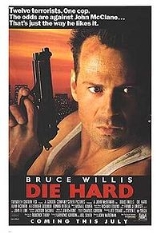
Die Hard is the first action film in the Die Hard series. The film was produced by Lawrence and Charles Gordon, along with Joel Silver.
It was written by Jeb Stuart and Steven E. de Souza, stars Bruce Willis, Bonnie Bedelia, Alan Rickman, Paul Gleason, Alexander Godunov, Reginald VelJohnson and William Atherton, and was directed by John McTiernan. A critical and commercial success, Die Hard propelled Willis' film career and established Rickman as a popular portrayer of villains in American film. The film also started the Die Hard series.
The movie is based on a 1979 novel by Roderick Thorp titled Nothing Lasts Forever, itself a sequel to the book The Detective, which was previously made into a 1968 movie starring Frank Sinatra.
lass="link1" onMouseover='showByLink("m399465",this)' onMouseout='hide("m399465")'href="http://www.absoluteastronomy.com/topics/John_McClane">John McClane, a detective with the New York City Police Department, arrives in Los Angeles, attempting to reunite and reconcile with his estranged wife Holly, who is attending a Christmas party thrown by her employer, the fictional Japan-based Nakatomi Corporation at its still-unfinished American branch office headquarters, the high-rise Nakatomi Plaza.

Discussion
Ask a question about 'Die Hard'
Start a new discussion about 'Die Hard'
Answer questions from other users
|
Quotations
When Alexander saw the breadth of his domain, he wept for there were no more worlds to conquer.
The benefits of a classical education.
40 Stories High — with Suspense, Excitement and Adventure on every level!
I am going to count to three, there will not be a four. Give me the code.
I promise I will never even think about going up in a tall building again. Oh, god. Please don't let me die.
It's Christmas Eve In L.A. And The Party Action's About To Explode... On The Fortieth Floor!
It's Christmas, Theo, it's the time of miracles. So be of good cheer and call me when you hit the last lock.

Encyclopedia
Die Hard is the first action film in the Die Hard series. The film was produced by Lawrence and Charles Gordon, along with Joel Silver.
It was written by Jeb Stuart and Steven E. de Souza, stars Bruce Willis, Bonnie Bedelia, Alan Rickman, Paul Gleason, Alexander Godunov, Reginald VelJohnson and William Atherton, and was directed by John McTiernan. A critical and commercial success, Die Hard propelled Willis' film career and established Rickman as a popular portrayer of villains in American film. The film also started the Die Hard series.
The movie is based on a 1979 novel by Roderick Thorp titled Nothing Lasts Forever, itself a sequel to the book The Detective, which was previously made into a 1968 movie starring Frank Sinatra.
Plot
John McClane, a detective with the New York City Police Department, arrives in Los Angeles, attempting to reunite and reconcile with his estranged wife Holly, who is attending a Christmas party thrown by her employer, the fictional Japan-based Nakatomi Corporation at its still-unfinished American branch office headquarters, the high-rise Nakatomi Plaza. When McClane refreshes himself from the flight in Holly's corporate room, they have an argument over the use of her maiden name, Gennaro, but Holly is called away. As the party continues, a group of terrorists led by Hans Gruber seize the building and hold the partygoers as hostages in exchange for the release of imprisoned terrorist operatives. In the confusion, McClane was able to disappear unnoticed into the building's maintenance areas, and learns that Gruber is actually using the hostage situation as a cover to steal $640 million in bearer bonds stored in the building's vault. McClane is unable to stop Gruber from executing Joe Takagi, Holly's boss, when he refuses to hand over the vault's combination.
McClane attempts to alert the local police by setting off the fire alarm, and Gruber's men come after him, after they cancel the alarm. McClane kills them, securing one of their radios, a quantity of C4 explosives and all the crucial detonators which one of Gruber's men was setting into prepared explosives. Gruber and his men listen over the radio as McClane contacts the Los Angeles Police Department. Officer Al Powell arrives to check the building, despite the canceled fire alarm, and finds nothing amiss and begins to drive off. McClane gets his attention by dropping one of the corpses onto Powell's patrol vehicle. The situation rapidly escalates, and the SWAT team arrives to storm the building. McClane attempts to get Powell to stop the SWAT team from walking into a trap, but Powell cannot convince his superiors. The SWAT team is repelled and many are injured, the SWAT armored vehicle is disabled by a rocket launcher, and the police are out-gunned by the firepower of the terrorists. McClane drops C4 down the elevator shaft and destroys the entire floor and Gruber's men along with it.
As the remainder of Gruber's men attempt to locate McClane and the detonators, one of the hostages, Ellis, betrays McClane's identity to Gruber. Gruber uses the radio to contact McClane, and demands that McClane return the detonators or else he will shoot Ellis. McClane refuses, and Gruber kills Ellis, to the horror of the police force who heard everything on radio. McClane continues to keep moving through the building to try to learn Gruber's plans. McClane and Gruber accidentally meet but Gruber gains McClane's trust by passing himself off as an escaped hostage. Gruber's identity is discovered as he threatens to shoot McClane. When Gruber's men arrive, McClane flees, dropping the detonators.
The Federal Bureau of Investigation arrives and takes control of the situation. They shut off the building's power while they plan a helicopter raid. However, Gruber had planned for the FBI's predictability - disconnecting the power opened the final electromagnetic lock on the vault and gave him access to the bonds. He has used the recovered detonators to rig the helipad on the building's roof with explosives, knowing the FBI would attempt a sneak attack on the building. After the FBI informs Gruber that his demands have been met, Gruber's men force the hostages to the roof to be killed, leaving himself his remaining crew to escape in the confusion. McClane is able to get the hostages back inside safely, but the FBI helicopter shoots at him, believing he's one of the terrorists. The helipad explodes, the helicopter is destroyed and the two head FBI agents are killed.
Gruber has discovered from over-eager reporter Richard Thornburg's investigative newscast that Holly Gennaro is McClane's wife. He holds her hostage to prevent McClane from interfering in his getaway. McClane, down to his last two bullets, is able to lure Gruber into a trap, killing the last remaining terrorist and wounding Gruber, who falls backwards and out of the building through a window. Gruber manages to hang onto Holly's wristwatch, his weight dragging her out the window as well. McClane is able to unstrap the watch and Gruber falls to his death. Meanwhile, Theo, Gruber's technological assistant, is detained by McClane's limo driver, Argyle, after collecting the bonds. McClane and Holly leave the building together, and meet Officer Powell face to face for the first time. However, one of the terrorists, Karl (Alexander Godunov), who is Gruber's right hand man that was earlier severely injured by McClane, bursts out behind McClane and Holly with a gun and Powell (who had not drawn his gun for several years after shooting a child) shoots him before he can harm McClane and Holly. When Thornburg attempts to interview them as they are leaving the scene, Holly punches him in the face. McClane and Holly take off in Argyle's limo as the building is secured by the police.
Cast
Production
Fox Plaza in Los Angeles was used for exterior shots of the Nakatomi building. Die Hard follows its source material — Roderick Thorp's novel Nothing Lasts Forever — closely, much of the film's memorable scenes, characters, and dialogue taken directly from the novel. Nothing Lasts Forever, a sequel to Thorp's earlier novel The Detective, was written with the intention of being adapted into a film sequel to the film adaptation of The Detective, which starred Frank Sinatra. When Sinatra turned down the offer to star in the sequel, the story was altered to be a stand-alone film with no connections to The Detective. Other changes included the older hero of the novel becoming younger, the hero's daughter becoming his wife, and the American Klaxon Oil Corporation becoming the Japanese Nakatomi Corporation. The novel's tone is darker and more serious than the film's, and the politically-motivated fighters of the novel became thieves pretending to be terrorists in the film. Director John McTiernan states on the DVD commentary that the change from a tale of political terrorism to a heist movie was made because he wanted to bring "joy" to the story, rather than having the villains be overly ponderous.
In the German dub, the names and backgrounds of the German-born terrorists were changed into English forms (mostly into their British equivalents, though two were turned Italian): Hans became Jack, Karl became Charlie, Heinrich turned into Henry (in the scene where John is writing down the names of the terrorists, a voiceover in the German version says "I'm gonna call you Hans and Karl, just like the two evil giants in the fairy tale" while referring to them as Jack and Charlie later). The new background depicts them as some internationally organized terrorists having gone freelance and for profit rather than ideals . This was because German terrorism (especially by the Red Army Faction) was still considered a sensitive issue by the German government in the 1980s.
According to commentary from the movie's DVD release, Alan Rickman's surprise when Gruber is dropped from the building is genuine: the director chose to release Rickman a full second before he expected it in order to get genuine surprise, a move which angered Rickman. The text commentary track also reveals that the shooting script did not originally feature the meeting between McClane and Gruber pretending to be a hostage; it was only written in when it was discovered that Rickman could do an American accent.
Die Hards title has been changed for different market releases to an extent rarely seen:
Big Building Fight. In Spain, La Jungla de Cristal (The Glass Jungle). In Latin America and Romania, Duro de Matar and Greu de ucis, respectively (Hard to Kill). In Russia, ??????? ?????? (A Hard Nut to Crack, literally "Hard Nutlet"). In Poland, Szklana Pulapka (The Glass Trap). In Portugal, Assalto ao Arranha-Céus (Skyscraper Assault). In Greece, ???? s?????? ??a ?a pe???e? (Too tough to die). In Norway, Operasjon Skyskraper, ("Operation Skyscraper"). It was later changed to its original name. In France and in Italy, Pičge de Cristal and Trappola di Cristallo, respectively (The Crystal Trap). In Yugoslavia, Umri Muški (Die like a Man). In Finland, Vain kuolleen ruumiini yli (Only over my dead body). In Germany, Stirb langsam (Die Slowly). In Hungary, Drágán add az életed (Give your life expensive). In Estonia, Visa Hing (Sturdy Soul). In Israel, ?? ????? (Dying to Live). In the Czech Republic, Smrtonosná Past (Lethal Trap). In Taiwan, "????" (Ultimate Detective) In Hong Kong and mainland China, "????" (Tiger's bravery and Dragon's might).
Music
Beethoven's 9th Symphony is featured prominently in Kamen's score throughout the film, in many guises and variations. Thematic variations on "Singin' in the Rain" are also featured as the theme for the character Theo. Basing his score around thematic variations on well-known pieces is a conceit that Kamen would repeat in Die Hard 2 (which featured Jean Sibelius's Finlandia) and Die Hard With A Vengeance (which featured variations on the Civil War marching tune, "When Johnny Comes Marching Home").
Due to the film's Christmas setting, the score also features sleigh bells in some cues, most notably when the main title appears and during the climactic fight where Gruber falls.
Bach's Brandenburg Concerto is playing during the reception at the party at the start of the film.
Near the beginning of the film, limousine driver Argyle plays the rap song Christmas In Hollis, performed by Run-D.M.C. and first released in 1987.
The final 4 minutes were tracked with music from two other Twentieth Century Fox features - these were 'temp tracks' which the studio ultimately decided to leave in the picture. The poignant music heard when McClane and Powell see each other for the first time is from John Scott's score for Man On Fire (1987). When Karl appears with his rifle, a cut from the 1986 sci-fi action movie Aliens composed by James Horner is heard. This music can be found on the Aliens soundtrack as the first few minutes of the cue "Resolution and Hyperspace" - much of it was not used in the final cut of Aliens, and was replaced instead with an edited version of the track "Bishop's Countdown".
In February 2002, A Limited Edition Score for Die Hard, composed by Michael Kamen, was released.
Reception
When Die Hard was released, it was considered one of the best action films of its era (the film currently holds a 94% "fresh" rating on Rotten Tomatoes). This is probably in part due to the fact that there are few artificial plot points in the story. The film features Willis as a sympathetic hero with typical human weaknesses, unlike the overpowered heroes exemplified by Arnold Schwarzenegger and Sylvester Stallone. It is noted for including humor as a complement to the action and dramatic elements of the story. It is said to have reinvented the action genre and set the stage for '90s action/thriller movies such as Under Siege, Sudden Death, Cliffhanger, Passenger 57 and Speed. "Die Hard on a _____" became a common way to describe the plot of many of the action films that came in its wake. For example, 1994's Speed was called "Die Hard on a bus", 1996's The Rock was dubbed "Die Hard on an island".
It was highly acclaimed by critics and spawned three popular sequels: Die Hard 2 (1990), Die Hard with a Vengeance (1995) and Live Free or Die Hard (2007), all featuring Willis as McClane. Die Hard was listed at #39 on the AFI's 100 Years... 100 Thrills list of the most thrilling American movies of all time in 2001. In 2003, Hans Gruber was listed at #46 on the AFI's 100 Years... 100 Heroes and Villains special. However, Roger Ebert gave it a less than flattering review, giving it a mere 2 stars and criticizing the stupidity of the characters and the satirical view the film takes on authority figures.
Die Hard had a budget of $28 million. Released in 1,276 theaters, it grossed $7.1 million in its opening weekend. The film earned $83 million domestically and $138.7 million worldwide. The movie was nominated for Best Sound Effects Editing, Best Film Editing, Best Sound and Best Visual Effects. John McClane's infamous line "Yippee ki yay, motherfucker" was voted as #96 of "The 100 Greatest Movie Lines" by Premiere magazine in 2007. In the June 22 2007 issue of Entertainment Weekly, it was named the best action movie of all time.
Legacy
The success of Die Hard led to the production of three sequels spanning over 20 years. These titles include Die Hard 2: Die Harder (1990), Die Hard With a Vengeance (1995) and Live Free or Die Hard (2007).
See Also:
External links
|