
All Topics  
New York City Police Department

 
New York City Police Department

   Email Print
   Bookmark   Link


New York City Police Department


The New York City Police Department (NYPD), established in 1844, is currently the largest police force in the United States, with primary responsibilities in law enforcement and investigation within the five boroughs
Borough (New York City)

New York City is one of the largest cities in the world, and it is segmented into boroughs for various reasons. A borough is a unique form of government which administers the five fundamental constituent parts that make up the History of New York City ....
 of New York City
New York City

The City of New York is the List of United States cities by population in the United States, while the New York metropolitan area ranks among the List of urban areas by population....
. The NYPD was the first police
Police

Police are agents or agencies, usually of the executive , empowered to enforce the law and to ensure public and social order through the legitimized use of force....
 department in the United States
United States

The United States of America is a Federal government constitutional republic comprising U.S. state and a federal district. The country is situated mostly in central North America, where its Contiguous United States and Washington, D.C., the Capital districts and territories, lie between the Pacific Ocean and Atlantic Oceans, Borders of the U...
.

Overview
The NYPD has a broad array of specialized services, including tactical operations, K-9
Police dog

A police dog is a dog that is trained specifically to assist police and similar law-enforcement personnel with their work. Police dogs are often referred to by the term K9, which sounds like the term canine, a word that generally refers to the dog and its relatives....
, harbor patrol, air support, bomb disposal, counter-terrorism, intelligence
Criminal intelligence

Criminal intelligence is information gathered or collated, analyzed, recorded/reported and disseminated by law enforcement agencies concerning types of crime, identified criminals and known or suspected criminal groups....
, anti-gang
Gang

A gang is a Group of people who through the organization, formation, and establishment of an assemblage share a common Identity . In current usage it typically denotes a organized crime or else a criminal affiliation....
, narcotic
Narcotic

The term narcotic is believed to have been coined by the Greek physician Galen to refer to agents that benumb or deaden, causing loss of feeling or paralysis....
s, public transportation, and public housing
Public housing

Public housing is a form of housing tenure in which the property is owned by a government authority, which may be central or local. Social housing is an umbrella term referring to rental housing which may be owned and managed by the state, by not-for-profit organizations, or by a combination of the two, usually with the aim of providi...
.


Discussion
Ask a question about 'New York City Police Department'
Start a new discussion about 'New York City Police Department'
Answer questions from other users
Full Discussion Forum


Recent Posts


Encyclopedia


The New York City Police Department (NYPD), established in 1844, is currently the largest police force in the United States, with primary responsibilities in law enforcement and investigation within the five boroughs
Borough (New York City)

New York City is one of the largest cities in the world, and it is segmented into boroughs for various reasons. A borough is a unique form of government which administers the five fundamental constituent parts that make up the History of New York City ....
 of New York City
New York City

The City of New York is the List of United States cities by population in the United States, while the New York metropolitan area ranks among the List of urban areas by population....
. The NYPD was the first police
Police

Police are agents or agencies, usually of the executive , empowered to enforce the law and to ensure public and social order through the legitimized use of force....
 department in the United States
United States

The United States of America is a Federal government constitutional republic comprising U.S. state and a federal district. The country is situated mostly in central North America, where its Contiguous United States and Washington, D.C., the Capital districts and territories, lie between the Pacific Ocean and Atlantic Oceans, Borders of the U...
.

Overview


The NYPD has a broad array of specialized services, including tactical operations, K-9
Police dog

A police dog is a dog that is trained specifically to assist police and similar law-enforcement personnel with their work. Police dogs are often referred to by the term K9, which sounds like the term canine, a word that generally refers to the dog and its relatives....
, harbor patrol, air support, bomb disposal, counter-terrorism, intelligence
Criminal intelligence

Criminal intelligence is information gathered or collated, analyzed, recorded/reported and disseminated by law enforcement agencies concerning types of crime, identified criminals and known or suspected criminal groups....
, anti-gang
Gang

A gang is a Group of people who through the organization, formation, and establishment of an assemblage share a common Identity . In current usage it typically denotes a organized crime or else a criminal affiliation....
, narcotic
Narcotic

The term narcotic is believed to have been coined by the Greek physician Galen to refer to agents that benumb or deaden, causing loss of feeling or paralysis....
s, public transportation, and public housing
Public housing

Public housing is a form of housing tenure in which the property is owned by a government authority, which may be central or local. Social housing is an umbrella term referring to rental housing which may be owned and managed by the state, by not-for-profit organizations, or by a combination of the two, usually with the aim of providi...
. NYPD has extensive crime scene
Crime scene

A crime scene is a location where an Law act took place, and comprises the area from which most of the Forensic identification is retrieved by trained police, crime scene investigators or in rare circumstances, Forensic science....
 investigation and laboratory resources, as well as units which assist with computer crime
Computer crime

Computer crime, cybercrime, e-crime, hi-tech crime or electronic crime generally refers to criminal activity where a computer or Computer networking is the source, tool, target, or place of a crime....
 investigations. The NYPD's headquarters at One Police Plaza
One Police Plaza

One Police Plaza is the headquarters of the New York City Police Department . One Police Plaza is located on Park Row across the street from New York City Hall in downtown Manhattan near the Brooklyn Bridge....
 houses an anticrime computer network, essentially a large search engine and data warehouse operated by detectives to assist officers in the field with their investigations. According to the department, its mission is to "enforce the law
LAW

LAW may refer to:* Anti-tank warfare, e.g. the US Army M72 LAW or the British Army LAW 80*Palestinian Society for the Protection of Human Rights ...
s, preserve the peace, reduce fear, and provide for a safe environment."

The New York City Transit Police
New York City Transit Police

The New York City Transit Police Department, officially established in 1953, was a transit police department responsible for the protection of New York City Subway and bus lines....
 and Housing Police
New York City Police Department Housing Bureau

File:Nypdpatch.jpgThe New York City Police Department Housing Bureau is responsible for providing the security and delivery of police services to about 420,000 people using Public housing in the United States and Canada throughout New York City....
 were fully integrated into the NYPD in 1995; Police officers are randomly assigned to the Transit and Housing units upon graduation of the police academy. Members of the NYPD are frequently referred to by the nickname New York's Finest. The NYPD is headquartered at One Police Plaza located on Park Row
Park Row (Manhattan)

Park Row is a street located in the Financial District, Manhattan of the New York City borough of Manhattan. It was previously called Chatham Square, Manhattan and during the late 19th century it was nicknamed Newspaper Row, as most of New York City's newspapers located on the street to be close to the action at New York City Hall....
 across the street from City Hall
New York City Hall

New York City Hall is located at the center of City Hall Park in the Civic Center, Manhattan section of Lower Manhattan between Broadway , Park Row and Chambers Street ....
.

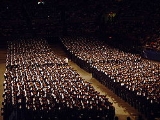
The size of the force has fluctuated, depending on crime rates, politics, and available funding. The overall trend, however, shows that the number of sworn officers is decreasing. In June 2004, there were about 40,000 sworn officers plus several thousand support staff; In June 2005, that number dropped to 35,000. As of November 2007, it had increased to slightly over 36,000 with the graduation of several classes from the Police Academy
Police Academy

Police Academy is a series of comedy films, the first six of which were made in the 1980s. The seventh and to date last installment, Police Academy: Mission to Moscow, was released in 1994....
. The NYPD's current authorized uniformed strength is 37,838. There are also approximately 4,500 Auxiliary Police Officers, 5,000 School Safety Agents
New York City Police Department School Safety Division

The New York City Police Department School Safety Division is the law enforcement agency for New York City Department of Education schools. The agency is a division of the New York City Police Department, and is one of the largest law enforcement agencies in New York City and the United States with approximately 5,000 School Safety Agents....
, 2,300 Traffic Enforcement Agents, and 370 Traffic Enforcement Supervisors currently employed by the department.

Duty shifts


In the NYPD, one day is divided into three 8-hour and 35-minute shifts: 11:15 PM to 7:50 AM (called a 12 to 8), 7:05 AM to 3:40 PM (called an 8 to 4) and 3:00 PM to 11:35 PM (called a 4 to 12). Officers work 5 of these shifts per week based upon a a rotating "scooter" chart schedule (ie. 5 working days, 2 days off then another 5 working but now instead of 2 there are 3 days off)

5 & 2, 5 & 3 is known as a "rotating duty chart," a scooter chart entails the working of an alternating week of day tours (8x4) followed by a week of 4x12's, while rotating through a 5 &2, 5&3 duty chart.

History


Salary and retention issues


After years of bitter wrangling that saw starting pay for new officers fall to as low as $25,100 a year, the city and the Patrolmen's Benevolent Association
Patrolmen's Benevolent Association of the City of New York

The Patrolmen's Benevolent Association of the City of New York is the largest labor union representing police officers of the New York City Police Department....
 on Aug. 21, 2008 reached agreement on a new four-year contract.

The contract, which runs from August 1, 2006 to July 31, 2010, gives police officers a 17 percent pay raise over its four-year life, and raises starting pay from $35,881 to $41,975, and top pay from $65,382 to approximately $76,000 annually. With longevity pay, holiday pay, night shift differential and other additions, the total annual compensation for officers receiving top pay will be approximately $91,823, not including overtime. It should also be noted that this is the first contract since 1994 the Patrolmen's Benevolent Association and the City of New York mutually agreed on without involving a mediator.

While an improvement on the expired contract, the new terms still leave a substantial gap between the NYPD and nearby departments that pay considerably more, up to $50,000 for new hires and over $100,000 for more experienced officers. Over the years, hundreds of city officers have left for higher paying jobs with other agencies, notably the Nassau County Police Department
Nassau County Police Department

The Nassau County Police Department is the law enforcement agency of Nassau County, New York....
, the Suffolk County Police Department, Westchester County police departments, and the Port Authority Police of New York and New Jersey. Discontent over pay issues has become so widespread and so well-known that higher-paying departments in lower cost-of-living areas, such as the Rochester, New York
Rochester, New York

Rochester is a city in Monroe County, New York, New York State, south of Lake Ontario in the United States. The Rochester metropolitan area is the second largest economy in New York State, behind the New York City metropolitan area....
 Police, the Albuquerque, New Mexico
Albuquerque, New Mexico

Albuquerque is the largest List of cities in the United States in the US state of New Mexico, United States. It is the county seat of Bernalillo County, New Mexico and is situated in the central part of the state, straddling the Rio Grande....
 Police, and the Seattle Police Department
Seattle Police Department

The Seattle Police Department is the principal police force of the city of Seattle, Washington, except for the campus of the University of Washington, for which responsibility falls to the University of Washington Police Department....
, are actively recruiting NYPD officers to join their forces.

Police departments in neighboring Rockland County and Westchester County have top base salaries ranging from around $85,000 to $105,000, not counting longevity, uniform pay, overtime and benefits. In 2007 a Westchester County Department of Public Safety officer reportedly made over $250,000 (with overtime), making him the highest paid police officer in the United States.

Large numbers of NYPD officers have also migrated to the New York City Fire Department
New York City Fire Department

The New York City Fire Department or the Fire Department City of New York has the responsibility for protecting the citizens and property of New York City's five borough from fire fighting, providing emergency medical services, technical rescue as well as providing first response to biological, chemical and radioactive hazards....
, where, even though pay is comparable with that of the NYPD, work schedules are more attractive and relations with the public more amicable. Contract changes in 2006, however, now forbid the prior practice of allowing police officers who join the fire department to transfer their seniority for compensation purposes. With all new firefighters now compelled to begin working at the same starting pay, the number of NYPD officers "rolling over" to the FDNY is likely to fall considerably.

Some NYPD officers charge that the department's leadership is seeking to stem the flow of officers to other jurisdictions by administrative means. In January 2006, 35 NYPD officers seeking to move to the Port Authority Police sued the New York department, claiming that it was refusing to make their personnel records available to PAPD background investigators. The plaintiffs won an injunction at the trial level, but the Appellate Division in January 2007 overturned that ruling and ordered the case to trial.

For its part, the NYPD claims its actions are merely in line with the personnel practices of other employers and that there is no "stealth" effort to prevent officers from moving elsewhere. Nonetheless, it is a fact that no NYPD officers have been included in the last two PAPD police academy classes as a result.

Despite these obstacles, there are signs that the exodus from the NYPD may be accelerating. In 2007, 990 officers resigned before becoming eligible for retirement, on top of 902 who left in 2006, 867 in 2005 and 635 in 2004, which makes for an attrition rate of around two percent. While Police Commissioner Raymond Kelly insists that figure compares positively with turnover rates in private industry, police union officials note that the proper comparison should be with prior years on the NYPD. In 1991, for example, only 159 officers left early, for an attrition rate of less than one half of one percent.

Ranks of the NYPD

on Times Square
Times Square

Times Square is a major intersection in Manhattan, a borough of New York City at the junction of Broadway and Seventh Avenue and stretching from West 42nd Street to West 47th Street s....
]]
Nypd Suv
Nypdvehicle135
There are twelve sworn titles (referred to as ranks) in the New York City Police Department:

Promotion from Police Officer to Detective- Specialist, a non-investigative rank, is based on merit. Generally, each precinct has one member designated "Detective-Specialist" and they are also found in specialized units. These officers often possess a unique or esoteric skill the department needs, e.g., sharpshooter, scuba instructor, helicopter instructor, sketch artist, etc.

Promotion to Detective-Investigator is based on investigative experience. Generally a Police Officer who is assigned to an investigative assignment for 18 months will be designated "Detective-Investigator". Contrary to what is often portrayed in Hollywood, there is no rank of "detective sergeant" or "detective lieutenant." Sergeants and lieutenants can be assigned to detective squads as supervisors, but the rank of detective carries no supervisory responsibilities.

Promotion to Sergeant, Lieutenant and Captain is based on a civil service promotion exam, in which an officer answers 100 multiple choice questions based on Department procedures and the law.

Promotion to Deputy Inspector and above is based on merit and those promotions are made by the Police Commissioner.

The Department is ultimately administered and governed by the Police Commissioner
New York City Police Commissioner

The New York City Police Commissioner is the head of the New York City Police Department, appointed by the Mayor of New York City. Governor Theodore Roosevelt, in one of his final acts before becoming Vice President of the United States in March 1901, signed legislation replacing the Police Board and office of police chief with a single polic...
, who is appointed by the Mayor and technically serves a five-year term; however as a practical matter and custom, the Police Commissioner serves at the Mayor's pleasure. The Police Commissioner also appoints numerous Deputy Commissioners. The Police Commissioner and his subordinate Commissioners are civilians under an oath of office, as opposed to the uniformed members of the force who are sworn officers of the law. However, a police commissioner who comes up from the ranks of the sworn members, will retain that status while serving as police commissioner. This has ramifications on their police pensions and the fact that any police commissioner who is considered sworn does not need a pistol permit to carry a firearm, and does retain the statutory powers of a police officer. Some police commissioners (like Ray Kelly) do carry a personal firearm, but they also have a full-time security detail from the Police Commissioner's (Detective) Squad. A First Deputy Police Commissioner may have a security detail when he/she acts as commissioner or under other circumstances as approved by the police commissioner.

Commissioner titles:

These individuals are administrators who supersede the Chief of Department, and they usually specialize in areas of great importance to the Department, such as counter-terrorism, operations, training, public information, legal matters, intelligence, and information technology. Despite their role, as civilian administrators of the Department, they are prohibited from taking operational control of a police situation (with the exception of the First Deputy Commissioner).

Within the rank structure, there are also designations, known as "grades", that connote differences in duties, experience, and pay. However, supervisory functions are generally reserved for the rank of sergeant and above. The title "Detective" is not a chain of command supervisory rank within the New York City Police Department. A "Detective-Investigator" has the equivalent rank of a police officer with the specification "Detective First Grade" (highest), "Detective Second Grade", and "Detective Third Grade". Movies and TV have only perpetuated this misunderstanding by portraying detectives as having supervisory powers. While a First Grade Detective may supervise other detectives in his/her squad, he/she is still outranked in the chain of command by a uniformed police sergeant.

Common designations of the various ranks are listed below:

  • Police Officer - First Grade: "Grades" are actually only used to refer to pay "steps" or annual salary increasing gradually until the final "step" which is a large raise. Pay steps for a police officer are predetermined through service time and determined through a negotiated contract. Currently there are six "grades" including a substantial pay reduction for the first six months while training in the Police Academy. After graduating from the academy, the probationary police officer will receive small raises of one to two thousand dollars annually until they have completed five full years whereupon they will receive a large raise (10 to 15 thousand dollars) to "top pay". All police officer "grades" are the same rank, though seniority is respected.


All "Detective Investigators" start at Detective Third Grade, which has a pay rate roughly between that of Police Officers and Sergeants; they can then get "promoted" to Detective Second Grade which has roughly the salary of Sergeants or Detective First Grade which has a pay rate roughly that of Lieutenants.

All "Detective-Specialists" start at third grade, but can be promoted to second or first grade status. It is common knowledge in the NYPD that detective investigators resent the detective specialist rank as these officers are not "detecting" crimes. NYPD is the only police force in the world that uses this rank. Most other reward technical skills or special merit with ranks such as senior patrol officer, technical sergeant or corporal. The detective specialist title was created during the Edward I. Koch mayoralty and has been controversial ever since. They carry the same "gold" shield as detective investigators, further adding to the resentment for the title.

  • Sergeant: Supervisor Detective Squad, Special Assignment


  • Lieutenant: Commander Detective Squad, Special Assignment


Promotion from Police Officer to Sergeant, Sergeant to Lieutenant, and Lieutenant to Captain all occur via a civil service formula that factors: performance on the civil service written examination for that rank, length of service, citations awarded, optional physical fitness test (for extra points). Promotion beyond the rank of Captain is discretionary.

Promotion to grades within the detective rank is also discretionary.

Badge
Badge

A badge is a personal device, patch, or accoutrement which is presented or displayed to indicate some feat of service, a special accomplishment, a symbol of authority granted by taking an oath , a sign of legitimate employment or student status, or as a simple means of identification....
s in the New York City Police Department are referred to as "shields" (the traditional term). Lower rank police officers are identified by their shield number, and tax registry number. Lieutenants and above do not have shield numbers and are identified by tax registry number. All sworn members of NYPD have their I.D. card photos taken against a red background. Civilian employees of the NYPD have their I.D. card photos taken against a blue background, signifying that they are not commissioned to carry a firearm. All ID cards have an expiration date. Sworn police officers are referred to as "MOS" or, members of the service.

Organization & structure


Line of duty deaths

NYPD Line of Duty deaths
Type number Type number
9/11 related 23 Accidental 10
Aircraft accident 7 Animal related 17
Asphyxiation 3 Assault 31
Automobile accident 50 Bicycle accident 4
Boating accident 5 Bomb 2
Drowned 12 Duty related illness 10
Electrocuted 5 Explosion 8
Exposure 1 Fall 12
Fire 14 Gunfire 321
Gunfire (Accidental) 23 Heart attack 44
Motorcycle accident 36 Stabbed 24
Struck by streetcar 7 Struck by train 5
Struck by vehicle 37 Structure collapse 3
Terrorist attack 24 Vehicle pursuit 12
Vehicular assault 20 Total 758


From December 25, 1806 to November 5, 2007, the NYPD has lost 758 officers in the line of duty. This figure includes officers from agencies that were absorbed or became a part of the modern NYPD in addition to the modern department itself. The NYPD lost 23 officers on September 11, 2001.


Civilian Complaint Review Board (CCRB)


Allegations of police misconduct


Medals


Demographics

The NYPD is majority white with an increasing number of minority officers. Amongst minorities 17.4% of the officers are African American
African American

African Americans or Black Americans are citizens or residents of the United States who have origins in any of the Black people populations of Africa....
, 26.5% Hispanic
Hispanic

Hispanic is a term that historically denoted relation to the ancient Hispania . During the Modern Era, it took on a more limited meaning relating to the contemporary nation of Spain....
, and 3.8% Asian American
Asian American

Asian Americans are United States of Asian people. They include sub-ethnic groups such as Chinese Americans, Filipino Americans, Indian Americans, Vietnamese Americans, Korean Americans, Japanese Americans and others whose national origin is from the Asia....
. This compares to a city population that is 27% Hispanic
Hispanic

Hispanic is a term that historically denoted relation to the ancient Hispania . During the Modern Era, it took on a more limited meaning relating to the contemporary nation of Spain....
, 26.6% African American
African American

African Americans or Black Americans are citizens or residents of the United States who have origins in any of the Black people populations of Africa....
, and 9.8% Asian American
Asian American

Asian Americans are United States of Asian people. They include sub-ethnic groups such as Chinese Americans, Filipino Americans, Indian Americans, Vietnamese Americans, Korean Americans, Japanese Americans and others whose national origin is from the Asia....
. In 1970, there were only 300 sworn Hispanic officers on the force, in today's department there are over 9,000 sworn Hispanic officers. 2005 marked the first academy class that was majority minority where only 45.2% of the graduates were non-Hispanic Whites. Amongst the white officers, more of the newer recruits live in the city and are of an Eastern European background as opposed to previous generations of white officers who have been largely Irish, Italian, and German and have lived in both the city and surrounding areas
Nassau County

Nassau County is the name of two counties in the United States of America:*Nassau County, New York*Nassau County, Florida...
.

Affiliations

  • The department is affiliated with the New York City Police Museum
    New York City Police Museum

    The New York City Police Museum celebrates the history and contributions of the New York City Police Department since its establishment in 1845....
    .
  • The department also runs a Summer Youth Police academy to provide positive interaction with police officers and to educate young people about the challenges and responsibility of police work.
  • The department also provides a citizen Police Academy which educates the public on basic law and policing procedures.


Service Pistols

Officers of the NYPD are issued a 9mm service pistol
Service pistol

A service pistol is any handgun issued to military personnel, or in some contexts, law enforcement officers....
 that fires in DAO (Double Action Only). Currently authorized pistols for new officers to select from include the SIG P226 (DAO)
SIG P226

The SIG Sauer P226 is a full-sized, service type pistol chambered for the 9x19mm Parabellum, .40 S&W and .357 SIG. Its design is based on the SIG P220....
, Smith & Wesson 5906 (DAO), and Glock 19. All are modified to a 12 pound
Pound-force

The pound-force or simply pound is a Units of measurement of force....
 (53 N
Newton

The newton is the International System of Units SI derived unit of force, named after Isaac Newton in recognition of his work on classical mechanics....
) trigger pull. Senior officers who joined prior to 1993 are still authorized to carry Smith & Wesson Model 64
Smith & Wesson Model 64

The Smith and Wesson Model 64 is the stainless steel version of its Smith & Wesson Model 10 Heavy Barrel. It is a six shot revolver chambered in .38 Special....
 & Model 10 .38 Special
.38 Special

The .38 Smith & Wesson Special is a rim , Centerfire ammunition Cartridge designed by Smith & Wesson. It is most commonly used in revolvers, although some Semi-automatic self-loading pistols and carbines also use this round....
 revolvers.

Fictional portrayals


NYPD Gallery


See also

  • List of law enforcement agencies in New York
    List of law enforcement agencies in New York

    List of law enforcement agencies in the State of New York....
  • New York City Police Commissioner
    New York City Police Commissioner

    The New York City Police Commissioner is the head of the New York City Police Department, appointed by the Mayor of New York City. Governor Theodore Roosevelt, in one of his final acts before becoming Vice President of the United States in March 1901, signed legislation replacing the Police Board and office of police chief with a single polic...
  • New York City Police Department Highway Patrol
    New York City Police Department Highway Patrol

    The New York City Police Department Highway Patrol, also known as the NYPD Highway Patrol or by the shorthand NYPD HWY, is a specialized unit under the auspices of the NYPD's NYPD Transportation Bureau primarily responsible for patrolling and maintaining traffic safety on limited-access highways within New York City....
  • New York City Police Department Auxiliary Police
  • New York City Police Department School Safety
  • New York City Police Department Cadet Corps
  • New York City Housing Authority Police Department
    New York City Housing Authority Police Department

    The New York City Housing Authority Police Department was a law enforcement agency in New York City that existed from 1952 to 1995. The roots of this organization go back to 1934 and the creation of the New York City Housing Authority....
  • New York City Transit Police
    New York City Transit Police

    The New York City Transit Police Department, officially established in 1953, was a transit police department responsible for the protection of New York City Subway and bus lines....
  • New York City Police Foundation
    New York City Police Foundation

    The New York City Police Foundation was established in 1971 by business and civic leaders as an independent, non-profit organization to strengthen the services of the New York City Police Department and to improve public safety in New York City....
  • New York City Civilian Complaint Review Board
  • NYPD Rodman's Neck Firing Range
    NYPD Rodman's Neck Firing Range

    The NYPD Rodman's Neck Firing Range is a police training base operated by The NYPD Firearms and Tactics Section on Rodman's Neck in the Bronx, New York City....
  • New York City Sheriff's Office
    New York City Sheriff's Office

    The New York City Sheriff's Office is the civil Law enforcement agency of the Government of New York City. The Sheriff's office is headed by a Sheriff, who is appointed to the position by the Mayor of New York City, unlike most Sheriffs in New York who are elected officials....
  • New York State Police
    New York State Police

    The New York State Police is the state police force of 4,600 sworn Troopers for the U.S. state of New York. It was established on April 11, 1917 by the New York Legislature, in response to the 1913 murder of construction foreman Sam Howell in Westchester County, New York, which at that time did not have a local police department....
  • Real time crime center
    Real Time Crime Center

    The Real Time Crime Center is the first centralized technology center for the New York Police Department . Its primary purpose is to give field officers and detectives instant and comprehensive information to help identify patterns and stop emerging crime....
  • Police memorabilia collecting
    Police memorabilia collecting

    Police memorabilia collecting is a hobby involving the collection and trading of law enforcement related patches or badges, and other memorabilia including Custodian helmet, training manuals, police medals, and historic artifacts such as turn-of-the-century screw-based handcuffs and police-box globes....
  • Thomas F. Byrnes
  • Color of the day (police)
    Color of the day (police)

    The color of the day is a recognition signal used by undercover Police officer of major police departments in the USA. It is most commonly associated with the New York Police Department, the Transit Bureau ' and the Housing Bureau ' ....
  • Recognition signal
    Recognition signal

    File:HMS Belfast - Superstructure.jpgA recognition signal is a wikt:signal where a person, a ship, an airplane or something else is wikt:recognized....


External links