

Descriptive chess notation

Encyclopedia
Descriptive notation is a notation
for recording chess
games, and at one time was the most popular notation in English-speaking and Spanish-speaking countries , . It was used in Europe until it was superseded by abbreviated algebraic notation, which was introduced by Philipp Stamma in 1737. Algebraic notation is more concise and requires less effort to avoid ambiguity; however much older literature uses descriptive notation. Descriptive notation exists in many language-based variants, the most prevalent being English descriptive notation and Spanish descriptive notation. Howard Staunton
, in The Chess-Player's Handbook (1847), uses a cumbersome early version, viz., "P. to K's 4th." (later written P-K4). Notably, in the back of the book he offers brief descriptions of long algebraic notation, which he calls that adopted by "Alexandre
, Jaenisch
, the 'Handbuch
,' and in Germany generally", and of ICCF numeric notation
, which he calls "Koch's Notation" . FIDE stopped recognizing descriptive notation in 1981 .
begins with the same letter as king, so to get around this it is abbreviated to either Kt or N. "Kt" was used in older chess literature. "N" is used in the examples in this article. In 1944 Chess Review
received many letters debating the change from Kt to N .
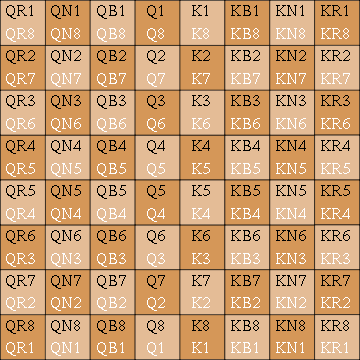 In descriptive notation each square has two names, depending on Black's or White's viewpoint. Each file is given a name corresponding with the piece that occupies the first rank at the start of the game. Thus the queen
's file is named "Q" and the king
's file is named "K". Since there are two each of the remaining pieces on the first rank, it is necessary to distinguish between them. The pieces on the queen's side of the board (left for white, right for black) are named with respect to the queen i.e. "queen's rook", "queen's knight" and "queen's bishop" and have the shortened names "QR", "QN" and "QB" respectively. Similarly, the pieces on the king's side (right for white, left for black) are named with respect to the king i.e. "king's rook", "king's knight" and "king's bishop" and have the shortened names "KR", "KN" and "KB" respectively. The rank is given a number, ranging from 1 to 8, with rank 1 being closest to the player. This method of naming the squares means that each square has one name from white's point of view and another from black's. For instance, the corner square nearest white's left hand ("a1" in algebraic notation) is called "queen's rook 1" (QR1) by white and "queen's rook 8" (QR8) by black.
Typically, the full designation for a piece or a file is shortened to just the last part (indicating a type of piece) whenever this does not produce ambiguity. For example, the move KP-K4 would always be written P-K4 since only one pawn can move to K4 without capturing; the move Q-QB4 would be written Q-B4 whenever Q-KB4 is not a legal move. A pawn capturing a pawn may be shown as PxP if it is the only one possible, or as BPxP if only one of the player's bishop's pawns can capture another pawn, or as QBPxP, or PxQBP, or other such variations.
Disambiguation of pieces using notations like QBP and KR becomes awkward once they have moved away from their starting positions (or starting files, for pawns) and is impossible for pieces created by promotion (such as a second queen). So as an alternative, moves may also be disambiguated by giving the starting position or the location of a capture, delimited with parentheses or a slash, as BxN/QB6, or R(QR3)-Q3. Sometimes only the rank or file is indicated, as R(6)xN.
When listing the moves of a game, first the move number is written, then the move by White followed by the move by Black. If there's no appropriate White move to use (e.g., if the moves are interrupted by commentary) then an ellipsis ... is used in its place.
In Spanish descriptive notation the hyphen is not needed, as the rank serves as separator. So the Sicilian opening (1. P-K4 P-QB4 in English) would be written 1. P4R P4AD. This is also the method used in French and Iberian countries .
The maxim that "a pawn on the seventh is worth two on the fifth" makes sense from both Black's perspective as well as White's perspective.
English descriptive notation is also particular to chess, not to any other game.
(Adolf Anderssen
versus Jean Dufresne
, 1852) in English descriptive notation.
 Other examples occur in Lewis Carroll's Through the Looking-Glass
.
Chess notation
Chess notation is the term for several systems that have developed to record either the moves made during a game of chess or the position of the pieces on a chess board. The earliest systems of notation used lengthy narratives to describe each move; these gradually evolved into terser systems of...
for recording chess
Chess
Chess is a two-player board game played on a chessboard, a square-checkered board with 64 squares arranged in an eight-by-eight grid. It is one of the world's most popular games, played by millions of people worldwide at home, in clubs, online, by correspondence, and in tournaments.Each player...
games, and at one time was the most popular notation in English-speaking and Spanish-speaking countries , . It was used in Europe until it was superseded by abbreviated algebraic notation, which was introduced by Philipp Stamma in 1737. Algebraic notation is more concise and requires less effort to avoid ambiguity; however much older literature uses descriptive notation. Descriptive notation exists in many language-based variants, the most prevalent being English descriptive notation and Spanish descriptive notation. Howard Staunton
Howard Staunton
Howard Staunton was an English chess master who is generally regarded as having been the world's strongest player from 1843 to 1851, largely as a result of his 1843 victory over Saint-Amant. He promoted a chess set of clearly distinguishable pieces of standardised shape—the Staunton pattern—that...
, in The Chess-Player's Handbook (1847), uses a cumbersome early version, viz., "P. to K's 4th." (later written P-K4). Notably, in the back of the book he offers brief descriptions of long algebraic notation, which he calls that adopted by "Alexandre
Aaron Alexandre
Aaron Alexandre was a Jewish German–French–English chess player and writer.Aaron Alexandre, a Bavarian trained as a rabbi, arrived in France in 1793. Encouraged by the French Republic's policy of religious toleration, he became a French citizen. At first, he worked as a German teacher and as...
, Jaenisch
Carl Jaenisch
Carl Friedrich Andreyevich von Jaenisch was a Finnish and Russian chess player and theorist. In the 1840s, he was among the top players in the world.-Life and career:...
, the 'Handbuch
Handbuch des Schachspiels
Handbuch des Schachspiels is a chess book, first published in 1843 by Tassilo von Heydebrand und der Lasa. It was one of the most important opening references for many decades...
,' and in Germany generally", and of ICCF numeric notation
ICCF numeric notation
ICCF numeric notation is the official chess game notation for all International Correspondence Chess Federation games. This is because in international correspondence chess the use of algebraic notation may cause confusion, since different languages have different names for the pieces.In brief,...
, which he calls "Koch's Notation" . FIDE stopped recognizing descriptive notation in 1981 .
Naming the pieces
Each piece is abbreviated to the first letter of its name: K for king, Q for queen, R for rook, B for bishop, P for pawn. KnightKnight (chess)
The knight is a piece in the game of chess, representing a knight . It is normally represented by a horse's head and neck. Each player starts with two knights, which begin on the row closest to the player, one square from the corner...
begins with the same letter as king, so to get around this it is abbreviated to either Kt or N. "Kt" was used in older chess literature. "N" is used in the examples in this article. In 1944 Chess Review
Chess Review
Chess Review is a U.S. chess magazine that was published from January 1933 until October 1969 . Until April 1941 it was called The Chess Review. Published in New York, it began on a schedule of at least ten issues a year but later became a monthly...
received many letters debating the change from Kt to N .
Naming squares on the board
Queen (chess)
The queen is the most powerful piece in the game of chess, able to move any number of squares vertically, horizontally, or diagonally. Each player starts the game with one queen, placed in the middle of the first rank next to the king. With the chessboard oriented correctly, the white queen starts...
's file is named "Q" and the king
King (chess)
In chess, the king is the most important piece. The object of the game is to trap the opponent's king so that its escape is not possible . If a player's king is threatened with capture, it is said to be in check, and the player must remove the threat of capture on the next move. If this cannot be...
's file is named "K". Since there are two each of the remaining pieces on the first rank, it is necessary to distinguish between them. The pieces on the queen's side of the board (left for white, right for black) are named with respect to the queen i.e. "queen's rook", "queen's knight" and "queen's bishop" and have the shortened names "QR", "QN" and "QB" respectively. Similarly, the pieces on the king's side (right for white, left for black) are named with respect to the king i.e. "king's rook", "king's knight" and "king's bishop" and have the shortened names "KR", "KN" and "KB" respectively. The rank is given a number, ranging from 1 to 8, with rank 1 being closest to the player. This method of naming the squares means that each square has one name from white's point of view and another from black's. For instance, the corner square nearest white's left hand ("a1" in algebraic notation) is called "queen's rook 1" (QR1) by white and "queen's rook 8" (QR8) by black.
Notation for moves
Each move of a piece is indicated by a sequence of characters. Castling has its own sequence of characters and special indicators are added to the end of the sequence if relevant.- Move that is not a capture: A move without capture is represented by the piece's name, a hyphen and the square at the end of the move e.g. N-QB3 (knight to queen's bishop 3), P-QN4 (pawn to queen's knight 4). In some literature, if the move is to the first rank, the "1" is omitted.
- Capture: A move with capture is represented by the piece's name, a cross (x) and the destination square is identified by the name of the piece captured e.g. QxN (queen captures knight).
- CastlingCastlingCastling is a special move in the game of chess involving the king and either of the original rooks of the same color. It is the only move in chess in which a player moves two pieces at the same time. Castling consists of moving the king two squares towards a rook on the player's first rank, then...
: The notation 0-0 is used for castling kingside and 0-0-0 for castling queenside. The word "Castles" is sometimes used instead, particularly in older literature.
- PromotionPromotion (chess)Promotion is a chess rule describing the transformation of a pawn that reaches its eighth rank into the player's choice of a queen, knight, rook, or bishop of the same color . The new piece replaces the pawn on the same square and is part of the move. Promotion is not limited to pieces that have...
: Parentheses are used to indicate promotion, with the piece resulting from the promotion in parentheses: P-R8(Q) or after a slash: P-R8/Q. Sometimes an equal sign is used instead, as in P-R8=Q.
- Special terms: Special indicators that are appended to the move include e.p. (en passantEn passantEn passant is a move in the board game of chess . It is a special pawn capture which can occur immediately after a player moves a pawn two squares forward from its starting position, and an enemy pawn could have captured it had it moved only one square forward...
), ch or + (check), mate or ++ (checkmateCheckmateCheckmate is a situation in chess in which one player's king is threatened with capture and there is no way to meet that threat. Or, simply put, the king is under direct attack and cannot avoid being captured...
), resignsResignationA resignation is the formal act of giving up or quitting one's office or position. It can also refer to the act of admitting defeat in a game like chess, indicated by the resigning player declaring "I resign", turning his king on its side, extending his hand, or stopping the chess clock...
, and drawDraw (chess)In chess, a draw is when a game ends in a tie. It is one of the possible outcomes of a game, along with a win for White and a win for Black . Usually, in tournaments a draw is worth a half point to each player, while a win is worth one point to the victor and none to the loser.For the most part,...
.
Typically, the full designation for a piece or a file is shortened to just the last part (indicating a type of piece) whenever this does not produce ambiguity. For example, the move KP-K4 would always be written P-K4 since only one pawn can move to K4 without capturing; the move Q-QB4 would be written Q-B4 whenever Q-KB4 is not a legal move. A pawn capturing a pawn may be shown as PxP if it is the only one possible, or as BPxP if only one of the player's bishop's pawns can capture another pawn, or as QBPxP, or PxQBP, or other such variations.
Disambiguation of pieces using notations like QBP and KR becomes awkward once they have moved away from their starting positions (or starting files, for pawns) and is impossible for pieces created by promotion (such as a second queen). So as an alternative, moves may also be disambiguated by giving the starting position or the location of a capture, delimited with parentheses or a slash, as BxN/QB6, or R(QR3)-Q3. Sometimes only the rank or file is indicated, as R(6)xN.
When listing the moves of a game, first the move number is written, then the move by White followed by the move by Black. If there's no appropriate White move to use (e.g., if the moves are interrupted by commentary) then an ellipsis ... is used in its place.
In Spanish descriptive notation the hyphen is not needed, as the rank serves as separator. So the Sicilian opening (1. P-K4 P-QB4 in English) would be written 1. P4R P4AD. This is also the method used in French and Iberian countries .
Advantages
By identifying each square with reference to the player on move, descriptive notation better reflects the symmetry of the game's starting position ("both players opened with P-K4 and planned to play B-KN2 as soon as possible"), and because the pieces captured are named, it is easy to skim over a game record and see which ones have been taken at any particular point.The maxim that "a pawn on the seventh is worth two on the fifth" makes sense from both Black's perspective as well as White's perspective.
English descriptive notation is also particular to chess, not to any other game.
Disadvantages
Confusion can arise because the squares are named differently. Errors may be made when not realizing that a move is ambiguous. In comparison, abbreviated algebraic notation represents the same moves with fewer characters, on average, and can avoid confusion since it always represents the same square in the same way.Example
The Evergreen gameEvergreen game
The Evergreen game is a famous chess game played in Berlin in 1852 between Adolf Anderssen and Jean Dufresne.Adolf Anderssen was one of the strongest players of his time, and was considered by many to be the world champion after winning the London 1851 tournament. Jean Dufresne, a popular author of...
(Adolf Anderssen
Adolf Anderssen
Karl Ernst Adolf Anderssen was a German chess master. He is considered to have been the world's leading chess player in the 1850s and 1860s...
versus Jean Dufresne
Jean Dufresne
Jean Dufresne was a German chess player and chess composer. He was a student of Adolf Anderssen, and lost the "Evergreen game" to him in 1852. Dufresne was an unsuccessful novelist under the anagrammatic pseudonym E. S...
, 1852) in English descriptive notation.
White:  G. A. Anderssen

Black:  J. Dufresne

Opening:  Evans Gambit

Location: Berlin, 1852

    White       Black

   -------     -------

 1. P-K4        P-K4

 2. N-KB3       N-QB3

 3. B-B4        B-B4

 4. P-QN4       BxNP

 5. P-B3        B-R4

 6. P-Q4        PxP

 7. O-O         P-Q6

 8. Q-N3        Q-B3

 9. P-K5        Q-N3

10. R-K1        KN-K2

11. B-R3        P-N4

12. QxP         R-QN1

13. Q-R4        B-N3

14. QN-Q2       B-N2?

15. N-K4        Q-B4?

16. BxQP        Q-R4

17. N-B6 ch!    PxN

18. PxP         R-N1

19. QR-Q1!      QxN

20. RxN ch      NxR

21. QxP ch!     KxQ

22. B-B5 dbl ch K-K1

23. B-Q7 ch     K-B1

24. BxN mate
Through the Looking-Glass
Through the Looking-Glass, and What Alice Found There is a work of literature by Lewis Carroll . It is the sequel to Alice's Adventures in Wonderland...
.