

Density 21.5

Encyclopedia
Density 21.5 is a piece of music for solo flute
written by Edgard Varèse
in 1936 and revised in 1946. The piece was composed at the request of Georges Barrère
for the premiere of his platinum flute, the density
of platinum
being close to 21.5 grammes per cubic centimetre (Chou, 1994).
Allmusic's Sean Hickey says, "According to the composer, Density 21.5 is based on two melodic
ideas — one modal
, one atonal — and all of the subsequent material is generated from these two themes
. Despite the inherent limitations of writing for an unaccompanied melodic instrument, Varèse expertly explores new areas of space and time, utilizing registral
contrasts to effect polyphonic continuity."
George Perle
(1990) analyses the piece both harmonically
and motivically
, and describes its background structure. Formally
, he says, the piece consists of two parts of nearly equal length, the end of the first section being bars 24–28 (p.77). The piece uses interval cycles, "inherently non-diatonic symmetrical elements." (p.83) The opening ten bars outline a tritone
, C–G, itself further divided into minor third
s (by E) with the upper minor third differentiated by a passing tone, F, that is lacking in the lower minor third. Thus the diminished seventh chord
, or rather C31, interval
cycle, partitions the octave
, and "places Varèse with Scriabin
and the Schoenberg circle
among the revolutionary
composers whose work initiates the beginning of a new mainstream tradition
in the music of our century." (p.12)
He continues: "the concept of the perfect fourth
or fifth
as a referential interval relative to which the tritone requires resolution . . . has no relevance at all to Density 21.5." (p. 17) However, there still is a reference point, first in the differentiated minor third, C–(E–F–G)–B. The second tritone, created by C31, E-B, C64, is hierarchically related to the C-G tritone, C61. Thus regristral placement is taken into consideration, creating pitches
rather than pitch class
es. "My reason for stressing this hierchical distinction between C61, and C64 is that there is a constant shifting of such distinctions, a constant reinterpretation of structural notes as passing notes and vice versa, and it is through this ambiguity
, this perpetual change of function, that the composition unfolds. This is what the composition is about." (p.71)
The piece proceeds to outline new tritones, D–G, D–A, and then pauses, in measures 13–14, B–E, which is part of C3, "right back where he had started," however, "the relation between the two tritones of C31 becomes not less but more ambiguous." (p.74–75) He sees the close of the first section as the attainment of the e-c missing from the E–G of bars 13–17. However, the B which divides G–D require an F, "if we assume that the G–B–D collection represents an incomplete diminished-seventh chord, that the work is based on structural relations derived from the interval-3 cycle, and that this implies a tendency for each partition of the cycle to be completely represented." (p.77)
From the second beat of bar 56 until the end, however, the piece uses an interval-2 cycle, C2, which still produces tritones, but partitions them differently. E-B is paired with D–(G) and C–F, rather than C–G. The only odd interval (outside the interval-2 cycle) is the F–C, "which transfers us from C20 to C21. And here, in the last two notes of Density 21.5 we at last find B paired with its tritone associate . . . only as a consequence of an entirely new harmonic direction that the work takes in its closing bars." However, "the music of the 'common practice
' offers many exemplars of such altogether unexpected digressions just as a work is drawing to its close, followed by a return, for the final cadence, to a consequently more emphatic confirmation of the structural relations implied in the body of the work." (p.79–80)
In the foreground, the head motif, presumably Varèse's atonal "idea", does not contain a minor third or tritone, and thus each pitch, F–E–F, is a member of a different interval-3 cycle or diminished-seventh chord. The structural importance of each pitch is then dependent on its context, at which level it partitions the octave, the tritone which divides the octave, the minor third which divides the tritone, the major second which divides the minor third, the minor second which divides the major second. "This variable relation of the basic motive of Density 21.5 to the harmonic structure of the piece, and its function in articulating and clarifying the formal design, are exactly what we would expect and take for granted in the relation between motive and background in traditional tonal music." (p.108–109)
Defined by the head motif and its repetition in bar 3, is "characterized by its relative pitch content (a three-note segment of the semitonal scale), by its interval order—down a half step and up a whole step—and by its rhythm (two sixteenth-notes on the beat followed by a tied eighth-note). This definitive version of the motive, combining all three attributes, occurs at only three different points (not counting the repetition in bar 3), each initiating a new and major formal subdivision of the piece." (Perle, 1990)
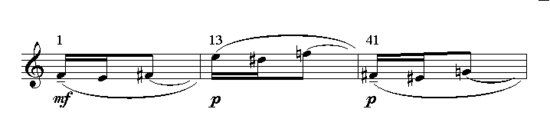 Timothy Kloth (1991, p.2) interprets the head motif or, "the molecular structure around which the entire composition is cast," as being the five-pitch-class motive which opens the piece, F–E–F–C–G. This is divided into two trichords: "cell X" (also Perle's head motif, F–E–F) and "cell Y", F–C–G.
George Perle
and Marc Wilkinson
, in writing, and Harvey Sollberger
, in recording, all interpret the fourth note in bar twenty-three as a B natural.
The piece has been recorded and released on:
Flute
The flute is a musical instrument of the woodwind family. Unlike woodwind instruments with reeds, a flute is an aerophone or reedless wind instrument that produces its sound from the flow of air across an opening...
written by Edgard Varèse
Edgard Varèse
Edgard Victor Achille Charles Varèse, , whose name was also spelled Edgar Varèse , was an innovative French-born composer who spent the greater part of his career in the United States....
in 1936 and revised in 1946. The piece was composed at the request of Georges Barrère
Georges Barrère
Georges Barrère was a French flautist.-Early life:Georges Barrère was the son of a cabinetmaker, Gabriel Barrère, and Marie Périne Courtet, an illiterate farmer's daughter from Guilligomarc'h. They married in 1874. They had previously had a son Étienne, out of wedlock, in 1872...
for the premiere of his platinum flute, the density
Density
The mass density or density of a material is defined as its mass per unit volume. The symbol most often used for density is ρ . In some cases , density is also defined as its weight per unit volume; although, this quantity is more properly called specific weight...
of platinum
Platinum
Platinum is a chemical element with the chemical symbol Pt and an atomic number of 78. Its name is derived from the Spanish term platina del Pinto, which is literally translated into "little silver of the Pinto River." It is a dense, malleable, ductile, precious, gray-white transition metal...
being close to 21.5 grammes per cubic centimetre (Chou, 1994).
Allmusic's Sean Hickey says, "According to the composer, Density 21.5 is based on two melodic
Melody
A melody , also tune, voice, or line, is a linear succession of musical tones which is perceived as a single entity...
ideas — one modal
Musical mode
In the theory of Western music since the ninth century, mode generally refers to a type of scale. This usage, still the most common in recent years, reflects a tradition dating to the middle ages, itself inspired by the theory of ancient Greek music.The word encompasses several additional...
, one atonal — and all of the subsequent material is generated from these two themes
Theme (music)
In music, a theme is the material, usually a recognizable melody, upon which part or all of a composition is based.-Characteristics:A theme may be perceivable as a complete musical expression in itself, separate from the work in which it is found . In contrast to an idea or motif, a theme is...
. Despite the inherent limitations of writing for an unaccompanied melodic instrument, Varèse expertly explores new areas of space and time, utilizing registral
Register (music)
In music, a register is the relative "height" or range of a note, set of pitches or pitch classes, melody, part, instrument or group of instruments...
contrasts to effect polyphonic continuity."
George Perle
George Perle
George Perle was a composer and music theorist. He was born in Bayonne, New Jersey. Perle was an alumnus of DePaul University...
(1990) analyses the piece both harmonically
Harmony
In music, harmony is the use of simultaneous pitches , or chords. The study of harmony involves chords and their construction and chord progressions and the principles of connection that govern them. Harmony is often said to refer to the "vertical" aspect of music, as distinguished from melodic...
and motivically
Motif (music)
In music, a motif or motive is a short musical idea, a salient recurring figure, musical fragment or succession of notes that has some special importance in or is characteristic of a composition....
, and describes its background structure. Formally
Musical form
The term musical form refers to the overall structure or plan of a piece of music, and it describes the layout of a composition as divided into sections...
, he says, the piece consists of two parts of nearly equal length, the end of the first section being bars 24–28 (p.77). The piece uses interval cycles, "inherently non-diatonic symmetrical elements." (p.83) The opening ten bars outline a tritone
Tritone
In classical music from Western culture, the tritone |tone]]) is traditionally defined as a musical interval composed of three whole tones. In a chromatic scale, each whole tone can be further divided into two semitones...
, C–G, itself further divided into minor third
Minor third
In classical music from Western culture, a third is a musical interval encompassing three staff positions , and the minor third is one of two commonly occurring thirds. The minor quality specification identifies it as being the smallest of the two: the minor third spans three semitones, the major...
s (by E) with the upper minor third differentiated by a passing tone, F, that is lacking in the lower minor third. Thus the diminished seventh chord
Diminished seventh chord
A diminished seventh chord is a four note chord that comprises a diminished triad plus the interval of a diminished seventh above the root. Thus it is , or enharmonically , of any major scale; for example, C diminished-seventh would be , or enharmonically...
, or rather C31, interval
Interval (music)
In music theory, an interval is a combination of two notes, or the ratio between their frequencies. Two-note combinations are also called dyads...
cycle, partitions the octave
Octave
In music, an octave is the interval between one musical pitch and another with half or double its frequency. The octave relationship is a natural phenomenon that has been referred to as the "basic miracle of music", the use of which is "common in most musical systems"...
, and "places Varèse with Scriabin
Alexander Scriabin
Alexander Nikolayevich Scriabin was a Russian composer and pianist who initially developed a lyrical and idiosyncratic tonal language inspired by the music of Frédéric Chopin. Quite independent of the innovations of Arnold Schoenberg, Scriabin developed an increasingly atonal musical system,...
and the Schoenberg circle
Second Viennese School
The Second Viennese School is the group of composers that comprised Arnold Schoenberg and his pupils and close associates in early 20th century Vienna, where he lived and taught, sporadically, between 1903 and 1925...
among the revolutionary
20th century classical music
20th century classical music was without a dominant style and highly diverse.-Introduction:At the turn of the century, music was characteristically late Romantic in style. Composers such as Gustav Mahler and Jean Sibelius were pushing the bounds of Post-Romantic Symphonic writing...
composers whose work initiates the beginning of a new mainstream tradition
Common practice period
The common practice period, in the history of Western art music , spanning the Baroque, Classical, and Romantic periods, lasted from c. 1600 to c. 1900.-General characteristics:...
in the music of our century." (p.12)
He continues: "the concept of the perfect fourth
Perfect fourth
In classical music from Western culture, a fourth is a musical interval encompassing four staff positions , and the perfect fourth is a fourth spanning five semitones. For example, the ascending interval from C to the next F is a perfect fourth, as the note F lies five semitones above C, and there...
or fifth
Perfect fifth
In classical music from Western culture, a fifth is a musical interval encompassing five staff positions , and the perfect fifth is a fifth spanning seven semitones, or in meantone, four diatonic semitones and three chromatic semitones...
as a referential interval relative to which the tritone requires resolution . . . has no relevance at all to Density 21.5." (p. 17) However, there still is a reference point, first in the differentiated minor third, C–(E–F–G)–B. The second tritone, created by C31, E-B, C64, is hierarchically related to the C-G tritone, C61. Thus regristral placement is taken into consideration, creating pitches
Pitch (music)
Pitch is an auditory perceptual property that allows the ordering of sounds on a frequency-related scale.Pitches are compared as "higher" and "lower" in the sense associated with musical melodies,...
rather than pitch class
Pitch class
In music, a pitch class is a set of all pitches that are a whole number of octaves apart, e.g., the pitch class C consists of the Cs in all octaves...
es. "My reason for stressing this hierchical distinction between C61, and C64 is that there is a constant shifting of such distinctions, a constant reinterpretation of structural notes as passing notes and vice versa, and it is through this ambiguity
Ambiguity
Ambiguity of words or phrases is the ability to express more than one interpretation. It is distinct from vagueness, which is a statement about the lack of precision contained or available in the information.Context may play a role in resolving ambiguity...
, this perpetual change of function, that the composition unfolds. This is what the composition is about." (p.71)
The piece proceeds to outline new tritones, D–G, D–A, and then pauses, in measures 13–14, B–E, which is part of C3, "right back where he had started," however, "the relation between the two tritones of C31 becomes not less but more ambiguous." (p.74–75) He sees the close of the first section as the attainment of the e-c missing from the E–G of bars 13–17. However, the B which divides G–D require an F, "if we assume that the G–B–D collection represents an incomplete diminished-seventh chord, that the work is based on structural relations derived from the interval-3 cycle, and that this implies a tendency for each partition of the cycle to be completely represented." (p.77)
From the second beat of bar 56 until the end, however, the piece uses an interval-2 cycle, C2, which still produces tritones, but partitions them differently. E-B is paired with D–(G) and C–F, rather than C–G. The only odd interval (outside the interval-2 cycle) is the F–C, "which transfers us from C20 to C21. And here, in the last two notes of Density 21.5 we at last find B paired with its tritone associate . . . only as a consequence of an entirely new harmonic direction that the work takes in its closing bars." However, "the music of the 'common practice
Common practice period
The common practice period, in the history of Western art music , spanning the Baroque, Classical, and Romantic periods, lasted from c. 1600 to c. 1900.-General characteristics:...
' offers many exemplars of such altogether unexpected digressions just as a work is drawing to its close, followed by a return, for the final cadence, to a consequently more emphatic confirmation of the structural relations implied in the body of the work." (p.79–80)
In the foreground, the head motif, presumably Varèse's atonal "idea", does not contain a minor third or tritone, and thus each pitch, F–E–F, is a member of a different interval-3 cycle or diminished-seventh chord. The structural importance of each pitch is then dependent on its context, at which level it partitions the octave, the tritone which divides the octave, the minor third which divides the tritone, the major second which divides the minor third, the minor second which divides the major second. "This variable relation of the basic motive of Density 21.5 to the harmonic structure of the piece, and its function in articulating and clarifying the formal design, are exactly what we would expect and take for granted in the relation between motive and background in traditional tonal music." (p.108–109)
Defined by the head motif and its repetition in bar 3, is "characterized by its relative pitch content (a three-note segment of the semitonal scale), by its interval order—down a half step and up a whole step—and by its rhythm (two sixteenth-notes on the beat followed by a tied eighth-note). This definitive version of the motive, combining all three attributes, occurs at only three different points (not counting the repetition in bar 3), each initiating a new and major formal subdivision of the piece." (Perle, 1990)
George Perle
George Perle
George Perle was a composer and music theorist. He was born in Bayonne, New Jersey. Perle was an alumnus of DePaul University...
and Marc Wilkinson
Marc Wilkinson
Marc Wilkinson is an Australian composer and conductor best known for his film scores, most particularly Blood on Satan's Claw, and music for the theatre. For most of his life resident in the UK, his approach has combined traditional techniques with elements of the avant-garde...
, in writing, and Harvey Sollberger
Harvey Sollberger
Harvey Sollberger is an American composer, flutist, and conductor specializing in contemporary classical music.-Life:...
, in recording, all interpret the fourth note in bar twenty-three as a B natural.
The piece has been recorded and released on:
- Edgard Varèse: The Complete Works (1994/1998). Performed by Jacques ZoonJacques Zoon-Education:Following a gymnasium education in Alkmaar, Zoon studied flute at the Sweelinck Conservatorium in Amsterdam with Koos Verheul and Harrie Starreveld, graduating with honors...
. Decca London Polygram 289 460 208-2. Assistance and advised from Professor Chou Wen-chungChou Wen-chungChou Wen-chung , Shandong, China) is a Chinese American composer of contemporary classical music. He emigrated in 1946 to the United States where he lives.-Life:...
, who worked closely with Varèse. - Harvey SollbergerHarvey SollbergerHarvey Sollberger is an American composer, flutist, and conductor specializing in contemporary classical music.-Life:...
- Philippe Bernold, Alexandre TharaudAlexandre Tharaud-Biography:Born in Paris, Alexandre Tharaud discovered the music scene through his father, a director and singer of operettas, which were put on in theaters of Northern France, where his family spent many weekends...
, The Solo Flute in the 20th Century (2008), Harmonia Mundi Musique d'Abord HMA1951710