

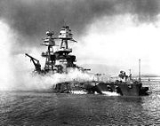
Damage control

Encyclopedia

Navy
A navy is the branch of a nation's armed forces principally designated for naval and amphibious warfare; namely, lake- or ocean-borne combat operations and related functions...
for the emergency control of situations that may hazard the sinking of a ship. It is also used in other contexts as explained below.
Examples are:
- rupture of a pipe or hullHull (watercraft)A hull is the watertight body of a ship or boat. Above the hull is the superstructure and/or deckhouse, where present. The line where the hull meets the water surface is called the waterline.The structure of the hull varies depending on the vessel type...
especially below the waterline and - damage from grounding (running aground) or hard berthing against a wharfWharfA wharf or quay is a structure on the shore of a harbor where ships may dock to load and unload cargo or passengers.Such a structure includes one or more berths , and may also include piers, warehouses, or other facilities necessary for handling the ships.A wharf commonly comprises a fixed...
. - temporary fixing of bomb or explosive damage.
The term
Terminology
Terminology is the study of terms and their use. Terms are words and compound words that in specific contexts are given specific meanings, meanings that may deviate from the meaning the same words have in other contexts and in everyday language. The discipline Terminology studies among other...
is also used in project management
Project management
Project management is the discipline of planning, organizing, securing, and managing resources to achieve specific goals. A project is a temporary endeavor with a defined beginning and end , undertaken to meet unique goals and objectives, typically to bring about beneficial change or added value...
and other contexts to describe the actions needed to deal with any problem
Problem
A problem is an obstacle, impediment, difficulty or challenge, or any situation that invites resolution; the resolution of which is recognized as a solution or contribution toward a known purpose or goal...
that may jeopardize an endeavor. As well, it has been adopted for use in politics and media to describe a need to suppress information or employ spin doctors to represent a response to a situation.
Measures used
Simple measures may stop flooding, such as:- locking off the damaged area from other ship's compartments;
- blocking the damaged area by wedging a box around a tear in the ship's hull,
- putting a band of thin sheet steel around a tear in a pipe, bound on by clamps.
More complicated measures may be needed if a repair must take the pressure of the ship moving through the water. For example:
- Thermal lanceThermal lanceA thermal lance, thermic lance, oxygen lance, or burning bar is a tool that burns iron in the presence of pressurized oxygen to create very high temperatures for cutting. It consists of a long iron tube packed with iron rods, sometimes mixed with aluminium or magnesium rods to increase the heat...
cutting around the rupture. - Oxyacetylene weldingOxy-fuel welding and cuttingOxy-fuel welding and oxy-fuel cutting are processes that use fuel gases and oxygen to weld and cut metals, respectively. French engineers Edmond Fouché and Charles Picard became the first to develop oxygen-acetylene welding in 1903...
or electric arc weldingArc weldingArc welding is a type of welding that uses a welding power supply to create an electric arc between an electrode and the base material to melt the metals at the welding point. They can use either direct or alternating current, and consumable or non-consumable electrodes...
of plates over the rupture. - Quick-drying cementCementIn the most general sense of the word, a cement is a binder, a substance that sets and hardens independently, and can bind other materials together. The word "cement" traces to the Romans, who used the term opus caementicium to describe masonry resembling modern concrete that was made from crushed...
is applied underwater over the rupture.
Damage control training is undertaken by most seafarers, but the engineering staff are most experienced in making lasting repairs.
Damage control is distinct from firefighting. Damage control methods of fighting fire are based on the class of ship and cater to ship specific equipment on board.
Maintenance and drills
In damage control there is more than just the knowledge of the equipment used in a casualty. First you must know how to maintain the equipment used, this is important because the equipment must be in working condition in case of an emergency. For example you must ensure the PHARS (Portable Hydraulic Access Rescue System) is able to do the job you need it to when it needs to be done. You do this by checking the hydraulic fluid and all the connections. Also every month you must ensure the equipment you are performing maintenance on is working. If there were any discrepancies in the equipment you would have to report it and fix it using the proper materials and documents.Another major part of damage control is drills. On most ships there are four major drills ran depending on the design of the ship. The first type of drill is fire. This is broken down into Alpha fire or anything that would leave an ash, Bravo or any flammable liquid fires, Charlie or electrical fires, and Delta or flammable metals. The second type is flooding drills. These consist of pipe ruptures, hull breaches, or drainage system backups. The third type is toxic gas. This is a big problem on ships as there are many toxic gases on ships and some are more deadly than others. Several examples include H2S hydrogen Sulfide
Hydrogen sulfide
Hydrogen sulfide is the chemical compound with the formula . It is a colorless, very poisonous, flammable gas with the characteristic foul odor of expired eggs perceptible at concentrations as low as 0.00047 parts per million...
and Chlorofluorocarbon
Chlorofluorocarbon
A chlorofluorocarbon is an organic compound that contains carbon, chlorine, and fluorine, produced as a volatile derivative of methane and ethane. A common subclass are the hydrochlorofluorocarbons , which contain hydrogen, as well. They are also commonly known by the DuPont trade name Freon...
. The fourth type of drill is potentially the most dangerous: a main space fire. This would be a scenario where one of the engines or any auxiliary space for the engine would catch on fire.
Common damage control access equipment includes PHARS (Portable Hydraulic Access Rescue System), PECU (Portable Exothermic Cutting Unit), and hand tools such as axes and mauls.
Notable contemporary examples
Particular examples:- USS ColeUSS Cole (DDG-67)The second USS Cole is an Arleigh Burke-class Aegis-equipped guided missile destroyer homeported in NS Norfolk, Virginia. The Cole is named in honor of Marine Sergeant Darrell S. Cole, a machine-gunner killed in action on Iwo Jima on 19 February 1945, during World War II...
: immediate measures to stop sinking after the ship was bombed in 2000USS Cole bombingThe USS Cole Bombing, or the USS Cole Incident, was a suicide attack against the United States Navy destroyer on October 12, 2000 while it was harbored and refueled in the Yemeni port of Aden. Seventeen American sailors were killed, and 39 were injured...
. - USS Samuel B. RobertsUSS Samuel B. Roberts (FFG-58)USS Samuel B. Roberts is one of the final ships in the United States Navy's Oliver Hazard Perry class of guided missile frigates . The ship was severely damaged by an Iranian mine in 1988, leading U.S. forces to respond with Operation Praying Mantis.-Commissioning and namesake:The frigate was...
: After an IranIranIran , officially the Islamic Republic of Iran , is a country in Southern and Western Asia. The name "Iran" has been in use natively since the Sassanian era and came into use internationally in 1935, before which the country was known to the Western world as Persia...
ian mineNaval mineA naval mine is a self-contained explosive device placed in water to destroy surface ships or submarines. Unlike depth charges, mines are deposited and left to wait until they are triggered by the approach of, or contact with, an enemy vessel...
holed the frigateFrigateA frigate is any of several types of warship, the term having been used for ships of various sizes and roles over the last few centuries.In the 17th century, the term was used for any warship built for speed and maneuverability, the description often used being "frigate-built"...
beneath the waterline in 1988, the crew fought fire and flooding that threatened to sink it.http://www.navybook.com/nohigherhonor/pic-ffg58damage.shtml - USS PrincetonUSS Princeton (CG-59)USS Princeton is a guided missile cruiser serving in the United States Navy. Armed with naval guns and anti-air, anti-surface, and anti-submarine missiles, plus other weapons, she is equipped for surface-to-air, surface-to-surface, and anti-submarine warfare. She also is the home of two Seahawk...
: After an Iraqi naval mine damaged the cruiserCruiserA cruiser is a type of warship. The term has been in use for several hundreds of years, and has had different meanings throughout this period...
during the 1991 Gulf WarGulf WarThe Persian Gulf War , commonly referred to as simply the Gulf War, was a war waged by a U.N.-authorized coalition force from 34 nations led by the United States, against Iraq in response to Iraq's invasion and annexation of Kuwait.The war is also known under other names, such as the First Gulf...
, her crew fought fires and sealed cracks in the hull, then repaired electronic systems, bringing the Aegis combat systemAegis combat systemThe Aegis Combat System is an integrated naval weapons system developed by the Missile and Surface Radar Division of RCA, and now produced by Lockheed Martin...
back on line within 2 hours. - HMS NottinghamHMS Nottingham (D91)HMS Nottingham was a batch two Type 42 destroyer of the Royal Navy, named after the city of Nottingham, England. She was launched on 18 February 1980, and commissioned on 8 April 1983 as the sixth ship to bear the name....
: measures to keep the ship afloat after, on 7 July 2002, the Nottingham ran aground on the submerged but well-charted Wolf RockWolf Rock, Lord Howe IslandWolf Rock, or sometimes spelt Wolfe Rock in the past, is a rock and reef east of Lord Howe Island.The rock is named after the Wolf, an ex-Royal Navy gun brig built in 1814, which was working as a whaling ship when on 6 August 1837 it struck an outer reef near Lord Howe Island...
near Lord Howe IslandLord Howe IslandLord Howe Island is an irregularly crescent-shaped volcanic remnant in the Tasman Sea between Australia and New Zealand, directly east of mainland Port Macquarie, and about from Norfolk Island. The island is about 11 km long and between 2.8 km and 0.6 km wide with an area of...
.