

Dactylopteridae

Encyclopedia
The flying gurnards are a family
, Dactylopteridae, of marine
fish
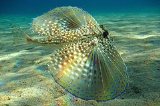
notable for their greatly enlarged pectoral fins. As they cannot literally fly, an alternative name preferred by some authors is helmet gurnards. They are the only family in the suborder Dactylopteroidei.
They have been observed to "walk" along sandy sea floors while looking for crustacean
s and other small invertebrate
s by using their pelvic fins. Like the true gurnards (sea robin
s), to which they may be related, they possess a swim bladder with two lobes and a "drumming muscle" that can beat against the swim bladder to produce sounds. They have heavy, protective, scales, and the undersides of their huge pectoral fins are brightly coloured, perhaps to startle predators.
Most species live in the Indo-Pacific
, but at least one is native to the Atlantic. The adults live on the sea bottom, but many species have an extended larva
l stage, which floats freely in the oceans.
. How, DNA sequence data quite consistently support the view that the latter are paraphyletic with the Gasterosteiformes
sensu lato. As it seems, flying gurnards are particularly close to Aulostomidae
and Fistulariidae, and would have to be included with these.
Family (biology)
In biological classification, family is* a taxonomic rank. Other well-known ranks are life, domain, kingdom, phylum, class, order, genus, and species, with family fitting between order and genus. As for the other well-known ranks, there is the option of an immediately lower rank, indicated by the...
, Dactylopteridae, of marine
Ocean
An ocean is a major body of saline water, and a principal component of the hydrosphere. Approximately 71% of the Earth's surface is covered by ocean, a continuous body of water that is customarily divided into several principal oceans and smaller seas.More than half of this area is over 3,000...
fish
Fish
Fish are a paraphyletic group of organisms that consist of all gill-bearing aquatic vertebrate animals that lack limbs with digits. Included in this definition are the living hagfish, lampreys, and cartilaginous and bony fish, as well as various extinct related groups...
notable for their greatly enlarged pectoral fins. As they cannot literally fly, an alternative name preferred by some authors is helmet gurnards. They are the only family in the suborder Dactylopteroidei.
They have been observed to "walk" along sandy sea floors while looking for crustacean
Crustacean
Crustaceans form a very large group of arthropods, usually treated as a subphylum, which includes such familiar animals as crabs, lobsters, crayfish, shrimp, krill and barnacles. The 50,000 described species range in size from Stygotantulus stocki at , to the Japanese spider crab with a leg span...
s and other small invertebrate
Invertebrate
An invertebrate is an animal without a backbone. The group includes 97% of all animal species – all animals except those in the chordate subphylum Vertebrata .Invertebrates form a paraphyletic group...
s by using their pelvic fins. Like the true gurnards (sea robin
Sea robin
Sea robins, also known as gurnard, are bottom-feeding scorpaeniform fishes in the family Triglidae. They get their name from their large pectoral fins, which, when swimming, open and close like a bird's wings in flight....
s), to which they may be related, they possess a swim bladder with two lobes and a "drumming muscle" that can beat against the swim bladder to produce sounds. They have heavy, protective, scales, and the undersides of their huge pectoral fins are brightly coloured, perhaps to startle predators.
Most species live in the Indo-Pacific
Indo-Pacific
The Indo-Pacific is a biogeographic region of the Earth's seas, comprising the tropical waters of the Indian Ocean, the western and central Pacific Ocean, and the seas connecting the two in the general area of Indonesia...
, but at least one is native to the Atlantic. The adults live on the sea bottom, but many species have an extended larva
Larva
A larva is a distinct juvenile form many animals undergo before metamorphosis into adults. Animals with indirect development such as insects, amphibians, or cnidarians typically have a larval phase of their life cycle...
l stage, which floats freely in the oceans.
Taxonomy
Morphological traits uniting the flying gurnards (Dactylopteridae) and the Syngnathiformes have long been noted. Most authors however placed them with the ScorpaeniformesScorpaeniformes
Scorpaeniformes is an order of ray-finned fish, but it has also been called the Scleroparei.They are known as "mail-cheeked" fishes due to their distinguishing characteristic, the suborbital stay: a backwards extension of the third circumorbital bone across the cheek to the preoperculum, to which...
. How, DNA sequence data quite consistently support the view that the latter are paraphyletic with the Gasterosteiformes
Gasterosteiformes
Gasterosteiformes is an order of ray-finned fishes that includes the sticklebacks and relatives.In the Gasterosteiformes, the pelvic girdle is never attached to the cleithra directly, and the supramaxillary, orbitosphenoid, and basisphenoid bones are absent. The body is often partly or completely...
sensu lato. As it seems, flying gurnards are particularly close to Aulostomidae
Aulostomidae
The family Aulostomidae is a monogeneric family of highly specialized, tubularly-elongated marine fishes commonly known as trumpetfishes. Aulostomids belong to the order Syngnathiformes, along with the seahorses and the similarly built cornetfishes...
and Fistulariidae, and would have to be included with these.
Species
The family is small, with seven species in two genera.- Genus Dactyloptena
- Dactyloptena gilberti, Snyder, 1909
- Spotwing flying gurnardSpotwing flying gurnardThe spotwing flying gurnard, Dactyloptena macracantha, is an unusual looking fish because of its huge pectoral fins. The fish has dark spots and wavy lines on the fins...
, Dactyloptena macracantha (Bleeker, 1854) - Oriental flying gurnardOriental flying gurnardThe oriental flying gurnard, Dactyloptena orientalis, is a flying gurnard of the family Dactylopteridae. This flying gurnard inhabits the Indo-Pacific Oceans at depths to...
, Dactyloptena orientalis (Cuvier, 1829) - Butterfly flying gurnard, Dactyloptena papilio Ogilby, 1910
- Starry flying gurnard, Dactyloptena peterseni (Nyström, 1887)
- Dactyloptena tiltoni, Eschmeyer, 1997
- Genus Dactylopterus
- Flying gurnard, Dactylopterus volitansDactylopterus volitansThe flying gurnard, Dactylopterus volitans, is a fish of tropical to warm temperate waters on both sides of the Atlantic, found as far north as New Jersey and south as Brazil, and from the English Channel to Angola....
(Linnaeus, 1758)
- Flying gurnard, Dactylopterus volitans