

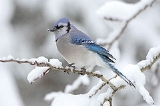
Cyanocitta

Encyclopedia
The genus Cyanocitta is a New World
genus of jay
s, passerine
bird
s of the family Corvidae
. Cyanocitta includes only two of the New World jays; they are blue, crested birds that differ in the colour of the head. Their ranges generally do not overlap.
New World
The New World is one of the names used for the Western Hemisphere, specifically America and sometimes Oceania . The term originated in the late 15th century, when America had been recently discovered by European explorers, expanding the geographical horizon of the people of the European middle...
genus of jay
Jay
The jays are several species of medium-sized, usually colorful and noisy, passerine birds in the crow family Corvidae. The names jay and magpie are somewhat interchangeable, and the evolutionary relationships are rather complex...
s, passerine
Passerine
A passerine is a bird of the order Passeriformes, which includes more than half of all bird species. Sometimes known as perching birds or, less accurately, as songbirds, the passerines form one of the most diverse terrestrial vertebrate orders: with over 5,000 identified species, it has roughly...
bird
Bird
Birds are feathered, winged, bipedal, endothermic , egg-laying, vertebrate animals. Around 10,000 living species and 188 families makes them the most speciose class of tetrapod vertebrates. They inhabit ecosystems across the globe, from the Arctic to the Antarctic. Extant birds range in size from...
s of the family Corvidae
Corvidae
Corvidae is a cosmopolitan family of oscine passerine birds that contains the crows, ravens, rooks, jackdaws, jays, magpies, treepies, choughs and nutcrackers. The common English names used are corvids or the crow family , and there are over 120 species...
. Cyanocitta includes only two of the New World jays; they are blue, crested birds that differ in the colour of the head. Their ranges generally do not overlap.
- C. cristata, Blue JayBlue JayThe Blue Jay is a passerine bird in the family Corvidae, native to North America. It is resident through most of eastern and central United States and southern Canada, although western populations may be migratory. It breeds in both deciduous and coniferous forests, and is common near and in...
- C. stelleri, Steller's JaySteller's JayThe Steller's Jay is a jay native to western North America, closely related to the Blue Jay found in the rest of the continent, but with a black head and upper body. It is also known as the Long-crested Jay, Mountain Jay, and Pine Jay...