

Contrabass Bugle

Encyclopedia
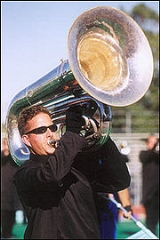
The contrabass bugle, usually shortened to contra, is the lowest-pitched instrument in the drum and bugle corps
hornline. It is essentially the drum corps' counterpart to the marching band's sousaphone
: the lowest-pitched member of the hornline, and a replacement for the concert tuba
on the marching field.
It is different from the other members of the marching band and drum corps hornlines in that it rests on the shoulder of the player, rather than being held in front of the body. Because this orientation can obstruct standard headgear, it is not uncommon for contrabass players to wear a beret
instead of whatever else the rest of the ensemble is wearing for headgear. This also gives the players some distinction from the rest of the brass ensemble.

for many drum corps of that era. Matching all other competition bugles at the time, these early contrabass bugles were pitched in the key of G, making them significantly larger than all tubas to that date, save the large E and BB concert tubas used in all brass bands.
The contrabass bugle is the only member of the drum corps bugle line that has never been produced in a valve-less style, as it was developed when the drum corps rules allowed one piston valve and one rotary valve
(typically lowering the instrument's pitch by two semitones and one semitone, respectively). They changed to fit new rules along with the rest of the drum corps hornline, first receiving two vertical (or in this case, slanted for ease of use) piston valves, then 3 and later 4 valves to make the instrument fully chromatic.
Equivalent instruments in the key of BB and CC were produced by instrument manufacturers for marching bands who wished to possess the sound of these contrabass bugles, generally regarded as "darker", without losing hornline sonority by having the basses in a different overtone series from the rest of the hornline (or requiring marching tubists to learn another set of fingerings for tuba parts originally written for BB and CC instruments).
In the 2000s, contrabass bugles often have three or four valves, as is common on concert tubas. Like most of their concert counterparts, they are pitched in either C or BB♭, although within the dwindling number of drum corps still using older instruments, they are, like the rest of the traditional bugle line, pitched in the key of G (or GG, depending on which naming convention is used). Instruments in any of these keys are generally larger in modern times compared to their older counterparts, although improved materials and construction techniques in the manufacture of instruments allows them to be made stronger and lighter than before.
Although historically (see below) drum and bugle corps contras were pitched in G, the construction was nearly identical to modern B♭ and C instruments, the only differences being the length and diameter of the tubing and (at one time) the valve section. In fact, modern drum corps now use multi-key instruments originally developed several years ago for marching bands who wished to emulate the sound of contemporary (G-instrumented) drum corps hornlines.
The mouth of the large bell of a contrabass bugle can be used to display a colored elastic screen with a logo, as was done by the Madison Scouts in 1985. This usually does not affect the sound significantly, as long as the fabric is lightweight.
Manufactures of marching tubas/contrabass bugles:
Video of the Contrabass bugle being played in an orchestral band:
Drum and bugle corps (modern)
A drum and bugle corps, also known as a drum corps, is a musical marching unit consisting of brass instruments, percussion instruments, and color guard. Typically operating as independent non-profit organizations, drum corps perform in competitions, parades, festivals, and other civic functions...
hornline. It is essentially the drum corps' counterpart to the marching band's sousaphone
Sousaphone
The sousaphone is a type of tuba that is widely employed in marching bands. Designed so that it fits around the body of the musician and is supported by the left shoulder, the sousaphone may be readily played while being carried...
: the lowest-pitched member of the hornline, and a replacement for the concert tuba
Tuba
The tuba is the largest and lowest-pitched brass instrument. Sound is produced by vibrating or "buzzing" the lips into a large cupped mouthpiece. It is one of the most recent additions to the modern symphony orchestra, first appearing in the mid-19th century, when it largely replaced the...
on the marching field.
It is different from the other members of the marching band and drum corps hornlines in that it rests on the shoulder of the player, rather than being held in front of the body. Because this orientation can obstruct standard headgear, it is not uncommon for contrabass players to wear a beret
Beret
A beret is a soft, round, flat-crowned hat, designated a "cap", usually of woven, hand-knitted wool, crocheted cotton, or wool felt, or acrylic fiber....
instead of whatever else the rest of the ensemble is wearing for headgear. This also gives the players some distinction from the rest of the brass ensemble.
History
The first contrabass bugle was developed in the 1960s by Whaley Royce, a Canadian instrument manufacturer who produced buglesBugle (instrument)
The bugle is one of the simplest brass instruments, having no valves or other pitch-altering devices. All pitch control is done by varying the player's embouchure, since the bugle has no other mechanism for controlling pitch. Consequently, the bugle is limited to notes within the harmonic series...
for many drum corps of that era. Matching all other competition bugles at the time, these early contrabass bugles were pitched in the key of G, making them significantly larger than all tubas to that date, save the large E and BB concert tubas used in all brass bands.
The contrabass bugle is the only member of the drum corps bugle line that has never been produced in a valve-less style, as it was developed when the drum corps rules allowed one piston valve and one rotary valve
Rotary valve
A rotary valve is a type of valve in which the rotation of a passage or passages in a transverse plug regulates the flow of liquid or gas through the attached pipes. The common stopcock is the simplest form of rotary valve...
(typically lowering the instrument's pitch by two semitones and one semitone, respectively). They changed to fit new rules along with the rest of the drum corps hornline, first receiving two vertical (or in this case, slanted for ease of use) piston valves, then 3 and later 4 valves to make the instrument fully chromatic.
Equivalent instruments in the key of BB and CC were produced by instrument manufacturers for marching bands who wished to possess the sound of these contrabass bugles, generally regarded as "darker", without losing hornline sonority by having the basses in a different overtone series from the rest of the hornline (or requiring marching tubists to learn another set of fingerings for tuba parts originally written for BB and CC instruments).
In the 2000s, contrabass bugles often have three or four valves, as is common on concert tubas. Like most of their concert counterparts, they are pitched in either C or BB♭, although within the dwindling number of drum corps still using older instruments, they are, like the rest of the traditional bugle line, pitched in the key of G (or GG, depending on which naming convention is used). Instruments in any of these keys are generally larger in modern times compared to their older counterparts, although improved materials and construction techniques in the manufacture of instruments allows them to be made stronger and lighter than before.
Construction and naming
With most circuits now permitting B♭ and C instruments, the modern contrabass bugle is essentially a concert tuba converted for ease of marching. Generally, the primary differences between pure concert tubas and contrabass bugles are- On both pure marching and convertible tubas, the concert leadpipeLeadpipeIn a brass instrument, a leadpipe is the pipe or tube into which the mouthpiece is placed.For example, on the illustration of a trombone, the leadpipe would be between #3 and #4, the mouthpiece and the slide lock ring. In the illustration of a French horn, the leadpipe is #2.Some instruments have a...
, with the pipe curving around the bell to the valves, is replaced with one that curves forward and back, placing the mouthpiece in an appropriate location for the new playing position, on the left (or occasionally, right) shoulder (which has earned it the nickname of "shoulder rocket"), rather than in front of the player. On some "Marching-Convertible" models, this leadpipe can be unscrewed and replaced with a concert model. - All dedicated marching instruments have the valve section rotated into a more comfortable playing position. Some higher-end convertible tubas have the capacity to rotate the valve section between marching and concert configurations.
Although historically (see below) drum and bugle corps contras were pitched in G, the construction was nearly identical to modern B♭ and C instruments, the only differences being the length and diameter of the tubing and (at one time) the valve section. In fact, modern drum corps now use multi-key instruments originally developed several years ago for marching bands who wished to emulate the sound of contemporary (G-instrumented) drum corps hornlines.
Movement and visual effects
In a drum and bugle corps, the marching style for contrabass bugles are the same as for the rest of the hornline. However, there can be small differences, especially with effects such as ripples of the hornline. Often, instead of snapping the horn up or down or to the side, the players will have their horns bell down on the ground and will snap their hands on top of the horn.The mouth of the large bell of a contrabass bugle can be used to display a colored elastic screen with a logo, as was done by the Madison Scouts in 1985. This usually does not affect the sound significantly, as long as the fabric is lightweight.
See also
- TubaTubaThe tuba is the largest and lowest-pitched brass instrument. Sound is produced by vibrating or "buzzing" the lips into a large cupped mouthpiece. It is one of the most recent additions to the modern symphony orchestra, first appearing in the mid-19th century, when it largely replaced the...
- SousaphoneSousaphoneThe sousaphone is a type of tuba that is widely employed in marching bands. Designed so that it fits around the body of the musician and is supported by the left shoulder, the sousaphone may be readily played while being carried...
- Drum and bugle corps (modern)Drum and bugle corps (modern)A drum and bugle corps, also known as a drum corps, is a musical marching unit consisting of brass instruments, percussion instruments, and color guard. Typically operating as independent non-profit organizations, drum corps perform in competitions, parades, festivals, and other civic functions...
- Drum and bugle corps (classic)Drum and bugle corps (classic)Classic drum and bugle corps are North American musical ensembles that descended from military bugle and drum units returning from World War I and succeeding wars. Traditionally, drum and bugle corps served as signaling units as early as before the American Civil War, with these signaling units...
External links
Manufacturers of G bugles:- Kanstul Musical Instruments
- Dynasty Brass
- Yamaha USA made a G conversion slide for their first-generation marching tubas.
Manufactures of marching tubas/contrabass bugles:
- Dynasty Brass
- Kanstul Musical Instruments
- King Musical Instruments
- Yamaha USA
- Jupiter Quantum Marching Brass
Video of the Contrabass bugle being played in an orchestral band: