

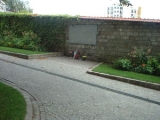
Communards' Wall

Encyclopedia
The Communards’ Wall at the Père Lachaise cemetery
is where, on May 28, 1871, one-hundred forty-seven fédéré
s, combatants of the Paris Commune
, were shot and thrown in an open trench at the foot of the wall.
To the French left
, especially socialists
and communists
, the wall became the symbol of the people's struggle for their liberty and ideals. Many leaders of the French Communist Party
, especially those involved in the French resistance
, are buried nearby.
The Père Lachaise cemetery was established in May 1804 on a land owned by the Jesuits
for centuries, and where Père ("Father") Lachaise, confessor of Louis XIV
, lived the latter part of his life. Cemetery of the aristocracy in the 19th century, it also received the remains of famous people from previous eras. During the spring of 1871 the last of the combatants of the Commune entrenched themselves in the cemetery. The Armée versaillaise, which was summoned to suppress the Commune, had control over the area towards the end of the afternoon of May 28th, and shot all of the prisoners against the wall.
The massacre of the Communards did not put an end to the repression. During the fighting between 20,000 and 35,000 deaths, and more than 43,000 prisoners were taken; afterwards, a military court pronounced about a hundred death sentences, more than 13,000 prison sentences, and close to 4,000 deportation
s to New Caledonia
.
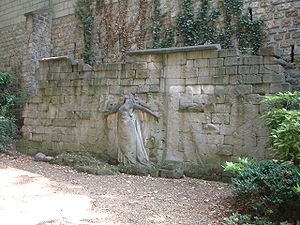 The memory of the Commune remained engraved in the people's memory, especially within the workers' movement which regenerated itself in a few years time. The first march before the Wall, at the call of Jules Guesde
, took place on May 23, 1880, two months before the Communards' Amnesty: 25,000 people, a symbolic "immortal" red rose in their buttonholes, stood up against police forces. From that time on, this "ascent to the Wall", punctuated French labor force political history. Every year since 1880, the organizations of the French left have held a demonstration in this symbolic place during the last week of May. Jean Jaurès
-- although a child in the provinces at the time of the Commune, hence with no direct memory —- made the ascent several times, accompanied by Édouard Vaillant
, Jean Allemane
, and by thousands of socialist, syndicalist, and anarchist militants.
The record-breaking demonstration took place on May 24, 1936: 600,000 people, led by Léon Blum
and Maurice Thorez
, right in the middle of the strikers movement, several weeks after the start of the Popular Front
.
Père Lachaise Cemetery
Père Lachaise Cemetery is the largest cemetery in the city of Paris, France , though there are larger cemeteries in the city's suburbs.Père Lachaise is in the 20th arrondissement, and is reputed to be the world's most-visited cemetery, attracting hundreds of thousands of visitors annually to the...
is where, on May 28, 1871, one-hundred forty-seven fédéré
Fédéré
The term "fédérés" most commonly refers to the troops who volunteered for the French National Guard in the summer of 1792 during the French Revolution...
s, combatants of the Paris Commune
Paris Commune
The Paris Commune was a government that briefly ruled Paris from March 18 to May 28, 1871. It existed before the split between anarchists and Marxists had taken place, and it is hailed by both groups as the first assumption of power by the working class during the Industrial Revolution...
, were shot and thrown in an open trench at the foot of the wall.
To the French left
Left-wing politics
In politics, Left, left-wing and leftist generally refer to support for social change to create a more egalitarian society...
, especially socialists
Socialism
Socialism is an economic system characterized by social ownership of the means of production and cooperative management of the economy; or a political philosophy advocating such a system. "Social ownership" may refer to any one of, or a combination of, the following: cooperative enterprises,...
and communists
Communism
Communism is a social, political and economic ideology that aims at the establishment of a classless, moneyless, revolutionary and stateless socialist society structured upon common ownership of the means of production...
, the wall became the symbol of the people's struggle for their liberty and ideals. Many leaders of the French Communist Party
French Communist Party
The French Communist Party is a political party in France which advocates the principles of communism.Although its electoral support has declined in recent decades, the PCF retains a large membership, behind only that of the Union for a Popular Movement , and considerable influence in French...
, especially those involved in the French resistance
French Resistance
The French Resistance is the name used to denote the collection of French resistance movements that fought against the Nazi German occupation of France and against the collaborationist Vichy régime during World War II...
, are buried nearby.
The Père Lachaise cemetery was established in May 1804 on a land owned by the Jesuits
Society of Jesus
The Society of Jesus is a Catholic male religious order that follows the teachings of the Catholic Church. The members are called Jesuits, and are also known colloquially as "God's Army" and as "The Company," these being references to founder Ignatius of Loyola's military background and a...
for centuries, and where Père ("Father") Lachaise, confessor of Louis XIV
Louis XIV of France
Louis XIV , known as Louis the Great or the Sun King , was a Bourbon monarch who ruled as King of France and Navarre. His reign, from 1643 to his death in 1715, began at the age of four and lasted seventy-two years, three months, and eighteen days...
, lived the latter part of his life. Cemetery of the aristocracy in the 19th century, it also received the remains of famous people from previous eras. During the spring of 1871 the last of the combatants of the Commune entrenched themselves in the cemetery. The Armée versaillaise, which was summoned to suppress the Commune, had control over the area towards the end of the afternoon of May 28th, and shot all of the prisoners against the wall.
The massacre of the Communards did not put an end to the repression. During the fighting between 20,000 and 35,000 deaths, and more than 43,000 prisoners were taken; afterwards, a military court pronounced about a hundred death sentences, more than 13,000 prison sentences, and close to 4,000 deportation
Deportation
Deportation means the expulsion of a person or group of people from a place or country. Today it often refers to the expulsion of foreign nationals whereas the expulsion of nationals is called banishment, exile, or penal transportation...
s to New Caledonia
New Caledonia
New Caledonia is a special collectivity of France located in the southwest Pacific Ocean, east of Australia and about from Metropolitan France. The archipelago, part of the Melanesia subregion, includes the main island of Grande Terre, the Loyalty Islands, the Belep archipelago, the Isle of...
.
Jules Guesde
Jules Basile Guesde was a French socialist journalist and politician.Guesde was the inspiration for a famous quotation by Karl Marx. Shortly before Marx died in 1883, he wrote a letter to Guesde and Paul Lafargue, both of whom already claimed to represent "Marxist" principles...
, took place on May 23, 1880, two months before the Communards' Amnesty: 25,000 people, a symbolic "immortal" red rose in their buttonholes, stood up against police forces. From that time on, this "ascent to the Wall", punctuated French labor force political history. Every year since 1880, the organizations of the French left have held a demonstration in this symbolic place during the last week of May. Jean Jaurès
Jean Jaurès
Jean Léon Jaurès was a French Socialist leader. Initially an Opportunist Republican, he evolved into one of the first social democrats, becoming the leader, in 1902, of the French Socialist Party, which opposed Jules Guesde's revolutionary Socialist Party of France. Both parties merged in 1905 in...
-- although a child in the provinces at the time of the Commune, hence with no direct memory —- made the ascent several times, accompanied by Édouard Vaillant
Édouard Vaillant
Marie Édouard Vaillant was a French politician.Born in Vierzon, Cher, son of a lawyer, Édouard Vaillant studied engineering at the École Centrale des Arts et Manufactures, graduating in 1862, and then law at the Sorbonne. In Paris he knew Charles Longuet, Louis-Auguste Rogeard, and Jules Vallès...
, Jean Allemane
Jean Allemane
Jean Allemane was a French socialist politician, veteran of the Paris Commune of 1871, pioneer of syndicalism, leader of the Socialist-Revolutionary Workers' Party and co-founder of the unified French Section of the Workers' International in 1905...
, and by thousands of socialist, syndicalist, and anarchist militants.
The record-breaking demonstration took place on May 24, 1936: 600,000 people, led by Léon Blum
Léon Blum
André Léon Blum was a French politician, usually identified with the moderate left, and three times the Prime Minister of France.-First political experiences:...
and Maurice Thorez
Maurice Thorez
thumb|A Soviet stamp depicting Maurice Thorez.Maurice Thorez was a French politician and longtime leader of the French Communist Party from 1930 until his death. He also served as vice premier of France from 1946 to 1947....
, right in the middle of the strikers movement, several weeks after the start of the Popular Front
Popular Front (France)
The Popular Front was an alliance of left-wing movements, including the French Communist Party , the French Section of the Workers' International and the Radical and Socialist Party, during the interwar period...
.
"Tombe sans croix et sans chapelle, sans lys d'or, sans vitraux d'azur, quand le peuple en parle, il l'appelle le Mur." - Jules Jouy
"Tomb without a cross or chapel, or golden lilies, or sky blue church windows, when the people talk about it, they call it The Wall." - Jules Jouy